




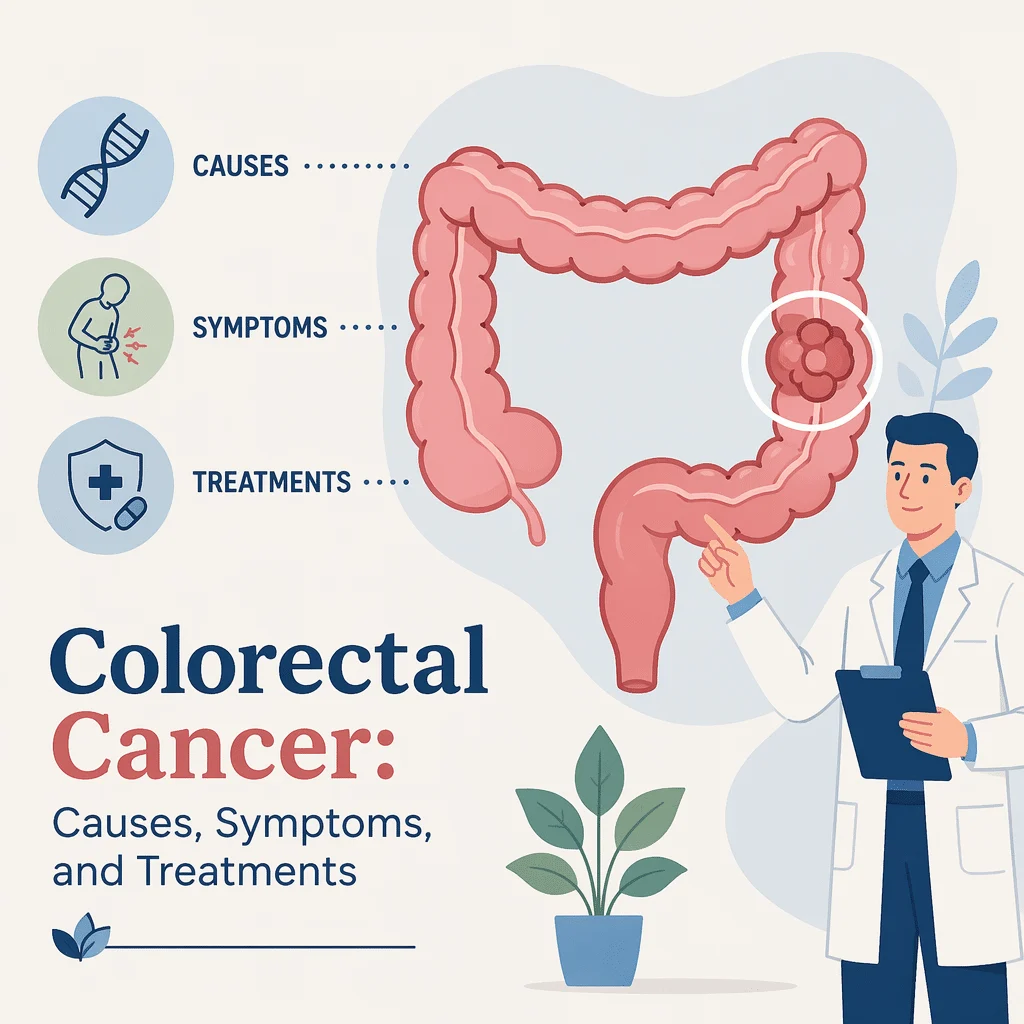
Colorectal cancer is a cancer that begins in the colon or rectum, the lower part of the digestive system. It is one of the most common cancers in the United Kingdom, yet it is also one of the most preventable and treatable when it is found early. Many cases start as a small, harmless-looking growth called a polyp that can be removed long before it ever turns into cancer, which is exactly why screening matters so much. In this article you’ll learn how colorectal cancer develops, the symptoms to watch for, who is most at risk, and how today’s screening tests, from stool tests and colonoscopy to newer blood tests, find it early. We’ll also explain, in plain language, the lab tests used for diagnosis and follow-up, and point you towards trustworthy next steps.
What colorectal cancer is, and how it begins
It is the general name for cancer of the colon (the large intestine) and the rectum (the last few inches of the bowel before the anus). Because these organs work together and the cancers behave in similar ways, doctors often group them under a single term. The disease usually grows slowly, over many years, which is what makes it so treatable when it is caught in time.
From polyp to cancer
Most of these cancers begin as a polyp, a small growth on the inner lining of the bowel. Many polyps never cause any trouble, but one type, called an adenoma, can slowly develop changes that turn it cancerous. This step-by-step process often takes ten years or more, which gives screening a wide window to find and remove polyps before they ever become dangerous.
Colon cancer, rectal cancer, and bowel cancer
You may see several names for the same family of disease. “Colon cancer” refers to tumours in the colon, “rectal cancer” to tumours in the rectum, and “bowel cancer” is an everyday term used widely in the United Kingdom and elsewhere. “Colorectal cancer” simply covers both locations. The symptoms, screening tests, and many treatments overlap, although the exact surgery or radiotherapy plan can differ depending on where the tumour sits.
Symptoms and warning signs of colorectal cancer
Early colorectal cancer often causes no symptoms at all, which is precisely why screening is so valuable: it can find the disease before you feel anything. When symptoms do appear, they are easy to mistake for far more common and harmless problems.
Common early signs
- A lasting change in bowel habits, such as diarrhoea, constipation, or narrower stools, that continues for more than a few weeks
- Blood in or on the stool, which may look bright red or make stools appear dark
- A feeling that the bowel does not empty completely
- Cramping, wind, or abdominal discomfort that does not settle
Because a slow-bleeding tumour can lower your red blood cell count, a routine blood test is sometimes the first hint that something is wrong; our explainer covers the complete blood count. That low count is called anaemia, and our health library explains anaemia symptoms, causes and tests.
Signs of more advanced disease
- Unexplained weight loss
- Ongoing tiredness or weakness
- Iron-deficiency anaemia found on a blood test, sometimes without any obvious bleeding
Unexplained iron deficiency in an adult is worth investigating, and our library details the iron studies panel.
When to see a doctor
See a healthcare professional promptly if you notice any of the following:
- Rectal bleeding, or blood in your stool, at any age
- A change in your bowel habits that lasts more than three to four weeks
- Unexplained weight loss, ongoing fatigue, or abdominal pain that will not go away
- A family history of colorectal cancer or polyps, especially before the age of 50
Most of these symptoms turn out to be caused by conditions such as haemorrhoids, infections, or irritable bowel syndrome rather than cancer. Even so, they are worth checking, because finding it early makes it far easier to treat.
Who is at higher risk
Anyone can develop colorectal cancer, but some factors raise the odds. Understanding them helps you and your doctor decide when to start screening and how often to repeat it.
Risk factors you can influence
- A diet high in red and processed meats and low in fibre
- Carrying excess weight, and low levels of physical activity
- Smoking and heavy alcohol use
- Type 2 diabetes
Risk factors you cannot change
- Older age, although rates in younger adults are rising
- A personal or family history of colorectal cancer or advanced polyps
- Inherited syndromes such as Lynch syndrome or familial adenomatous polyposis
- Long-standing inflammatory bowel disease, such as Crohn’s disease or ulcerative colitis
Long-standing inflammatory bowel disease raises the risk over time, and our library covers Crohn’s disease and how it is managed. Doctors also use stool tests to measure inflammation in the gut; our guide outlines the faecal calprotectin test.
Screening: how colorectal cancer is found early
Screening means testing for cancer before there are any symptoms. For this cancer it is remarkably effective, because removing polyps can prevent the disease entirely, and catching a tumour early greatly improves the odds of a cure.
Why screening now starts at 45
For years, routine screening began at 50. That changed as doctors saw the disease rising among younger adults. In the United States, the American Cancer Society and the U.S. Preventive Services Task Force now recommend that people at average risk begin screening at age 45, and the Centers for Disease Control and Prevention echoes this guidance. People with a strong family history or other risk factors may need to start earlier, a decision best made with your doctor. A 2025 review in a leading medical journal confirmed that early-onset colorectal cancer, diagnosed before age 50, is now among the fastest-rising cancers in the country, and a 2022 analysis supported moving the screening age down to 45.
Stool-based tests
These tests check a sample of stool that you collect at home. The fecal immunochemical test (FIT) looks for tiny amounts of hidden blood and is done every year. The multi-target stool DNA test adds a search for altered DNA shed by tumours and polyps, and is done every one to three years. Both are convenient and non-invasive, but if the result is positive, you will need a colonoscopy to find out what caused it.
Colonoscopy and other visual examinations
Colonoscopy is the most thorough test: a doctor guides a thin, flexible camera through the entire colon and can remove polyps during the same examination, which is why it serves as both a screening test and the follow-up for any positive result. It is usually repeated every ten years. Flexible sigmoidoscopy, which views the lower colon, and CT colonography, a “virtual” colonoscopy using a CT scanner, are alternatives carried out every five years.
Newer blood-based tests
A newer option analyses a blood sample for circulating tumour DNA (ctDNA), genetic fragments that a tumour sheds into the bloodstream. Research shows these tests can detect established colorectal cancers with fairly high accuracy, though they are much less reliable at spotting pre-cancerous polyps. For now they are best seen as a way to reach people who would otherwise skip screening altogether; a positive blood test still needs a colonoscopy to confirm the cause.
| Screening test | How it works | How often (average risk) | Positive result needs a colonoscopy? |
|---|---|---|---|
| Faecal immunochemical test (FIT) | Checks a stool sample for tiny amounts of hidden blood | Every year | Yes |
| Multi-target stool DNA test | Checks stool for hidden blood plus altered DNA from tumours and polyps | Every 1 to 3 years | Yes |
| Colonoscopy | A camera examines the whole colon; polyps can be removed during the examination | Every 10 years | It is the follow-up test |
| Flexible sigmoidoscopy | A camera examines the lower colon and rectum | Every 5 years | Yes |
| CT colonography | A CT scanner builds 3-D images of the colon (a “virtual” colonoscopy) | Every 5 years | Yes |
| Blood-based (ctDNA) test | Checks a blood sample for tumour DNA; a newer option | Discuss timing with your doctor (about every 3 years) | Yes |
The best test, in the end, is the one you will actually complete. A 2025 survey found that patients often prefer stool tests they can do at home, whilst doctors tend to favour colonoscopy, so it is worth discussing the trade-offs and choosing an option you will stick with.
Diagnosis and the lab tests involved
If a screening test is positive or symptoms point to a problem, the next step is usually a colonoscopy with a biopsy, a small tissue sample examined under a microscope. This is how the cancer is confirmed. Imaging scans then show whether and how far it has spread, a process called staging.
The CEA tumour marker
Carcinoembryonic antigen, or CEA, is a protein measured in blood. It is not used to screen healthy people, because many everyday factors can nudge it up or down. Instead, doctors use it mainly to monitor the disease: a CEA level that falls after surgery and stays low is reassuring, whilst a rising level can be an early sign that the cancer has returned. After treatment, care teams often track this marker; our marker guide explains the CEA (carcinoembryonic antigen) blood test.
MSI and MMR testing, in plain language
Doctors also test the tumour tissue itself for a feature called mismatch repair (MMR) status, sometimes reported as microsatellite instability (MSI). In plain terms, this checks whether the cancer’s built-in DNA “spell-check” system is working. When it is broken, described as MMR-deficient or MSI-high, the tumour tends to carry many mutations, which makes it more visible to the immune system and often very responsive to immunotherapy. This single test can therefore change the whole treatment plan.
If colorectal cancer spreads, it often reaches the liver, so clinicians watch certain enzymes; our explainer breaks down liver function tests. Making sense of any lab report takes context, and we offer a plain-language guide to reading blood test results.
How colorectal cancer is treated
Treatment depends on where the cancer is, how far it has spread, and your overall health. Most people receive a combination of approaches, planned together by a team of specialists.
Surgery
Surgery to remove the tumour and nearby lymph nodes is the main treatment for cancer that has not spread widely. For very early tumours confined to a polyp, this can sometimes be completed during a colonoscopy.
Chemotherapy and radiation
Chemotherapy uses medicines to kill cancer cells. It may be given before surgery to shrink a tumour, or after surgery to lower the chance it returns, which is known as adjuvant therapy. Radiation, more common for rectal cancer, uses targeted energy beams and is often combined with chemotherapy.
Targeted therapy and immunotherapy
Targeted drugs block specific signals that cancers rely on to grow. Immunotherapy takes a different approach: it releases the natural brakes on the immune system so that it can recognise and attack the cancer. Immunotherapy works best for the MMR-deficient, MSI-high tumours described above, which is why that lab test matters so much.
Latest scientific advances in colorectal cancer
Research over the last few years has genuinely changed how the disease is detected and treated. Here is what the newest and most reliable studies show, in plain language.
Blood tests are joining the screening toolkit
Scientists have developed blood tests that look for tumour DNA floating in the bloodstream. In one 2023 study, such a test correctly identified about nine in ten people who had colorectal cancer, but it flagged only a small share of pre-cancerous polyps. A 2025 systematic review, a study that pools many earlier studies together, reached a similar conclusion. A 2024 review of stool and blood biomarkers took the same broad view, noting that these tools are reshaping both how the disease is found and how it is monitored after treatment through markers such as CEA. What this means for you: a blood test is a promising, easy option, especially if you would otherwise avoid screening, but it does not yet replace colonoscopy, and any positive result still needs one.
The best test is the one you will actually do
A 2025 study of patient and physician preferences found that many people favour home stool tests, while doctors more often prefer colonoscopy. The practical lesson from that research is simple: screening only helps if it gets done, so choosing a test you are comfortable with can matter as much as which test looks best on paper.
Why the starting age dropped to 45
Doctors have watched this cancer climb steadily in adults under 50. A 2025 review in a major medical journal described early-onset disease as one of the fastest-growing cancers in the United Kingdom, and earlier work supported moving the screening age down to 45. What this means for you: if you are in your mid-40s, screening is now recommended even if you feel completely well.
Immunotherapy for tumours with faulty DNA repair
For the subset of colorectal cancers that are MMR-deficient, roughly one in seven, immunotherapy has been a breakthrough. In a large trial, the immunotherapy drug pembrolizumab kept these advanced cancers in check far longer than chemotherapy, and after five years about half of the patients treated with it were still alive, with fewer side effects. Even more striking, a study of rectal cancers with this same feature found that a related drug, dostarlimab, made the tumours disappear completely in every patient, so that many avoided surgery altogether; a 2025 follow-up extended those results to other early-stage tumours. What this means for you: these treatments only help tumours that carry the faulty-repair feature, which is exactly why doctors run the MMR and MSI test. They are not a cure-all, and longer follow-up is still being collected, but they have genuinely improved the outlook for this group.
Glossary
| Term | Definition |
|---|---|
| Colorectal cancer | Cancer that begins in the colon or rectum, the last sections of the digestive tract. |
| Polyp | A small growth on the inner lining of the colon or rectum. Most are harmless, but some types can slowly turn into cancer. |
| Adenoma | A type of polyp that can become cancerous over time. Removing adenomas during a colonoscopy helps prevent cancer. |
| Colonoscopy | An examination in which a doctor uses a thin, flexible camera to view the whole colon and rectum and remove polyps if needed. |
| Faecal immunochemical test (FIT) | A stool test that detects hidden blood, which can be an early sign of cancer or polyps. |
| Multi-target stool DNA test | A stool test that looks for both hidden blood and DNA changes shed by tumours and polyps. |
| Circulating tumour DNA (ctDNA) | Small fragments of DNA released by a tumour into the bloodstream, which newer blood tests can detect. |
| Carcinoembryonic antigen (CEA) | A protein measured in blood that can rise with colorectal cancer; used mainly to follow the disease after diagnosis, not to screen healthy people. |
| Mismatch repair (MMR) / microsatellite instability (MSI) | Lab tests on the tumour that show whether its DNA-repair system is faulty. A faulty system (MMR-deficient or MSI-high) can make the cancer respond well to immunotherapy. |
| Adjuvant therapy | Treatment such as chemotherapy given after surgery to lower the chance the cancer comes back. |
Frequently asked questions
What is the difference between colon cancer and colorectal cancer?
They overlap almost completely. “Colorectal cancer” is an umbrella term that covers cancer in either the colon or the rectum. “Colon cancer” refers specifically to tumours in the colon, the longest part of the large intestine, while “rectal cancer” refers to tumours in the rectum, the final few inches. Because the two are closely related and share most risk factors, symptoms, and screening tests, they are frequently discussed together. The main practical difference is in treatment: rectal cancer is more likely to involve radiation.
Can colorectal cancer be present without any symptoms?
Yes. In its early stages, colorectal cancer very often causes no symptoms at all, and polyps that may later become cancer almost never do. This is the whole reason screening exists. By the time symptoms such as bleeding, a change in bowel habits, or weight loss appear, the disease can be more advanced. Screening tests are designed to find cancer, or the polyps that precede it, well before you would notice anything, which is why they are recommended even when you feel perfectly healthy.
Is there a blood test for colorectal cancer?
There are two different kinds. Newer blood tests look for tumour DNA (ctDNA) and can be used as a screening option, although a positive result still requires a colonoscopy, and they are less reliable for pre-cancerous polyps. A separate blood test measures a marker called CEA; this one is not used to screen healthy people but to monitor a known cancer during and after treatment. Talk with your doctor about whether a blood-based screening test is appropriate for you.
Should I start screening earlier if a close relative had colorectal cancer?
Often, yes. A parent, sibling, or child diagnosed with colorectal cancer or advanced polyps raises your own risk, and guidelines generally suggest starting earlier than the standard age of 45, sometimes at 40 or ten years before the age at which your relative was diagnosed. Inherited conditions such as Lynch syndrome call for a tailored plan and may involve genetic counselling. Share your full family history with your doctor so that your screening schedule can be matched to your personal risk.
How serious is colorectal cancer if it is caught early?
When colorectal cancer is found at an early, localised stage, the outlook is generally very good, and many people are cured. Survival is closely tied to how far the cancer has spread at diagnosis, which is why early detection through screening makes such a difference. Cancer found only after it has spread to distant organs is harder to treat, though newer therapies are steadily improving those outcomes too. The single most helpful step you can take is to keep up with recommended screening.
How can I lower my risk of colorectal cancer?
Several everyday habits help. Eating plenty of fibre from fruits, vegetables, legumes, and whole grains, whilst limiting red and processed meats, supports bowel health. Staying physically active, keeping to a healthy weight, not smoking, and moderating alcohol all reduce risk. Just as important, keep up with screening from age 45, or earlier if you are at higher risk, because removing polyps prevents many cancers before they start. These steps lower risk but cannot remove it entirely, so screening remains essential.
Sources
- U.S. Preventive Services Task Force — Colorectal Cancer: Screening (final recommendation statement, 2021) — uspreventiveservicestaskforce.org
- Centers for Disease Control and Prevention — Colorectal Cancer Screening Tests (2024) — cdc.gov
- American Cancer Society — American Cancer Society Guideline for Colorectal Cancer Screening — cancer.org
- Bessa X, et al. — High accuracy of a blood ctDNA-based multimodal test to detect colorectal cancer — Annals of Oncology, 2023 — doi.org/10.1016/j.annonc.2023.09.3113
- Shweikeh F, et al. — The emerging role of blood-based biomarkers in early detection of colorectal cancer: a systematic review — Cancer Treatment and Research Communications, 2025 — doi.org/10.1016/j.ctarc.2025.100872
- Mannucci A, Goel A — Stool and blood biomarkers for colorectal cancer management: an update on screening and disease monitoring — Molecular Cancer, 2024 — doi.org/10.1186/s12943-024-02174-w
- Fendrick AM, et al. — Patient and physician preferences among colorectal cancer screening tests — Current Medical Research and Opinion, 2025 — doi.org/10.1080/03007995.2025.2576596
- Jayakrishnan T, Ng K — Early-onset gastrointestinal cancers: a review — JAMA, 2025 — doi.org/10.1001/jama.2025.10218
- Carethers JM — Commencing colorectal cancer screening at age 45 years in U.S. racial groups — Frontiers in Oncology, 2022 — doi.org/10.3389/fonc.2022.966998
- André T, et al. — Pembrolizumab versus chemotherapy in MSI-H/dMMR metastatic colorectal cancer: 5-year follow-up from KEYNOTE-177 — Annals of Oncology, 2024 — doi.org/10.1016/j.annonc.2024.11.012
- Cercek A, et al. — PD-1 blockade in mismatch repair-deficient, locally advanced rectal cancer — New England Journal of Medicine, 2022 — doi.org/10.1056/NEJMoa2201445
- Cercek A, et al. — Nonoperative management of mismatch repair-deficient tumours — New England Journal of Medicine, 2025 — doi.org/10.1056/NEJMoa2404512
Further reading
- The CA 19-9 tumour marker, explained
- Understanding the faecal lactoferrin stool test
- Irritable bowel syndrome: symptoms and management
- CRP, the C-reactive protein inflammation marker
- Low ferritin: causes, symptoms and treatment
Understand your lab results with AI DiagMe
Get your results interpreted in minutes
Colorectal cancer is closely tied to tests you can already see on a lab report, from a stool test for hidden blood to a complete blood count that flags anaemia or a CEA marker followed after treatment. AI DiagMe helps you understand what these numbers mean in plain language, so you can walk into your next appointment better informed. It is a tool to help you understand your results, not a way to diagnose disease, and it never replaces your doctor’s advice.