








































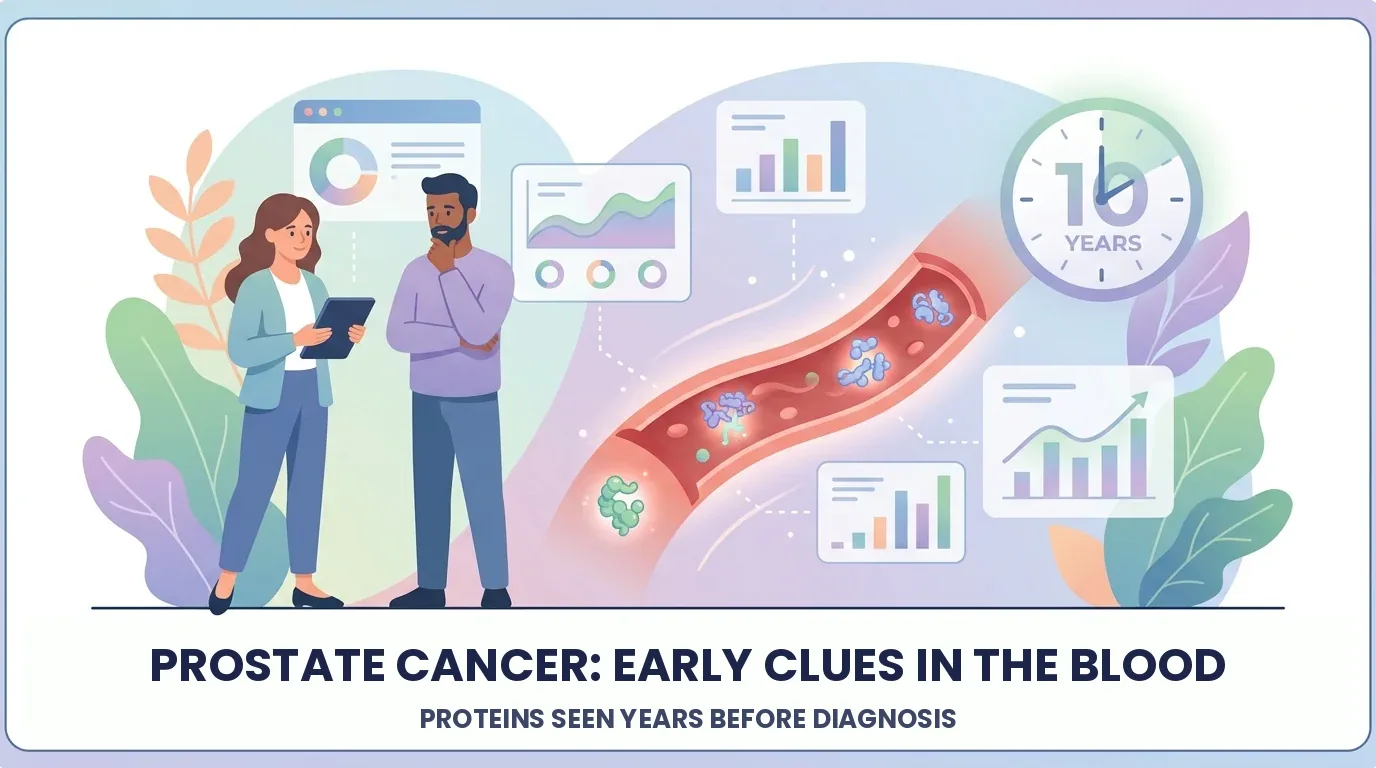
Could a prostate cancer blood test one day flag risk long before a tumor shows up? A study from the University of Oxford, published in October 2026 in European Urology, found that certain proteins circulating in the blood were linked to prostate cancer diagnosed more than 10 years later, and in some cases more than 15 years later. The work is not a new test you can order today, but it adds early clues to the familiar PSA story.
Here is what the researchers measured, what they found, what it changes for you now, and which tests are actually used to check the prostate.
What the Oxford prostate cancer study found
The team, led by Zhe Huang, Karl Smith-Byrne and Ruth Travis of Oxford Population Health, used blood samples stored in the European Prospective Investigation into Cancer and Nutrition (EPIC), a large cohort that collected samples between 1992 and 2000. They compared 982 men who later developed prostate cancer with a random group of 1,573 men from the same cohort. Of the cancers, 290 were classed as aggressive.
Using a high-throughput platform called SomaScan, they measured more than 6,000 proteins in each plasma sample, then looked at which ones were linked to a later diagnosis.
- Three proteins were linked to overall prostate cancer risk: KLK3, ACP3 and FLT4. KLK3 is the protein measured by the standard PSA test.
- Seven proteins were linked to aggressive disease. One of them, ANKRD1, stood out across several clinically important forms of the disease.
- Twelve proteins were linked to cancers diagnosed more than 15 years after the blood draw, including ANXA2, GZMK and OSCAR.
- Proteins made by known cancer driver genes, including ERBB3, KRAS and NRAS, were associated with future aggressive cancer.
Key numbers at a glance
| Protein | Linked to | Hazard ratio per 1 SD increase |
|---|---|---|
| KLK3 (PSA) | Overall prostate cancer | 2.28 |
| FLT4 | Overall prostate cancer | 1.26 |
| ACP3 | Overall prostate cancer | 1.20 |
A hazard ratio of 1.20 means roughly a 20% higher risk over time for each step up in the protein level, compared with men lower on the scale. It describes groups of men, not an individual prediction.
Proteins that may lower the risk
Not every signal pointed toward more risk. Higher levels of two immune-related proteins, GZMK and ANXA2, were associated with a lower risk of prostate cancer diagnosed more than 15 years later. GZMK is made by immune cells that can kill damaged cells. The researchers see this as a hint that the immune system may play a role in the earliest stages of the disease, long before any symptom or PSA change.
Why this is not a new screening test yet
The authors call their results exploratory. The study is observational: it shows links between protein levels and later cancer, not that these proteins cause the disease. When the team checked their findings in a second U.S. cohort, the Atherosclerosis Risk in Communities (ARIC) study, only part of them held up: ACP3, ANXA2, APOC2 and KLK3 showed consistent results. Genetic analyses supported a causal role for only a few proteins.
Most important for patients, the study did not show that adding these proteins predicts prostate cancer better than PSA and the usual clinical factors. As Euronews and News-Medical both report, more validation is needed before any of this reaches a doctor's office.
What it means for prostate cancer screening today
For now, nothing changes in practice. In the United States, the U.S. Preventive Services Task Force (USPSTF) recommends that men aged 55 to 69 make an individual decision about PSA screening with their clinician, after weighing benefits and harms, and recommends against routine PSA screening from age 70. The Task Force notes that this recommendation is being updated.
The PSA test has known limits. A raised PSA does not always mean cancer: infection, an enlarged prostate or recent ejaculation can raise it. A normal value does not fully rule cancer out. The long-term goal of research like the Oxford study is to tell apart men who are likely to develop an aggressive cancer from those whose cancer would never cause harm. Read our guide to the PSA blood test for how to read your own result.
Which tests are used to check the prostate?
- PSA blood test: the main blood marker, interpreted with age, prostate size, medicines and past results.
- Free PSA and PSA trends: the share of free PSA and how fast PSA rises can help decide whether to investigate further.
- Digital rectal exam: a quick physical check of the prostate by your doctor.
- Prostate MRI: often used after an abnormal PSA to decide whether a biopsy is needed.
- Biopsy: the only way to confirm a diagnosis of prostate cancer.
Lifestyle research continues too. A recent study looked at ultra-processed foods and prostate cancer, and large protein panels are also being tested to estimate overall mortality risk.
Latest scientific advances
Based on articles retrieved from PubMed, the Oxford study is part of a fast-growing field that searches the blood for signs of cancer years ahead.
The main study itself, published in European Urology, describes candidate proteins tied to immune defense, cell adhesion, blood vessel growth and known prostate cancer genes. The authors present them as leads for future research and prevention, not as a ready-made test (DOI).
A 2026 review by the same Oxford group, in eBioMedicine, pooled long-term studies of blood proteins and cancer. Many protein signals held up for lung and colorectal cancer, but very few did for prostate cancer, which shows how hard it is to find reliable early markers for this disease (DOI).
A 2025 study from China, using UK Biobank data, found two other proteins, TSPAN1 and GP2, that started to rise several years before a prostate cancer diagnosis. Different studies are pointing to different proteins, so independent confirmation is the key next step (DOI 10.1097/JS9.0000000000002805).
What this means for you: PSA remains the blood test that matters for prostate cancer today. Protein panels may one day help target screening, but they are still in the research phase.
When to talk to your doctor
Talk to your doctor about PSA testing if you are between 55 and 69, or earlier if you have a father or brother who had prostate cancer, if you are Black, or if you carry a BRCA2 or other inherited gene change linked to cancer. See a doctor promptly if you notice blood in your urine or semen, a weak or interrupted urine stream, frequent urination at night, or new pain in the back, hips or pelvis.
Glossary
- PSA (prostate-specific antigen): a protein made by the prostate, measured in a blood test; its gene is called KLK3.
- Proteomics: the large-scale measurement of thousands of proteins in a sample.
- Cohort study: a study that follows a group of people over time to see who develops a disease.
- Hazard ratio: a measure comparing how quickly an event happens in one group versus another.
- Aggressive prostate cancer: cancer that is high grade, advanced, or likely to spread or be fatal.
- Driver gene: a gene whose changes help push a normal cell toward cancer.
FAQ
Is there a blood test that predicts prostate cancer 15 years in advance?
Not yet. The Oxford study found proteins linked to cancers diagnosed more than 15 years later, but the results are exploratory and have not been turned into a test.
Does this study replace the PSA test?
No. PSA itself was one of the strongest signals in the study, and the authors did not show that the new proteins improve prediction beyond PSA.
Can I ask my lab for these protein tests?
No. The SomaScan platform used in the study is a research tool and is not part of routine blood work.
Why do some proteins seem protective?
Higher GZMK and ANXA2 levels were linked to lower long-term risk. Both are tied to immune activity, which may help keep early abnormal cells in check, but this still needs to be proven.
At what age should men consider PSA screening?
The USPSTF advises men aged 55 to 69 to decide with their clinician. Men at higher risk may start the conversation earlier.
Sources
- Huang Z, et al. Circulating Immune and Cancer Driver Gene Biomarkers Precede Prostate Cancer Diagnosis by over 10 yr. European Urology, 2026 (DOI 10.1016/j.eururo.2026.08.014)
- PubMed: abstract of the European Urology study (PMID 42907294)
- Euronews: Blood test could reveal prostate cancer risk more than a decade before diagnosis, October 27, 2026
- News-Medical: Clues to prostate cancer risk in blood samples taken 15 years earlier, October 26, 2026
- Medical News Today: Blood proteins may signal prostate cancer risk 15 years pre-diagnosis
- U.S. Preventive Services Task Force: Prostate Cancer Screening recommendation
- Dillman A, et al. The circulating proteome and cancer risk: a systematic review and meta-analysis of 26 prospective studies. eBioMedicine, 2026
- Chen Y, et al. Plasma proteomics and machine learning for early risk prediction of prostate cancer. Int J Surg, 2025 (DOI 10.1097/JS9.0000000000002805)
Other articles
- PSA blood test: what your result means and what it doesn't
- Prostate cancer: symptoms, diagnosis and treatment
- Ultra-processed foods and prostate cancer: what the new study found
- Blood protein panels and mortality risk
- Early-onset cancer: why cases are rising under 50
Understand your own blood test results with AI DiagMe
Has your PSA come back high, or has it risen since your last test? Upload your blood test results to AI DiagMe for a clear, personalized explanation in plain language, to prepare your next conversation with your doctor.