








































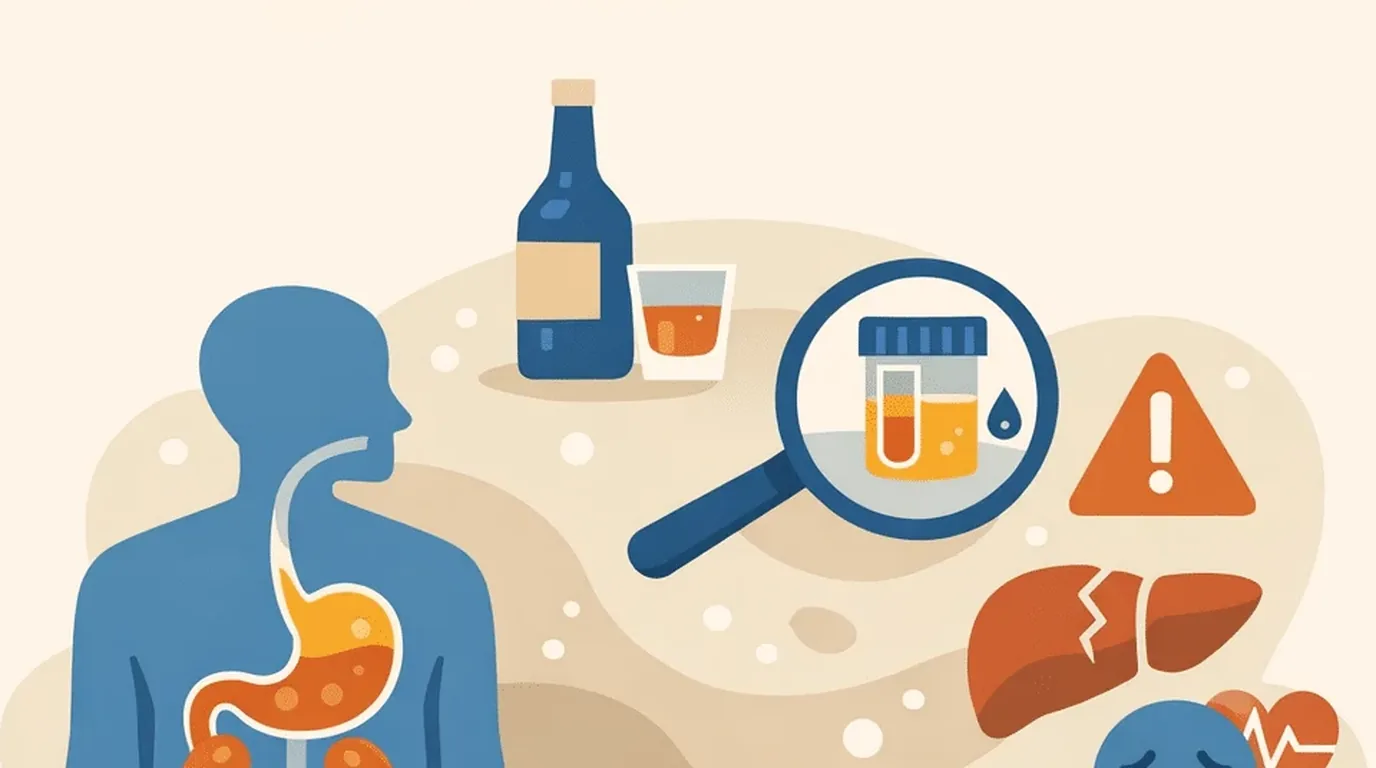
How much alcohol is too much? A large analysis published in October 2026 in the Journal of Studies on Alcohol and Drugs gives one of the clearest answers so far. The researchers found no level of drinking that protects health overall, and they estimate that people who average 14 drinks a week, or two a day, face about a 1 in 25 lifetime risk of dying from an alcohol-caused condition.
The work, known as the Alcohol Intake and Health Study, was commissioned by the U.S. federal government to inform the Dietary Guidelines for Americans. Here is what it found, how it fits with the new guidelines, and which routine blood tests can show how alcohol is affecting your body.
What the new alcohol study found
The team, led by Kevin Shield of the University of Toronto, with Timothy Naimi of the University of Victoria as co-author, reviewed more than 7,200 scientific publications on illnesses and injuries linked to alcohol. They turned those findings into risk estimates for each condition and applied them to large national health datasets to model lifetime risk at different drinking levels.
- Up to 7 drinks per week was linked to only small increases in risk for most conditions.
- Risk rose more clearly above one drink per day, for both men and women.
- At an average of 14 drinks per week, the lifetime risk of death from alcohol-caused conditions reached about 1 in 25.
- No drinking level showed a significant overall protective effect. A possible lower risk of ischemic heart disease and stroke at low intake was outweighed by other risks, cancer in particular.
The authors stress that these are population estimates. They describe average risk across many people and cannot predict what will happen to one individual.
| Average weekly intake | What the 2026 study reported |
|---|---|
| Up to 7 drinks | Small increases in risk for most conditions |
| More than 7 drinks (above one a day) | Risk rises more steeply, in men and in women |
| 14 drinks (two a day) | About 1 in 25 lifetime risk of death from alcohol-caused conditions |
| Any level | No significant overall protective effect |
What counts as one drink?
In the United States, a standard drink contains 14 grams of pure alcohol, according to the National Institute on Alcohol Abuse and Alcoholism (NIAAA). That is about 12 fluid ounces of regular beer at 5 percent alcohol, 5 fluid ounces of wine at 12 percent, or 1.5 fluid ounces of 40 percent spirits. A large craft beer or a generous pour of wine can easily count as two drinks, so many people drink more than they think.
Why this matters for the 2025-2030 dietary guidelines
Earlier U.S. guidelines advised no more than two drinks a day for men and one for women. The 2025-2030 Dietary Guidelines for Americans, released in January 2026, dropped these numeric limits and simply encourage people to drink less. According to the journal, an accompanying editorial by Robert M. Vincent, a former SAMHSA official, argues that the study was requested to inform those guidelines but that its findings were overlooked.
For readers, the practical message is consistent with earlier research: less is better, and there is no amount you need to drink for your health.
Which blood tests show how alcohol affects your body?
No single test measures how much you drink, but several routine markers can reflect the effect of regular drinking. Your doctor reads them together, with your history.
- GGT (gamma-glutamyl transferase): drinking alcohol raises GGT, and MedlinePlus notes that it can be used to screen for or monitor alcohol use disorder. It also rises with other liver problems and some medicines.
- ALT and AST: these liver enzymes are part of the liver function tests. The AST/ALT ratio helps your doctor think about the possible cause of liver strain.
- MCV (mean corpuscular volume): regular heavy drinking is one of the causes of larger red blood cells, which shows up as a high MCV on a complete blood count.
- PEth (phosphatidylethanol): a more specific blood marker that forms only when alcohol is present and reflects drinking over the previous weeks. It is not part of a routine checkup.
Urine tests detect recent drinking rather than long-term effects; our guide to the alcohol urine test explains how they work. If you also have weight or blood sugar concerns, alcohol and metabolism can add up in the liver, as explained in our article on the fatty liver blood test.
Latest scientific advances
Based on articles retrieved from PubMed, recent research points in the same direction as the 2026 study and is improving how doctors measure drinking.
A large 2023 review in JAMA Network Open pooled more than a hundred long-term studies. Once the researchers corrected for a common bias, where people who quit drinking because they were already ill are counted as non-drinkers, light drinkers no longer lived longer than people who never drank. The old idea that a daily glass is good for you does not hold up well (DOI).
A 2026 study from Swedish primary care compared the PEth blood test with patients' own answers about drinking. Each method flagged some people the others missed, so the authors advise using the blood test alongside a conversation and questionnaire, not on its own (DOI).
A 2026 review on fatty liver disease linked to both metabolism and alcohol recommends combining PEth with self-reported intake and simple questionnaires to better estimate how much alcohol contributes to liver damage (DOI).
What this means for you: an honest discussion about your drinking, plus a few routine blood markers, gives your doctor a much better picture than any single number.
When to talk to your doctor
Talk to your doctor if you regularly drink more than one drink a day, if you find it hard to cut down, or if a recent blood test showed high GGT, ALT, AST or MCV. Also mention alcohol if you take medicines, have liver disease, are pregnant or planning a pregnancy, or have a family history of alcohol problems. Seek urgent care for vomiting blood, yellowing of the skin or eyes, confusion, or severe abdominal pain.
Glossary
- Standard drink: in the U.S., an amount of beer, wine or spirits containing 14 grams of pure alcohol.
- Lifetime risk: the chance that an event, here death from an alcohol-caused condition, happens over a whole life.
- GGT: a liver enzyme that often rises with regular drinking.
- MCV: the average size of red blood cells, measured in a complete blood count.
- PEth: phosphatidylethanol, a blood marker formed only in the presence of alcohol.
- Ischemic heart disease: heart damage caused by reduced blood flow in the coronary arteries.
FAQ
How much alcohol is too much per week?
The 2026 study found only small increases in risk up to about 7 drinks a week for most conditions, with risk rising more clearly above one drink a day. It found no level that improves health overall.
Is a glass of red wine a day good for the heart?
The study saw a possible small benefit for some heart and stroke risks at low intake, but it was outweighed by other risks such as cancer, so the overall effect was not protective.
Are women and men at the same risk?
The study reports that risk rises above one drink a day for both men and women. The 2023 JAMA Network Open review found higher mortality risk in women drinkers than in women who never drank.
Can a blood test tell if I drink too much?
Markers such as GGT, ALT, AST and MCV can show effects of regular drinking but have other causes too. PEth is more specific but is usually ordered only for a particular reason.
What do the new U.S. dietary guidelines say about alcohol?
The 2025-2030 guidelines no longer give daily limits for men and women and instead encourage people to drink less.
Sources
- ScienceDaily (Journal of Studies on Alcohol and Drugs): Just two drinks a day may be far riskier than you think, October 2026
- The ASCO Post: New research links low alcohol consumption to elevated health risks
- Journal of Studies on Alcohol and Drugs, 2026; 87(4): 621 (DOI 10.15288/jsad.25-00435)
- NIAAA: What is a standard drink?
- MediaPost: New U.S. dietary guidelines scrap suggested limits for alcohol
- MedlinePlus: Gamma-glutamyl transferase (GGT) test
- Zhao J, et al. Association between daily alcohol intake and risk of all-cause mortality. JAMA Netw Open, 2023
- Månsson V, et al. Identifying hazardous alcohol use in primary care: PEth and self-reports. Ann Fam Med, 2026
- Lin H, et al. Risk assessment in MASLD and MetALD. Clin Mol Hepatol, 2026
Other articles
- GGT test: what your liver enzyme results mean
- Liver function tests: how to read your liver panel
- High MCV: what it means, causes and next steps
- Alcohol urine test: detection times, cutoffs and false positives
- Fatty liver blood test: can blood work catch the silent disease?
Understand your own blood test results with AI DiagMe
Have your GGT, ALT, AST or MCV come back outside the reference range? Upload your blood test results to AI DiagMe for a clear, personalized explanation in plain language, to prepare your next conversation with your doctor.