



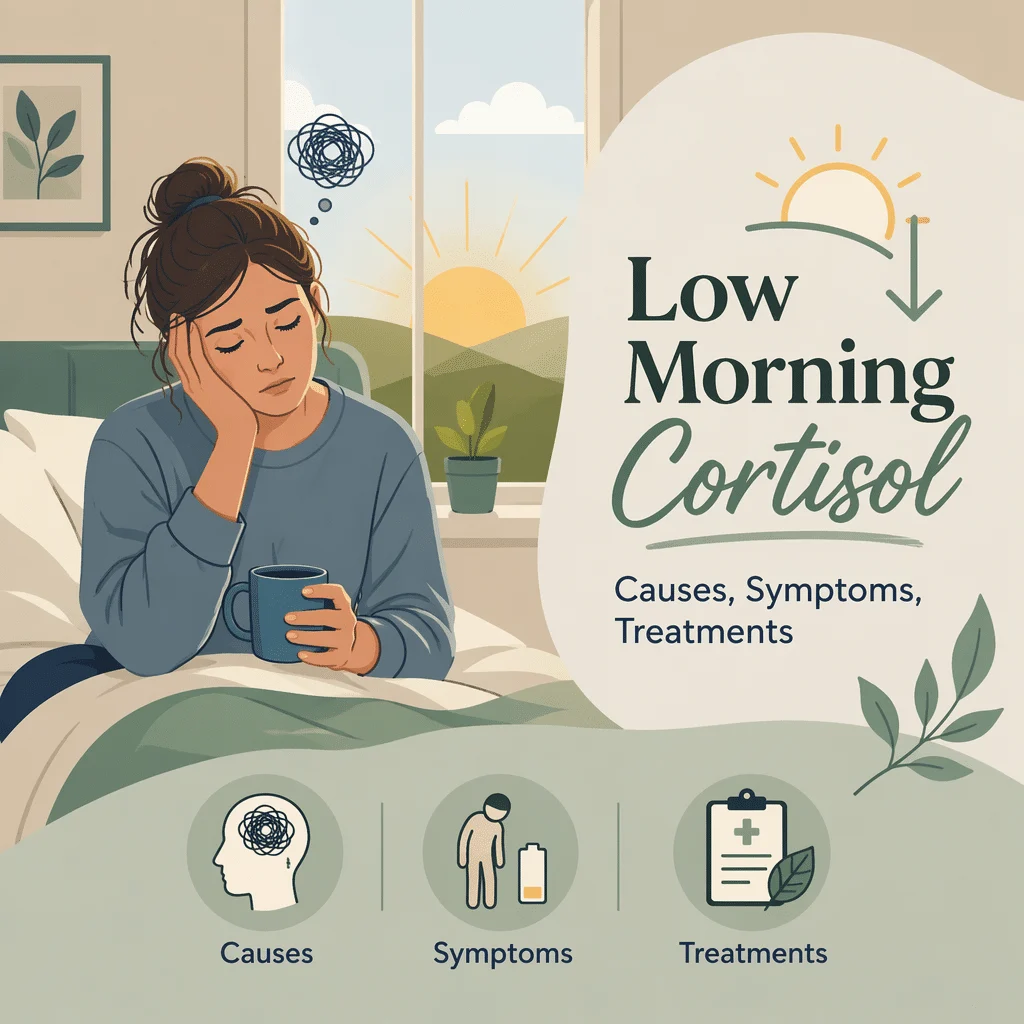
A low morning cortisol result means your blood cortisol sat below the expected range at the time of day when it should be at its highest. That is worth taking seriously, but on its own it is a screening finding rather than a diagnosis, and most people who receive one do not turn out to have disease of the adrenal glands. In this article you will learn what a low morning cortisol raises the question of, why steroid medicines are by far the commonest explanation, how doctors confirm or exclude adrenal insufficiency, which symptoms carry weight, and what can make the number misleading. Before anything else, please read the emergency box directly below. A small number of people with very low cortisol become acutely unwell, and that situation cannot wait.
Emergency: adrenal crisis needs immediate care
Adrenal crisis is a sudden, life-threatening shortage of cortisol. Call emergency services or go to an emergency department at once if you or someone else has:
- severe weakness or collapse
- repeated vomiting, diarrhea or severe abdominal pain
- confusion, drowsiness or loss of consciousness
- very low blood pressure, fainting or shock
Treatment is urgent injected or intravenous hydrocortisone plus fluids, given by a medical team. In someone who already has adrenal insufficiency, an infection, an injury, an operation or an episode of vomiting can trigger a crisis. People with a confirmed diagnosis are given individual sick-day instructions by their endocrine team, and those instructions come from that team rather than from any article. Tell any emergency clinician straight away if you take, or have recently taken, steroid medicines.
What a low morning cortisol actually means
Cortisol follows a daily cycle and reaches its peak shortly after waking, which is why a morning sample is the most informative single measurement. Our companion guide covers that rhythm and the different ways of measuring the hormone, so if you want the background, start with our overview of the cortisol blood test.
What a low result does is open a question. It asks whether the body can produce enough cortisol when it needs to, a condition doctors call adrenal insufficiency. A single morning value sits on a continuum: a very low figure makes adrenal insufficiency much more likely, a clearly normal figure makes it much less likely, and the wide middle band tells you very little on its own. This is why clinicians treat a low morning cortisol as a trigger for further testing rather than as a verdict, and why context does most of the work in reading it.
The commonest cause is a steroid medicine, whatever the route
In everyday practice, the single most frequent reason for a low morning cortisol is not a rare adrenal disease. It is exogenous glucocorticoid suppression: the body has been receiving steroid hormone from a medicine, so the brain has stopped asking the adrenal glands to make their own. Cortisol production quietens down, and a blood test taken during or after that period shows a low figure.
People often assume this applies only to steroid tablets. It does not. Suppression has been documented with inhaled steroids for asthma and COPD, potent topical steroid creams and ointments, intra-articular steroid injections into a joint, intranasal steroid sprays used long term, and eye drops. Dose, potency, duration and individual susceptibility all matter, and two people on the same prescription can respond very differently. No route is automatically safe.
After a long course ends, the axis linking brain to adrenal gland can take weeks or months to switch back on, so a low cortisol during or shortly after a taper often reflects that lag rather than permanent damage.
Never stop or reduce a steroid on your own
This is the most important line in the article. If you take a glucocorticoid and you have just learned that steroids lower cortisol, the instinct to cut down or stop is understandable and it is dangerous. Abruptly withdrawing a long-term glucocorticoid can itself precipitate an adrenal crisis, because the medicine has been doing the job your own glands have stopped doing. Any change to a steroid dose, including tapering, is planned and supervised by the prescribing doctor. Bring your low result to that doctor and ask what it means for your treatment. Do not act on it alone.
Primary versus secondary adrenal insufficiency
If a genuine cortisol deficiency is confirmed, one distinction organizes everything that follows: where the problem sits.
Primary adrenal insufficiency (Addison’s disease)
Here the adrenal glands themselves are damaged, most often by an autoimmune process, sometimes by infection, bleeding or surgery. The brain keeps sending its signal, so the pituitary hormone ACTH runs high while cortisol stays low. Because the outer adrenal layer also makes aldosterone, salt and water handling suffers too, which produces a recognizable pattern: low sodium, high potassium, low blood pressure and a craving for salty food. Darkening of the skin, especially in scars, skin creases, gums and knuckles, is characteristic and reflects the high ACTH signal. Your doctor may therefore also request an ACTH blood test, a measurement of aldosterone, and a check of blood sodium alongside blood potassium.
Secondary and tertiary adrenal insufficiency
Here the adrenal glands are intact but under-instructed. In secondary adrenal insufficiency the pituitary gland fails to release enough ACTH, usually because of a tumor, surgery, radiation treatment, bleeding or inflammation. In tertiary adrenal insufficiency the hypothalamus above it is the problem, and this is the mechanism behind steroid-induced suppression. In both, ACTH is low or inappropriately normal rather than high. Aldosterone production is usually preserved, so potassium is typically normal, and there is no skin darkening because the ACTH signal is not elevated. Because pituitary damage rarely affects one hormone alone, a doctor investigating this pattern will often check thyroid function with a TSH blood test and review sex hormones as well.
How adrenal insufficiency is actually confirmed
The Endocrine Society, in its joint clinical practice guideline with the European Society of Endocrinology, sets out the standard sequence. A morning cortisol is the screening step. Confirmation comes from a dynamic test, most commonly the ACTH stimulation test, also called the short Synacthen or cosyntropin test. A synthetic form of ACTH is injected, and cortisol is measured before and roughly thirty to sixty minutes afterwards. Healthy adrenal glands respond by pushing cortisol up sharply. Glands that cannot respond adequately fail that challenge, which is what establishes the diagnosis.
Once insufficiency is confirmed, a simultaneous ACTH measurement separates the two families described above. High ACTH with low cortisol points to the adrenal glands themselves. Low or inappropriately normal ACTH with low cortisol points upstream, to the pituitary or hypothalamus, or to steroid exposure. Depending on the picture, further work may include an MRI of the pituitary, adrenal imaging, adrenal antibody testing, or a 17-OH progesterone blood test when a congenital enzyme disorder is being considered.
The table below summarizes how clinicians read the common patterns. It is a map of the reasoning, not a self-scoring tool, and only your doctor can apply it to your case.
| Pattern | What it usually points to | Usual next step |
|---|---|---|
| Low cortisol in someone taking or recently tapering any steroid | Glucocorticoid-induced suppression, the commonest explanation by far | Review with the prescriber; testing timed around the medicine; never a self-directed dose change |
| Low cortisol with high ACTH | Primary adrenal insufficiency, that is Addison’s disease | ACTH stimulation test, electrolytes, aldosterone and renin, adrenal antibodies |
| Low cortisol with low or inappropriately normal ACTH | Secondary or tertiary insufficiency from the pituitary or hypothalamus | ACTH stimulation test, full pituitary hormone panel, pituitary MRI |
| Low cortisol with vomiting, severe weakness or collapse | Possible adrenal crisis | Emergency care immediately; treatment is not delayed for test results |
Why the symptoms are so hard to read
The symptoms of cortisol deficiency are genuinely miserable and almost entirely non-specific. Persistent fatigue, muscle weakness, poor appetite, unexplained weight loss, nausea, abdominal pain and dizziness on standing all appear on the list, and each of them appears on dozens of other lists too. Anemia, depression, thyroid disease, chronic infection and simple exhaustion produce overlapping pictures.
This is why a number cannot be interpreted in isolation, and why doctors weigh the clinical picture heavily. Low blood pressure that drops further on standing, nausea and vomiting, low sodium, skin darkening and salt craving are more discriminating than fatigue alone. Low blood sugar can also occur, particularly in children, so a fasting blood glucose measurement is sometimes part of the assessment, alongside a broader electrolyte panel.
What can distort a cortisol result
Several things unrelated to adrenal disease change the figure a laboratory reports.
Timing is the obvious one. A sample drawn late in the morning, in the afternoon, or after a night shift can look low simply because the peak has passed or the body clock has shifted. Shift workers may need sampling timed to their actual waking hour rather than to the clock.
Oral estrogen works in the opposite direction and is easy to miss. Combined oral contraceptives and some oral hormone replacement raise cortisol-binding globulin, the protein that carries cortisol in the blood. Standard tests measure total cortisol, bound plus free, so the reported figure rises even though active free hormone has not increased. A person on oral estrogen can therefore have a reassuring-looking total cortisol while the real picture is less reassuring. Pregnancy has a similar effect. Tell the laboratory and your doctor what you take.
High-dose biotin supplements, often sold for hair and nails, can interfere with the immunoassay technology many laboratories use for hormones, distorting results in either direction. Acute severe illness disturbs the whole system, which is why cortisol measured during critical illness is read quite differently. Assays also differ between laboratories, so compare a value with that laboratory’s own reference range.
“Adrenal fatigue”: what the evidence supports
The fatigue people describe when they search for this term is real, often severe, and deserves a proper explanation. The label itself does not hold up. “Adrenal fatigue” proposes that ordinary chronic stress gradually exhausts the adrenal glands into a state of mild under-function. A systematic review of the published studies found no consistent evidence that this state exists, and it is not recognized as a diagnosis by endocrinology bodies. Saliva panels marketed to detect it have not been shown to identify a real condition, and the supplements sold alongside them treat nothing. AI DiagMe does not sell or recommend any such product.
The practical risk of the label runs in two directions. It can send someone toward expensive unregulated supplements while a treatable cause of exhaustion, such as iron deficiency, thyroid disease, sleep apnea, depression or genuine adrenal insufficiency, goes undiagnosed. It can also cause a genuinely low cortisol to be dismissed as a lifestyle matter. If you are persistently exhausted, that is a reason to be investigated properly, not a reason to accept a label the evidence does not support.
Living with a confirmed diagnosis
Adrenal insufficiency is treatable, and people who are diagnosed and followed up properly generally do well. Treatment replaces the hormone the body is not making; doses are individual and set by an endocrinologist, so this article deliberately gives none. Illness, injury and surgery raise the body’s cortisol requirement, so each person receives personalized sick-day instructions from their own team, and carrying medical identification matters because it tells an emergency clinician what they need to know in seconds. Follow-up usually includes symptoms, blood pressure and an adrenal blood panel at intervals your specialist decides.
Latest scientific advances in diagnosing adrenal insufficiency
Research published since 2023 has sharpened both the caution and the confidence around morning cortisol. According to PubMed, these are among the most relevant recent findings.
A joint international guideline set the first shared standard for steroid-related cases. In 2024 the European Society of Endocrinology and the Endocrine Society published their first joint clinical practice guideline on glucocorticoid-induced adrenal insufficiency (Beuschlein and colleagues, DOI). What was found: at least one person in a hundred is on long-term glucocorticoid therapy, and their risk of adrenal insufficiency depends on the dose, potency, duration and route of the medicine as well as on individual susceptibility. What this means for you: your steroid history is a central part of interpreting a low cortisol, and the guideline explicitly frames tapering as a supervised medical process, because withdrawal symptoms and true insufficiency overlap.
Steroid-related insufficiency is more common than clinicians once assumed. A 2025 systematic review and meta-analysis combined with an expert Delphi panel looked at people with inflammatory bowel disease treated with glucocorticoids (Law and colleagues, DOI). What was found: roughly a quarter of patients across the pooled studies showed glucocorticoid-induced adrenal insufficiency, and the panel urged a high index of suspicion in anyone treated for four weeks or more. The pooled figure varied a great deal between studies, so it is best read as a signal that the problem is frequent rather than as a precise rate. What this means for you: if you have taken steroids for a serious inflammatory illness, a low cortisol is a common and expected finding rather than a sign of something exotic.
A morning cortisol is most useful at the extremes. A 2026 study of 228 outpatients referred for suspected adrenal insufficiency compared morning cortisol with the short Synacthen test (Sheikh-Ahmad and colleagues, DOI). What was found: very low and clearly high morning values predicted the stimulation test result reliably, while values in the middle band did not. What this means for you: this is the clinical reality behind “your result needs confirming”. A borderline number genuinely cannot settle the question, and being sent for a stimulation test is normal practice rather than a sign that something alarming has been found.
Morning cortisol alone performs poorly as a stand-alone test. A 2025 multicenter cohort compared 168 people investigated for adrenal insufficiency with 105 healthy volunteers (Guia Lopes and colleagues, DOI). What was found: basal morning cortisol did not reliably separate those who turned out to have adrenal insufficiency from those who did not, and its positive predictive value was low. Patients who did have the condition more often reported low blood pressure and nausea. This was a retrospective study, so it describes practice rather than proving cause. What this means for you: symptoms carry real diagnostic weight alongside the number, which is why your doctor asks so many questions about how you actually feel.
Opioid-related adrenal suppression is being recognized, and may reverse. A 2026 report from an Australian cohort followed for eighteen to twenty years assessed hormone function in 123 people with a history of heroin dependence (Tremonti and colleagues, DOI). What was found: low cortisol was present in about one in seven of those still using opioids and in none of those who had sustained abstinence, and not one affected participant had been diagnosed beforehand despite regular healthcare contact. What this means for you: long-term opioid treatment, including prescribed medicines for chronic pain or opioid dependence, belongs on the list of things that can lower cortisol, and it is worth mentioning explicitly to whoever ordered your test.
Crisis prevention rests on education, not on testing. A 2024 review of adrenal crisis in secondary, tertiary and medication-induced insufficiency (Martel-Duguech and colleagues, DOI) found that crises are becoming more frequent as steroid prescribing, immunotherapy and opioid use grow, and that delayed recognition is a major contributor to harm. What this means for you: if you are diagnosed, the education your team repeats about illness and injury is the most effective protection available.
Glossary of key terms
| Term | Definition |
|---|---|
| Cortisol | A hormone made by the adrenal glands that supports blood pressure, blood sugar and the body’s response to stress and illness. |
| Adrenal insufficiency | A condition in which the body cannot produce enough cortisol for its needs. |
| Primary adrenal insufficiency | Cortisol deficiency caused by damage to the adrenal glands themselves; Addison’s disease is the commonest form. |
| Secondary adrenal insufficiency | Cortisol deficiency caused by the pituitary gland not releasing enough ACTH to instruct the adrenal glands. |
| ACTH | Adrenocorticotropic hormone, the pituitary signal that tells the adrenal glands to release cortisol. |
| ACTH stimulation test | The standard confirmatory test, also called the short Synacthen or cosyntropin test, in which synthetic ACTH is given and the cortisol response is measured. |
| Glucocorticoid | A steroid medicine such as prednisone, hydrocortisone or budesonide, given by mouth, inhaler, cream, spray, drops or injection. |
| Cortisol-binding globulin | The blood protein that carries most circulating cortisol; oral estrogen and pregnancy increase it and so raise measured total cortisol. |
| Adrenal crisis | A sudden, life-threatening shortage of cortisol requiring emergency injected steroid and fluids. |
| Hyperpigmentation | Darkening of skin in scars, creases, gums and knuckles, seen in primary adrenal insufficiency because ACTH levels are high. |
Frequently asked questions
Does a low morning cortisol mean I have Addison’s disease?
Usually not. Addison’s disease is uncommon, while low morning cortisol results are relatively frequent, so most low values have another explanation: steroid medicines, sampling at the wrong time, acute illness, opioid treatment, or simply a result in the borderline band where the test cannot decide. Addison’s disease specifically involves damage to the adrenal glands themselves and is typically accompanied by a high ACTH level, and often by low sodium, high potassium and darkening of the skin. Confirming or excluding it requires an ACTH stimulation test and an ACTH measurement, not a single cortisol figure. Ask your doctor what the next test in your case should be.
Can steroid medicines cause a low cortisol, and should I stop taking them?
Yes, they can, and no, you should not stop them yourself. Steroids are the commonest cause of a low cortisol result, and this includes inhalers, nasal sprays, skin creams, eye drops and joint injections, not only tablets. But stopping or reducing a long-term glucocorticoid abruptly can trigger an adrenal crisis, because the medicine has been replacing hormone your own glands have stopped producing. Every dose change, including a taper, must be planned by the doctor who prescribed it. Take your result to that doctor and ask what it means for your treatment plan.
Is “adrenal fatigue” the reason I feel exhausted every morning?
The exhaustion is real, but the label is not supported by evidence. A systematic review of the published research found no substantiation for the idea that ordinary chronic stress wears the adrenal glands into a state of mild under-function, and endocrinology bodies do not recognize it as a diagnosis. Saliva testing panels sold to detect it have not been shown to identify a genuine condition, and no supplement treats it. The more useful path is a proper evaluation of persistent fatigue, which can uncover iron deficiency, thyroid disease, sleep apnea, depression, or, occasionally, true adrenal insufficiency.
Why does the time of the blood draw matter so much?
Cortisol is not a steady number. It peaks shortly after you wake and falls across the day, so a result that would be clearly low at eight in the morning may be entirely normal at four in the afternoon. Laboratories publish separate reference ranges for different collection times for exactly this reason. If you work night shifts or your sleep pattern is very irregular, your peak occurs at a different clock time, and your doctor may want the sample timed to your own waking hour instead. Always check that the collection time is recorded on the report.
What is the ACTH stimulation test like, and why do I need one?
It is a short outpatient procedure. Blood is taken, a synthetic form of ACTH is injected, and blood is taken again after about thirty to sixty minutes to see how much cortisol the adrenal glands can produce on demand. It usually takes under an hour and is generally well tolerated. You need it because a resting morning cortisol only tells your doctor what your body is doing at that moment, not what it can do under pressure, and pressure is exactly when cortisol matters. This test is the standard confirmation step in the Endocrine Society guidance.
Can birth control pills or supplements change my cortisol result?
Yes. Combined oral contraceptives and some oral hormone replacement raise cortisol-binding globulin, the protein that carries cortisol, so total cortisol measured in blood goes up without the active free hormone increasing. That can make a genuinely low value look acceptable. Pregnancy has the same effect. High-dose biotin supplements are a separate issue: they can interfere with the laboratory technology used for many hormone tests and distort the reading. Tell the laboratory and your doctor about every medicine and supplement you take, including ones bought without a prescription.
Sources
- Adrenal Insufficiency & Addison’s Disease — National Institute of Diabetes and Digestive and Kidney Diseases (NIDDK), National Institutes of Health.
- Addison Disease — MedlinePlus, U.S. National Library of Medicine.
- Adrenal Crisis — Elshimy G, Chippa V, Kaur J, et al. StatPearls, NCBI Bookshelf, National Library of Medicine.
- European Society of Endocrinology and Endocrine Society Joint Clinical Guideline: Diagnosis and Therapy of Glucocorticoid-induced Adrenal Insufficiency — Beuschlein F, Else T, Bancos I, et al. Journal of Clinical Endocrinology and Metabolism, 2024.
- Evaluation and Management of Glucocorticoid-Induced Adrenal Insufficiency in IBD: An Expert Opinion — Law CCY, Sheskier R, Viera-Feliciano N, et al. Inflammatory Bowel Diseases, 2025.
- Diagnostic utility of morning serum cortisol in predicting short synacthen test outcomes in outpatients with suspected adrenal insufficiency — Sheikh-Ahmad M, Rosenblat I, Salameh S, et al. BMC Endocrine Disorders, 2026.
- Reassessing the Role of Morning Cortisol in Adrenal Insufficiency Diagnosis: Insights from a Multicentric Cohort — Guia Lopes ML, Regala C, Limbert C, et al. Hormone and Metabolic Research, 2025.
- Endocrinopathies and Their Recovery in a 20-Year Cohort Study of People With Heroin Dependence — Tremonti C, Twigg SM, Mills KL, et al. Clinical Endocrinology, 2026.
- Diagnosis and management of secondary adrenal crisis — Martel-Duguech L, Poirier J, Bourdeau I, Lacroix A. Reviews in Endocrine and Metabolic Disorders, 2024.
Further reading
- Cortisol: a guide to understanding your blood test
- High cortisol levels: symptoms and causes
- Urine cortisol: understanding test results
- Burnout and cortisol rhythms
- Glucose levels: causes, symptoms and treatments
Understand your lab results with AI DiagMe
A report showing morning cortisol, ACTH, sodium and potassium can be hard to read on your own, especially when the numbers sit close to a reference limit. AI DiagMe turns those values into plain language and shows you which findings are worth raising with your doctor. It helps you understand a result; it does not diagnose or exclude adrenal insufficiency, and it does not replace your doctor. Never use it in an emergency: if you have symptoms of adrenal crisis, seek immediate medical care.
Get your results interpreted in minutes