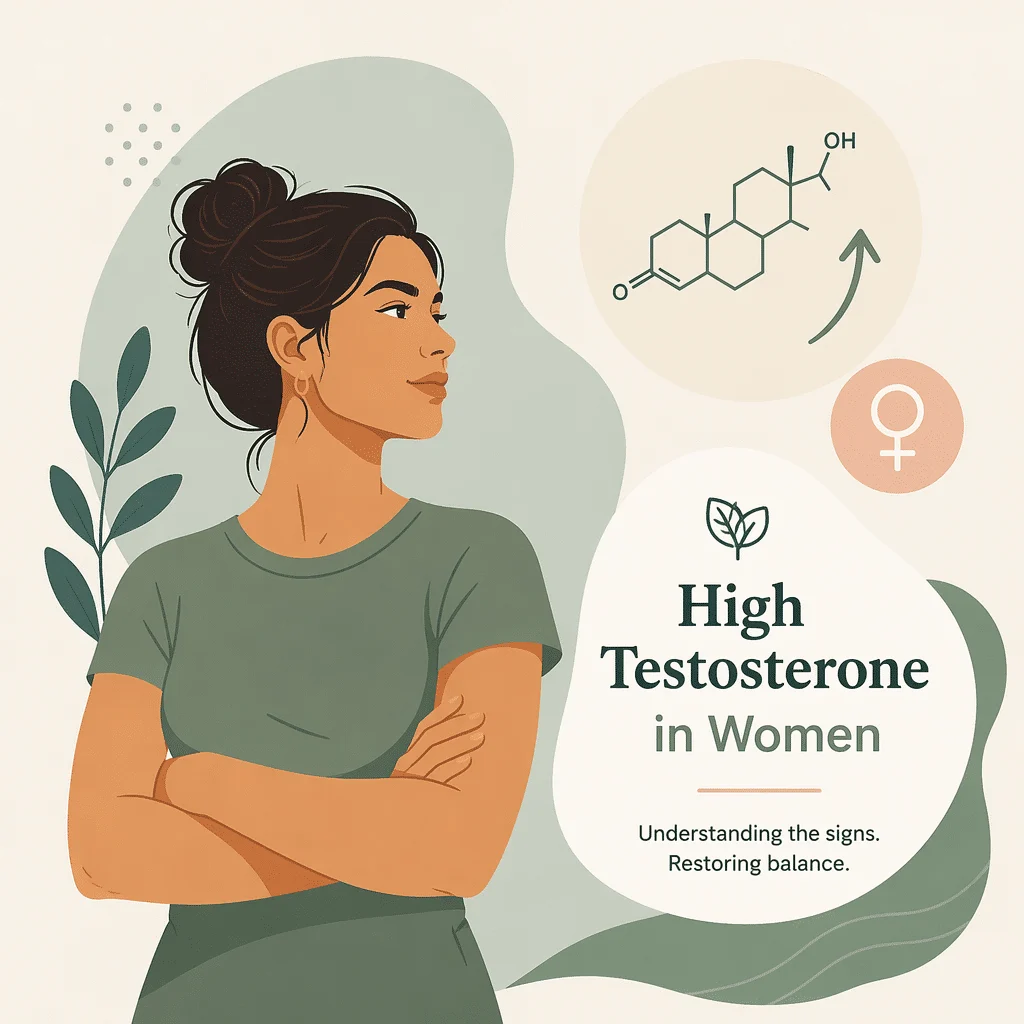
High testosterone in women, known medically as hyperandrogenism, is one of the more common reasons a hormone panel comes back outside the reference range. One condition explains the large majority of cases: polycystic ovary syndrome (PCOS). The signs that usually lead to testing, such as coarse hair growth, persistent acne, thinning scalp hair or irregular periods, are clinical signals of a hormonal imbalance. They deserve investigation, not embarrassment, and they are not cosmetic problems.
In this article you’ll learn what testosterone actually does in the female body, why this particular blood test is unusually difficult to perform accurately, how PCOS is diagnosed and why it is a diagnosis of exclusion, which other conditions and medicines raise androgens, and the one pattern of change that means you should be assessed quickly rather than routinely.
What testosterone does in women and what the test measures
Testosterone is often called a male hormone, but every woman produces it. Roughly half comes from the ovaries and half from the adrenal glands, with a further contribution made in fat and skin tissue from weaker precursors such as androstenedione and DHEA-S. Levels in women are around one twentieth of those in men, and they vary across the cycle and across the day, usually peaking in the morning.
In normal amounts, androgens support bone strength, muscle maintenance, libido and healthy ovarian follicle development. Testosterone is also a chemical stepping stone to estrogen, which is why the two are so closely linked. There is a general overview in our guide to testosterone as a blood marker, and the mirror-image problem in men is covered in our article on low testosterone in men.
Most laboratories report total testosterone, which is everything circulating in the blood. Only a small fraction is biologically active; the rest is bound tightly to a carrier protein called sex hormone-binding globulin (SHBG) or loosely to albumin. This distinction causes a great deal of confusion when results are read.
Why measuring testosterone in women is harder than it looks
Assays struggle at low concentrations
Most routine hormone analyzers use an immunoassay, a method built around antibodies that recognize the hormone. Immunoassays perform well at the concentrations seen in men, but they lose accuracy at the far lower concentrations found in women. Structurally similar steroids can be picked up as though they were testosterone, which tends to push results upward. The reference method is liquid chromatography with tandem mass spectrometry, written LC-MS/MS, which identifies the molecule directly rather than inferring it. If your result is borderline or surprising, asking which method the laboratory used is a reasonable question.
SHBG shifts the total without changing the active hormone
Because most testosterone travels bound to SHBG, anything that changes SHBG changes the total result. Estrogen-containing contraception and an overactive thyroid raise SHBG, and so raise total testosterone. Insulin resistance, an underactive thyroid and higher body weight lower SHBG, and so lower the total even when the active fraction is unchanged or higher. A woman can therefore have symptoms of androgen excess with a total testosterone that looks reassuringly normal, which is why SHBG is often measured alongside it.
The free androgen index is a calculation, not a measurement
The free androgen index (FAI) is derived arithmetically from total testosterone and SHBG. So is calculated free testosterone. Neither is measured directly. They are useful, and international guidance supports their use, but they inherit every inaccuracy of the two numbers behind them. Directly measured free testosterone needs specialist techniques such as equilibrium dialysis, which few routine laboratories offer.
Polycystic ovary syndrome: the most common explanation by far
PCOS affects roughly one in ten women of reproductive age and accounts for the large majority of raised androgen results in women who are still menstruating. It is a whole-body endocrine condition involving the ovaries, insulin signaling and the brain’s control of the reproductive cycle, not simply a matter of ovarian appearance.
The Rotterdam framework in plain terms
Diagnosis in adults rests on the Rotterdam framework, carried forward into the 2023 international evidence-based guideline. A woman meets the criteria if she has at least two of the following three features:
- Irregular or absent ovulation, which shows up as periods that are infrequent, unpredictable or missing altogether
- Hyperandrogenism, either clinical (hirsutism, persistent acne, scalp hair thinning) or biochemical (a genuinely raised androgen level on a reliable assay)
- Polycystic ovarian morphology, meaning a high number of small follicles or an enlarged ovarian volume on ultrasound
Two of three is enough, which is why PCOS looks so different in different women. One may have irregular cycles and a raised testosterone with entirely normal-looking ovaries; another may have androgen symptoms and typical ovarian appearances with fairly predictable periods. In adolescents the criteria are deliberately stricter, and ultrasound and anti-Müllerian hormone are not used for diagnosis because normal young ovaries often look polycystic.
Why PCOS is a diagnosis of exclusion
This is the point most often missed. PCOS is diagnosed only after the conditions that imitate it have been ruled out: thyroid function, prolactin and 17-OH progesterone should have been checked, and Cushing’s syndrome and androgen-secreting tumors considered where the picture warrants it. Being told you have PCOS before those checks is a reasonable thing to query.
Weight and PCOS are entangled in both directions: insulin resistance can drive androgen production, and androgen excess can in turn affect how the body handles insulin and stores fat. Many women with PCOS are not overweight at all. Describing the association is accurate; treating body weight as the cause, or as anyone’s fault, is not.
Other hormonal causes a clinician will consider
Non-classic congenital adrenal hyperplasia
This is a milder, later-presenting form of an inherited enzyme problem, most often 21-hydroxylase deficiency. It can look almost identical to PCOS and is far from rare in women investigated for androgen excess. It is screened for with an early-morning 17-OH progesterone blood test, ideally in the first part of the cycle.
Cushing’s syndrome
This is prolonged exposure to excess cortisol, whether from the body or from steroid medication. It can raise adrenal androgens and typically brings other features such as easy bruising, muscle weakness, rising blood pressure and skin changes. A cortisol blood test is the usual entry point, though confirming the diagnosis takes more than one measurement.
Raised prolactin
A raised prolactin level disrupts ovulation and can be accompanied by mild adrenal androgen excess. Because it also causes irregular periods, it is easily mistaken for PCOS. Our guide to high prolactin levels covers the causes and the tests.
Thyroid disease
Both underactive and overactive thyroid states alter SHBG and disturb the menstrual cycle, which distorts androgen results in either direction. A TSH test is a standard part of the work-up.
Insulin resistance
Higher circulating insulin stimulates ovarian androgen production and suppresses SHBG, raising the active fraction. Clinicians often assess this with an insulin blood test, fasting glucose or HbA1c, partly to guide treatment and partly because PCOS carries a long-term metabolic risk worth monitoring.
Adrenal androgen excess
Where DHEA-S is disproportionately raised, attention shifts from the ovary to the adrenal gland. Our overview of DHEA levels explains what this precursor hormone represents.
Medicines and external androgens
Not all androgen excess comes from inside the body. Anabolic steroids, prescribed or otherwise, raise testosterone directly and can cause changes that do not fully reverse. Danazol, used for endometriosis, is itself androgenic. Some antiepileptic medicines, valproate in particular, are associated with a PCOS-like hormonal pattern. Testosterone gels and creams, including those prescribed to a partner, can transfer through skin contact. Certain unregulated supplements sold for energy, muscle or libido have been found to contain undeclared androgens.
This is worth raising unprompted. A full list of everything you take, including anything bought online or without a prescription, can shorten the investigation considerably.
When a rapid change points to a tumor
Androgen-secreting tumors of the ovary or adrenal gland are rare, but they are the reason a work-up sometimes needs to move quickly. The distinguishing feature is not the symptoms themselves but their speed and severity.
PCOS and non-classic congenital adrenal hyperplasia typically produce a gradual pattern developing over years, often from adolescence. A tumor typically produces virilization over weeks to months: a voice that deepens and stays deep, noticeable enlargement of the clitoris, rapid balding at the temples and crown, and hair growth that progresses visibly month by month. A markedly raised testosterone alongside that speed of change is the combination that prompts urgent assessment.
Seek prompt medical assessment if you have any of the following:
- Virilization developing rapidly, over weeks to months rather than years
- A voice that is deepening
- Enlargement of the clitoris
- A testosterone level reported as markedly raised, particularly well above the female reference range
- An abdominal or pelvic mass, or new abdominal swelling
- Any new, severe or rapidly worsening symptom
These findings do not mean a tumor is present, but they warrant assessment sooner rather than at a routine appointment.
| Pattern | What it usually points to | Usual next step |
|---|---|---|
| Gradual hirsutism with irregular periods, present for years, often since the teens | Polycystic ovary syndrome, once other causes are excluded | Repeat androgen testing with SHBG, plus thyroid, prolactin and 17-OH progesterone; pelvic ultrasound in adults |
| Rapid virilization over weeks to months with a markedly raised testosterone | Possible androgen-secreting tumor of the ovary or adrenal gland | Prompt specialist referral with targeted imaging of the pelvis and adrenal glands |
| Raised testosterone together with a raised 17-OH progesterone | Non-classic congenital adrenal hyperplasia | Confirmatory adrenal stimulation testing, sometimes genetic testing |
| Raised testosterone together with a raised prolactin | A pituitary cause requiring its own assessment | Repeat prolactin under standard conditions, then pituitary evaluation |
| Raised androgens with rising blood pressure, easy bruising and skin thinning | Possible Cushing’s syndrome | Cortisol testing, followed by confirmatory endocrine tests |
How the work-up usually proceeds
A work-up follows a recognizable order. It starts with the history and examination: when the changes began, how fast they progressed, what your cycles have done, family history, and every medicine and supplement you take. Speed of onset is the single most informative question.
Blood tests usually come next, drawn in the morning and, where cycles allow, in the early follicular phase. A typical panel includes total testosterone with SHBG so free testosterone can be calculated, DHEA-S to gauge the adrenal contribution, 17-OH progesterone, prolactin and TSH. Luteinizing hormone (LH) and follicle-stimulating hormone (FSH) may be added; an altered ratio between them is common in PCOS but is not diagnostic on its own. A genuinely abnormal androgen result is normally repeated before conclusions are drawn.
Imaging follows if needed. A pelvic ultrasound assesses ovarian morphology in adults, and cross-sectional imaging of the abdomen and pelvis is arranged when the picture or the level itself raises concern about a tumor. Metabolic screening with glucose and lipid measurement is standard once PCOS is confirmed, because the condition carries long-term cardiometabolic risk.
Treatment is discussed only after the cause is understood, and it depends on that cause and on what matters to you. Broad categories a clinician may raise include combined hormonal contraception, anti-androgen medication, insulin-sensitizing medication, ovulation-induction treatment where pregnancy is the goal, and surgery for a confirmed tumor. Which of these is appropriate, if any, is a conversation for you and your doctor.
When to see a doctor
Book an appointment if you have persistent hirsutism, acne that continues into adulthood or resists usual treatment, noticeable thinning of scalp hair, periods that are irregular or absent, or difficulty conceiving after a year of trying (six months if you are over 35). These are recognized clinical signs worth investigating.
On fertility, there is genuine reason for optimism. PCOS is one of the most common causes of difficulty conceiving and also one of the most treatable. Many women with PCOS conceive spontaneously, and many others conceive with ovulation-induction treatment. No one can promise an individual outcome, but a diagnosis is not the end of the conversation about having children, and starting it early gives you more options.
If your symptoms are affecting your mood or your confidence, say so. Anxiety and low mood are more common in PCOS than in the general population, and this is a legitimate part of your care.
Latest scientific advances in assessing high testosterone in women
Which androgen test performs best
A systematic review and diagnostic meta-analysis of eighteen studies, conducted to inform the 2023 international PCOS guideline, compared total testosterone, calculated free testosterone, the free androgen index, androstenedione and DHEA-S for identifying biochemical androgen excess. Total and free testosterone performed best, while androstenedione and DHEA-S were noticeably less specific. Across the board, mass spectrometry outperformed direct immunoassay. What this means for you: total and free testosterone are the appropriate first-line tests, and the laboratory method used affects how much weight your result deserves.
How often immunoassays overcall a high result
A retrospective hospital study re-tested women whose testosterone had been flagged as elevated by chemiluminescent immunoassay, using LC-MS/MS as the reference. A substantial majority of those flagged results were not confirmed, and many of the women had already undergone repeat testing, hormone panels and imaging that proved unnecessary. What this means for you: a single mildly raised testosterone on a routine analyzer is not a diagnosis, and confirmation on a more accurate method is a reasonable step before wider investigation.
Sorting benign from serious causes after menopause
A twenty-year observational series of postmenopausal women referred for androgen excess found that most had benign explanations, most often ovarian hyperthecosis, while a small minority had borderline or malignant tumors. Virilization and the height of the testosterone and estradiol levels discriminated well between the groups, and the authors set out an algorithm in which warning features trigger urgent imaging. What this means for you: androgen excess after menopause is uncommon and deserves careful assessment, but most cases turn out to be benign.
Diagnosing PCOS in adolescents
The adolescent-specific recommendations of the 2023 international guideline restrict diagnosis to those with both irregular cycles (defined by time since first period) and clinical or biochemical androgen excess, after other disorders that mimic PCOS have been excluded. Ultrasound and anti-Müllerian hormone are explicitly not to be used for diagnosis in this age group, and girls with only one feature are labeled “at risk” and followed up. The guideline also asks clinicians to discuss weight-related health without stigma. What this means for you: a diagnosis made in the teenage years on the basis of an ultrasound alone may warrant review.
Streamlining the diagnostic pathway in adults
A multicenter retrospective study built prediction models from ultrasound, hormonal and clinical variables in women with and without PCOS. AMH alone predicted the diagnosis reasonably well, and combining it with ovarian volume, a hirsutism score and the longest recent cycle length performed almost as well as using every available variable. What this means for you: AMH is emerging as a useful adjunct in adults, though it does not replace the established criteria and is not used diagnostically in adolescents.
Glossary of key terms
| Term | Definition |
|---|---|
| Androgen | A family of hormones that includes testosterone, androstenedione and DHEA-S. All women produce them in small amounts. |
| Hyperandrogenism | The medical term for androgen levels or androgen effects that are higher than expected for a woman. |
| SHBG | Sex hormone-binding globulin, the carrier protein that binds most circulating testosterone and keeps it inactive. |
| Free androgen index | A number calculated from total testosterone and SHBG to estimate the active fraction. It is derived, not measured. |
| LC-MS/MS | Liquid chromatography with tandem mass spectrometry, the reference laboratory method for measuring steroid hormones accurately at low concentrations. |
| Hirsutism | Growth of coarse, dark hair in a pattern more typical of men, such as the face, chest or abdomen. A clinical sign, assessed with a standard score. |
| Virilization | A more pronounced set of changes including voice deepening, clitoral enlargement and male-pattern balding. Rapid onset requires prompt assessment. |
| Rotterdam criteria | The diagnostic framework for PCOS in adults, requiring two of three features after other causes have been excluded. |
| Non-classic congenital adrenal hyperplasia | A milder inherited enzyme deficiency of the adrenal gland that raises androgens and can closely resemble PCOS. |
| Anti-Müllerian hormone (AMH) | A hormone produced by small ovarian follicles. It reflects follicle number and is increasingly used as an adjunct in adult PCOS assessment. |
Frequently asked questions
What is considered a high testosterone level in women?
There is no single universal cut-off. Laboratories report different reference ranges depending on the method they use, the units they report in and the population they derived the range from, and results also vary with age, cycle phase and time of day. As a rough orientation, MedlinePlus gives a typical adult female total testosterone range of about 15 to 70 ng/dL. What matters clinically is the size of the elevation, whether it is confirmed on repeat testing, and whether it fits the symptoms. Always interpret your own result against the range printed on your own report, with your doctor.
Does high testosterone always mean PCOS?
No. PCOS is by far the most common explanation, but it is a diagnosis of exclusion, which means it can only be made properly once other causes have been ruled out. Non-classic congenital adrenal hyperplasia, raised prolactin, thyroid disease, Cushing’s syndrome, certain medicines and, rarely, androgen-secreting tumors all need to be considered first. A laboratory artifact is also a real possibility, since immunoassays tend to overestimate testosterone at female concentrations.
Can I still get pregnant if my testosterone is high?
Very often, yes. PCOS is one of the most common causes of difficulty conceiving and also one of the most treatable, because the underlying problem is usually irregular ovulation rather than an inability to conceive. Many women conceive without intervention; others do so with ovulation-induction treatment or assisted reproduction. Outcomes cannot be promised for any individual, but a diagnosis is a starting point for treatment, not a verdict. Raise fertility plans early so the work-up and any treatment can be shaped around them.
Can high testosterone cause weight gain or fatigue?
The relationship is more tangled than a simple cause and effect. Androgen excess and insulin resistance influence each other in both directions, and insulin resistance affects how the body stores fat and uses energy. Many women with PCOS report fatigue, and disrupted sleep, low mood and thyroid problems can all contribute. Because several of these overlap, they are worth investigating individually rather than being attributed to testosterone alone.
Do supplements such as inositol or berberine lower testosterone?
These are heavily marketed, and the evidence behind them is considerably weaker than the marketing suggests. Inositol has been studied in PCOS with mixed and generally low-certainty results; international guidance treats it as experimental rather than established, and berberine has an even thinner evidence base. Supplements are also loosely regulated, and some products sold for energy or muscle have been found to contain undeclared androgens, which would work against you. Discuss anything you are taking or considering with your doctor before starting it.
Can testosterone rise for the first time after menopause?
It can. After menopause, ovarian estrogen production falls sharply while androgen production declines more slowly, so the balance shifts. New androgen symptoms appearing in a postmenopausal woman are uncommon enough to deserve proper assessment. Most cases turn out to have benign explanations, but this is the age group in which the threshold for looking carefully is lowest, particularly if changes are progressing quickly.
Understand your lab results with AI DiagMe
A hormone panel rarely makes sense in isolation. Testosterone, SHBG, LH and 17-OH progesterone only tell a coherent story when they are read together and against the right reference ranges. AI DiagMe turns those numbers into plain language and helps you arrive at your appointment with better questions. It helps you understand your results; it does not diagnose anything and it does not replace your doctor.
Get your results interpreted in minutes
Sources
- Eunice Kennedy Shriver National Institute of Child Health and Human Development (NICHD) — Polycystic Ovary Syndrome (PCOS)
- Office on Women’s Health, U.S. Department of Health and Human Services — Polycystic ovary syndrome
- MedlinePlus, U.S. National Library of Medicine — Testosterone (blood test)
- Bizuneh AD, Joham AE, Teede H, Mousa A, Earnest A, Hawley JM, Smith L, Azziz R, Arlt W, Tay CT. Evaluating the diagnostic accuracy of androgen measurement in polycystic ovary syndrome: a systematic review and diagnostic meta-analysis to inform evidence-based guidelines. Human Reproduction Update, 2025
- Wu M, Luo Y, Ji L. False positives in female testosterone testing and the diagnostic value of mass spectrometry. Journal of Peking University (Health Sciences), 2026
- Luque-Ramírez M, Nattero-Chávez L, Rodríguez-Rubio Corona C, Ortiz-Flores AE, García-Cano AM, Rosillo Coronado M, Pérez Mies B, Ruz Caracuel I, Escobar-Morreale HF. Postmenopausal onset of androgen excess: a diagnostic and therapeutic algorithm based on extensive clinical experience. Journal of Endocrinological Investigation, 2024
- Peña AS, Witchel SF, Boivin J, Burgert TS, Ee C, Hoeger KM, Lujan ME, Mousa A, Oberfield S, Tay CT, Teede H. International evidence-based recommendations for polycystic ovary syndrome in adolescents. BMC Medicine, 2025
- Evans AT, Rehani E, Smith B, Hong MD, Lewin Z, Hiroshige K, Spandorfer SD, Hajirasouliha I, Lujan ME, Hoeger KM. Diagnosis of Polycystic Ovary Syndrome With Predictive Modeling of Select Clinical Features. O&G Open, 2026
Further reading
- Testosterone: understanding this essential blood marker
- 17-OH progesterone blood test: a complete guide
- High prolactin levels: causes, symptoms and tests
- Luteinizing hormone (LH): role, analysis and results
- Low testosterone in women: causes, symptoms and treatments