





Low prolactin levels turn up on lab reports far more often than most people expect, and in the large majority of cases they are not a sign of disease. Many laboratories place the bottom of the prolactin reference range close to zero, so a result under the printed minimum can simply reflect ordinary physiology in a man, or in a woman who is neither pregnant nor breastfeeding. There are, however, a small number of situations where the number genuinely matters, and it is worth knowing which ones they are.
In this article you’ll learn what actually counts as a low prolactin result, which medications and pituitary conditions push the hormone down, the one symptom that reliably points to true prolactin deficiency, and which tests a clinician usually orders next. The emphasis throughout is practical: what the result rules in, what it rules out, and when it deserves a second look.
What counts as a low prolactin level?
Prolactin is a hormone made by lactotroph cells in the front portion of the pituitary gland, a pea-sized organ at the base of the brain. It is measured in nanograms per milliliter (ng/mL) on a standard blood draw. Cleveland Clinic gives typical values as under 20 ng/mL in men and under 25 ng/mL in women who are not pregnant, rising to 80-400 ng/mL during pregnancy and breastfeeding.
Those are upper limits. The awkward part is the other end of the scale: there is no internationally agreed lower reference limit. A 2026 review in Clinical Endocrinology calls this missing threshold the central obstacle to diagnosing prolactin deficiency at all, and evidence-based cut-offs have only recently been proposed.
Why laboratories disagree about the bottom of the range
Two practical problems sit underneath the confusion. First, most routine immunoassays, the antibody-based methods laboratories use to measure hormones, are calibrated for the middle and upper parts of the prolactin range, where clinically important high results live. Precision at the very bottom is poorer, so a single low figure carries real measurement uncertainty. Second, prolactin varies through the day and rises with sleep, stress, meals, exercise and even the discomfort of the needle, so the value depends partly on when the sample was taken.
The effect is straightforward: one low reading rarely means anything on its own. The information sits in the pattern across repeat samples and the other pituitary hormones.
Why a low result is usually not a disease
Outside pregnancy and the weeks after childbirth, prolactin has no daily job a person would notice. MedlinePlus states the position plainly: lower-than-normal prolactin levels are rare, and when they do occur the inability to make enough milk after birth is usually the only symptom. That single sentence resolves most of the anxiety a low result generates.
The table below separates what the result genuinely supports from the conclusions people jump to.
| What people often assume | What the result actually supports |
|---|---|
| It means my hormones are out of balance | On its own, no. Prolactin sits near the bottom of its range in plenty of healthy men and non-pregnant women, and assays are least precise there. |
| It explains my fatigue or low libido | Not directly. Those complaints are far more often traced to the thyroid, adrenal or sex-hormone axes, each of which is tested separately. |
| It means I cannot get pregnant | No. A low prolactin does not block ovulation or conception. It is a high prolactin that interferes with fertility. |
| It means I will not be able to breastfeed | Only after childbirth. Failure to produce milk postpartum is the one setting where a genuinely low prolactin has a clear, concrete consequence. |
| It proves I have a pituitary problem | Sometimes. Prolactin is usually the last front-pituitary hormone to fail, so a truly low value can flag extensive damage. The other axes tell the story. |
| I should take something to raise it | No prolactin replacement is sold anywhere. Care targets the cause, most often a medication the prescriber can review. |
What causes low prolactin levels
Three groups of explanations account for almost every genuinely low prolactin, and they are very unequal in frequency.
Medications, by far the most common cause
Prolactin release is held in check by dopamine, so any drug that boosts dopamine signaling drives the hormone down. A 2024 review of drug-induced hypoprolactinemia identifies the everyday scenario: people treated with cabergoline or bromocriptine, the dopamine agonists prescribed for prolactin-secreting pituitary tumors, whose dose overshoots and pushes prolactin below the normal range. The same review notes accumulating reports in patients taking aripiprazole, and intravenous dopamine used in intensive care has the same effect. Reassuringly, the change reverses once the dose is reduced or the drug is stopped, which is a conversation to have with the prescriber rather than a reason to stop treatment.
Damage to the pituitary gland
When the pituitary is injured, prolactin is usually the last of its front-lobe hormones to be lost, after growth hormone and the reproductive hormones have gone and after thyroid and adrenal signaling is already impaired. A 2024 review in Reviews in Endocrine and Metabolic Disorders sets out the causes: large pituitary tumors, pituitary apoplexy (sudden bleeding or loss of blood supply to the gland), and inflammatory conditions such as IgG4-related hypophysitis or hypophysitis triggered by immune checkpoint-inhibitor cancer therapy. Sheehan syndrome, in which heavy blood loss during childbirth damages the gland, remains the classic obstetric cause. Because prolactin falls late in this sequence, a convincingly low value reads as a marker of widespread pituitary failure rather than the problem itself.
Rare genetic and isolated forms
Prolactin deficiency also accompanies several congenital syndromes, including those caused by PROP1, POU1F1 and IGSF1 gene changes. Isolated low prolactin, meaning a low value with every other pituitary hormone intact, is described by a 2024 Johns Hopkins-led review as extremely rare, and most published cases have no identified cause. The same review notes that prolactin is the most abundantly expressed gene in the human pituitary, one reason researchers suspect it does more than the textbooks credit.
Symptoms, and what they actually point to
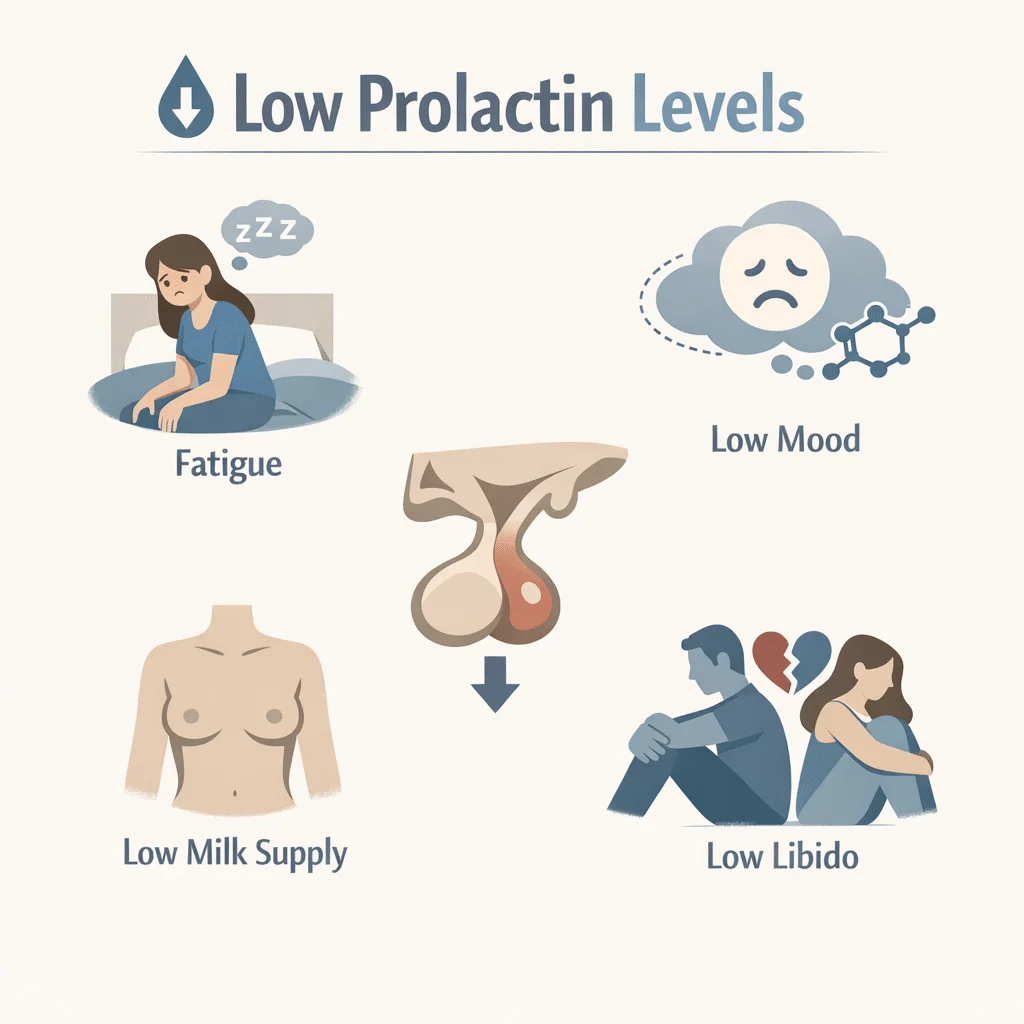
The one symptom that counts: milk that does not come in
Prolactin drives milk production, so the clearest consequence of true deficiency is a failure of lactation after delivery. If a new mother produces little or no milk despite frequent feeding and good support, and especially if the birth involved significant blood loss, a prolactin measurement belongs in the work-up alongside the other pituitary hormones. This is the single situation in which a low prolactin changes what happens next.
Symptoms that belong to the other pituitary axes
Persistent tiredness, feeling cold, low mood, reduced sex drive, loss of body hair, absent periods or unexplained low blood pressure are all reported by people who also have low prolactin, but they are not caused by it. They are the symptoms of the hormones that failed first. Mayo Clinic describes this pattern under hypopituitarism: too little thyroid-stimulating hormone lowers thyroid hormones, too little adrenocorticotropic hormone impairs the adrenal glands, and loss of the gonadotropins disrupts the reproductive system. A 2026 review adds a nuance for women: a markedly low prolactin with low reproductive hormones can support a diagnosis of functional hypothalamic amenorrhea, the loss of periods driven by energy deficit, heavy training or stress.
When low prolactin levels need follow-up
Most low results need nothing at all. The following situations are the ones where a clinician will normally look further, and they are worth checking against your own circumstances before you worry.
- Milk production has failed or is clearly insufficient after childbirth, particularly following heavy bleeding at delivery.
- You are taking cabergoline or bromocriptine for a pituitary tumor, where a low value usually signals that the dose can be reviewed.
- Another pituitary hormone is already abnormal, so thyroid, adrenal, growth or reproductive results are out of range alongside the prolactin.
- You have symptoms of pituitary disease such as persistent headaches, changes in peripheral vision, unexplained weight change or collapse.
- You have a known history of pituitary surgery, radiotherapy, head injury or a condition affecting the base of the brain.
- Periods have stopped without an explanation, and the reproductive hormones are also low.
If none of these applies, a low prolactin on an otherwise unremarkable panel is generally recorded and left alone. Our team also covers the causes of high prolactin levels, which is the far more common and more consequential abnormality.
What doctors check next
A repeat draw before anything else
Because assay precision is weakest at the low end and prolactin moves through the day, the first step is almost always a confirmatory sample, usually drawn in the morning, at rest, without a stressful or repeated venipuncture. A low value that does not reproduce on a second sample is rarely pursued further.
The rest of the pituitary panel
If the low reading holds, attention moves to the axes that fail earlier and matter more. A pituitary assessment typically includes a TSH blood test read together with a free T4 measurement, because central thyroid failure produces a low free T4 with an inappropriately normal TSH. The adrenal axis is assessed with an early-morning cortisol, and our team explains the causes of low morning cortisol, supported where needed by an ACTH blood test. Reproductive function is checked through the LH blood test and the FSH blood test, and growth hormone reserve is screened with an IGF-1 blood test. Specialist centers may add a stimulation test, in which a small dose of thyrotropin-releasing hormone is given and prolactin is measured as it rises; a blunted response supports genuine deficiency.
When imaging enters the picture
Pituitary MRI is not ordered for an isolated low prolactin. It becomes appropriate when the blood work shows more than one hormone axis failing, when there are visual or headache symptoms, or when the history points to injury, surgery, inflammation or postpartum hemorrhage. Imaging follows the pattern of results, not the prolactin number by itself.
Treatment addresses the cause, not the number
There is no prolactin replacement on the market. Research groups have given recombinant human prolactin to a small number of women who could not produce milk, and it restored a useful milk volume, but the preparation is not commercially available. That fact reframes the whole question: the target of treatment is never the prolactin figure.
In practice, management follows the cause. A dose of cabergoline or bromocriptine that has overshot can be adjusted by the prescribing specialist. Where low prolactin sits alongside broader pituitary failure, treatment replaces the hormones that actually cause symptoms: thyroid hormone, hydrocortisone and, where appropriate, sex hormone or growth hormone therapy, each managed by an endocrinologist. Supplements and online protocols marketed to raise prolactin have no evidence behind them.
Latest scientific advances
Low prolactin was long treated as a curiosity. That is changing, and the recent literature is worth summarizing in plain language, with its limits stated honestly.
Researchers are finally trying to define the lower limit
A large European study of men aged 40 to 86 proposed a threshold of about 3 ng/mL below which prolactin should be considered deficient. A 2025 analysis of two European cohorts of women landed close to the same mark and suggested a single cut-off around 3 ng/mL could serve both sexes. A separate 2024 review argued for higher benchmarks, roughly 5 ng/mL in men and 7 ng/mL in women. What this means for you: expert groups still disagree by a factor of two, which is precisely why a single reading below a printed range is not treated as a diagnosis.
A possible link with metabolism, still unproven
The most active question is whether prolactin has a routine metabolic role. A 2024 meta-analysis, a study that pools the results of earlier studies, brought together data on more than twelve thousand adults and found that people in the lowest prolactin group were roughly twice as likely to have type 2 diabetes as people in the highest group. In a long-running German cohort, women with the very lowest readings went on to have more heart attacks over about twelve years, although the number of events was small and the finding comes from a single population. These are associations measured across groups, not evidence that a low prolactin causes anything.
The mechanism behind the interest is real enough: prolactin receptors sit in the pancreas, the liver and fat tissue, and laboratory work suggests the hormone helps regulate blood sugar and fat handling. The “homeo-FIT-prolactin” hypothesis, set out in 2024, proposes that the relationship is causal in both directions, with levels that are too low or too high both being unfavorable. It remains a hypothesis. What this means for you: nothing to act on today. No guideline recommends treating a low prolactin to protect the heart or the metabolism, and if your metabolic markers concern you the standard tests are the useful ones, such as the HOMA-IR insulin resistance score.
Glossary of key terms
| Term | Definition |
|---|---|
| Prolactin | A hormone made by the pituitary gland whose best-known job is enabling milk production after childbirth. |
| Hypoprolactinemia | The medical term for a prolactin level below the normal range. Hypo- means low. |
| Anterior pituitary | The front section of the pituitary gland, the pea-sized gland at the base of the brain that releases prolactin, growth hormone, TSH, ACTH and the reproductive hormones. |
| Lactotroph cells | The specialized pituitary cells that manufacture and release prolactin. |
| Hypopituitarism | Reduced output of one or more pituitary hormones. It is the setting in which a genuinely low prolactin is most often found. |
| Sheehan syndrome | Damage to the pituitary gland caused by heavy blood loss during childbirth, historically the classic cause of an inability to breastfeed. |
| Dopamine agonist | A class of medication, including cabergoline and bromocriptine, that mimics dopamine and lowers prolactin. Used to treat prolactin-secreting pituitary tumors. |
| Gonadotropins | Luteinizing hormone (LH) and follicle-stimulating hormone (FSH), the two pituitary hormones that drive the ovaries and testes. |
| Immunoassay | The antibody-based laboratory method used to measure hormones such as prolactin. Its accuracy is lowest at the extreme bottom of the measuring range. |
Frequently asked questions
What is considered a low prolactin level?
There is no universally accepted figure. Research groups have proposed thresholds ranging from about 3 ng/mL to 7 ng/mL depending on the study and on sex, and laboratories differ in where they print the bottom of their range. In practice a value is treated as meaningfully low only when it is very low, reproduces on a repeat sample, and sits alongside a clinical reason to look, such as failed lactation or another abnormal pituitary hormone.
What causes low prolactin levels in a woman who is not pregnant?
Most often nothing at all: prolactin is naturally low outside pregnancy and breastfeeding, so a result under the printed minimum is usually normal physiology. When there is a cause, medication is the leading one, especially dopamine agonists such as cabergoline. Less commonly the pituitary gland itself is underperforming, in which case other hormones are abnormal too and the prolactin is a clue rather than the problem.
Can low prolactin levels cause infertility?
No. Low prolactin does not prevent ovulation or conception, and it is not a recognized cause of infertility. The confusion arises because high prolactin genuinely does interfere with the menstrual cycle and fertility. If conception is proving difficult, the informative hormones are the reproductive ones, and our library also details the hormones on a fertility blood test.
How can I raise low prolactin levels?
You generally should not try. No prolactin replacement is marketed, no supplement has been shown to raise prolactin usefully, and in a person without symptoms there is nothing to correct. If a medication is responsible, the prescribing doctor can review the dose. If the pituitary gland is underactive, treatment replaces the hormones that actually produce symptoms rather than the prolactin itself.
Do low prolactin levels affect periods?
Not by themselves. Absent or irregular periods alongside a low prolactin usually reflect low reproductive hormones rather than the prolactin. In women, a markedly low prolactin combined with low LH and FSH can support a diagnosis of functional hypothalamic amenorrhea, where periods stop because of energy deficit, intensive training or sustained stress. Our team also explains the meaning of an estradiol result.
Is a low prolactin different in men?
The interpretation is broadly the same, and men have lower baseline prolactin than women to begin with. Research in older men has linked very low prolactin with less favorable metabolic and sexual-function profiles, but these remain associations under study rather than a reason to treat. As in women, an isolated low value with normal thyroid, adrenal and testosterone results is not usually pursued.
Sources
- MedlinePlus, National Library of Medicine — Prolactin Levels — medlineplus.gov
- Cleveland Clinic — Prolactin — my.clevelandclinic.org
- Mayo Clinic — Hypopituitarism: symptoms and causes — mayoclinic.org
- Paragliola RM, Corsello A, Cera G, et al. — Hypoprolactinemia: biology, clinical relevance, and diagnostic challenges — Clinical Endocrinology, 2026 — pubmed.ncbi.nlm.nih.gov
- Urhan E, Karaca Z — Diagnosis of hypoprolactinemia — Reviews in Endocrine and Metabolic Disorders, 2024 — pubmed.ncbi.nlm.nih.gov
- Shimon I — Prolactin deficiency in the context of other pituitary hormone abnormalities — Reviews in Endocrine and Metabolic Disorders, 2024 — pubmed.ncbi.nlm.nih.gov
- Ioachimescu AG, Kelestimur F — Drug induced hypoprolactinemia — Reviews in Endocrine and Metabolic Disorders, 2024 — pubmed.ncbi.nlm.nih.gov
- Khan A, Di Dalmazi G, Najafian Zahmatkeshan K, Caturegli P — Isolated hypoprolactinemia: the rarest of the rare? — Reviews in Endocrine and Metabolic Disorders, 2024 — pubmed.ncbi.nlm.nih.gov
- Han TS, Antonio L, Bartfai G, et al. — Evidence-based definition of hypoprolactinemia in European men aged 40-86 years: the European Male Ageing Study — Reviews in Endocrine and Metabolic Disorders, 2024 — pubmed.ncbi.nlm.nih.gov
- Han TS, Hannemann A, Arffman R, et al. — The relationship between hypoprolactinemia and cardiometabolic health in women — European Journal of Endocrinology, 2025 — pubmed.ncbi.nlm.nih.gov
- Ken-Dror G, Fluck D, Lean MEJ, et al. — The relationship between low prolactin and type 2 diabetes — Reviews in Endocrine and Metabolic Disorders, 2024 — pubmed.ncbi.nlm.nih.gov
- Krogh J — The homeo-FIT-prolactin hypothesis: the role of prolactin in metabolic homeostasis, association or causality? — Reviews in Endocrine and Metabolic Disorders, 2024 — pubmed.ncbi.nlm.nih.gov
Further reading
- Female hormone panel: understanding your FSH, LH, estradiol and prolactin results
- Male hormone panel: testosterone and the key hormones it measures
- PCOS: symptoms, causes, diagnosis and tests explained
- Blood tests during pregnancy: what is checked and when
- Menopause symptoms and the hormones behind them
Understand your lab results with AI DiagMe
A prolactin figure only makes sense next to the hormones around it, and most people receive the report long before they can discuss it. AI DiagMe reads your results in context, so a prolactin value sits alongside your thyroid, adrenal and reproductive markers rather than standing alone. It helps you understand what your report says and which questions are worth raising; it does not diagnose and does not replace your doctor.
Get your results interpreted in minutes