































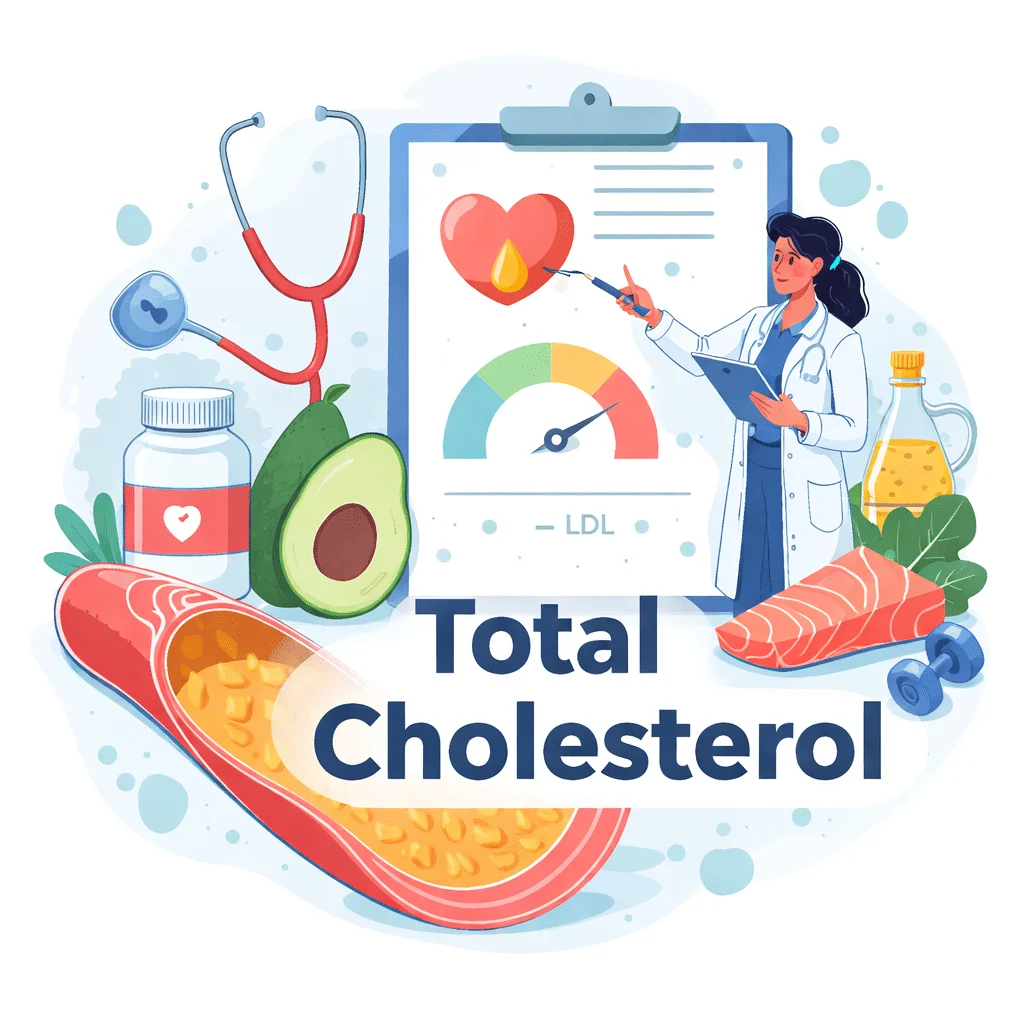
Total cholesterol is one of the first numbers most people see when their lab results come back, and it can be confusing on its own. This single figure combines several different fats circulating in your blood, so a high or low number does not always mean what it seems to at first glance. This guide walks through what the test measures, how the number is calculated, what counts as a normal range, and why doctors now look well beyond total cholesterol to understand your heart disease risk. You will also find a look at how cholesterol guidance has evolved recently, plus practical steps you can take regardless of where your result falls.
What the total cholesterol test measures
A total cholesterol test adds up all the cholesterol carried by the different particles in your bloodstream. Cholesterol itself is a waxy, fat-like substance your body needs to build cell membranes, produce hormones, and make vitamin D. Because cholesterol cannot dissolve in blood on its own, it travels attached to proteins in packages called lipoproteins.
The total cholesterol number reflects the combined cholesterol content of low-density lipoprotein (LDL), high-density lipoprotein (HDL), and a portion of the cholesterol carried in triglyceride-rich particles. It is usually measured as part of a broader lipid panel blood test, which reports LDL, HDL, and triglycerides separately alongside the total figure. Some clinics also request a cholesterol ratio, which compares total cholesterol to HDL to give a quick sense of relative balance between the particle types.
Because total cholesterol is a sum rather than a single molecule, two people with the same total number can have very different underlying pictures. One person might have that number driven mostly by protective HDL, while another might have it driven by LDL, the fraction most closely tied to artery plaque buildup.
How the total cholesterol number is calculated
Most laboratories calculate total cholesterol using the Friedewald equation, which combines directly measured HDL cholesterol and triglycerides with an estimate of LDL cholesterol. The formula is expressed as total cholesterol equals HDL cholesterol plus LDL cholesterol plus one-fifth of the triglyceride level, since triglyceride-rich particles carry a smaller, roughly proportional amount of cholesterol.
Some labs now use newer equations, such as the Martin-Hopkins or Sampson formulas, which adjust that triglyceride-to-cholesterol ratio more precisely, especially in people with high triglycerides or very low LDL. These newer methods tend to produce a slightly more accurate LDL estimate, which in turn affects the total cholesterol figure reported on your results.
A standard lipid panel traditionally required a 9- to 12-hour fast, since eating raises triglycerides temporarily and can throw off the calculation. Many guidelines now accept non-fasting lipid panels for routine screening, since average triglyceride effects on the total cholesterol result tend to be modest for most people. Your clinician will let you know if fasting is needed for your specific situation.
Normal, borderline, and high total cholesterol ranges
Total cholesterol results are typically reported in milligrams per deciliter (mg/dL) in the United States. Standard reference ranges are used as a starting point for interpretation, though your doctor will weigh your result against your age, other risk factors, and overall reference ranges for related blood tests before drawing conclusions.
| Category | Total cholesterol (mg/dL) | What it generally suggests |
|---|---|---|
| Desirable | Below 200 | Lower likelihood of lipid-related cardiovascular risk, though other markers still matter |
| Borderline high | 200 to 239 | Warrants a closer look at LDL, HDL, and triglyceride fractions individually |
| High | 240 and above | Usually prompts further evaluation of individual lipid fractions and overall risk factors |
| Low | Below 125 to 130 | Uncommon; sometimes linked to liver conditions, malabsorption, or certain medications |
These categories are general reference points rather than fixed cutoffs that automatically trigger treatment. A total cholesterol of 210 in an otherwise healthy 30-year-old with high HDL and normal triglycerides is a very different clinical picture from the same number in someone with diabetes, high blood pressure, and low HDL. This is exactly why doctors rarely act on total cholesterol in isolation.
Why total cholesterol alone gives an incomplete risk picture
Total cholesterol was historically the headline number in cardiovascular screening, largely because it was simple to measure before more detailed lipid testing became routine. Today, most cardiology and lipid specialty groups treat it as a useful starting point rather than the primary decision-making marker.
The core issue is that total cholesterol cannot tell you how that cholesterol is distributed. A person with high HDL cholesterol, often called good cholesterol because it helps clear excess cholesterol from arteries, can have an elevated total cholesterol number that looks concerning on paper but reflects a favorable balance. Conversely, someone with a normal total cholesterol can still carry an unfavorable mix if their LDL cholesterol is high and their HDL is low.
Because of this, clinicians increasingly emphasize non-HDL cholesterol, which is simply total cholesterol minus HDL cholesterol, as a better single-number summary. Non-HDL cholesterol captures LDL along with other atherogenic, artery-damaging particles such as remnant cholesterol and lipoprotein(a), all in one calculation that does not require fasting. Apolipoprotein B, a protein found on the surface of every potentially artery-damaging particle, has emerged as an even more precise measure, since it reflects the actual number of atherogenic particles rather than just the cholesterol they carry.
A full lipid panel paired with markers like apolipoprotein A1 and, where available, apolipoprotein B gives a much richer picture than total cholesterol alone. Some clinicians also check lipoprotein(a), a genetically determined particle that behaves differently from standard cholesterol and is not affected by diet or exercise in the way LDL is.
What drives high total cholesterol
Total cholesterol levels reflect a mix of factors that are within your control and some that are not. Understanding which category applies to you helps set realistic expectations for how much a given lifestyle change might move the number.
- Diet high in saturated fat and trans fat, which tends to raise LDL cholesterol specifically
- Excess body weight, particularly abdominal fat, which is linked to higher LDL and triglycerides and lower HDL
- Physical inactivity, which is associated with lower HDL cholesterol over time
- Genetics, including inherited conditions such as familial hypercholesterolemia that can produce very high LDL cholesterol from an early age
- Age and hormonal changes, since cholesterol levels commonly rise with age and shift around menopause
- Underlying conditions such as diabetes, hypothyroidism, and chronic kidney disease, which can all alter lipid metabolism
- Certain medications, including some steroids, diuretics, and hormone therapies
Because genetics and age contribute meaningfully to cholesterol levels, two people with identical diets and exercise habits can still land in different categories. This is one more reason clinicians look at your total clinical picture rather than a single lab value in isolation.
Lifestyle steps that influence total cholesterol
For most people, total cholesterol responds at least partially to sustained lifestyle changes, even if genetics set a baseline that diet and exercise cannot fully override. Common evidence-based steps clinicians recommend include:
- Shifting saturated fat toward unsaturated fats found in olive oil, nuts, and fatty fish
- Increasing soluble fiber from oats, beans, and fruits, which can help lower LDL modestly
- Building regular aerobic activity into your week, which tends to raise HDL over time
- Reaching and maintaining a weight that is healthy for your body, since even modest weight loss can improve lipid numbers
- Limiting or stopping smoking, since smoking lowers HDL and damages the blood vessel lining
- Moderating alcohol intake, since heavy drinking can raise triglycerides substantially
When lifestyle measures are not enough on their own, particularly for people with genetically driven high cholesterol or established cardiovascular disease, statins and other lipid-lowering medications remain a well-studied and effective option that your doctor can discuss based on your full risk profile.
When to see a doctor about your results
Total cholesterol results rarely require same-day action, but certain situations call for a more prompt conversation with a healthcare provider rather than waiting for your next routine visit.
- Your total cholesterol is above 300 mg/dL, which can sometimes signal an inherited lipid disorder
- You have a personal history of heart attack, stroke, or peripheral artery disease alongside an elevated result
- A close family member had very high cholesterol or early heart disease before age 55 in men or 65 in women
- You notice new symptoms such as chest discomfort, unusual fatigue, or leg pain with walking
- Your result is unexpectedly low and you have unexplained weight loss, digestive symptoms, or fatigue
- You are already on cholesterol medication and your numbers are not moving as expected
Outside of these situations, an elevated or borderline total cholesterol result is generally best discussed at a regular follow-up, where your doctor can review the full lipid panel alongside markers like blood pressure and blood sugar to judge your overall cardiovascular risk.
Recent scientific advances in cholesterol testing
A large 2025 review pooling data from more than 590,000 people compared how well LDL cholesterol, non-HDL cholesterol, and apolipoprotein B each predicted cardiovascular events. The simple finding was that apolipoprotein B, often shortened to ApoB, came out ahead of both LDL and non-HDL cholesterol as a predictor in the large majority of comparisons. What this means for you is that if your doctor orders an ApoB test alongside your standard lipid panel, it is not redundant; it can offer a more precise view of your actual particle-based risk. Apolipoprotein B, or ApoB, is a protein tag found on each potentially artery-damaging particle, so measuring it is like counting the particles directly rather than estimating from their cholesterol content.
A separate 2026 study introduced a new combined measurement called risk-weighted apoB, which factors in triglyceride-rich particles and lipoprotein(a) alongside standard ApoB. The straightforward takeaway is that this combined score reclassified a meaningful share of people compared with ApoB alone, catching some higher-risk individuals who would otherwise have looked lower risk. For you, this means cardiovascular risk assessment is becoming more personalized over time, moving beyond any single cholesterol number, though this specific combined score is still a research tool rather than a routine clinical test today. Lipoprotein(a), often written Lp(a), is a cholesterol-carrying particle whose level is set mostly by your genes rather than your diet.
Clinical guidelines have also shifted in response to this evidence. An updated 2025 European lipid guideline recommends universal lipoprotein(a) testing at least once in adulthood and places new emphasis on non-HDL cholesterol as a standard part of risk reporting. In practical terms, this means more people may see non-HDL cholesterol and Lp(a) appear on their standard lab reports going forward, even if they never specifically requested those tests. A parallel 2026 US dyslipidemia guideline update reinforced this direction, recommending that non-HDL cholesterol be reported routinely alongside total cholesterol and that ApoB testing be used selectively, particularly for people with high triglycerides, diabetes, or lipid numbers that do not fully align with their overall risk. For you, this means your routine lipid panel may look slightly different at your next visit, with non-HDL cholesterol given more attention than in years past. You can read more detail on the related shift in lipoprotein(a) screening recommendations in our dedicated guide.
None of this research suggests total cholesterol has become meaningless. It remains a quick, inexpensive, and widely available first step. What has changed is the recognition that total cholesterol works best as an opening question, with non-HDL cholesterol, ApoB, and Lp(a) available as follow-up tools when a more precise answer is needed.
Glossary
| Term | What it means |
|---|---|
| LDL cholesterol | Low-density lipoprotein cholesterol, often called bad cholesterol because it contributes directly to artery plaque buildup. |
| HDL cholesterol | High-density lipoprotein cholesterol, often called good cholesterol because it helps remove excess cholesterol from the bloodstream. |
| Triglycerides | A type of fat in the blood used for energy storage. High levels are linked to increased cardiovascular risk, especially alongside low HDL. |
| Non-HDL cholesterol | Total cholesterol minus HDL cholesterol. It captures LDL plus other artery-damaging particles in a single, non-fasting-friendly number. |
| Apolipoprotein B (ApoB) | A protein present on every potentially artery-damaging lipoprotein particle. Measuring it estimates the actual particle count rather than just cholesterol content. |
| Lipoprotein(a), Lp(a) | A genetically determined lipoprotein particle linked to cardiovascular risk. Levels are set mainly by genetics rather than diet or exercise. |
| Lipid panel | A blood test that reports total cholesterol, LDL, HDL, and triglycerides together, giving a fuller picture than any single value alone. |
| Familial hypercholesterolemia | An inherited condition that causes very high LDL cholesterol from a young age, increasing the risk of early heart disease. |
| Statins | A class of medications that lower LDL cholesterol by reducing cholesterol production in the liver. |
Frequently asked questions
Do I need to fast before a total cholesterol test?
It depends on why the test is being ordered. Many routine screenings now use non-fasting samples, since average results are similar for most people. If your doctor is evaluating high triglycerides specifically, or if you have diabetes, a fasting sample of 9 to 12 hours may be requested for more precise results. Always follow the specific instructions given for your appointment.
Can total cholesterol be normal even with heart disease risk factors?
Yes. Total cholesterol only reflects the sum of your cholesterol-carrying particles, not their individual proportions. Someone can have a normal total cholesterol while still carrying elevated LDL, low HDL, high triglycerides, or elevated lipoprotein(a), any of which can raise cardiovascular risk independently of the total number.
How often should adults get a total cholesterol test?
General guidance suggests healthy adults have their cholesterol checked roughly every four to six years starting around age 20, with more frequent testing recommended for people with risk factors such as diabetes, high blood pressure, obesity, or a family history of heart disease. Your doctor can tailor a schedule to your specific situation.
What is considered a dangerously high total cholesterol level?
Total cholesterol above 240 mg/dL is generally classified as high, though very high results above 300 mg/dL sometimes prompt evaluation for an inherited lipid disorder such as familial hypercholesterolemia. Context always matters, since the same number carries different implications depending on your other risk factors and lipid fractions.
Does age affect what counts as a normal total cholesterol level?
Cholesterol levels tend to rise gradually with age for both men and women, and shift further around menopause for women due to hormonal changes. Reference ranges are generally the same across adulthood, but your doctor will weigh your number against your age-related cardiovascular risk profile rather than applying a single fixed standard to everyone.
Can total cholesterol change quickly after starting treatment?
Lifestyle changes such as improved diet and increased exercise can begin shifting cholesterol numbers within a few weeks, though meaningful changes typically take a few months to show clearly on a repeat test. Statins and other cholesterol medications often produce measurable LDL and total cholesterol reductions within four to six weeks of consistent use.
Sources
- MedlinePlus, National Library of Medicine — Cholesterol Levels, 2025 — link
- Centers for Disease Control and Prevention — About Cholesterol, 2025 — link
- Mayo Clinic — High Cholesterol: Diagnosis and Treatment, 2025 — link
- Sehayek D, et al. — ApoB, LDL-C, and Non-HDL-C as Markers of Cardiovascular Risk — Journal of Clinical Lipidology, 2025 — link
- Rehman MB, Björnson E, Borén J, et al. — Risk-Weighted ApoB: A Novel Summary Metric Outperforming Traditional Lipid Biomarkers in Predicting Coronary Heart Disease — European Heart Journal, 2026 — link
- Ray KK, Kronenberg F — Seventeen Years to Change Practice: Will the 2025 ESC/EAS Dyslipidaemia Guidelines Finally Break the Sisyphean Cycle? — Atherosclerosis, 2026 — link
- American College of Cardiology / American Heart Association — 2026 Guideline on the Management of Dyslipidemia, 2026 — link
Further reading
- HDL cholesterol test: understanding your results
- LDL cholesterol: understanding and interpreting this blood marker
- Triglycerides: understanding your blood test
- Lipoprotein(a): understanding this cardiovascular risk marker
- Advanced lipid panel: ApoB and heart risk
Understand your lab results with AI DiagMe
Total cholesterol is just one piece of a much larger cardiovascular picture, alongside LDL, HDL, triglycerides, and increasingly apolipoprotein B. Making sense of how these markers fit together can be difficult from a lab printout alone. AI DiagMe helps you understand what your results may indicate in plain language, without replacing the diagnosis or guidance only your doctor can provide.
Get your results interpreted in minutes