











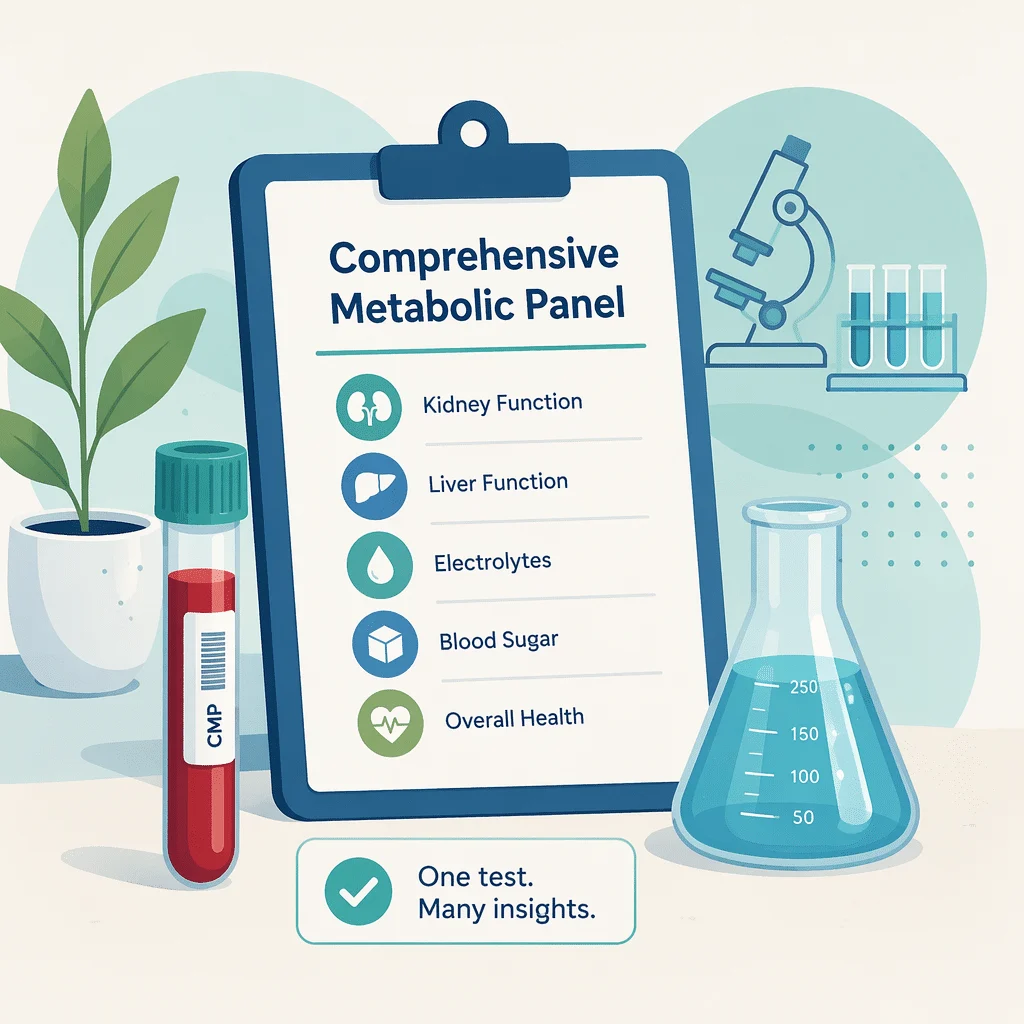
A comprehensive metabolic panel is one of the most common blood tests your doctor will order, yet the report it produces can look like a wall of abbreviations and numbers. This guide explains how to read it, line by line. You will learn what the 14 results mean, what counts as a normal range, why a value can read high or low without signalling disease, and which findings are worth raising with your doctor. The aim is not to replace your physician’s judgment but to help you walk into your next appointment understanding what you are looking at — and asking better questions about your own health. Throughout, keep in mind a principle doctors use every day: results are read as a pattern, not as isolated numbers.
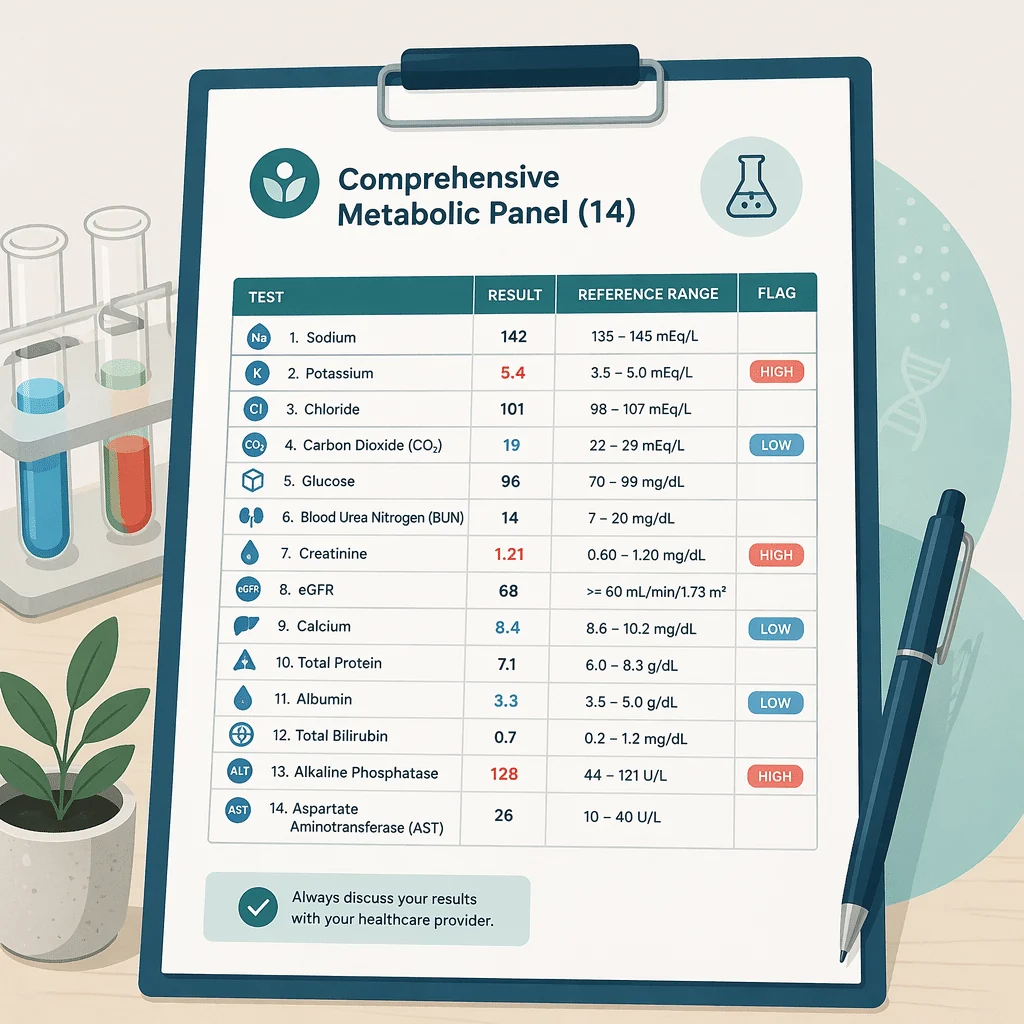
What a comprehensive metabolic panel measures
A comprehensive metabolic panel (CMP) is a single blood test that measures 14 different substances at once. From one blood draw, it gives a broad snapshot of how several body systems are working: your blood sugar, your kidneys, your liver, the salts and fluids in your blood (electrolytes), and the main proteins your blood carries.
Doctors order a CMP for routine check-ups, to investigate symptoms such as fatigue or swelling, to monitor a known condition like diabetes or kidney disease, and to keep an eye on medicines that can affect the liver or kidneys.
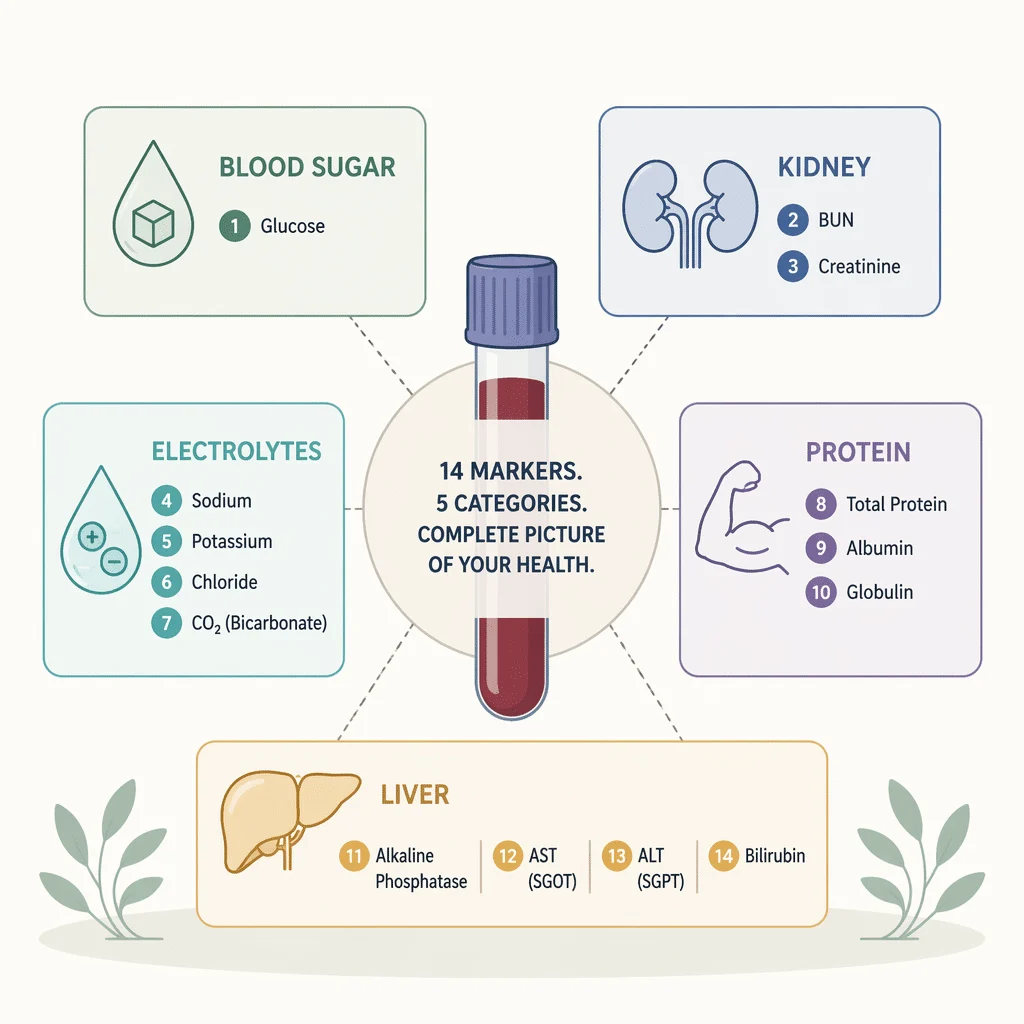
The 14 measurements fall into a few natural groups:
- Blood sugar: glucose.
- Kidney function: blood urea nitrogen (BUN) and creatinine.
- Electrolytes and fluid balance: sodium, potassium, chloride, and carbon dioxide (CO2, also called bicarbonate).
- Minerals and protein: calcium, total protein, and albumin.
- Liver: two enzymes called ALT and AST, a third enzyme called alkaline phosphatase (ALP), and bilirubin.
Many labs also report a few calculated values alongside these 14, such as the estimated kidney filtration rate (eGFR), the BUN-to-creatinine ratio, and the albumin-to-globulin (A/G) ratio. These are not extra blood tests; they are figures worked out from the numbers above.
A CMP is broad, but it is not all-encompassing. It does not measure your cholesterol, your blood cell counts, your thyroid, or your vitamin and iron levels — each of those needs its own test. Think of the CMP as a chemistry overview that doctors frequently pair with a complete blood count or a lipid panel to build a fuller picture of your health.
How to read your comprehensive metabolic panel: a 5-step method
Most reports list each substance in a row, with your result, the unit, the lab’s reference range, and sometimes a flag. Reading a comprehensive metabolic panel becomes far less intimidating when you follow the same order every time.
Step 1: Find the reference range column
Next to each result, your lab prints its own reference range — the band of values considered typical for most healthy adults at that lab. This column is your anchor. Ranges differ slightly between laboratories and between machines, so always compare your number to the range printed on your report, not to a figure you found online.
Step 2: Scan the flags, but don’t stop there
Many reports add a letter beside out-of-range results: H for high, L for low, and sometimes HH or LL for markedly abnormal. Flags are a useful shortcut for spotting what to look at first. They are not a diagnosis, and a value can sit just outside the range and mean very little.
Step 3: Read by group, not one line at a time
A single number rarely tells the story. Doctors read the panel in clusters: the two kidney markers together, the four electrolytes together, the liver enzymes together. A pattern across a group is far more meaningful than one lonely arrow. For example, BUN and creatinine that are both raised point more clearly toward the kidneys than either value alone.
Step 4: Notice the size of the deviation
There is a real difference between a result that is a hair outside the range and one that is far beyond it. A glucose of 101 mg/dL when the top of the range is 99 is a different matter from a glucose of 260. As a rule of thumb, small deviations are common and often unimportant; large ones deserve attention.
Step 5: Put the numbers in context
Your results are shaped by everyday factors: whether you fasted, how hydrated you are, medicines you take, a recent illness, or hard exercise the day before. Before assuming a number means disease, ask whether something ordinary could explain it. The next two sections show how often that turns out to be the case.
A quick worked example
Picture a report where glucose is 104 mg/dL (slightly high), BUN is 24 mg/dL (slightly high), and everything else — creatinine, the electrolytes, the liver enzymes — sits comfortably in range. Reading by the method above: the flags are small (Step 4); the kidney pair disagrees, because creatinine is normal (Step 3); and you recall grabbing a coffee and skipping water that morning (Step 5). The likely story is mild dehydration plus a non-fasting effect, not kidney or sugar disease — though the slightly high glucose is still worth repeating on a fasted sample. That is the whole difference between reacting to one number and reading the panel as a whole.
The 14 markers explained, group by group
Here is what each result reflects, with a typical adult reference range. Treat these ranges as a guide only — the band on your own report is the one that counts.
Blood sugar
Glucose is the sugar your body uses for energy. On a fasting sample it is a key screen for prediabetes and diabetes; a high reading can also follow a recent meal or a stressful event. A low glucose is less common on a routine panel but can follow skipped meals or some diabetes medicines. You can read more in our guide to blood glucose levels.
Kidney function
BUN (blood urea nitrogen) and creatinine are waste products your kidneys filter out. When the kidneys slow down, both tend to rise together. Our pages on BUN and creatinine explain each one. Dehydration is a very common, harmless reason for a higher BUN. A creatinine that stays raised across more than one test is the finding doctors take most seriously, because it points to the kidneys themselves rather than to hydration.
Electrolytes and fluid balance
Sodium, potassium, chloride, and CO2 (bicarbonate) keep your fluids, nerves, and heart rhythm in balance. Of these, potassium matters most for the heart, while sodium closely tracks hydration. Small swings in these four are common and usually reflect fluids or diet; it is large or fast changes — especially in potassium — that prompt action.
Minerals and protein
Calcium supports bones, nerves, and muscles. Total protein and albumin reflect nutrition, hydration, and liver and kidney health. See our guides to total calcium and albumin. Low albumin can also make a calcium result look lower than it truly is, which is why labs sometimes report a corrected calcium. As a rough guide, a low total protein or albumin more often reflects nutrition, inflammation, or dilution than a serious organ problem — but a clear pattern is always worth discussing.
Liver
ALT and AST are enzymes that leak into the blood when liver cells are stressed or damaged; ALP relates to the bile system and bones; bilirubin is a yellow pigment the liver clears. Mildly raised liver enzymes are common and often temporary. Our ALT and AST guides go further. Here too the pattern matters more than any single enzyme: which enzymes rise, by how much, and whether bilirubin moves with them all help point toward the cause.
| Marker | What it checks | Typical adult range | Often higher with… | Often lower with… |
|---|---|---|---|---|
| Glucose (fasting) | Blood sugar control | 70–99 mg/dL | Diabetes, a recent meal, stress, steroids | Skipped meals, some diabetes medicines |
| BUN | Kidney function, hydration | 7–20 mg/dL | Dehydration, reduced kidney function, high-protein diet | Overhydration, liver disease, low protein intake |
| Creatinine | Kidney function | 0.6–1.3 mg/dL | Reduced kidney function, dehydration, high muscle mass | Low muscle mass, pregnancy |
| Sodium | Fluid balance | 135–145 mmol/L | Dehydration | Overhydration, certain medicines |
| Potassium | Nerve and heart function | 3.5–5.0 mmol/L | Kidney problems, sample handling (false high) | Diuretics, vomiting or diarrhea |
| Chloride | Fluid and acid balance | 98–107 mmol/L | Dehydration | Vomiting, some lung conditions |
| CO2 (bicarbonate) | Acid–base balance | 22–29 mmol/L | Some breathing or metabolic conditions | Diarrhea, certain metabolic states |
| Calcium | Bones, nerves, muscles | 8.6–10.3 mg/dL | Parathyroid or bone conditions | Low albumin, vitamin D deficiency |
| Total protein | Nutrition, immune proteins | 6.0–8.3 g/dL | Dehydration, some immune conditions | Malnutrition, liver or kidney disease |
| Albumin | Liver, nutrition, hydration | 3.5–5.0 g/dL | Dehydration | Liver disease, malnutrition, inflammation |
| ALP | Liver/bile and bone activity | 44–147 IU/L | Bile-duct or bone conditions, growth in teens | Rare; some nutritional issues |
| ALT | Liver cell health | 7–56 U/L | Liver stress or damage, some medicines | Generally not a concern |
| AST | Liver and muscle | 8–48 U/L | Liver or muscle stress | Generally not a concern |
| Total bilirubin | Liver clearing pigment | 0.1–1.2 mg/dL | Liver or bile problems, red-cell breakdown | Generally not a concern |
Units and reference ranges vary by laboratory; the figures above are typical adult values for orientation only.
What “abnormal,” “high,” and “low” really mean
A reference range is a statistical band, usually built so that the middle 95% of healthy people fall inside it. By design, that leaves about 1 in 20 healthy people with a result just outside the range on any given test. An out-of-range number is therefore a prompt to look more closely, not proof of illness.
This is why the word abnormal on a CMP can be misleading. It means “outside the expected band,” not “diseased.” Doctors weigh how far the value sits from the range, whether other related markers point the same way, your symptoms, and your history. One mildly abnormal result on an otherwise clean panel is usually repeated or simply watched over time. If you have had a CMP before, comparing today’s numbers with your earlier ones is often more telling than the range itself: a value that has barely moved over years is reassuring, while a steady drift in one direction is worth a conversation, even when it stays inside the normal band.
Why a result can be off without disease
Some of the most common reasons for an unexpected value have nothing to do with illness:
- You didn’t fast. A recent meal can raise glucose and shift several other results.
- You were dehydrated. Low fluid concentrates the blood and can nudge BUN, sodium, and other values upward; the BUN-to-creatinine ratio often hints at this.
- The blood sample was affected during the draw. A tight or prolonged tourniquet, or red cells breaking open in the tube (hemolysis), can falsely raise potassium in particular.
- Medications. Diuretics, certain blood-pressure drugs, and others routinely shift electrolytes and kidney numbers.
- Recent exercise or illness. Hard workouts can raise some enzymes, and a recent infection can move several markers at once.
If a single value looks off and you feel well, a repeat test under better conditions — properly fasted and hydrated — often brings it back into range.
Do you need to fast? How the test works
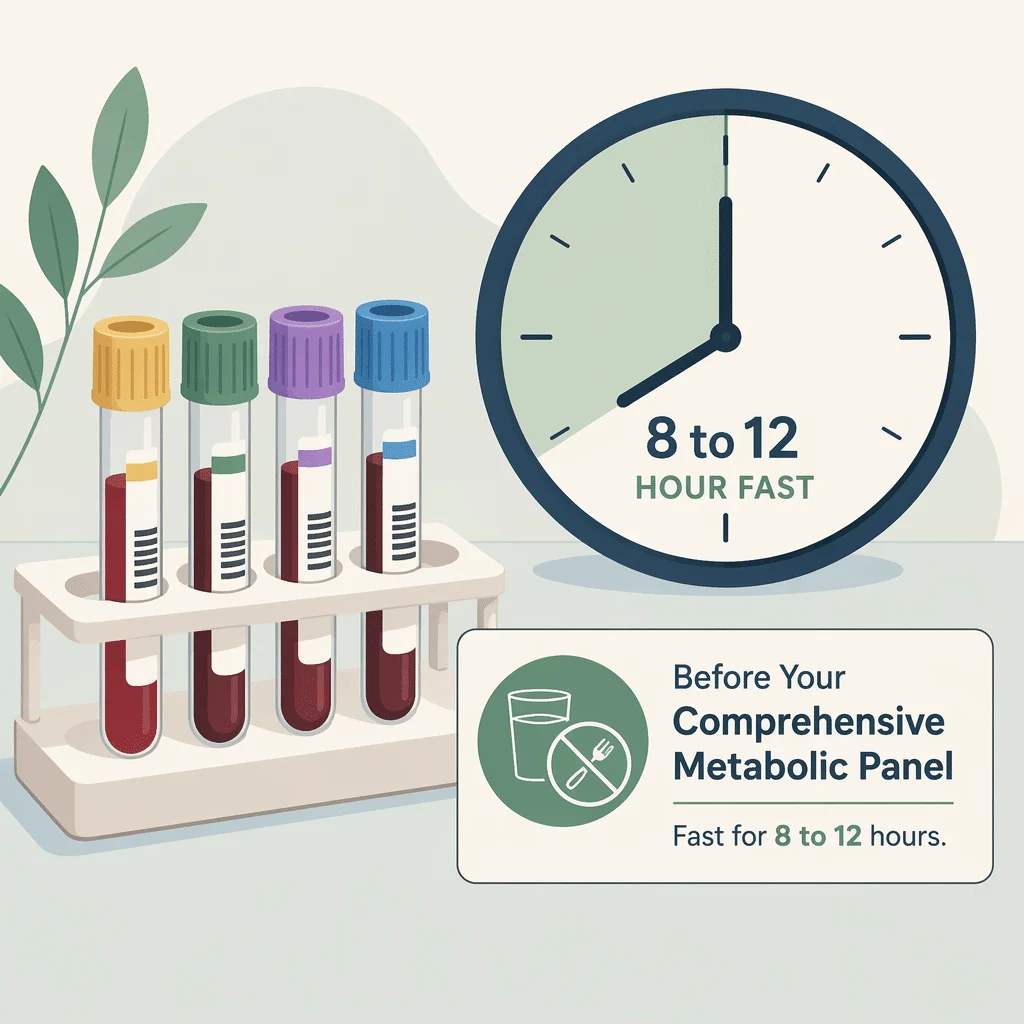
For many CMPs, you will be asked to fast for 8 to 12 hours beforehand, taking only water. The main reason is glucose: eating raises blood sugar, so a fasting sample gives a cleaner reading. If your doctor is not focused on glucose, fasting may not be required — always follow the instructions you were given. Our guide to fasting blood glucose explains why timing matters.
The test itself is a routine blood draw from a vein in your arm and takes a minute or two. Most laboratories return results within the same day to a few days, depending on the lab and how the sample is processed.
CMP vs basic metabolic panel (BMP) and CBC
These three blood tests are easy to mix up:
- A basic metabolic panel (BMP) includes 8 of the 14 CMP measurements — mainly glucose, the electrolytes, and the kidney markers. A CMP adds the liver enzymes, bilirubin, total protein, and albumin, giving a fuller picture.
- A complete blood count (CBC) is a different kind of test altogether: it counts your blood cells — red cells, white cells, and platelets — rather than the chemistry a CMP measures. The two are often ordered together. Our CBC vs CMP guide breaks down the differences.
In short, a BMP is a shorter chemistry panel, a CMP is the broader one, and a CBC looks at cells rather than chemistry.
When to talk to a doctor
A CMP is a screening tool, so the safest move with any result you don’t understand is to ask the clinician who ordered it. A few situations deserve prompter attention:
- A very high glucose reading, especially with thirst, frequent urination, blurred vision, or fatigue.
- A markedly abnormal potassium (very high or very low), which can affect heart rhythm.
- Liver enzymes that are many times above the range, or a high bilirubin with yellowing of the skin or eyes.
- A sharp rise in BUN and creatinine, particularly with reduced urination or swelling.
- Any result paired with feeling genuinely unwell.
By contrast, a single value sitting just outside the range, on a panel that otherwise looks fine and with no symptoms, is rarely an emergency — though it is still worth mentioning at your next visit.
Glossary
- Albumin: the most abundant protein in blood, made by the liver; reflects nutrition, hydration, and liver and kidney health.
- ALT (alanine aminotransferase): a liver enzyme that rises in the blood when liver cells are damaged.
- AST (aspartate aminotransferase): an enzyme found in the liver and muscles; raised levels can signal liver or muscle stress.
- Bilirubin: a yellow pigment from the breakdown of old red blood cells, cleared by the liver.
- BUN (blood urea nitrogen): a waste product filtered by the kidneys; helps gauge kidney function and hydration.
- Creatinine: a muscle waste product the kidneys remove; a core marker of kidney function.
- eGFR (estimated glomerular filtration rate): a calculated estimate of how well the kidneys filter, based mainly on creatinine.
- Electrolyte: a mineral that carries an electrical charge in blood, such as sodium or potassium, vital for nerves, muscles, and fluid balance.
- Reference range: the band of values a lab considers typical for most healthy adults, printed next to your result.
Frequently asked questions
What is the CPT code for a comprehensive metabolic panel?
The standard billing code (CPT code) for a comprehensive metabolic panel is 80053. You may see it on your lab bill or insurance paperwork. It is purely an administrative code that tells the lab and your insurer which panel was run; it says nothing about your results. A separate set of codes — ICD-10 diagnosis codes — is chosen by your provider to record the reason the test was ordered.
What happens if I didn’t fast before my test?
If fasting was requested and you ate beforehand, the most affected result is usually glucose, which can read higher than your true fasting level; a few other values may shift slightly too. It does not ruin the whole panel, but your provider may set aside the glucose figure or ask you to repeat the test properly fasted. If you forgot to fast, tell the person drawing your blood so it can be noted on the sample.
Does a comprehensive metabolic panel check cholesterol?
No. Cholesterol and triglycerides are measured by a separate test called a lipid panel. A CMP looks at blood sugar, kidney and liver function, electrolytes, and proteins, but not your cholesterol. Doctors often order a CMP and a lipid panel together from the same blood draw, which is why people sometimes assume cholesterol is included.
How long does it take to get the results?
For most people, comprehensive metabolic panel results are available within the same day to a few days. Timing depends on the laboratory, how busy it is, and whether the sample is processed on site or sent elsewhere. Your clinic or an online patient portal will usually notify you when results are ready.
Can a CMP detect cancer?
A comprehensive metabolic panel is not a cancer screening test and cannot diagnose cancer. It can occasionally show indirect clues — for example, unusual calcium, liver enzyme, or protein patterns — that prompt a doctor to order more specific tests. On its own, a CMP neither confirms nor rules out cancer.
Should I worry about one abnormal value?
Usually not, on its own. Because reference ranges are built around most (not all) healthy people, a single value just outside the band is common and often harmless, especially if you feel well and the rest of the panel looks normal. What matters more is how far the value is from the range, whether related markers agree, and your symptoms. Bring any result you’re unsure about to the clinician who ordered the test.
Sources
- Comprehensive Metabolic Panel (CMP) – MedlinePlus, U.S. National Library of Medicine
- Comprehensive Metabolic Panel (CMP) – Cleveland Clinic
- Comprehensive Metabolic Panel – Johns Hopkins Health Library
Further reading
- CBC vs CMP: understanding the tests
- Fasting blood glucose: your complete guide to interpretation
- eGFR (estimated glomerular filtration rate) explained
- BUN/creatinine ratio: meaning and levels
- Blood markers: a comprehensive glossary
Understand your lab results with AI DiagMe
A comprehensive metabolic panel touches several systems at once — your blood sugar, your kidney markers (BUN and creatinine), your liver enzymes (ALT and AST), and your electrolytes (sodium and potassium) — and reading all of those together is exactly where people get stuck. AI DiagMe turns your lab report into clear, plain-language explanations of what each value means in context, so you can prepare for your appointment with confidence. It is designed to help you understand your results, not to diagnose you, and it never replaces your doctor’s advice.
➡️ Get your results interpreted in minutes