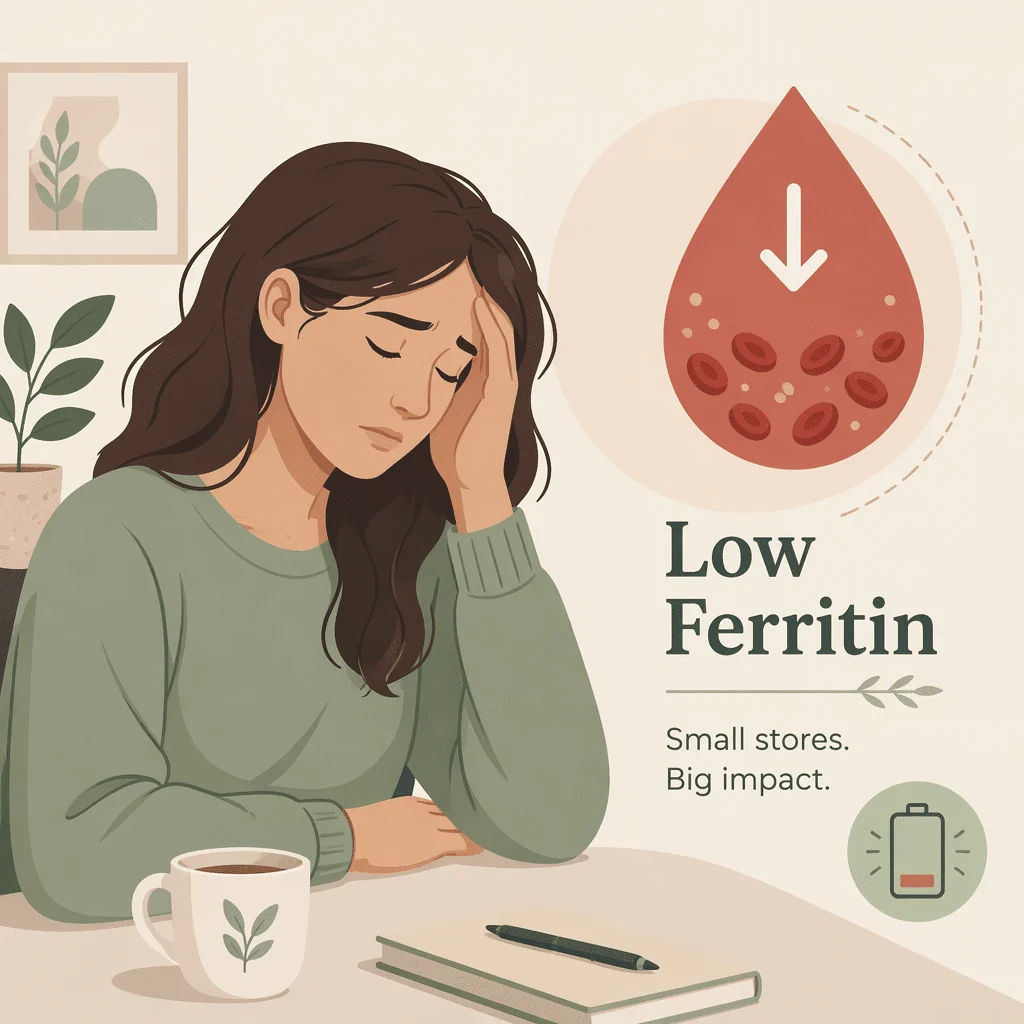
A low ferritin result is one of the most useful findings on a routine blood test, and one of the most often under-explained. Ferritin is the protein that stores iron inside your cells, so a low ferritin means your iron stores are running down. It is a remarkably specific finding: almost nothing else in everyday medicine pushes it down.
In this article you’ll learn what ferritin measures, why a low value points so directly at iron deficiency, and why a normal-looking ferritin can still hide a deficiency when inflammation is present. You’ll also learn why iron deficiency without anemia is real and symptomatic, which causes are worth tracking down, why an unexplained result sometimes prompts a look at the digestive tract, and what happens next.
What ferritin is, and why a low result is so informative
Iron is dangerous when it floats freely, so the body keeps almost all of it locked away. Ferritin is the storage container: a hollow protein shell that holds iron safely inside cells, mostly in the liver, spleen and bone marrow. A small amount leaks into the bloodstream in proportion to how much is stored, and that circulating fraction is what the ferritin blood test measures. It is the closest routine medicine gets to a direct reading of body iron stores.
Here is the point worth stating plainly, because many articles skirt around it: a genuinely low ferritin is essentially diagnostic of iron deficiency. No other common condition drives it down. Kidney disease does not. Thyroid disease does not. Vitamin deficiencies do not. If your ferritin is low, you are short of iron. That specificity is unusual among blood tests, and it is why ferritin sits at the front of any sensible iron work-up.
The other iron markers answer narrower questions. Serum iron shows how much is circulating right now, and it swings with meals and time of day. Transferrin and total iron-binding capacity describe the transport system, covered in our guide to transferrin and iron transport. The percentage of that protein currently carrying iron is a separate number with its own interpretation, explained in our article on iron saturation levels and causes. Ferritin speaks to stores, and it moves first.
Iron deficiency without anemia: why “your blood count is normal” isn’t the whole story
Iron deficiency is a sequence, not a switch. Stores empty first. Ferritin falls. Only later, once the reserve is genuinely exhausted, does the bone marrow start turning out red cells that are smaller and paler than they should be, and only then does hemoglobin drift below the reference range. Anemia is the last chapter, not the first.
This matters in practice, because many people are told their full blood count is fine and sent away, when ferritin was never checked or was quietly passed over. Their hemoglobin genuinely is normal. Their iron stores are not.
Iron deficiency without anemia is common, and it is not a silent laboratory curiosity. Iron is needed by muscle and brain tissue, not only by red cells, so people can feel unmistakably unwell while their blood count sits comfortably in range. If you have been dismissed on the strength of a normal blood count, that is worth raising again, specifically asking about ferritin.
One clue on the count itself: as deficiency deepens, red cells shrink, so a falling mean cell volume supports the picture. A high MCV points elsewhere, usually toward vitamin B12 or folate. But cell size changes late. Ferritin moves first.
Why a normal ferritin can still hide iron deficiency
This is the commonest way iron deficiency gets missed.
Ferritin is an acute-phase reactant. The body deliberately raises it during inflammation, infection, injury, liver disease and malignancy, as part of a defensive response that pulls iron out of circulation and away from invading organisms. The consequence is awkward but unavoidable: inflammation pushes ferritin up regardless of how much iron is actually stored.
So a person can have genuinely empty stores and a ferritin that reads as perfectly normal, because rheumatoid arthritis, inflammatory bowel disease, chronic kidney disease, obesity or a recent infection has inflated the number. The test has not malfunctioned. It is measuring two things at once, and only one of them is iron.
Clinicians handle this in two ways. First, they raise the threshold: in someone with a recognized inflammatory condition, a ferritin that would be reassuring in a healthy person is treated as potentially consistent with deficiency, and higher cut-offs are applied. Second, they measure inflammation directly, which is why C-reactive protein is so often requested alongside ferritin. A CRP result tells the doctor how much salt to take the ferritin with.
The takeaway is simple. A low ferritin is close to conclusive. A normal ferritin is only reassuring if there is no inflammation in the background. If you have a long-term inflammatory condition and persistent symptoms, a mid-range ferritin does not close the question.
Symptoms people actually notice
Because iron does more than carry oxygen, low stores produce a scattered, easily dismissed set of complaints. Fatigue is the usual headline, but of a specific kind: not sleepiness so much as a sense that ordinary effort costs more than it used to.
Poor exercise tolerance is common and often the first thing athletes notice, showing up as slower recovery and heavier legs long before performance measurably drops. Hair shedding, brittle nails and cracks at the corners of the mouth turn up regularly. Restless legs, that crawling urge to move at night, has a well-recognized association with low iron stores. Pica, the craving to chew ice or other non-food items, is unusual but strongly suggestive. Brain fog and low mood round out the list. Once anemia develops, the more familiar picture emerges: pallor, breathlessness on exertion, palpitations and dizziness.
The causes worth finding
Identifying why the ferritin fell matters at least as much as replacing the iron, because iron given without addressing the cause simply drains away again.
Menstrual blood loss
Heavy menstrual bleeding is the single commonest cause of iron deficiency in premenopausal women, and it is routinely normalized by patients and clinicians alike. Many people genuinely do not know their periods are heavy, because they have nothing to compare them with and have been bleeding this way since their teens.
Some practical markers: needing to change protection every hour or two, flooding onto clothes or bedding, passing clots larger than a coin, bleeding for more than seven days, or planning your life around your period. If any describe you, say so at the appointment, because the bleeding itself can often be treated, and treating it is frequently what finally fixes the iron.
Increased demand and blood donation
Pregnancy roughly doubles iron requirements as blood volume expands and the fetus builds its own stores, which is why iron status is monitored through antenatal care. Regular blood donation steadily depletes stores too, and committed donors can run low despite a normal hemoglobin at screening. Adolescent growth spurts and endurance training also raise demand.
Absorption problems and diet
Iron is absorbed in the upper small intestine, and that process needs stomach acid. Celiac disease damages exactly the stretch of bowel where absorption happens, and unexplained iron deficiency is a classic presentation, sometimes with no digestive symptoms at all. It is picked up initially with celiac serology.
Helicobacter pylori infection of the stomach lining interferes with iron uptake and can cause low-grade bleeding. Long-term proton pump inhibitors reduce gastric acid, and with it absorption. Bariatric surgery shrinks or bypasses the absorbing surface, which is why iron is monitored for life afterward. Diet matters too: iron from plants is absorbed far less efficiently than iron from meat, so vegetarian and vegan patterns raise requirements meaningfully.
Gastrointestinal blood loss
Slow, steady bleeding from anywhere in the digestive tract is a major cause, and it is frequently invisible. Blood lost a little at a time does not change the appearance of stool, and there may be no pain, no indigestion and no change in bowel habit. The only sign may be the ferritin. Ulcers, gastritis, inflammatory bowel disease, diverticular disease, abnormal gut blood vessels, polyps and bowel cancer can all cause it, and regular aspirin or anti-inflammatory use raises the risk.
When your doctor may suggest a gastrointestinal investigation
In a man of any age, or in a woman past the menopause, iron deficiency has no routine explanation: there is no monthly blood loss to account for it. When it appears in those groups without an obvious cause, guidelines across major health systems recommend investigating the digestive tract, usually with an endoscopy of the upper gut and a colonoscopy. The purpose is to find a bleeding source, and one thing being looked for is colorectal cancer, which can cause iron deficiency long before any bowel symptoms.
Read that as reassurance about process rather than a warning about outcome. Most people investigated this way do not turn out to have cancer. The recommendation exists precisely because treatable causes are common and serious ones are found early when you look. If your doctor proposes these tests, they are following standard practice, not responding to something alarming they have not told you.
The same logic applies less automatically to premenopausal women, where heavy periods usually explain things. But it is not a blanket exemption. If the bleeding is light, if iron does not hold after replacement, or if there are digestive symptoms or a family history of bowel cancer, the gut is still worth examining.
Reading a low ferritin in context
The same number carries different weight depending on whose it is. These are the patterns that come up most often.
| Situation | What it usually means | Usual next step |
|---|---|---|
| Low ferritin with a normal hemoglobin | Iron stores are depleted, but the deficiency has not yet reached the point of anemia. Symptoms are still possible. | Find the cause, and discuss with your doctor whether replacement is warranted. |
| Low-normal ferritin with a raised CRP | Inflammation may be propping the ferritin up. Iron deficiency is not excluded by this result. | Your doctor may apply a higher ferritin threshold and add further iron tests before deciding. |
| Low ferritin in a premenopausal woman with heavy periods | Menstrual blood loss is the most likely explanation, and often the whole explanation. | Assess and treat the bleeding itself, alongside restoring iron stores. |
| Low ferritin in a man or a postmenopausal woman with no obvious cause | Blood loss from the digestive tract needs to be considered, as there is no routine explanation. | Your doctor will usually recommend investigation of the stomach and bowel. |
What happens next, and why the cause matters as much as the iron
Treatment of iron deficiency has two halves, and only one of them involves iron.
The first is finding and dealing with the reason. Heavy periods can be treated. Celiac disease responds to a gluten-free diet. Helicobacter pylori can be eradicated. A bleeding lesion can be managed. Without this step, iron replacement becomes an indefinite treadmill.
The second is restoring the stores. Iron can be given by mouth or intravenously, and choosing between them is a clinical decision resting on how low the stores are, how well the gut absorbs, how the person tolerates oral iron and how quickly correction is needed. Intravenous iron is generally reserved for cases where oral iron cannot work or be tolerated, and is given in a supervised setting.
Deliberately, this article gives no doses, no schedules and no product suggestions. Iron replacement is a prescription-level decision, not a self-service one. Taking iron you do not need is not harmless: excess iron accumulates in the liver, heart and pancreas and causes damage, which is the whole problem in hereditary hemochromatosis. Just as importantly, self-treating masks the result: your ferritin recovers, everyone relaxes, and the bleeding lesion that caused it is never found.
Whatever is decided, expect follow-up tests. Ferritin is rechecked to confirm the stores are refilling, and again after treatment stops. A ferritin that falls once more is important information, because it means the loss is ongoing.
Red flags that need medical review
Contact a doctor promptly if you have a low ferritin alongside any of the following:
- Black, tarry stools, or visible blood in your stool
- Vomiting blood, or vomit that looks like coffee grounds
- Unintentional weight loss
- Breathlessness at rest or on mild exertion, or chest pain
- Fainting, or repeated episodes of feeling close to it
- Iron deficiency in a man, or in a woman past the menopause, with no obvious cause
Seek emergency care for heavy visible bleeding, vomiting blood, chest pain or collapse.
Latest scientific advances in ferritin testing
Recent research has converged on one practical question: are the ferritin thresholds laboratories use set too low, and how many deficiencies are they missing?
A multinational study across twelve countries took a new approach to the cut-off. Rather than relying on expert opinion, the researchers looked for the ferritin level at which hemoglobin actually starts to fall and the body starts signaling it is short of iron. Those turning points sat meaningfully higher than current international guidance, and applying them roughly doubled the measured prevalence of iron deficiency in women and young children. What this means for you: a result flagged as normal but sitting near the bottom of the range is worth asking about.
A 2025 laboratory analysis reached a similar conclusion from another direction. By building reference ranges from patients confirmed to be iron-replete rather than from the general population, the authors found the lower limits many laboratories use are dragged down by including people who were quietly iron-depleted all along. Raising the cut-off improved detection substantially, with the largest gain among women. What this means for you: reference ranges describe what is common, not what is healthy.
A 2025 review of laboratory markers of iron status set out why this is difficult in practice. It emphasized that ferritin works well in straightforward cases but poorly whenever inflammation is present, and that the diagnostic threshold varies widely between disease-specific guidelines for exactly that reason. What this means for you: if you have an inflammatory or chronic condition, your doctor may judge your ferritin against a different yardstick and add other markers.
On symptoms, a 2025 systematic review and meta-analysis pooled trials of iron supplementation in people who were iron deficient but not anemic, mainly menstruating adults plus children and adolescents. Across randomized placebo-controlled trials, iron improved fatigue, anxiety symptoms, physical well-being and aspects of memory, with no benefit in participants who were not deficient. What this means for you: iron deficiency before anemia can genuinely affect how you feel and think.
Finally, a review of serum ferritin and colonic disease examined how iron deficiency relates to bowel pathology. It confirmed that iron deficiency is the most common sign of colonic disease to appear outside the bowel, and that both upper endoscopy and colonoscopy are generally advised for unexplained iron deficiency, particularly in men and postmenopausal women. What this means for you: investigating is evidence-based and routine.
Glossary of key terms
| Term | Definition |
|---|---|
| Ferritin | The protein that stores iron inside cells. The amount in blood reflects how much iron the body has in reserve. |
| Iron stores | The reserve of iron held in the liver, spleen and bone marrow, drawn on when intake falls short of need. |
| Acute-phase reactant | A substance whose blood level changes during inflammation or infection. Ferritin rises, which can mask a deficiency. |
| Iron deficiency | A state in which body iron is insufficient for normal function, with or without anemia being present. |
| Iron deficiency anemia | The later stage, in which lack of iron has reduced hemoglobin below the normal range. |
| Hemoglobin | The iron-containing protein in red blood cells that carries oxygen around the body. |
| Mean cell volume (MCV) | The average size of red blood cells. It falls in established iron deficiency, but only late. |
| C-reactive protein (CRP) | A blood marker of inflammation, often measured alongside ferritin to help interpret it. |
| Endoscopy | A camera examination of the digestive tract, used to look for a source of bleeding. |
| Pica | A craving to chew or eat non-food substances such as ice, sometimes linked to low iron stores. |
Frequently asked questions
Can I have low ferritin with a normal blood count?
Yes, and this is one of the most common misunderstandings about iron. Ferritin measures your reserve, while the blood count measures the finished product. Your body protects hemoglobin production for as long as it can by drawing down stores, so ferritin falls well before red cells are affected. A normal blood count therefore does not rule out iron deficiency, and it does not mean your symptoms are unexplained. If your ferritin is low and you feel tired, breathless on exertion or foggy, that is a recognized combination worth discussing rather than dismissing.
Should I just take an iron supplement?
Not without knowing why your ferritin is low, and not without medical advice. There are two reasons. First, iron is not harmless in excess: it accumulates in the liver, heart and pancreas and causes damage over time, so it should only be taken when there is a demonstrated need. Second, and more importantly, correcting the number without finding the cause hides the problem. If slow bleeding in your gut is draining your iron, a supplement will lift your ferritin while the underlying cause continues unchecked. Your doctor decides whether, how and for how long to replace iron.
How long does it take to recover from low ferritin?
Longer than most people expect. Symptoms often start to ease within a few weeks of effective treatment, but rebuilding stores is slower than correcting hemoglobin, and refilling an empty reserve usually takes several months. This is why treatment is typically continued for a period after blood counts normalize, and why ferritin is rechecked afterward. If your ferritin drops again once treatment stops, that is meaningful information, because it indicates the underlying loss has not been resolved.
What counts as a dangerously low ferritin level?
There is no single number that flips from safe to dangerous, and reference ranges differ between laboratories. What matters more is the combination: how low the value is, whether hemoglobin has fallen, how you feel, and whether there is inflammation distorting the reading. Very low values alongside breathlessness, chest pain, fainting or visible bleeding need prompt medical assessment. A mildly low value in someone who feels reasonably well is still worth explaining, but it is not an emergency. Interpret your result with the doctor who ordered it.
Why is my ferritin low when my serum iron is normal?
This pattern is common and usually genuine. Serum iron reflects what is circulating at the moment of the blood draw, and it fluctuates considerably with meals, supplements and time of day. Ferritin reflects the reserve behind that circulation. Early in iron deficiency the body works hard to keep circulating iron in range even as stores empty, so a normal serum iron with a low ferritin typically means the reserve is gone but the day-to-day supply is holding. The ferritin is the more informative of the two.
Do I need to fast before a ferritin blood test?
Practice varies, and you should follow the instructions given with your request form. Some clinicians ask for a morning or fasting sample, particularly when serum iron is being measured at the same time, because circulating iron varies through the day. Ferritin itself is more stable. It is usually more important to mention any iron supplements you are taking and any recent infection or illness, since both can shift the results and change how they should be interpreted.
Sources
- MedlinePlus, U.S. National Library of Medicine — Ferritin blood test
- NIH Office of Dietary Supplements — Iron: Fact Sheet for Consumers
- National Institute of Diabetes and Digestive and Kidney Diseases — Celiac Disease
- Addo OY, Mei Z, Jefferds MED, et al. Physiologically based serum ferritin thresholds for iron deficiency among women and children from Africa, Asia, Europe, and central America: a multinational comparative study. The Lancet Global Health, 2025 (via PubMed)
- Troike KM, McShane AJ. Re-evaluating ferritin thresholds to diagnose iron deficiency. Clinical Biochemistry, 2025 (via PubMed)
- Girelli D, Marchi G, Busti F, Chesini F, Castagna A. Diagnostics: Markers of Body Iron Status. Advances in Experimental Medicine and Biology, 2025 (via PubMed)
- Fiani D, Chahine S, Zaboube M, Solmi M, Powers JM, Calarge C. Psychiatric and cognitive outcomes of iron supplementation in non-anemic children, adolescents, and menstruating adults: a meta-analysis and systematic review. Neuroscience and Biobehavioral Reviews, 2025 (via PubMed)
- Urback AL, Martens K, McMurry HS, Sharma A, Citti C, DeLoughery TG, Shatzel JJ. Serum ferritin and risk of colonic neoplasia: implications for the workup and treatment of iron deficiency. European Journal of Haematology, 2024 (via PubMed)
Further reading
- Iron saturation explained: levels and causes
- Transferrin: understanding its role in iron transport
- High ferritin levels: causes, symptoms and risks
- The iron studies panel: what each test shows
- Anemia: symptoms, causes and tests
Understand your lab results with AI DiagMe
Your ferritin rarely appears alone. It usually sits on a report beside a full blood count, a CRP and an iron saturation, and the meaning of each depends on the others. AI DiagMe reads those results together and explains them in plain language, so you arrive at your appointment knowing which questions to ask. It helps you understand your results; it does not diagnose anything and does not replace your doctor.
Get your results interpreted in minutes