






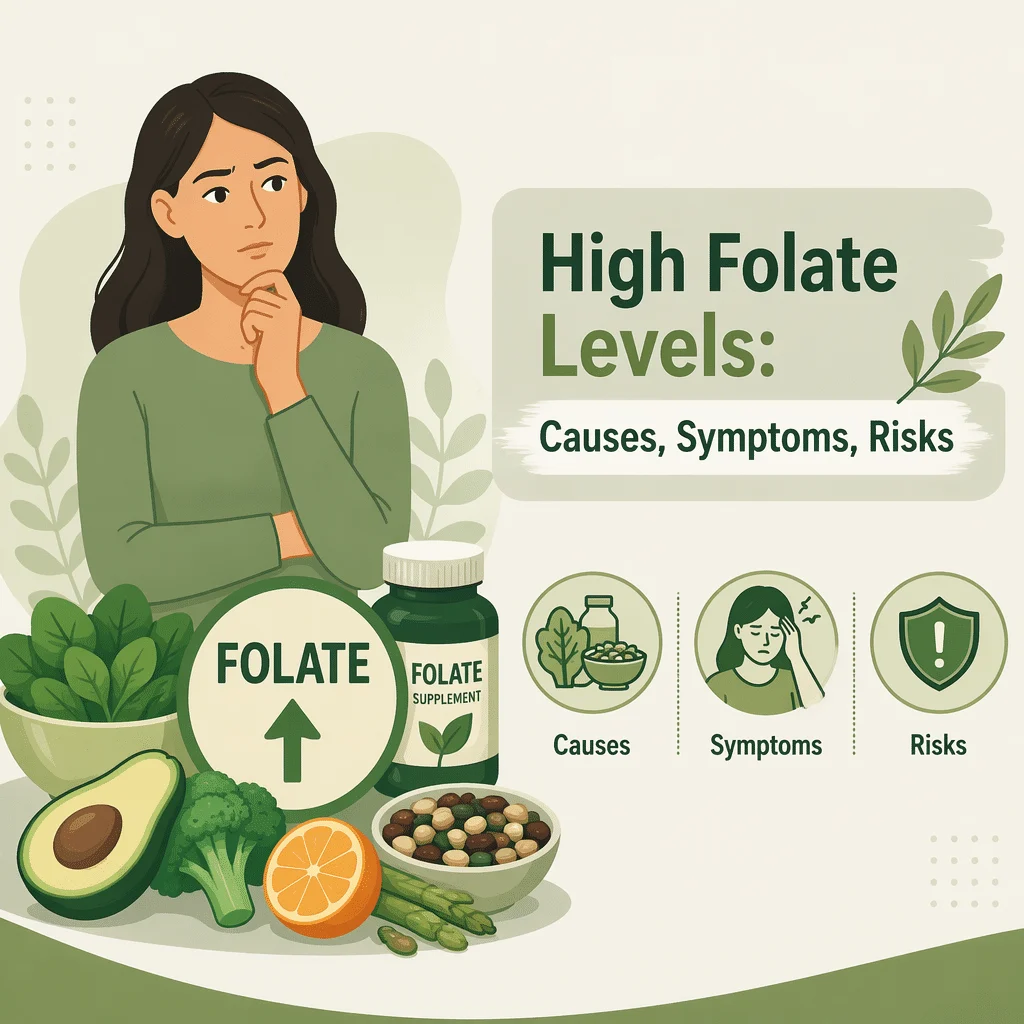
High folate levels on a blood test usually mean one simple thing: your body has been taking in plenty of folate lately, most often from a supplement or from fortified food. Unlike a low result, a high value is rarely a disease in its own right, and no toxicity has been established for folate from food. One consequence does matter, though, and it is easy to miss: a generous folate level can hide the blood signs of vitamin B12 deficiency while nerve damage quietly continues.
In this article you will learn what the test actually measures, why serum folate is a weak marker on its own, which situations turn a high result into a useful clue, and which follow-up tests belong alongside it.
What a high folate level actually measures
Folate is vitamin B9. Laboratories measure it in two very different places, and that distinction explains most of the confusion around a high result.
Serum folate measures the vitamin circulating in the liquid part of your blood right now. According to the National Institutes of Health Office of Dietary Supplements, a concentration above 3 ng/mL indicates adequacy, but the marker is sensitive to recent intake, so it may not reflect your longer-term status. A single vitamin tablet before your blood draw can lift the number.
Red blood cell folate is different. Red cells absorb folate only while they form in the bone marrow, then carry that snapshot for their lifespan of roughly three to four months. The same NIH source notes that erythrocyte folate is a longer-term measure of intake, with a concentration above 140 ng/mL indicating adequate status. That is why a clinician chasing a storage problem asks for the red cell version.
Neither measurement has an agreed upper limit that defines “too much.” Many analyzers report anything above their measuring ceiling as “greater than” a fixed value, so a result flagged high may only mean the assay ran out of range. Our team explains the folic acid blood test and its reference intervals.
| Feature | Serum folate | Red blood cell folate |
|---|---|---|
| What it reflects | Folate circulating right now | Folate built into red cells as they formed |
| Time window covered | Last few hours to days | Last three to four months |
| Moved by yesterday’s supplement | Yes, strongly | Barely |
| Best used for | A quick, inexpensive first look | Judging true folate stores |
| Main limitation | Recent intake distorts it | Transfusion or brisk cell turnover distorts it |
Why folate results come back high
In the United States, a high folate value is usually the expected consequence of two overlapping habits rather than a sign of illness.
Supplements are the leading cause
Multivitamins, prenatal vitamins, B-complex products and folic acid tablets all push serum folate up, and doses stack when several are taken together. The NIH Office of Dietary Supplements reports that about 5 percent of adults aged 51 and over exceed the tolerable upper intake level of 1,000 mcg of folic acid per day, mostly because of supplements, and that between 30 and 66 percent of children aged 1 to 13 who take folic acid-containing supplements go above their own age-specific limit. That limit covers folic acid from supplements and fortified foods only, not folate occurring naturally in food.
Fortified food raises the whole population
Since January 1998 the Food and Drug Administration has required manufacturers to add 140 mcg of folic acid per 100 g to enriched breads, cereals, flours, corn meals, pastas and rice, to reduce the risk of neural tube defects. The NIH estimates this raised average folic acid intake in the United States by roughly 190 mcg per day, and in April 2016 the agency also authorized voluntary fortification of corn masa flour. A moderately high folate result is now ordinary rather than remarkable.
Folate and folic acid are not the same molecule
Folate is the umbrella term for the vitamin in all its forms. Folic acid is the synthetic form used in supplements and fortified products, and the body must convert it before cells can use it. Natural food folate, abundant in spinach, liver, asparagus, beans and citrus, is handled differently. Both raise your test result, but only folic acid accumulates unconverted.
Timing of the blood draw
Because serum folate tracks recent intake, taking your vitamin on the morning of the test is enough to produce a high reading. If your result surprised you, check the timing of your last dose first.
How high folate levels can mask a vitamin B12 deficiency
This is the one genuine hazard behind a high folate result, and it is a hazard of interpretation rather than of the vitamin itself.
Folate and vitamin B12 work as a pair inside the bone marrow. When either runs short, red cells are produced abnormally large, a pattern called megaloblastic anemia that shows up as a raised mean corpuscular volume on a blood count. B12 has a second job that folate cannot cover: maintaining the myelin sheath that insulates nerves.
Here is the trap. The NIH Office of Dietary Supplements explains that folate can correct the megaloblastic anemia caused by vitamin B12 deficiency, but not the neurological damage, and that experts have long been concerned that high intakes of folate supplements might mask a B12 deficiency until its neurological consequences become irreversible. The fact sheet adds that questions about this still remain. In practice: someone with an untreated B12 problem takes a folic acid multivitamin, the blood count normalizes, the most visible warning light switches off, and the numbness, unsteady walking or memory changes progress unnoticed.
The defense is a laboratory habit rather than a treatment: folate should never be interpreted alone. Our team explains how to read a vitamin B12 blood test. When a blood count looks deceptively normal, our library describes the symptoms of low vitamin B12 that matter most. If you take folic acid and have any nerve-related symptom, that combination deserves a conversation with your doctor rather than reassurance from a normal hemoglobin.
When a high folate result is a clue to something else
Occasionally the number is not explained by diet or supplements. A few clinical situations can lift folate on their own, and each points somewhere different.
- Untreated vitamin B12 deficiency, including pernicious anemia. Cells need B12 to move folate into its usable form, so when B12 is missing, folate can back up in the circulation. A high folate sitting next to a low or borderline B12 is a combination to investigate, not to dismiss.
- Bacterial overgrowth of the small intestine. Some gut bacteria manufacture folate, and when they proliferate in the wrong part of the bowel that folate is absorbed. Bloating, diarrhea and weight change alongside a high result may point this way.
- Reduced kidney function. The kidneys clear folate, so impaired clearance leaves more circulating. To check whether filtration explains the picture, your doctor may order a kidney function panel.
- Recent transfusion or rapid red cell turnover. These distort red blood cell folate especially, because the cells measured were not all made by your own marrow.
- Malabsorption under treatment. People recovering from an untreated absorption disorder are often supplemented heavily, and one frequent reason folate was low to begin with is explained in our library, which covers celiac disease and gluten intolerance.
None of these is diagnosed by a folate value alone. Each is a reason to read the surrounding results rather than the flagged line in isolation, and our guide explains how to read a complete blood count.
The unmetabolized folic acid question, honestly stated
Folic acid has to be converted by an enzyme called dihydrofolate reductase before your cells can use it. The NIH Office of Dietary Supplements notes that this enzyme varies greatly between individuals, and that when its capacity is exceeded, unconverted folic acid circulates in the blood. Researchers call this unmetabolized folic acid.
It is a real, measurable phenomenon. What it means for health is not settled. The same NIH source states plainly that whether unmetabolized folic acid has any biological activity, or can be used as a marker of folate status, is not known. Studies since then have linked higher concentrations to various outcomes, but they are mostly observational or small and do not amount to a consensus.
The reasonable position is neither alarm nor dismissal. Staying within the 1,000 mcg per day upper limit for folic acid from supplements and fortified foods is prudent, and comfortably compatible with the 400 mcg daily dose recommended for people who could become pregnant. Food folate is not part of that limit. If you take several products at once, adding up their folic acid content is more useful than stopping everything.
What to do about a high folate result
There is no treatment aimed at lowering folate, and none is usually needed. What matters is the follow-up.
Review what you are taking
List every supplement, including gummies, greens powders and fortified drinks, and add up the folic acid. Do not stop a prescription on your own: it may be supporting a pregnancy, protecting against a known deficiency, or offsetting a medication such as methotrexate. Because the vitamin is water-soluble, levels fall within weeks once intake drops.
Ask for the right companion tests
A folate value becomes informative only in company. The pairing most clinicians reach for includes vitamin B12, and, when B12 sits in the grey zone, methylmalonic acid and homocysteine as second-line confirmation. Methylmalonic acid rises specifically in B12 deficiency, making it the more discriminating of the two. Our library explains what homocysteine levels reveal about both vitamins. A complete blood count with mean corpuscular volume completes the picture, and our team details the causes of a high MCV. When several nutrients are in question, AI DiagMe also interprets a full vitamin and nutritional panel.
When to see a doctor
- Numbness, tingling, burning feet, unsteady walking or new memory difficulty, particularly if you take folic acid.
- A high folate result together with a low or borderline vitamin B12.
- A high folate result with persistent bloating, diarrhea or unexplained weight loss.
- A high folate result in someone taking no supplements and eating no unusual amount of fortified food.
- Fatigue, breathlessness or pallor that persists despite a normal-looking blood count; our library covers the different types of anemia that hide behind an average result.
The opposite results deserve their own reading: our library details the symptoms of folate deficiency, and our team covers the causes of high B12 levels.
Latest scientific advances
Research published over the last three years has refined, rather than overturned, the picture above. Here is what it adds, in plain language.
High folate is common where flour is fortified
A national survey of more than 7,000 Brazilian children aged 6 to 59 months, published in 2023, found high folate concentrations in around a third of them, while true deficiency was rare. Children with high folate were not more likely to be short of vitamin B12; if anything, they were less likely. What this means for you: where flour is fortified, a high folate reading is a normal population finding rather than an alarm, and it does not by itself signal a hidden B12 problem. B12 still has to be measured to know.
Fortification policy does not always move the needle
Researchers at the Centers for Disease Control and Prevention analyzed United States survey data in 2024 to see whether voluntary fortification of corn masa flour had improved folate status among Hispanic women of reproductive age. It had not. What this means for you: your result reflects what you personally eat and take, not what policy permits.
Extra folic acid adds no cognitive benefit on top of fortification
A 2024 systematic review and meta-analysis, a study that pools the results of many earlier trials, looked at folate-based B vitamin supplements and thinking skills in older adults. Supplementation improved cognitive measures in countries without mandatory fortification, but showed no significant effect where fortification is mandatory. What this means for you: if you already eat fortified grains, extra folic acid is unlikely to sharpen your memory, removing one common reason for high doses.
The form of folate changes how much stays unconverted
A 24-week randomized trial published in 2026 compared a prenatal multivitamin containing 5-methyltetrahydrofolate, the already-converted form, with one containing standard folic acid. The alternative maintained folate status while leaving less unmetabolized folic acid circulating in mother and baby. The authors note that more research is needed to know whether that matters for health, and some were employed by the supplement manufacturer. What this means for you: the form is worth discussing with your obstetrician, not a reason to switch on your own.
Two open questions, reported as open
A 2026 report linked higher unmetabolized folic acid in mothers during pregnancy with a greater risk of allergy in their children; it is an observational association in a single population and needs confirmation. On the cancer question that worries many readers, a 2025 analysis of a United States cohort assembled before fortification found higher folate intake associated with fewer colorectal cancer deaths, the opposite direction from the fear, though it counted few deaths, so its precision is limited. What this means for you: both questions remain unsettled, and neither supports panic nor a blanket rule against folic acid.
Glossary
| Term | Definition |
|---|---|
| Folate | Vitamin B9. The umbrella name for the vitamin in every form, from food or supplement. |
| Folic acid | The synthetic form used in supplements and fortified foods. The body must convert it before cells can use it. |
| Serum folate | Folate circulating in the liquid part of the blood. It reflects intake over the last few hours to days. |
| Red blood cell folate | Folate stored inside red cells. It reflects the previous three to four months and is the better measure of stores. |
| Unmetabolized folic acid | Folic acid that circulates unconverted when the converting enzyme is overwhelmed. Its health significance is not established. |
| Megaloblastic anemia | Anemia in which red cells are made abnormally large, caused by a shortage of folate or vitamin B12. |
| Mean corpuscular volume (MCV) | The average size of your red blood cells, reported on a blood count. It rises in megaloblastic anemia. |
| Methylmalonic acid (MMA) | A substance that accumulates when vitamin B12 is lacking. It confirms a deficiency when the B12 result is borderline. |
| Homocysteine | An amino acid that rises when folate or vitamin B12 is low. It is sensitive but does not distinguish the two. |
| Tolerable upper intake level | The highest daily intake considered unlikely to cause harm. For folic acid in adults, 1,000 mcg per day. |
Frequently asked questions
Are high folate levels dangerous?
In themselves, generally not. No adverse effects have been established for folate obtained from food, and the body excretes what it does not need. The recognized concern is indirect: a generous folate level can normalize the blood picture of a vitamin B12 deficiency while nerve damage continues. That is why the finding calls for a B12 measurement rather than for treatment of the folate itself.
What does a folate level greater than 20 mean?
Usually that the result exceeded the upper measuring range of the analyzer, so the laboratory reports it as greater than a fixed number instead of an exact value. It is a statement about the assay, not a severity grade. Different laboratories use different ceilings, so the same blood could be reported differently in two places. In a person taking a multivitamin, this is an expected result and not a cause for concern on its own.
Can you have high folate levels without taking supplements?
Yes. Fortified grain products alone can lift the result, especially in someone who eats a lot of bread, pasta, rice or breakfast cereal. Beyond diet, an untreated vitamin B12 deficiency, bacterial overgrowth of the small intestine and reduced kidney clearance can each raise circulating folate. If you take nothing and eat nothing unusual, that is precisely the situation where the result deserves a proper look rather than reassurance.
What is a high folate level for a woman?
There is no separate female threshold and no consensus upper cutoff at all. Laboratories define adequacy at the lower end, and the NIH considers serum folate above 3 ng/mL adequate. Pregnancy is the one context where the interpretation shifts, because a daily 400 mcg folic acid dose is deliberately recommended before and during early pregnancy to prevent neural tube defects, so a raised level is the intended effect of good care.
Do high folate levels cause cancer?
The evidence does not support that conclusion. The relationship between folate and cancer has been studied for decades and remains inconclusive, with individual studies pointing in different directions. A 2025 analysis of a United States cohort assembled before fortification found higher folate intake associated with fewer colorectal cancer deaths. Staying within the 1,000 mcg daily upper limit for folic acid is a sensible precaution while the science continues.
Is there a treatment for high folate levels?
No specific treatment exists, and none is usually warranted. The practical steps are to review supplement intake, verify vitamin B12 status, and address any underlying condition found. Because folate is water-soluble, levels fall on their own within weeks once intake decreases. Never stop a prescribed folic acid supplement without medical advice, since it is often protecting against something more consequential.
Sources
- National Institutes of Health, Office of Dietary Supplements — Folate: Fact Sheet for Health Professionals — ods.od.nih.gov
- Centers for Disease Control and Prevention — About Folic Acid — cdc.gov
- MedlinePlus, U.S. National Library of Medicine — Folic Acid — medlineplus.gov
- Salvatte K, Farias DR, Normando P, et al. — High serum folate concentration, vitamin B12 deficiency, and anthropometric nutritional status in Brazilian children aged 6-59 months — The Journal of Nutrition, 2023 — pubmed.ncbi.nlm.nih.gov
- Wang A, Fothergill A, Yeung LF, Crider KS, Williams JL — Update on the impact of voluntary folic acid fortification of corn masa flour on red blood cell folate concentrations, NHANES 2011-March 2020 — Birth Defects Research, 2024 — pubmed.ncbi.nlm.nih.gov
- Zhang L, Chen X, Chen Y, et al. — Effectiveness of folate-based B vitamin intervention on cognitive function of older adults under mandatory folic acid fortification policy: a systematic review and meta-analysis — Nutrients, 2024 — pubmed.ncbi.nlm.nih.gov
- Draicchio F, Hausser J, Sharafi M, et al. — Using 6S-5-methyltetrahydrofolate instead of folic acid in prenatal multivitamin reduces unmetabolized folic acid concentrations in the mother-fetus dyad: a 24-week randomized controlled trial — Frontiers in Nutrition, 2026 — pubmed.ncbi.nlm.nih.gov
- Tan T, Liu J, Zhao Y, et al. — Elevated maternal unmetabolized folic acid during pregnancy increases offspring allergy risk — Clinical and Experimental Allergy, 2026 — pubmed.ncbi.nlm.nih.gov
- Bhattachary A, Tabi M, Yin J, Cowan L, Zhang J — Folate intake, tissue levels, and colorectal cancer deaths in a national cohort established before folic acid fortification — European Journal of Nutrition, 2025 — pubmed.ncbi.nlm.nih.gov
Further reading
- MCV Blood Test: What It Measures and What Results Mean
- Red Blood Cell Count: What Your RBC Results Mean
- Vitamin B12 Deficiency: Symptoms, Causes, Tests and Treatment
- Blood Tests During Pregnancy: What Is Checked and What Results Mean
- Hemoglobin Levels: What Your Blood Test Results Mean
Understand your lab results with AI DiagMe
A folate result only makes sense next to the values printed around it, and that is exactly where a report becomes hard to read on your own. AI DiagMe turns your laboratory document into clear language, connecting folate to vitamin B12, to the size of your red blood cells and to your blood count so you can see which numbers belong together. It helps you understand what you are looking at and prepare better questions. It does not diagnose, and it does not replace your doctor.
Get your results interpreted in minutes