



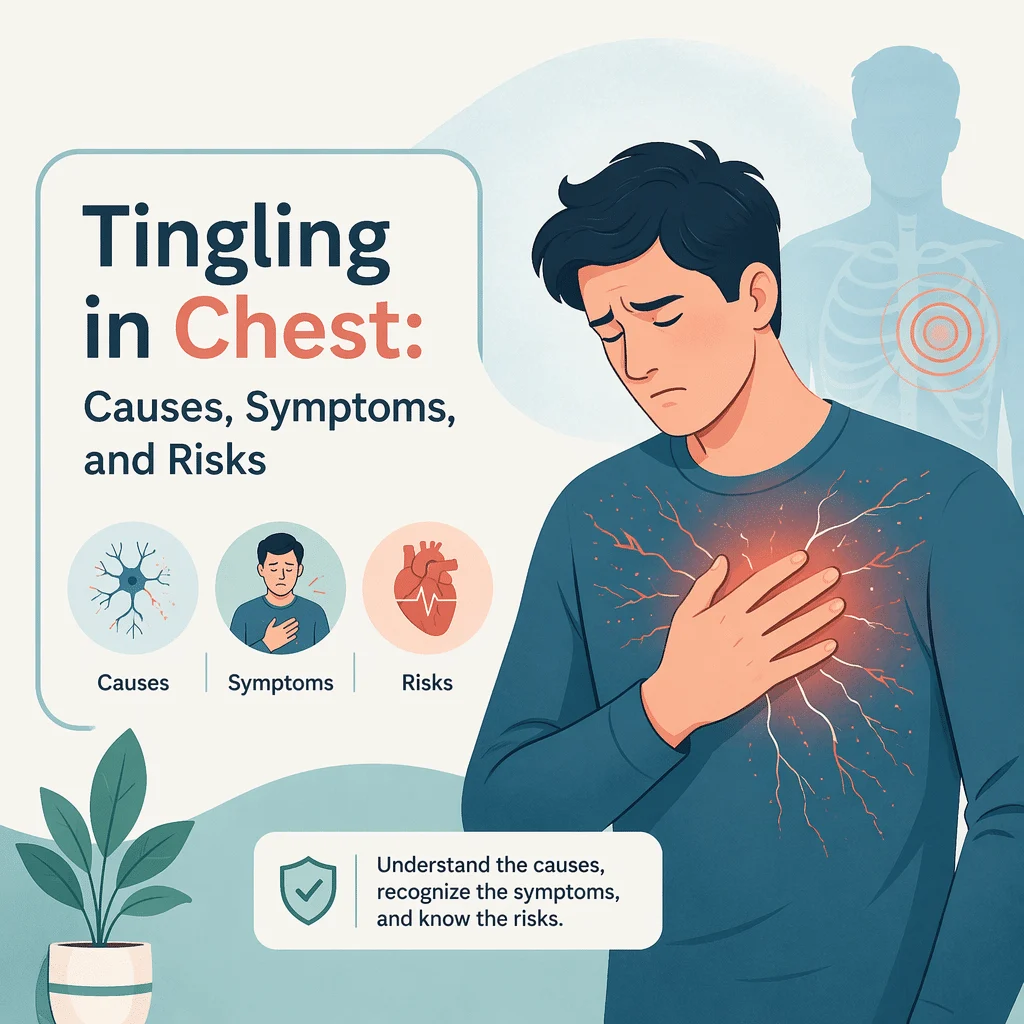
Tingling in the chest is a prickling, buzzing, or pins-and-needles feeling under the breastbone or across the rib cage, and it has many possible explanations, most of them not dangerous. The sensation can come from nerves, muscles, breathing patterns, digestion, or the heart itself, which is exactly why it is so hard to interpret on your own. Because a small share of cases signals a cardiac emergency, this guide starts with the warning signs that mean you should call 911, then works through the far more common non-urgent causes, the symptom patterns that point to each one, and the lab tests a clinician may order once heart problems have been excluded. In this article you’ll learn how to describe your symptoms accurately and what to bring to your appointment.
When tingling in the chest is a medical emergency
Most chest tingling is not a heart attack. But it can be part of one, and a heart attack is time-critical, so the safe order is to rule out the emergency first and read about the everyday causes afterward.
Call 911 right away if any of these apply
- Chest tingling, pressure, or tightness that arrives with shortness of breath, cold sweating, nausea, or lightheadedness
- Discomfort that spreads to one or both arms, the back, shoulders, neck, jaw, or the area above the belly button
- Symptoms that begin or clearly worsen with physical exertion, such as climbing stairs, and ease when you stop
- A sudden, severe, or crushing sensation, or one that simply does not go away
- Tingling alongside a rapid or irregular heartbeat, fainting, or a feeling that you are about to faint
- Sudden chest discomfort with breathlessness after long-haul travel, surgery, or a swollen and painful leg
Do not drive yourself, and do not wait to see whether the feeling passes. MedlinePlus advises immediate attention for chest pain that does not go away, crushing pain or pressure, or chest pain with nausea, sweating, dizziness, or shortness of breath. Mayo Clinic puts it plainly: never ignore the symptoms of a heart attack. Emergency teams would far rather assess a false alarm than a delayed one.
Warning signs are not the same for everyone
The stock image of a heart attack, a man clutching his chest in crushing pain, leaves out many people. The National Heart, Lung, and Blood Institute notes that unusual, unexplained tiredness lasting days is more common in women, that shortness of breath during light activity is more common in older adults, and that silent heart attacks, which produce few or no obvious symptoms, are more common in older adults and in people with diabetes or high blood sugar.
If you are in one of those groups, treat vague fatigue, nausea, jaw or back discomfort, and unexplained breathlessness as potentially cardiac. The absence of a textbook symptom is not reassurance.
If none of the emergency features above apply, the rest of this guide covers the much larger group of non-urgent explanations.
What tingling in the chest actually is
Doctors call an abnormal sensation of this kind paresthesia: the umbrella term for tingling, prickling, numbness, burning, or pins and needles that arrives without anything touching you. Paresthesia is a symptom, not a diagnosis, and the consultation’s job is to work out which system produced it.
According to PubMed, a 2024 review of tingling sensations makes a point that reframes the question: the feeling can be generated anywhere along the sensory pathway, from a nerve ending in the skin up to the brain. That is why chest tingling can originate in the chest wall, in a nerve root, in the blood chemistry that nerves depend on, or simply in the way you are breathing. The same review flags features that deserve prompt assessment: tingling that appears suddenly over a few days, spreads quickly, is severe, affects one side only, or comes with muscle weakness.
Heart and lung causes
Angina and reduced blood flow
Angina is the discomfort that appears when heart muscle temporarily receives less blood than it needs. Textbooks describe pressure or heaviness, but people report it differently, and a tingling or buzzing quality is possible. The distinguishing feature is usually the trigger: angina classically appears with exertion, emotional stress, cold air, or a heavy meal, and settles within minutes of rest.
Palpitations and rhythm changes
An awareness of your own heartbeat can register as fluttering, quivering, or a tingling ripple rather than a distinct thump. Occasional extra beats are common and often harmless, but a new, sustained, or irregular rhythm, especially with dizziness or breathlessness, needs assessment. Hospital teams also measure a blood marker released by injured heart muscle, and our team explains the troponin blood test.
Pericarditis
Inflammation of the thin sac around the heart tends to cause sharp or prickling chest discomfort that is worse lying flat and better sitting up and leaning forward. That positional pattern is a useful clue to mention to your doctor.
Breathing and lung causes
Asthma can produce chest tightness and an odd crawling sensation, particularly during a flare. Pleurisy, inflammation of the lining around the lungs, typically makes the discomfort sharper each time you breathe in or cough. A pulmonary embolism, a clot lodged in a lung artery, is the red flag in this group: it can cause sudden breathlessness, sharp chest discomfort, and a racing heart, and it is a medical emergency. This guide covers the warning signs of a pulmonary embolism.
Anxiety, panic attacks, and hyperventilation
Anxiety is one of the most frequent explanations for chest tingling, and hyperventilation is the mechanism that makes it so recognizable.
How over-breathing creates a tingling chest
When you breathe faster or more deeply than your body needs, during a panic attack but also during stress, pain, or plain worry about the chest sensation itself, you clear out more carbon dioxide than you produce. Cleveland Clinic describes the consequence as respiratory alkalosis: with less carbon dioxide dissolved in the blood, blood chemistry shifts toward the alkaline side.
That shift changes how much calcium is available in its active form. Calcium circulates partly bound to proteins and partly free, and only the free fraction, called ionized calcium, is what nerves use. As blood turns more alkaline, more calcium sticks to protein and the free fraction falls. Nerves become easier to trigger and start firing without being touched, and the brain reads that firing as tingling.
Why the lips and hands tingle too
This is the signature that makes over-breathing identifiable. Cleveland Clinic lists numbness and tingling in the arms or around the mouth alongside chest pain, shortness of breath, dizziness, a fast heartbeat, and muscle spasms in the hands and feet. If chest tingling arrives with numb lips and prickling fingers during a stressful moment, over-breathing is a strong candidate.
A feedback loop then keeps it going: the chest sensation causes alarm, alarm speeds up breathing, faster breathing deepens the tingling, and the tingling confirms the alarm. Breathing retraining is one approach clinicians use to interrupt that cycle, and it should be discussed with your doctor. Never settle on anxiety as the explanation until a clinician has considered the alternatives. Our library describes the symptoms and management of anxiety.
Chest wall, nerve, and digestive causes
Costochondritis, muscle strain, and rib injury
Costochondritis is inflammation where the ribs meet the breastbone, and it produces tenderness you can often find with a fingertip. Intercostal muscle strain after coughing, lifting, or an unfamiliar workout does much the same. If pressing on one spot reproduces the exact sensation, a chest wall source becomes more likely, though reproducible tenderness never rules out a heart problem on its own. This article explains the causes of rib cramps.
Shingles before the rash appears
Shingles is a reactivation of the chickenpox virus inside a single nerve, and it often causes burning, tingling, or itching for a few days before any rash is visible. Because the affected nerve wraps around one side of the chest, the sensation forms a band that stops at the midline and never crosses to the other side. That one-sided band is the strongest clue available, and recognizing it early matters because antiviral treatment works best when started promptly. Our team details the early symptoms of shingles.
Pinched nerves and neuropathy
A compressed nerve root in the mid-back, called thoracic radiculopathy, can send tingling around the rib cage along that nerve’s path, often changing with posture or movement. Peripheral neuropathy, nerve damage from causes such as long-standing high blood sugar, typically starts in the feet and hands but can involve the trunk. Our library covers the causes and treatments of neuralgia.
Reflux and esophageal spasm
The esophagus sits directly behind the breastbone and shares nerve pathways with the heart, which is why acid reflux and esophageal spasm can mimic cardiac symptoms convincingly. Clues include a burning quality, a link to meals or lying down, an acid taste, and a sensation that travels up toward the throat. Our team explains the symptoms of an acid reflux cough.
Nutritional and metabolic causes
Nerves depend on a stable chemical environment, so several correctable imbalances show up as tingling, usually in more than one part of the body and building over weeks rather than minutes.
Vitamin B12 deficiency
Low vitamin B12 damages the protective sheath around nerves and classically causes tingling and numbness, often with fatigue, a sore tongue, and balance problems. Risk is higher with vegetarian or vegan diets, long-term use of certain acid-reducing or diabetes medications, and conditions that limit absorption. This guide reviews the symptoms of low vitamin B12.
Low calcium and low magnesium
A fall in calcium raises nerve excitability directly, producing tingling around the mouth and in the fingers together with cramps or muscle twitching. Magnesium matters because the body needs it to keep calcium and potassium in balance, so a shortage can cause similar symptoms. Our library describes the signs of magnesium deficiency, and our team explains the calcium blood test.
Thyroid problems and blood sugar
An underactive thyroid can cause tingling, cold intolerance, and fatigue, while an overactive one can drive palpitations and a fluttering chest people describe as buzzing. Persistently high blood sugar damages small nerves over years. This guide sets out the normal thyroid level ranges.
Matching your symptom pattern to a likely cause
What accompanies the tingling is usually more informative than the tingling itself. Use the table below to organize what you have noticed before your appointment. It is a conversation aid, not a diagnosis, and it cannot exclude a heart problem.
| What you notice alongside the tingling | Likely category | Urgency |
|---|---|---|
| Cold sweat, nausea, breathlessness, or discomfort spreading to arm, jaw, neck, or back | Heart, possible heart attack | Emergency, call 911 now |
| Starts with exertion, eases within minutes of rest | Heart, possible angina | Urgent, same-day medical advice |
| Sharper each time you breathe in or cough | Lungs or their lining | Same-day advice, emergency if sudden with breathlessness |
| Reproduced by pressing on one spot on the chest wall | Muscle, rib, or cartilage | Routine appointment |
| A band of burning or tingling on one side only, rash appearing later | Nerve, possible shingles | Prompt appointment, antiviral timing matters |
| Numb lips and tingling hands during a stressful episode | Over-breathing or panic | Routine appointment, emergency if it is a first episode with chest pain |
| Burning behind the breastbone, worse after meals or lying flat | Digestive, reflux or spasm | Routine appointment |
| Constant over weeks, with hands and feet tingling too | Nutritional or metabolic | Routine appointment with blood tests |
Which lab tests help once cardiac causes are excluded
Blood tests do not diagnose chest tingling by themselves. What they do well is confirm or exclude the correctable causes, which is why clinicians reach for them once the heart has been assessed. A common starting set includes a complete blood count to look for anemia or infection, a thyroid panel built around TSH, vitamin B12, calcium and magnesium, a broader electrolyte panel, and a glucose or HbA1c measurement to check blood sugar over time. Our team explains how to read a complete blood count.
Two tests deserve a specific warning. Troponin and D-dimer are emergency department tools, ordered by a clinician and interpreted strictly in the context of your symptoms, examination, and heart tracing. Neither is something to request for reassurance or to interpret from a printout: a normal value at the wrong moment can be falsely reassuring, and a mildly raised value has many non-cardiac explanations. Treat them as part of a supervised assessment, never as a self-check.
The wider picture is reassuring. According to PubMed, a systematic review of emergency chest pain assessment reported that only about one in five people admitted to an emergency department with chest pain turn out to be having a heart attack, and that modern high-sensitivity troponin testing clears many of the rest quickly and safely.
Latest scientific advances
Research from the past three years has sharpened two things that matter for anyone with chest symptoms: who gets missed, and how tingling should be investigated.
Chest symptoms in women are being taken more seriously
A 2026 review in the BMJ examined how cardiac chest pain is assessed in female patients and concluded that women are still underdiagnosed and undertreated, partly because their symptoms and artery problems differ from the pattern medicine was built around. What this means for you: if you are a woman whose chest sensations have been attributed to stress without an examination, asking for a cardiac assessment is reasonable, not excessive.
A 2025 analysis of more than three thousand heart attack patients at two urban emergency departments found that women waited slightly longer than men for their first heart tracing, even when chest pain was the stated reason for the visit. The delay averaged a few minutes, which sounds small, but the first tracing starts the clock on everything else. What this means for you: describe your symptoms clearly and use the word chest when you check in.
A clearer framework for investigating tingling
The 2024 review of tingling sensations mentioned earlier proposed a practical approach that separates tingling needing rapid attention from tingling that can be investigated at a normal pace. Sudden onset, rapid spread, severity, one-sided involvement, and any muscle weakness push a case into the urgent group, while a slow build affecting both sides points toward causes such as vitamin B12 deficiency or diabetes. What this means for you: how quickly your tingling appeared is useful information, so note the timeline before your appointment.
Over-breathing leaves measurable traces
A 2025 case report described a patient with anxiety-related over-breathing whose blood tests showed both the expected shift toward alkaline blood and a severe drop in phosphate, another mineral that moves when breathing changes. This is a single patient, so it is an illustration rather than proof. What this means for you: hyperventilation is not imaginary. It produces real, measurable chemistry changes, which is why a clinician may check an electrolyte panel even when anxiety is the leading explanation.
Glossary
| Term | Definition |
|---|---|
| Paresthesia | The medical word for tingling, prickling, or pins and needles that appears without anything touching the skin. |
| Angina | Chest discomfort caused by heart muscle temporarily receiving less blood than it needs, classically brought on by exertion. |
| Arrhythmia | A heartbeat that is too fast, too slow, or irregular. Some arrhythmias are harmless and some need treatment. |
| Costochondritis | Inflammation of the cartilage joining the ribs to the breastbone, usually tender when pressed. |
| Pericarditis | Inflammation of the thin sac surrounding the heart, often worse lying flat and better leaning forward. |
| Hyperventilation | Breathing faster or more deeply than the body needs, which clears out too much carbon dioxide. |
| Respiratory alkalosis | The shift of blood chemistry toward the alkaline side that follows over-breathing. |
| Ionized calcium | The free, unbound portion of blood calcium that nerves and muscles actually use. |
| Troponin | A protein released into the blood when heart muscle is injured, measured in hospital to assess a suspected heart attack. |
| D-dimer | A blood marker of clot breakdown, used in emergency settings to help assess a suspected clot in the lung. |
Frequently asked questions
What does it mean when tingling in the chest comes and goes?
Intermittent tingling that lasts seconds to minutes and has no consistent trigger most often comes from the chest wall, a nerve, or breathing pattern changes rather than the heart. The pattern that should concern you is a symptom that reliably appears with physical effort and reliably settles with rest, because that is how reduced blood flow to heart muscle behaves. Keep a short log of when episodes happen, how long they last, and what you were doing, because that record is often more useful to your doctor than the sensation itself.
Can anxiety cause a tingling feeling in the chest?
Yes, and it is one of the most common explanations. Anxiety speeds up breathing, which lowers carbon dioxide in the blood and makes nerves fire more readily, producing tingling in the chest, hands, and around the mouth. The combination of chest tingling with numb lips and prickling fingers during a stressful moment points strongly toward this mechanism. That said, anxiety should be a conclusion your clinician reaches after considering other causes, not an assumption you make yourself, especially if this is your first episode.
Why do I feel tingling in my chest when I lie down?
Lying flat changes several things at once. It allows stomach acid to move up the esophagus more easily, it alters the pressure on nerve roots in the mid-back, and it removes the distractions that mask minor sensations during the day. Pericarditis is a specific cause that is characteristically worse lying flat and better sitting forward. If lying down consistently brings on the sensation, mention that pattern to your doctor, because it narrows the list considerably.
What causes a pricking sensation in the chest near the heart?
A sharp, brief, pricking feeling on the left side is frequently muscular or nerve-related rather than cardiac, particularly when it lasts only seconds, changes with position, or can be reproduced by pressing on the chest wall. Heart-related discomfort more often builds over minutes, feels like pressure or heaviness, and is triggered by effort. Location alone is not a reliable guide, because the heart sits centrally and its discomfort is frequently felt in the middle of the chest rather than on the left.
Should I worry about a strange feeling in the left side of my chest with no pain?
A sensation without pain is generally less concerning, but it is not automatically harmless, and the absence of pain is a poor way to exclude a heart problem. Silent heart attacks producing few obvious symptoms are more common in older adults and in people with diabetes. If the feeling is new, persistent, linked to exertion, or accompanied by breathlessness, fatigue, or nausea, have it assessed rather than waiting for pain to appear.
What does tingling in the chest and back at the same time mean?
Tingling that wraps from the chest around to the back along a single band on one side suggests a nerve root, with shingles and a compressed nerve in the mid-back being the usual candidates. Tingling felt in both the chest and back on both sides more often reflects a whole-body cause such as a vitamin or mineral imbalance. Discomfort spreading from the chest to the back with sweating or breathlessness is different again and needs emergency assessment.
Sources
- National Heart, Lung, and Blood Institute — Heart Attack: Symptoms, NIH — nhlbi.nih.gov
- MedlinePlus — Chest Pain, U.S. National Library of Medicine — medlineplus.gov
- Mayo Clinic — Chest Pain: Symptoms and Causes — mayoclinic.org
- Cleveland Clinic — Hyperventilation: Symptoms, Causes and Treatment — my.clevelandclinic.org
- Diercks D, Cao M, McHugh M, Kibbey C, Farooqi S — Evaluation and management of chest pain from cardiovascular causes in female patients — BMJ, 2026 — doi.org/10.1136/bmj-2025-086177
- Imboden MT, Koltner E, Bryant JH, et al. — Sex Disparities in Acute Myocardial Infarction Diagnosis and Treatment — The American Journal of Cardiology, 2025 — doi.org/10.1016/j.amjcard.2025.09.013
- Slouma M, Ben Dhia S, Cheour E, Gharsallah I — Acroparesthesias: An Overview — Current Rheumatology Reviews, 2024 — doi.org/10.2174/0115733971254976230927113202
- Jayakrishnan J, Narayanan N, Macriyiannis T — Severe Hypophosphatemia Induced by Hyperventilation: A Case Report — Cureus, 2025 — doi.org/10.7759/cureus.95048
- Westwood M, Ramaekers B, Grimm S, et al. — High-sensitivity troponin assays for early rule-out of acute myocardial infarction in people with acute chest pain: a systematic review and economic evaluation — Health Technology Assessment, 2021 — doi.org/10.3310/hta25330
Further reading
- The cardiac markers panel explained
- The electrolyte panel and what it measures
- The causes of tingling in the back
- The causes of pain under the left breast
- A pinched nerve in the shoulder blade
Understand your lab results with AI DiagMe
Once a clinician has excluded a cardiac cause, tingling in the chest often traces back to something a blood test can show, such as a low vitamin B12 level, a calcium or magnesium imbalance, an underactive thyroid, or blood sugar that has been high for a long time. AI DiagMe reads the results you already have and explains, in plain language, what each value means and which numbers sit outside the expected range. It helps you understand your report and prepare better questions. It does not diagnose, and it does not replace your doctor.
Get your results interpreted in minutes