




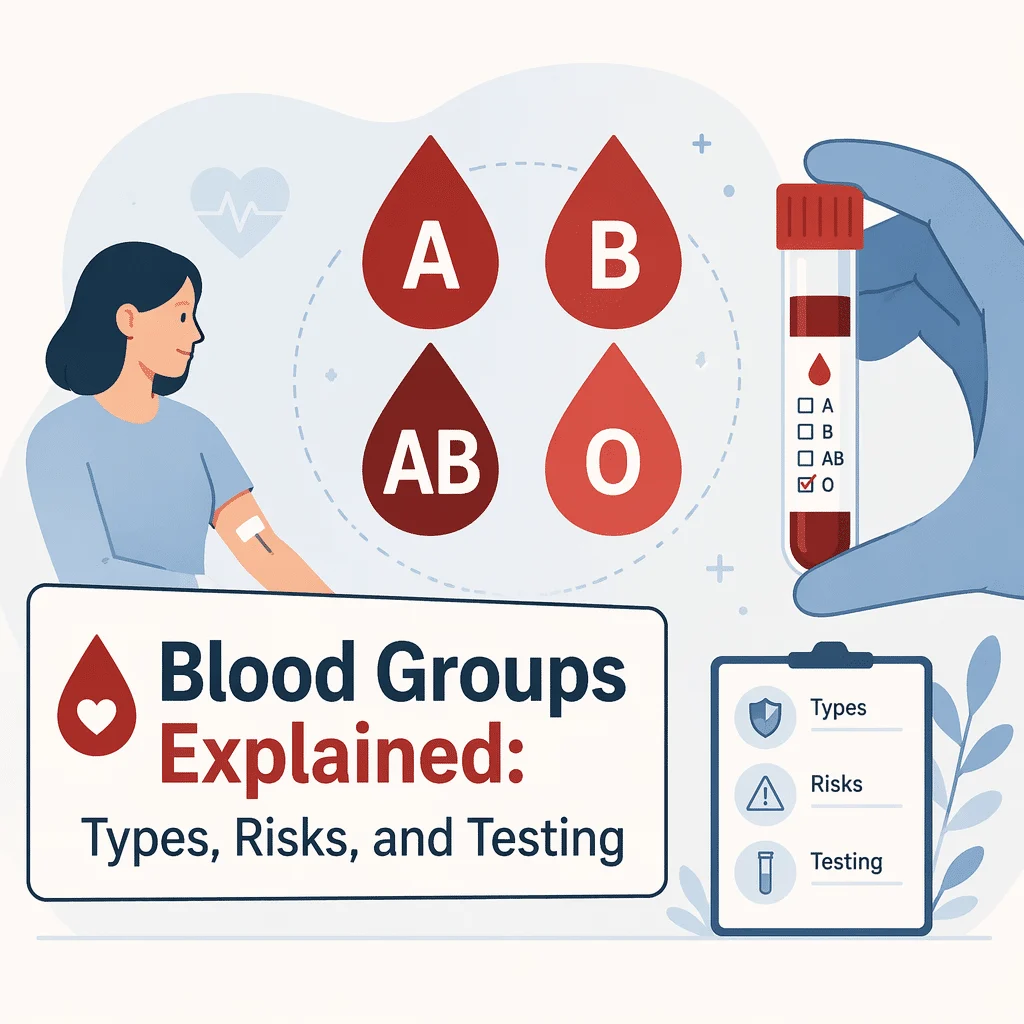
Blood groups are the labels that describe what sits on the surface of your red blood cells, and they decide which donated blood is safe for you and which is not. Most people only think about their blood type before surgery, during pregnancy, or when they give blood, yet the system behind those letters and plus-or-minus signs is simpler than it looks. This guide explains what blood groups and blood types are, walks through the eight common ABO and Rh types, and shows which are most common and which are rarest. You will also learn who can donate to whom, how a blood typing test works, how to read your result, why Rh status matters in pregnancy, how blood type is inherited, and what recent research is changing about so-called universal blood.
What blood groups are and why they matter
A blood group is a way of sorting blood by the markers, called antigens, that coat your red blood cells. Antigens are tiny proteins or sugars on the cell surface. Your immune system treats your own antigens as “self” and ignores them, but it can attack red cells that carry antigens it does not recognize.
Two systems do most of the work in everyday medicine: the ABO system and the Rh system. Together they create the familiar labels such as A positive or O negative. Your plasma, the liquid part of blood, may also carry antibodies, which are proteins built to lock onto foreign antigens.
This matching is why blood groups matter. If you receive red cells carrying an antigen your body sees as foreign, your antibodies can attack them and trigger a serious reaction. Knowing your group also guides care during pregnancy and is part of the routine workup that may accompany a complete blood count before treatment.
ABO and Rh: the two systems that matter most
The ABO system
The ABO system is built on two antigens, called A and B. If your red cells carry only A, you are group A; only B, group B; both, group AB; neither, group O. What makes ABO unusual is that your plasma naturally contains antibodies against the antigens you lack. A group A person carries anti-B antibodies, a group B person carries anti-A, a group O person carries both, and a group AB person carries neither. You can read more in our guides to blood group A, blood group B, blood group AB, and blood group O.
The Rh system
The Rh system adds a second label. Its most important marker is the D antigen. If your red cells carry it, you are Rh positive; if not, Rh negative. That is the plus or minus after your ABO letter, so A positive means the A antigen plus the Rh D antigen. Unlike ABO, Rh negative people do not usually carry anti-D antibodies unless they have been exposed to Rh positive blood, for example through a transfusion or pregnancy. Our guide to the Rh system covers this in more detail.
The eight common blood types
Combining the four ABO groups with Rh positive or negative gives the eight types you see on most reports. The table below shows the antigens on the red cells and the antibodies normally found in the plasma.
| Blood type | Antigens on red cells | Antibodies in plasma |
|---|---|---|
| A positive | A, Rh(D) | anti-B |
| A negative | A | anti-B |
| B positive | B, Rh(D) | anti-A |
| B negative | B | anti-A |
| AB positive | A, B, Rh(D) | none |
| AB negative | A, B | none |
| O positive | Rh(D) only | anti-A, anti-B |
| O negative | none | anti-A, anti-B |
These eight cover almost everyone, but they are only the start: laboratories recognize many more antigens that define rarer groups, which we cover further down.
Which blood types are most common and rarest
Blood types are not evenly spread, and the mix differs by country and ancestry. In the United States, group O positive is the most common and AB negative is the least common of the eight, according to the American Red Cross. The approximate distribution is shown below.
| Blood type | Approximate share of the U.S. population |
|---|---|
| O positive | 37% |
| A positive | 36% |
| B positive | 8% |
| O negative | 7% |
| A negative | 6% |
| AB positive | 3% |
| B negative | 2% |
| AB negative | 1% |
Figures are approximate and based on American Red Cross data. Two points stand out. First, more than 8 in 10 people are Rh positive. Second, although O negative makes up only about 7% of people, it is in constant demand because it can be given safely in many emergencies. Beyond these eight types, the American Red Cross notes there are more than 300 other antigens whose presence or absence creates genuinely rare blood types.
Universal donors and universal recipients
Because group O negative red cells carry no A, B, or Rh D antigen, they can be given to almost anyone without triggering an ABO or Rh reaction. That is why O negative is called the universal red cell donor and is the first choice in emergencies when there is no time to confirm a patient’s type. At the other end, group AB positive can receive red cells from any type, so it is called the universal recipient.
Plasma works in reverse: because AB plasma contains neither anti-A nor anti-B, group AB is the universal plasma donor. The table below summarizes which red cells each type can safely receive.
| Recipient blood type | Can receive red cells from |
|---|---|
| O negative | O negative |
| O positive | O negative, O positive |
| A negative | O negative, A negative |
| A positive | O negative, O positive, A negative, A positive |
| B negative | O negative, B negative |
| B positive | O negative, O positive, B negative, B positive |
| AB negative | O negative, A negative, B negative, AB negative |
| AB positive | All blood types (universal recipient) |
It is worth clearing up a common mix-up: O positive is not universal. It can go to any Rh positive type, but its Rh D antigen makes it unsuitable for many Rh negative patients. Only O negative is the true universal red cell donor.
Rare blood groups and “golden blood”
ABO and Rh are the headline systems, but they are far from the only ones. Red cells also carry antigens from systems with names such as Kell, Duffy, and Kidd. These rarely matter for a first transfusion, but they become important if someone has formed antibodies against them, often after previous transfusions or pregnancies.
Some blood is rare in the extreme. People described as Rh-null lack every antigen in the Rh system, a profile so uncommon it is sometimes nicknamed “golden blood,” with only a few dozen people identified worldwide. Such individuals can usually receive blood only from other Rh-null donors, which is why specialist rare-donor registries are so important. For people with an unusual type, planning ahead with their medical team can prevent dangerous delays.
How blood typing works and how to read your result
The blood typing test
A blood type is found from a small sample, usually drawn from a vein in your arm. Laboratories use two checks that should agree. In forward typing, technicians mix your red cells with reagents containing anti-A, anti-B, and anti-D; clumping, called agglutination, shows which antigens are present. In reverse typing, they mix your plasma with known A and B cells to confirm which antibodies you carry. For difficult cases, molecular methods read the genes that build the antigens. Typing is often done alongside other routine tests, and our overview of the blood test process explains what happens from the draw to the result.
Reading your result
A typed result lists your ABO group and your Rh status, such as “B positive.” Reports may also mention an antibody screen, a separate test that looks for unexpected antibodies in your plasma that could complicate a transfusion or pregnancy. A positive antibody screen does not mean something is wrong; it prompts your team to identify the antibody and choose compatible blood. Keeping a copy of your blood group is useful, because medical teams often need it quickly.
Blood type, pregnancy, and Rh incompatibility
Rh status is checked early in pregnancy for an important reason. If a person is Rh negative and carries a baby who is Rh positive, their blood can mix during pregnancy or birth, prompting the body to make anti-D antibodies. As Mayo Clinic explains, those antibodies are usually not a problem in a first pregnancy, but they can cross the placenta in a later one and attack an Rh positive baby’s red cells, a condition called hemolytic disease of the fetus and newborn.
To prevent this, Rh negative pregnant people are offered an antibody screen and an injection of Rh immune globulin (often known by the brand name RhoGAM), typically around week 28 and again after delivery if the baby is Rh positive. This is highly effective at stopping antibodies from forming. Blood type and Rh factor are part of the standard panel covered in our guide to blood tests during pregnancy.
How your blood type is inherited
You inherit blood type from both parents. In the ABO system you receive one gene copy, called an allele, from each parent: A and B are co-dominant and both mask O, so an A allele paired with an O allele still gives group A, while two O alleles give group O. A child of one A parent and one B parent can be A, B, AB, or O, depending on the combination.
The Rh D antigen follows a similar pattern, with Rh positive usually dominant over Rh negative. Because two Rh positive parents can each carry a hidden Rh negative allele, they can have an Rh negative child. This is also why a blood type cannot, on its own, confirm or rule out a biological relationship.
Latest scientific advances
Research on blood groups is moving quickly. The studies below are indexed in PubMed and are shared here to show the direction of travel; most are early-stage laboratory work, not yet everyday practice. None of them changes how your own blood is matched today.
Toward universal blood
The biggest effort aims to turn any donated blood into universal group O by stripping the A and B antigens with enzymes (proteins that act like molecular scissors). In 2024, a team from Lund University and the Technical University of Denmark reported that enzymes from a gut bacterium could remove both A and B antigens, including several harder-to-reach versions, more completely than earlier methods (Jensen and colleagues, Nature Microbiology, 2024).
The same idea is being tested on donor organs. Researchers at the University of Cambridge used enzymes to convert a human group A kidney toward type O during machine perfusion (MacMillan and colleagues, Nature Communications, 2024), and a Chinese team enzyme-treated a group B kidney and transplanted it into a group O recipient, where it survived for about 63 hours without immediate rejection in a deceased-donor study (Zeng and colleagues, Nature Communications, 2025). A United States military group has also converted group A whole blood into an O-like product in animal tests aimed at trauma care (Nowadly and colleagues, Transfusion, 2025). These results are promising but preliminary; researchers still need to confirm safety in people before any such blood could be used routinely.
A newly recognized blood group system
Knowledge of rare groups is still growing. In 2024, scientists at NHS Blood and Transplant and the University of Bristol showed that changes in a gene called MAL explain the long-mysterious AnWj-negative type, defining a brand-new blood group system (Tilley and colleagues, Blood, 2024). According to the International Society of Blood Transfusion, 47 blood group systems and 366 antigens are now recognized (Hyland and colleagues, Vox Sanguinis, 2025). Discoveries like these help laboratories identify rare types and find compatible blood for the hardest-to-match patients.
| Recent advance | Type of study | What it could change | Evidence stage |
|---|---|---|---|
| Gut-bacterium enzymes that strip A and B antigens to make universal O | Laboratory study | Convert donated blood to O for simpler, safer transfusion | Early / preclinical |
| Enzyme-treated donor kidneys converted toward O | Laboratory and first human (deceased-donor) tests | Wider ABO-incompatible transplants and shorter waits | Early / experimental |
| Enzyme-converted O whole blood from type A | Animal (swine) study | Backup O-type supply for trauma and remote care | Preclinical |
| MAL gene defines the AnWj-negative phenotype (new system) | Genetic study | Better identification of rare blood types | Confirmed and now official |
When knowing your blood type matters most
For most people, blood group has no effect on daily life. It moves to center stage in a handful of situations:
- Before an operation or a possible transfusion, so compatible blood can be ready. See our guide to blood work before surgery.
- During pregnancy, especially if you are Rh negative.
- In an emergency, when O negative blood may be given before your own type is known.
- If you have a rare type, where registering with a rare-donor program and carrying an alert card can prevent delays.
Carrying your blood group with you, and sharing it with your care team, helps everyone act quickly when it counts.
Glossary
| Term | Definition |
|---|---|
| Agglutination | The clumping of red blood cells that happens when antibodies attach to matching antigens; it is the visible signal used in blood typing. |
| Antibody | A protein made by the immune system that locks onto a specific antigen it treats as foreign. |
| Antibody screen | A blood test that looks for unexpected antibodies in the plasma that could affect a transfusion or pregnancy. |
| Antigen | A marker, usually a protein or sugar, on the surface of a cell; red cell antigens define your blood group. |
| Crossmatch | A final safety test that mixes a patient’s blood with donor red cells to confirm they are compatible before a transfusion. |
| Genotyping | A laboratory method that reads the genes responsible for blood group antigens, useful for rare or unclear types. |
| Hemolysis | The breakdown of red blood cells, which can occur during a mismatched transfusion reaction. |
| Hemolytic disease of the fetus and newborn | A condition in which a pregnant person’s antibodies cross the placenta and attack the baby’s red blood cells. |
| Rh factor (D antigen) | The main marker of the Rh system; having it makes you Rh positive, while lacking it makes you Rh negative. |
| Rh immune globulin (anti-D) | An injection given to Rh negative pregnant people to stop their immune system from making antibodies against Rh positive blood. |
Frequently asked questions
How can I find out my blood type?
The only reliable way is a blood test. A laboratory mixes a small sample with typing reagents and, in most cases, also checks your plasma to confirm the result. Many people first learn their type when they donate blood, before surgery, or during pregnancy, because typing is part of those routine checks. Home test kits exist, but a result on an official medical record is more dependable. If you have donated through a blood service, you can usually ask them for your type and request a donor card to carry.
Who is the universal blood donor, and is O positive universal too?
The universal red cell donor is group O negative, because its cells carry no A, B, or Rh D antigen and can be given to almost anyone in an emergency. O positive is not universal: it suits any Rh positive patient, but its Rh D antigen makes it unsuitable for many Rh negative people. Plasma is the mirror image, so group AB is the universal plasma donor, and AB positive patients are universal recipients who can accept red cells from any type.
Can my blood type change during my life?
For nearly everyone, blood type is fixed at birth and stays the same for life, because it is written into your genes. There are rare exceptions. A bone marrow or stem cell transplant can switch a person’s blood type to that of the donor, and some illnesses, such as certain cancers or infections, can temporarily weaken how strongly an antigen shows up on testing. In these unusual situations, laboratories simply retest to confirm the current result.
Does the blood type diet really work?
The “blood type diet” claims that eating for your group improves health, but good-quality research has not supported it. Studies that followed people on these diets found that any benefits came from the healthy eating itself, not from matching food to a blood group. There is no strong evidence that blood type affects which foods you should eat, your personality, or your risk of most diseases. A balanced diet suited to your own health needs is a more reliable guide.
Should I know both my ABO type and Rh status before surgery?
Yes. Hospitals usually confirm both your ABO group and your Rh status before an operation that might need a transfusion, and they often repeat the test on a fresh sample for safety. Knowing both means compatible blood can be prepared in advance, which saves time if it is needed. Even when you already know your type, the laboratory still performs its own checks, including a crossmatch, before any blood is given. Bringing your blood group information to appointments can help.
What happens if I receive the wrong blood type?
A serious ABO mismatch can make your immune system attack the transfused cells, which may cause fever, chills, and, in severe cases, damage to the kidneys or rapid breakdown of red cells. This is why hospitals follow strict steps, including blood typing, antibody screening, and crossmatching, and check your identity at the bedside. Such reactions are now rare because of these safeguards. If a reaction does begin, the transfusion is stopped immediately and the team treats the symptoms.
Sources
- American Red Cross — Blood Types Explained
- MedlinePlus (NIH) — Red Blood Cell Antibody Screen
- Mayo Clinic — Rh factor blood test
Recent research (indexed in PubMed):
- Jensen M, et al. Nature Microbiology (2024) — gut-bacterium enzymes generate ABO-universal blood
- MacMillan S, et al. Nature Communications (2024) — enzymatic conversion of group A kidneys to universal O
- Zeng J, et al. Nature Communications (2025) — enzyme-converted group B kidney in ABO-incompatible transplant
- Nowadly CD, et al. Transfusion (2025) — enzyme-converted type O whole blood from type A
- Tilley LA, et al. Blood (2024) — MAL gene defines the AnWj-negative phenotype and a new blood group system
- Hyland CA, et al. Vox Sanguinis (2025) — ISBT update: 47 blood group systems and 366 antigens
Further reading
- Understanding the Rh system: causes and risks
- Blood group A: a health guide
- Blood group B explained: traits, risks, and care
- Blood group AB explained: meaning and risks
- Blood group O explained: meaning and risks
Understand your lab results with AI DiagMe
A blood type result is one of the clearer lines on a lab report, but most reports are full of values that are harder to make sense of, from a blood type and Rh test to an antibody screen or a complete blood count (CBC). AI DiagMe reads your results and explains them in plain language, so you can see what each number means and prepare better questions for your appointment. It is built to help you understand your results, not to diagnose you, and it does not replace your doctor. Upload your report to see your results explained clearly.
➡️ Get your results interpreted in minutes