



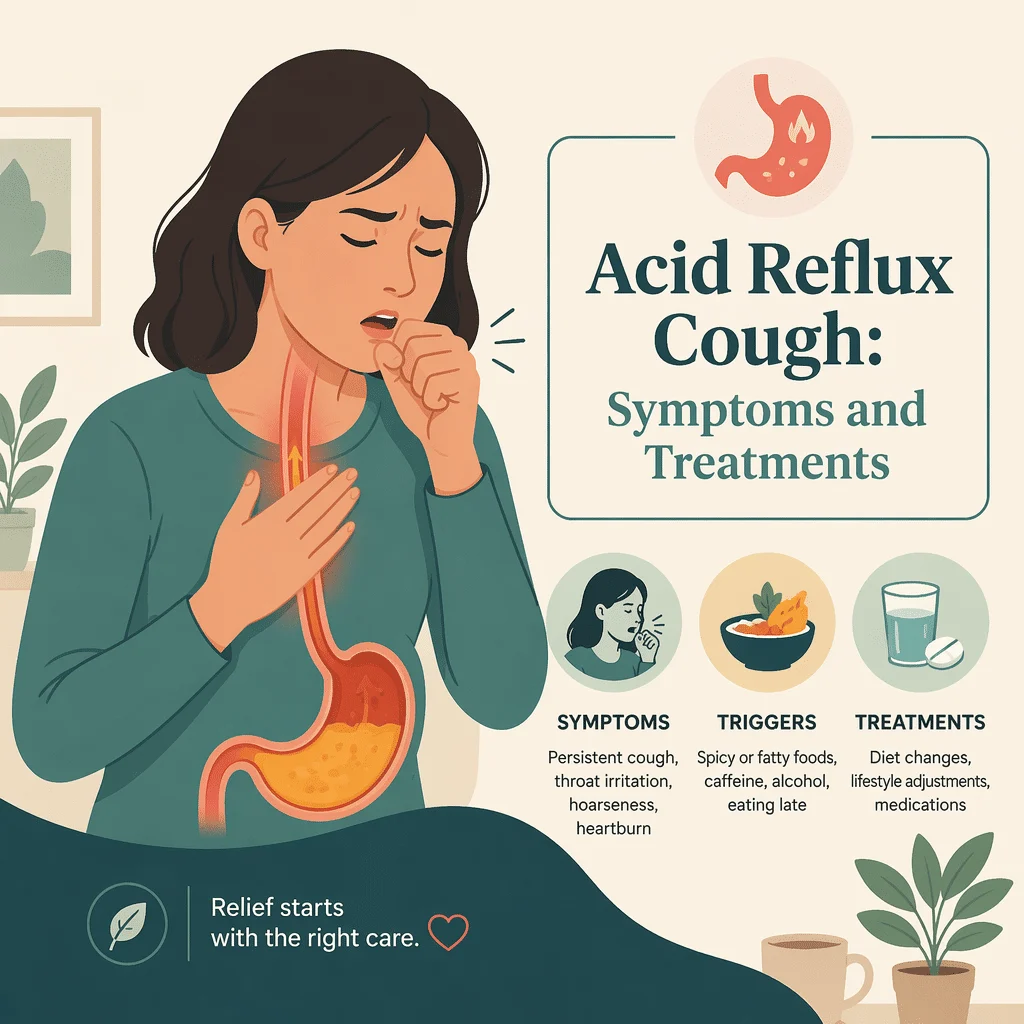
An acid reflux cough is a persistent cough driven by stomach contents traveling back up the esophagus. It is one of the most common explanations offered for a cough that has dragged on for weeks, and also one of the most frequently wrong. Many people with reflux-related cough never get heartburn at all, so being told “it cannot be reflux, you do not have heartburn” is unhelpful and often inaccurate.
In this article you’ll learn how reflux triggers coughing through two separate mechanisms, what the cough feels like, why reflux is over-diagnosed as a cause of long-lasting cough, how blood pressure medicines are mistaken for it, how it is actually assessed, and what genuinely helps. Please read the red-flag box below first: some coughs must never be put down to reflux without proper assessment.
How acid reflux causes a cough
Reflux happens when the lower esophageal sphincter, the muscular ring between the esophagus and the stomach, relaxes at the wrong moment and lets stomach contents move upward. Whether you cough depends on which of two very different pathways is involved.
Mechanism one: direct irritation of the throat and airway
In the first pathway, refluxed material travels high enough to reach the larynx (voice box) and the back of the throat. Acid, digestive enzymes and bile salts all irritate tissue that was never designed to meet them. The lining becomes inflamed and the cough reflex fires to clear it. This pattern is often called laryngopharyngeal reflux, or silent reflux, and it explains the throat symptoms that travel with the cough: constant throat clearing, a raw feeling, hoarseness and sometimes a sour or bitter taste in the phlegm. Repeated irritation can leave the throat looking bumpy, sometimes called cobblestone throat.
Mechanism two: the reflex that fires without anything reaching your throat
The second pathway surprises people. The esophagus and the airways share nerve supply through the vagus nerve, so when acid touches the lower esophagus, that shared wiring can set off a cough reflex in the airway even though nothing has traveled anywhere near the throat. This is called the esophago-bronchial reflex.
This is the single most useful fact in the whole subject. Because the trigger sits low in the esophagus and never reaches the throat or mouth, you can have a genuine reflux-driven cough and no heartburn whatsoever. The NIDDK overview of acid reflux and GERD is a good plain-language starting point. If a clinician has dismissed reflux purely because you do not get heartburn, that reasoning does not hold.
A third element keeps coughs going after the original trigger has settled. Repeated coughing can leave the nerves controlling the cough reflex over-sensitive, so small stimuli such as talking, laughing, cold air or perfume set off a bout. Doctors call this cough hypersensitivity, and it is one reason a cough can persist even after reflux is well controlled.
What a reflux cough feels like, and when it gets worse
The typical picture is a dry, tickly, unproductive cough rather than a wet, phlegmy one, often described as a tickle low in the throat that has to be cleared. Any phlegm brought up is usually scant and clear or white rather than colored.
Timing is the most informative clue. A reflux cough tends to be worse within an hour or two of eating, especially after a large or fatty meal, and worse when lying flat, because gravity is no longer keeping stomach contents down. Many people notice it most at bedtime or on waking. Some also get nausea at night, or a bitter mouthful on waking that can point toward bile as well as acid.
Alongside the cough, look for the throat cluster: frequent throat clearing, hoarseness that is often worst first thing, a globus sensation (a lump-in-the-throat feeling when nothing is there), and a sour or bitter taste. Some also report a tight or breathless feeling after eating. None of these prove reflux alone, but together they build a picture.
| Pattern you notice | What it may point to | Sensible next step |
|---|---|---|
| Cough plus clear heartburn or regurgitation | Reflux is a plausible contributor, though rarely the only one | Discuss a structured trial of therapy with a clinician, with a fixed review date |
| Dry tickly cough with no heartburn at all | Could still be reflux via the esophago-bronchial reflex, but post-nasal drip, asthma or cough hypersensitivity are just as likely | Ask for the three common causes to be worked through in order rather than assuming reflux |
| Cough that started within weeks of a new blood pressure medicine | An ACE inhibitor is a classic and commonly missed cause | Tell the prescriber. Never stop a blood pressure medicine yourself |
| Cough with any red-flag feature listed below | Something other than reflux needs to be ruled out first | Arrange prompt medical assessment. Do not attribute it to reflux |
The three common causes of chronic cough, and why reflux is over-diagnosed
A cough lasting more than about eight weeks in an adult is a chronic cough. In people who do not smoke, have a normal chest X-ray and take no ACE inhibitor, the great majority come down to three conditions, alone or in combination.
The first is upper airway cough syndrome, the modern name for post-nasal drip. Mucus from the nose and sinuses drips backward and irritates the throat, producing a cough with throat clearing that can look almost identical to reflux. Nasal allergy or sinus inflammation sits behind many of these cases.
The second is airway inflammation of the asthma type: classic asthma, cough-variant asthma where cough is the only symptom and there is no wheeze, and non-asthmatic eosinophilic bronchitis, where the airway is inflamed but lung function tests come back normal.
The third is reflux. It belongs on the list and is genuinely common. But it is also the cause blamed the most and proven the least, and this is where most health content goes wrong.
Here is the honest position. Reflux is easy to invoke because almost everyone has some reflux, throat symptoms are non-specific, and a laryngoscopy showing a slightly red or swollen larynx is a notoriously unreliable sign that appears in plenty of people with no reflux at all. Trials of acid suppression in people with chronic cough who have no objective evidence of reflux have been largely disappointing: pooled analyses of placebo-controlled trials show at best a small average benefit, and treating for longer does not produce a bigger effect. Guidance from gastroenterology and cough specialists is correspondingly cautious. An open-ended prescription of acid suppression for cough alone, in someone who has never had reflux demonstrated, is not well supported by the evidence.
So “your cough is reflux” should be treated as a hypothesis to be tested, not a diagnosis to be accepted. These three causes also frequently coexist, so fixing one and finding the cough only half better may mean there were two problems all along.
Medicines that cause a cough: the ACE inhibitor trap
ACE inhibitors (angiotensin-converting enzyme inhibitors) are among the most widely prescribed blood pressure and heart medicines, and their generic names end in “-pril”. A dry, persistent, tickly cough is a well-recognized effect of this drug class, caused by the medicine itself rather than by any lung or stomach problem.
The reason this gets missed so often is timing. The cough can begin within days of starting the drug, but it can also appear months later, which breaks the mental link between the tablet and the symptom. It then looks exactly like a reflux cough: dry, tickly, worse at night, with throat clearing. MedlinePlus lists medicines explicitly among the causes of chronic cough for precisely this reason.
The rule here is simple and non-negotiable. If you take an ACE inhibitor and have developed a persistent dry cough, tell your prescriber. Do not stop the medicine yourself and do not skip doses to “test” whether it is the cause. Untreated high blood pressure is dangerous, and stopping a heart or blood pressure medicine without cover can do far more harm than the cough. Whether to continue, switch class or investigate other causes is a decision for the person who prescribed it.
How a reflux-related cough is actually assessed
History does most of the work. A clinician will want to know how long the cough has lasted, whether it is dry or productive, what makes it worse, whether there is heartburn or regurgitation, what medicines you take, whether you smoke or have smoked, and whether you have nasal or allergy symptoms. A chest examination and often a chest X-ray follow, largely to exclude other explanations.
From there, the usual approach is a structured trial of therapy: one hypothesis at a time, a defined treatment period, and a firm review date at which you and the clinician judge whether the cough has actually changed. An open-ended prescription with no review is where reflux cough management most often goes off the rails. Improvement on acid-suppressing treatment does not by itself prove the cough was caused by acid.
When the picture stays unclear, or a proper trial has not worked, objective reflux testing beats another round of guessing. The main test is ambulatory pH-impedance monitoring, which records reflux episodes over a day or more. The impedance component matters most, because it detects reflux whether or not it is acidic. Upper endoscopy may be used to look for esophageal inflammation, and laryngoscopy lets a specialist view the voice box, though those findings need cautious interpretation.
Blood tests do not diagnose reflux cough. They are sometimes used to look at the wider picture, for example C-reactive protein, a full blood count, or an allergy blood test.
What actually helps, honestly
Measures clinicians commonly suggest
Non-drug measures are what most clinicians suggest first, and they are low-risk even when reflux turns out not to be the whole story. They commonly include eating smaller meals, leaving two to three hours between the last meal and lying down, raising the head of the bed by a few inches so the whole upper body is tilted rather than propping the head on pillows, and identifying personal trigger foods. Where relevant, weight reduction, reducing alcohol and stopping smoking have the strongest rationale. Avoiding forceful throat clearing helps too, because it irritates the larynx. Sipping water or using cough drops may ease the tickle without treating the cause.
Where acid suppression fits
Acid-suppressing medicines, including proton pump inhibitors, clearly have a place when someone has objectively demonstrated reflux disease. Used as a blanket treatment for a cough with no proven reflux, they often disappoint. Long-term use is not a benign default either, and both starting and stopping these medicines is a decision for your prescriber, not something to arrange yourself or continue indefinitely without review.
For coughs that persist despite all of this, specialist cough clinics use approaches aimed at the over-sensitive cough reflex rather than at acid: speech therapy with cough-suppression techniques, and prescribed neuromodulators that dampen nerve signaling.
How long it takes to settle
Even when reflux really is the driver and treatment is correct, a reflux-related cough usually takes weeks to months to settle, not days. Guidance commonly allows around eight to twelve weeks before judging whether a trial has worked. Inflamed laryngeal tissue heals slowly, and a sensitized cough reflex takes longer still to calm down. Nobody can promise you it will resolve, and partial improvement is a common and legitimate outcome. What you can reasonably expect is a clear plan, a review date, and a change of direction if that date passes without improvement.
Red flags: when a cough must not be blamed on reflux
Seek medical assessment promptly, and do not accept reflux as the explanation, if a cough comes with any of the following:
- Coughing up blood
- Unintentional weight loss
- Drenching night sweats
- Fever
- Breathlessness
- Chest pain
- Difficulty swallowing, or pain on swallowing
- A new hoarse voice lasting more than three weeks
- A lump in the neck
- A cough in anyone who currently smokes or used to smoke
These features need evaluation in their own right. Attributing such a cough to reflux, and treating it with acid suppression while the real cause goes unexamined, is the most serious avoidable harm in this area.
The National Institute on Deafness and Other Communication Disorders makes the same point about the voice: hoarseness lasting more than three weeks warrants a medical opinion.
Latest scientific advances in reflux-related cough
Research since 2023 has moved consistently away from treating suspected reflux blindly, and toward proving it first.
A pooled analysis of acid-suppression trials (Floria and colleagues, 2024)
What was found: this systematic review and meta-analysis pooled eleven double-blind, placebo-controlled randomized trials of acid-suppressing medicines in adults with non-specific chronic cough. Compared with placebo, proton pump inhibitors reduced cough severity only slightly, and longer courses did not produce greater improvement. What this means for you: if you have been prescribed acid suppression for a cough without reflux having been demonstrated, a modest effect is the realistic expectation, and extending the course is unlikely to change it.
The AGA expert review on reflux outside the esophagus (Chen and colleagues, 2023)
What was found: the American Gastroenterological Association’s clinical practice update concluded that no single test can confirm reflux as the cause of throat or airway symptoms, that improvement on acid suppression should not be treated as proof of reflux, and that after one adequate trial of up to about twelve weeks, further trials of different acid-suppressing drugs are low yield. It also advised considering objective reflux testing before starting treatment in people with cough or throat symptoms but no typical heartburn. What this means for you: if one proper trial has failed, testing is a more logical next step than a different tablet.
An update on laryngopharyngeal reflux (Algara and Chan, 2025)
What was found: this review reported that presumptive diagnoses of laryngopharyngeal reflux disease, made on symptoms or laryngoscopy findings alone, are often incorrect, because those findings correlate poorly with objective evidence of reflux. The authors argued for upfront reflux testing rather than empirical acid suppression, and for treatments aimed at non-reflux mechanisms including voice therapy, neuromodulation and behavioral therapy. What this means for you: a red-looking larynx is suggestive at best, and if reflux treatment has not worked, therapies targeting the cough reflex itself are a legitimate avenue.
Non-acid reflux in stubborn cough (Lilly and Carroll, 2026)
What was found: this review noted that laryngopharyngeal reflux is a common contributor to chronic cough but frequently fails to respond to acid suppression, because non-acidic and weakly acidic reflux are often responsible in stubborn cases. Combined impedance and pH testing is described as the reference standard for identifying it, with barrier agents such as alginates and lifestyle measures used alongside acid suppression only where indicated. What this means for you: a cough that has not budged on acid-lowering treatment does not rule reflux out. The reflux may simply not be acidic, which needs a different test.
Frequently asked questions
Can you have a reflux cough without heartburn?
Yes, and this is common. Reflux can trigger coughing through a nerve reflex shared between the esophagus and the airways, so the cough can fire even when nothing reaches the throat and even when there is no burning sensation at all. When reflux reaches the larynx without causing heartburn, it is often called silent reflux. Being told your cough cannot be reflux purely because you do not get heartburn is not sound reasoning. The flip side is that the absence of heartburn also removes an easy clue, which is exactly why objective testing matters more in this situation, not less.
How long does an acid reflux cough take to go away?
Longer than most people expect. Even when reflux is genuinely the cause and the treatment is right, weeks to months is the usual timescale rather than days. Guidance commonly allows around eight to twelve weeks before deciding whether an approach has worked. Irritated laryngeal tissue heals slowly, and a cough reflex that has become over-sensitive takes longer still to settle. Partial improvement is a common and acceptable outcome. If nothing has changed by your review date, that is useful information, and it should prompt a change of plan rather than more of the same.
Do proton pump inhibitors cure a reflux cough?
Often not on their own. Pooled evidence from placebo-controlled trials in people with non-specific chronic cough shows only a small average reduction in cough severity, and longer courses do not perform better. These medicines are far more useful when reflux disease has actually been demonstrated by testing. Improvement while taking one does not prove the cough was caused by acid, and long-term use is not a benign default. Whether to start, continue or stop is a decision for your prescriber, and it deserves a proper review rather than a repeat prescription that runs indefinitely.
Could my blood pressure medicine be causing my cough?
It is genuinely possible if you take an ACE inhibitor, a class whose generic names end in “-pril”. A dry, tickly, persistent cough is a recognized effect of these drugs, and because it can appear months after starting, the connection is often missed and the cough gets blamed on reflux instead. Tell your prescriber if this applies to you. Do not stop the medicine yourself and do not skip doses to test the theory, because untreated high blood pressure carries real risk. Switching to a different class, if appropriate, is a simple conversation to have.
Why is my cough worse at night?
Lying flat removes gravity’s help, so stomach contents move upward more easily, and reflux episodes at night tend to last longer because you swallow less while asleep. That is why the cough often peaks at bedtime or on waking. Nasal congestion and post-nasal drip also worsen when lying down, which is one reason night-time cough alone does not distinguish reflux from upper airway causes. Raising the head of the bed so the whole upper body is tilted, and leaving two to three hours between eating and lying down, are the measures clinicians most commonly suggest.
What does a reflux cough sound like?
Typically dry, short and tickly rather than deep and chesty, often coming in bursts and accompanied by throat clearing. Any phlegm is usually scant and clear or white. That said, sound is a weak diagnostic clue. Upper airway cough syndrome and cough-variant asthma can produce a near-identical dry cough, which is precisely why timing, associated symptoms, your medicine list and, where needed, objective testing carry far more weight than how the cough sounds.
Glossary of key terms
| Term | Definition |
|---|---|
| Gastroesophageal reflux disease (GERD) | Reflux of stomach contents into the esophagus that is frequent or severe enough to cause symptoms or complications |
| Laryngopharyngeal reflux (LPR) | Reflux reaching the throat and voice box, often causing cough, hoarseness and throat clearing without heartburn. Also called silent reflux |
| Lower esophageal sphincter | The ring of muscle between the esophagus and stomach that normally keeps stomach contents from moving upward |
| Esophago-bronchial reflex | A nerve reflex, carried by the vagus nerve, in which acid in the lower esophagus triggers coughing in the airway without anything reaching the throat |
| Cough hypersensitivity | An over-sensitive cough reflex in which minor triggers such as talking, laughing or cold air set off coughing |
| Upper airway cough syndrome | Cough caused by nasal or sinus secretions irritating the throat. The current term for post-nasal drip |
| Non-asthmatic eosinophilic bronchitis | Airway inflammation of the asthma type that causes cough while lung function tests remain normal |
| pH-impedance monitoring | An ambulatory test that records reflux episodes over 24 hours or more and detects both acidic and non-acidic reflux |
| Laryngoscopy | Examination of the voice box with a small flexible scope, usually performed by an ear, nose and throat specialist |
| ACE inhibitor | A class of blood pressure and heart medicines, with generic names ending in “-pril”, that can cause a dry persistent cough |
| Globus sensation | The feeling of a lump or tightness in the throat when no physical lump is present |
Sources
- National Institute of Diabetes and Digestive and Kidney Diseases. Acid Reflux (GER & GERD) in Adults
- MedlinePlus, National Library of Medicine. Cough
- National Institute on Deafness and Other Communication Disorders. Hoarseness
- Floria DE, Obeidat M, Kávási SB, et al. Systematic review and meta-analysis: proton pump inhibitors slightly decrease the severity of chronic cough. Scientific Reports, 2024. https://doi.org/10.1038/s41598-024-62640-9
- Chen JW, Vela MF, Peterson KA, Carlson DA. AGA Clinical Practice Update on the Diagnosis and Management of Extraesophageal Gastroesophageal Reflux Disease: Expert Review. Clinical Gastroenterology and Hepatology, 2023. https://doi.org/10.1016/j.cgh.2023.01.040
- Algara MA, Chan WW. Update on laryngopharyngeal reflux disease. Current Opinion in Gastroenterology, 2025. https://doi.org/10.1097/MOG.0000000000001108
- Lilly GL, Carroll TL. Laryngopharyngeal Reflux and Chronic Cough. Otolaryngologic Clinics of North America, 2026. https://doi.org/10.1016/j.otc.2026.03.015
Further reading
- Bad tasting phlegm: causes and treatments
- Sinus infection: is it contagious, causes and risks
- Cough drops: benefits, uses and risks
- Asthma: a respiratory disease explained
- Shortness of breath after eating: causes and treatments
Understand your lab results with AI DiagMe
A reflux cough is diagnosed clinically, from your history, your response to a structured trial and, where indicated, reflux testing. No blood test can confirm or exclude it. If a doctor investigates a persistent cough, they may check inflammatory markers or a full blood count as part of building the wider picture, and AI DiagMe can help you understand what those numbers mean before your appointment. AI DiagMe does not diagnose any condition and does not replace your doctor.
Get your results interpreted in minutes