





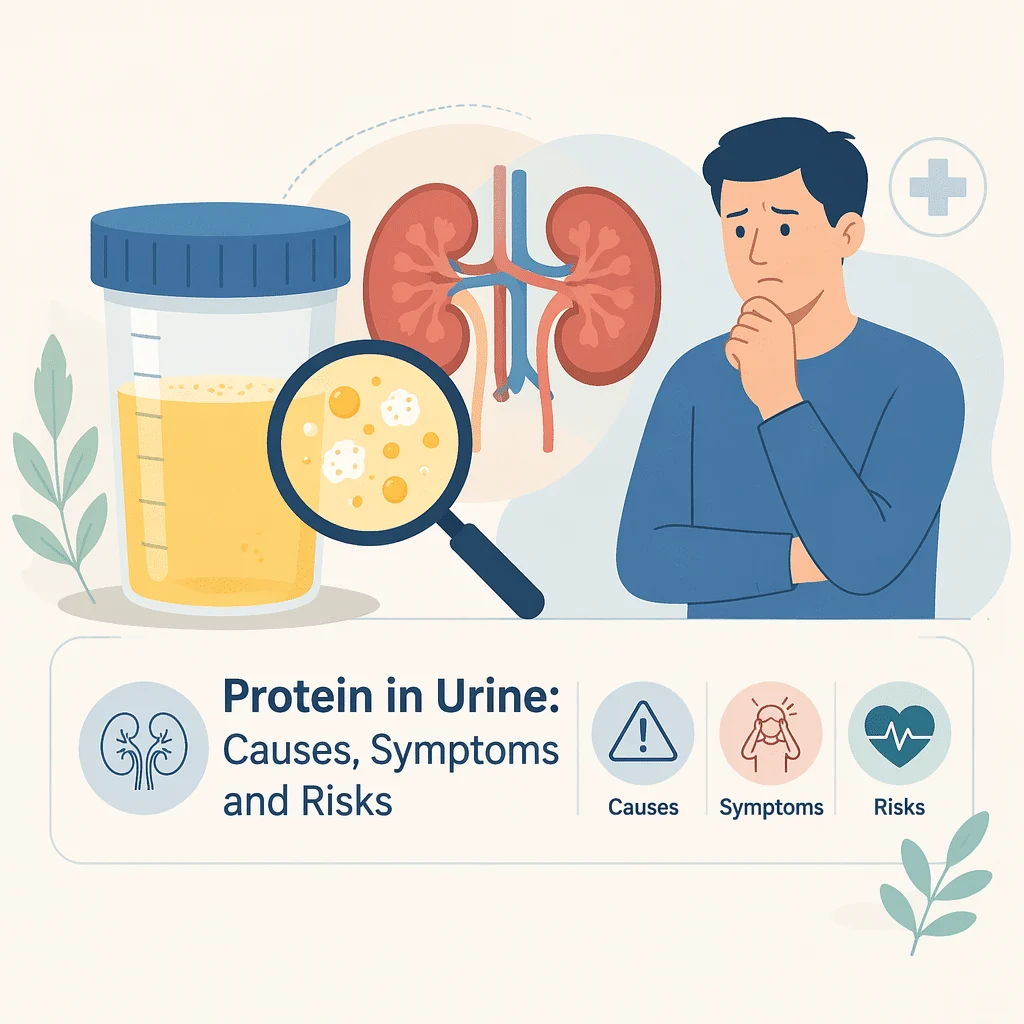
Protein in urine, called proteinuria in medical shorthand, is one of the most common abnormal findings on a routine test strip and one of the most misunderstood. Healthy kidneys keep protein in the bloodstream, so finding it in a urine sample suggests the filter is letting something through. Yet a single positive strip is very often nothing at all: a fever, a hard workout, cold weather or a long day upright can each produce one, and it clears on its own.
In this article you will learn which patterns are harmless, which conditions make protein leak persistently, why pregnancy changes the stakes, what the test strip cannot see, and what happens after an abnormal result. A short list of situations needing urgent attention sits in the red-flag box below: read that first if any of it applies to you. For the pad-by-pad tour of a whole report, see our urinalysis results interpretation guide.
What protein in urine actually means
Each kidney contains roughly a million filtering units. At the head of each sits a glomerulus, a tuft of tiny blood vessels that acts as a sieve, letting water, salts and waste through while holding back the larger proteins the body needs to keep, above all albumin. Whatever small amount slips past is largely reclaimed further down the tubule.
So a healthy urine sample contains only a trace of protein. When more appears, there are three broad explanations. The filter itself may be leaking, which is what happens in most kidney disease. The tubules may have lost the ability to reabsorb what they normally recover. Or the blood may contain far more of a small protein than the kidney was designed to handle, so the excess spills over even though the filter is intact.
What matters is therefore never one reading. It is whether the finding persists, how much protein is there when measured properly, and what else is going on.
The harmless patterns behind most positive results
Most people who see protein flagged on a single sample do not have kidney disease. Two benign patterns account for a large share of positive strips, particularly in younger people, and both resolve without treatment.
Transient proteinuria
Protein can appear in the urine for a day or two after a fever, a vigorous run or gym session, cold exposure, dehydration, emotional stress or any acute illness. The mechanism is temporary: blood flow through the kidney changes under stress, and a little more protein gets through. Nothing has been damaged, and a repeat sample taken once you are well and rested is typically clean.
This is the best reason not to act on one result. Repeating the test after the trigger has passed is standard practice, not a delaying tactic. A strip done while you had a temperature or straight after exercise may simply be describing that day.
Orthostatic (postural) proteinuria
In adolescents and young adults there is a distinct, entirely benign pattern in which protein appears while the person is upright and disappears completely when they lie down. It is called orthostatic, or postural, proteinuria. It is common at this age, it does not damage the kidneys, and long-term follow-up has not shown it progressing to kidney disease.
It is also easy to demonstrate, which is what makes it so reassuring. The split collection is simple. You empty your bladder just before bed, so that everything collected overnight was produced while lying flat. Immediately on waking, before standing up or moving around, you collect that first-morning sample. A second sample is collected later in the day, after normal upright activity. If the first-morning sample contains no protein while the daytime one does, the pattern is orthostatic and no kidney disease is present.
A great many teenagers are frightened by a positive dipstick at a school medical or a sports physical. In this age group that is usually the explanation, and the first-morning sample is usually the answer. The dividing line is exactly this: protein that vanishes overnight is benign, protein present in every sample is not.
When protein keeps appearing: the causes that matter
Protein present on repeated samples, including first-morning ones, is called persistent proteinuria, and it is the finding that carries weight. It marks kidney damage, and it also predicts how a kidney problem is likely to behave over time. The usual causes are these.
- Diabetes. Long-standing high blood sugar damages the glomerular filter, and diabetic kidney disease is the commonest single cause of kidney failure. Protein or albumin in the urine is often the earliest sign, appearing well before any symptom; our guide to glucose levels and what they mean covers the blood side.
- High blood pressure. Sustained pressure damages the small vessels of the filter, and the damaged kidney pushes pressure higher, which is why the two are managed together.
- Glomerulonephritis. A family of conditions in which the filters become inflamed. IgA nephropathy, the commonest worldwide, often shows up as protein together with blood.
- Lupus and other autoimmune disease. The immune system can attack the glomeruli directly, and urine testing is a main way lupus kidney involvement is found and monitored.
- Amyloidosis. Abnormal protein deposits accumulate in the filter and wreck it, often causing very heavy protein loss.
- Infection, obesity, some medicines and, less often, inherited conditions of the filter or tubules.
Protein and blood appearing together is a meaningful combination, because it points towards the filter itself rather than the bladder or a passing irritation, and it usually prompts a faster work-up than either finding alone; see our article on hematuria and blood in urine.
Nephrotic syndrome and what people actually notice
When protein loss becomes heavy, the level of albumin in the blood falls, and fluid that albumin would normally hold inside the vessels leaks into the tissues. That combination is called nephrotic syndrome: heavy protein loss, low blood albumin, swelling and raised blood fats.
The swelling is what people notice first, and its pattern is characteristic: puffy eyelids and a swollen face in the morning, ankles and legs that swell as the day goes on, sometimes a swollen abdomen, with weight gain from retained fluid, tiredness and loss of appetite. Because so much albumin is lost, people with nephrotic syndrome are also more prone to infections and blood clots.
The other thing people notice is frothy or foamy urine: protein changes the surface tension of urine, so it foams in the bowl and the foam lingers instead of clearing. Plenty of foam has nothing to do with protein, and our article on foamy urine and what it means works through the alternatives. Persistent foam alongside swelling is worth reporting promptly.
Protein in urine during pregnancy and the pre-eclampsia warning
This is the situation in which protein in urine stops being a question for the next appointment. New protein after 20 weeks of pregnancy, especially with raised blood pressure, can indicate pre-eclampsia, a condition affecting the placenta and the mother’s blood vessels that is dangerous for both parent and baby and can worsen quickly.
The symptoms to know are a headache that does not settle, visual disturbance such as flashing lights or blurring, pain below the ribs on the right or in the upper abdomen, sudden swelling of the face, hands or feet, nausea and vomiting in later pregnancy, and shortness of breath. Any of these warrant same-day contact with your maternity team rather than waiting for the next visit. Urine testing and a blood pressure check at every antenatal appointment exist precisely to catch this.
One point deserves emphasis, because it is where people are most often falsely reassured. Pre-eclampsia can now be diagnosed without any protein in the urine at all. Many current guidelines accept the diagnosis when new high blood pressure appears with evidence that another organ or the placenta is affected, even if the urine test is clean. A negative urine protein result in pregnancy is therefore not a reason to dismiss a headache, visual changes or upper abdominal pain. Describe the symptoms; do not let the strip speak for you.
What the urine dipstick can miss
The protein pad is a useful screening tool and a poor measuring instrument, and knowing its blind spots explains a lot of otherwise confusing results.
Its most important limitation is that it responds mainly to albumin and is comparatively insensitive to other proteins. That matters because of one condition in particular. In myeloma and related disorders, abnormal plasma cells produce large quantities of small immunoglobulin fragments called free light chains, known historically as Bence Jones protein, which pass into the urine. The pad detects them poorly, so a negative strip does not exclude them. This is why a doctor who suspects myeloma orders specific tests, such as serum free light chain measurement and protein electrophoresis, rather than relying on a strip; our guide to the kappa lambda ratio and free light chains explains what those look at.
Three further quirks matter. A very dilute sample can read falsely negative because the protein is spread too thinly to register, which is one reason urine specific gravity is reported alongside it. Very alkaline urine, contamination, blood in the sample, some antiseptics and a strip left in the urine too long can all push the pad towards a false positive. And the pads sit side by side for a reason: a positive protein result reads differently depending on whether the leukocyte esterase pad suggests infection, the glucose pad points to diabetes, or ketones show the sample was given during illness or fasting.
What happens after an abnormal protein result
There is a fairly standard sequence, and knowing it removes much of the anxiety of waiting.
The first step is almost always to repeat the test, usually on a first-morning sample and away from fever, exercise or menstruation. If protein is still present, it is quantified rather than estimated, by measuring it against creatinine so the result is not distorted by how dilute the urine was; our article on urine creatinine explains how that correction works and where it falls down.
Alongside that come blood tests of kidney function, since urine protein describes leakage while blood tests describe filtering capacity; our guide to high BUN and creatinine levels covers those numbers. Blood pressure is measured properly rather than in passing, blood glucose is checked, and depending on the picture a doctor may add tests for autoimmune disease or abnormal proteins, a kidney ultrasound, or referral to a nephrologist. A biopsy is occasionally needed when the cause is unclear.
Two things are worth saying plainly. Some blood pressure medicines are chosen specifically because they lower the amount of protein leaking into the urine as well as lowering pressure, which is why the prescriber’s choice matters and why you should never start, stop or change one on your own initiative. And any change to what you eat in kidney disease is a specialist decision taken with a renal dietitian, because getting it wrong causes malnutrition. No supplement or over-the-counter product has been shown to fix protein in the urine, and several can make kidney problems worse.
| Situation | What it usually means | What usually happens next |
|---|---|---|
| Trace protein after a fever, a hard workout or cold exposure | Transient proteinuria, a temporary change in kidney blood flow rather than damage | Repeat the sample once you are well and rested; usually no further action |
| Protein in a teenager that disappears in a first-morning sample | Orthostatic proteinuria, a benign postural pattern that does not progress | Confirmed by comparing overnight and daytime samples; reassurance, no treatment |
| Protein present on repeat testing with diabetes or high blood pressure | Persistent proteinuria, a marker of damage to the filter that needs a cause | Quantified against creatinine, blood tests of kidney function, blood pressure and glucose review |
| Protein with swelling of the eyelids or legs and frothy urine | Possible nephrotic syndrome, meaning heavy protein loss with low blood albumin | Prompt medical assessment, often within days; specialist input is usual |
| New protein after 20 weeks of pregnancy, with or without symptoms | Possible pre-eclampsia, particularly if blood pressure is also raised | Same-day contact with maternity care; blood pressure, bloods and monitoring |
When to seek care
Most protein findings are handled at the pace of a routine appointment. A handful are not.
Red flags: seek medical help the same day
- More than 20 weeks pregnant with new swelling of the face, hands or feet, a persistent headache, visual changes such as flashing lights, or pain in the upper abdomen or below the ribs on the right: contact your maternity team today, whatever the urine result showed.
- Swelling around the eyes or in the legs together with frothy urine that does not clear.
- Breathlessness, particularly when lying flat, alongside any swelling.
- Passing much less urine than usual, or almost none.
- Visible blood in the urine together with protein on a test result.
- Fever with pain in the flank or back, which can mean a kidney infection.
Otherwise, book a routine appointment if protein has shown up on more than one sample, or if you have diabetes, high blood pressure or a family history of kidney disease and have never had your urine checked. Bring the report itself.
Latest scientific advances in protein testing
Research over the past three years has sharpened four things: how confidently the benign patterns can be identified, how pre-eclampsia is defined, how much the strip misses, and what goes wrong after an abnormal result.
Proteinuria in adolescence is usually benign, and there is a pathway for proving it
What was found: an educational review in Pediatric Nephrology examined how protein in urine should be assessed in teenagers and concluded that at this age it is most often transient or orthostatic, while setting out how to recognise the minority of cases that signal genuine kidney disease. The authors proposed a single unified pathway, since adolescents are seen sometimes in children’s services and sometimes in adult ones.
What this means for you: if a school or sports physical picked up protein in a young person, the expected next step is a properly collected first-morning sample, not alarm.
Pre-eclampsia is increasingly defined without proteinuria
What was found: a scoping review in Hypertension in Pregnancy compared current international guidelines on how pre-eclampsia is defined. All agree on high blood pressure with new protein in the urine, but many also accept the diagnosis when raised pressure occurs with evidence of organ dysfunction or a struggling placenta, with no proteinuria required.
What this means for you: a clean urine test in pregnancy does not rule pre-eclampsia out. Symptoms are assessed on their own merits, which is why the red-flag box above says to report them regardless of the strip.
A negative strip does not settle the question in people at risk
What was found: a prospective screening study in general practice, published in MMW Fortschritte der Medizin, tested adults with risk factors such as diabetes, high blood pressure, obesity or heart disease but no known kidney disease. A substantial minority of those whose strip showed no protein nonetheless had a raised albumin-to-creatinine result when the sample went to the laboratory. The authors concluded that strip testing alone is of limited use for diagnosing chronic kidney disease.
What this means for you: with one of those risk factors, a laboratory albumin measurement is the test that answers the question, and a negative strip is no substitute.
The follow-up, not the detection, is where care most often breaks down
What was found: a very large population study in the American Journal of Kidney Diseases followed Stockholm adults in whom albuminuria was detected for the first time. Fewer than half were retested within the year, and only a minority of those with a clear indication were referred to a kidney specialist, with the widest gaps among people without diabetes.
What this means for you: detection is rarely the weak link; what happens next is. If protein or albumin has turned up, it is reasonable to ask when it will be repeated, whether it will be quantified, and what the plan is if it persists.
Frequently asked questions
Does protein in urine always mean kidney disease?
No. A single positive result is common and frequently has a benign explanation. Transient proteinuria follows fever, hard exercise, cold exposure, dehydration or acute illness and clears within days. Orthostatic proteinuria, seen in adolescents and young adults, appears only when the person is upright and vanishes in an overnight sample; it does not progress to kidney disease. What raises concern is protein that persists across repeated samples, including first-morning ones, particularly in someone with diabetes, high blood pressure or swelling. Only your doctor, with repeat testing and blood results, can say which category yours falls into.
Can exercise cause protein in urine?
Yes, and it is one of the commonest innocent explanations. Vigorous or prolonged exercise temporarily changes blood flow through the kidney and allows a little more protein through the filter than usual. Endurance events, heavy resistance training and hard interval sessions can all do it. The finding is temporary and typically gone within a day or two of rest. This is why clinicians ask what you had been doing before the sample, and why a repeat test is normally scheduled away from training rather than the result being acted on immediately.
What does foamy urine mean?
Foam that lingers instead of dispersing within a few seconds can reflect protein changing the surface tension of the urine, and it is the symptom people with heavy protein loss most often notice themselves. It is far from specific, though: a fast stream hitting the bowl, cleaning products in the toilet, concentrated urine and dehydration all produce foam in people with entirely normal kidneys. Persistent foam alongside swelling around the eyes or ankles deserves prompt assessment. Our dedicated article on foamy urine, linked above, works through the possibilities in detail.
Is a trace of protein in urine something to worry about?
Usually not on its own. A trace reading sits at the very bottom of the strip’s range and is easily produced by a concentrated sample, a recent workout, a mild illness or contamination during collection. It is not a diagnosis and it is not a measurement. What determines whether it matters is whether it is still there on a repeat sample and what your blood pressure, blood glucose and kidney blood tests show. A trace in a healthy person with no symptoms is generally repeated rather than investigated straight away.
Can protein in urine go away on its own?
Transient and orthostatic proteinuria resolve without any treatment, which is why so many positive results need nothing more than a repeat test. Persistent proteinuria is different: it does not resolve by itself, and how it is managed depends entirely on what is causing it, whether that is diabetes, blood pressure, an inflammatory kidney condition or something else. That is a matter for the doctor who has your full picture. Nothing you can buy over a counter treats it, and self-directed changes to diet or medication can cause harm.
Do I need a first-morning sample to check for protein?
For this particular question, yes, it is often specifically requested. Urine that has been in the bladder overnight was produced while you were lying flat, so it separates postural protein from the rest, and it is concentrated enough for small amounts to register rather than being diluted below the threshold. The instruction that makes it work is to empty your bladder immediately before bed and to collect the sample the moment you wake, before standing up and moving about. If nobody specified, ask which sample they want.
Glossary of key terms
| Term | Definition |
|---|---|
| Proteinuria | The presence of more protein in the urine than normal, whatever the cause |
| Albuminuria | Albumin specifically in the urine; albumin is the protein the dipstick pad detects best |
| Glomerulus | The tuft of tiny blood vessels that filters blood at the start of each kidney unit |
| Transient proteinuria | Short-lived protein in the urine after fever, exercise, cold or acute illness, which clears on its own |
| Orthostatic proteinuria | A benign pattern in young people where protein appears only when upright and is absent overnight |
| Nephrotic syndrome | Heavy protein loss with low blood albumin, swelling and raised blood fats |
| Pre-eclampsia | A pregnancy condition after 20 weeks involving raised blood pressure and organ or placental effects, sometimes with protein in the urine |
| Bence Jones protein | Free immunoglobulin light chains in the urine, associated with myeloma and poorly detected by a dipstick |
| Glomerulonephritis | Inflammation of the kidney filters, a group of conditions that includes IgA nephropathy |
Sources
- National Institute of Diabetes and Digestive and Kidney Diseases. Nephrotic Syndrome in Adults
- MedlinePlus, U.S. National Library of Medicine. Urine protein dipstick test
- Aslam A. Proteinuria. StatPearls, NCBI Bookshelf. Proteinuria
- Office on Women’s Health, U.S. Department of Health and Human Services. Pregnancy complications
- Pasini A, Nardini B, Alberici I, Pillon R, Fabbrizio B, Massella L. Proteinuria in adolescence. Pediatric Nephrology, 2026. doi:10.1007/s00467-025-07124-2
- Chamillard M, Diaz V, Gialdini C, Pasquale J, Portela A, Abalos E. Similarities and differences in international clinical practice guidelines for preeclampsia diagnosis and diagnostics: a scoping review. Hypertension in Pregnancy, 2025. doi:10.1080/10641955.2025.2532489
- Flohr J, Kemerle S, Klein S, Wendt R. Prospective CKD screening of high-risk patients in general practice. MMW Fortschritte der Medizin, 2025. doi:10.1007/s15006-025-5490-6
- Creon A, Faucon AL, Caldinelli A, Shin JI, Grams ME, Sjolander A, Fu EL, Carrero JJ. Care processes and clinical responses to newly detected albuminuria: the Stockholm Creatinine Measurements (SCREAM) project. American Journal of Kidney Diseases, 2026. doi:10.1053/j.ajkd.2025.09.020
Further reading
- Gamma globulins: high and low levels explained
- Low globulin levels: what they really mean
- Dehydration and blood pressure: higher or lower?
- Kidney stones: symptoms, treatment and prevention
- Kidney function panel: how to read it
Understand your lab results with AI DiagMe
A urinalysis report puts urine protein next to creatinine, glucose and a handful of other markers on a single page, usually without the context that decides what any of them mean. AI DiagMe reads your report back to you in plain language, including how a protein result sits alongside the rest. It helps you understand what you are looking at and what to ask your doctor; it does not diagnose kidney disease and it does not replace your doctor.
Get your results interpreted in minutes