






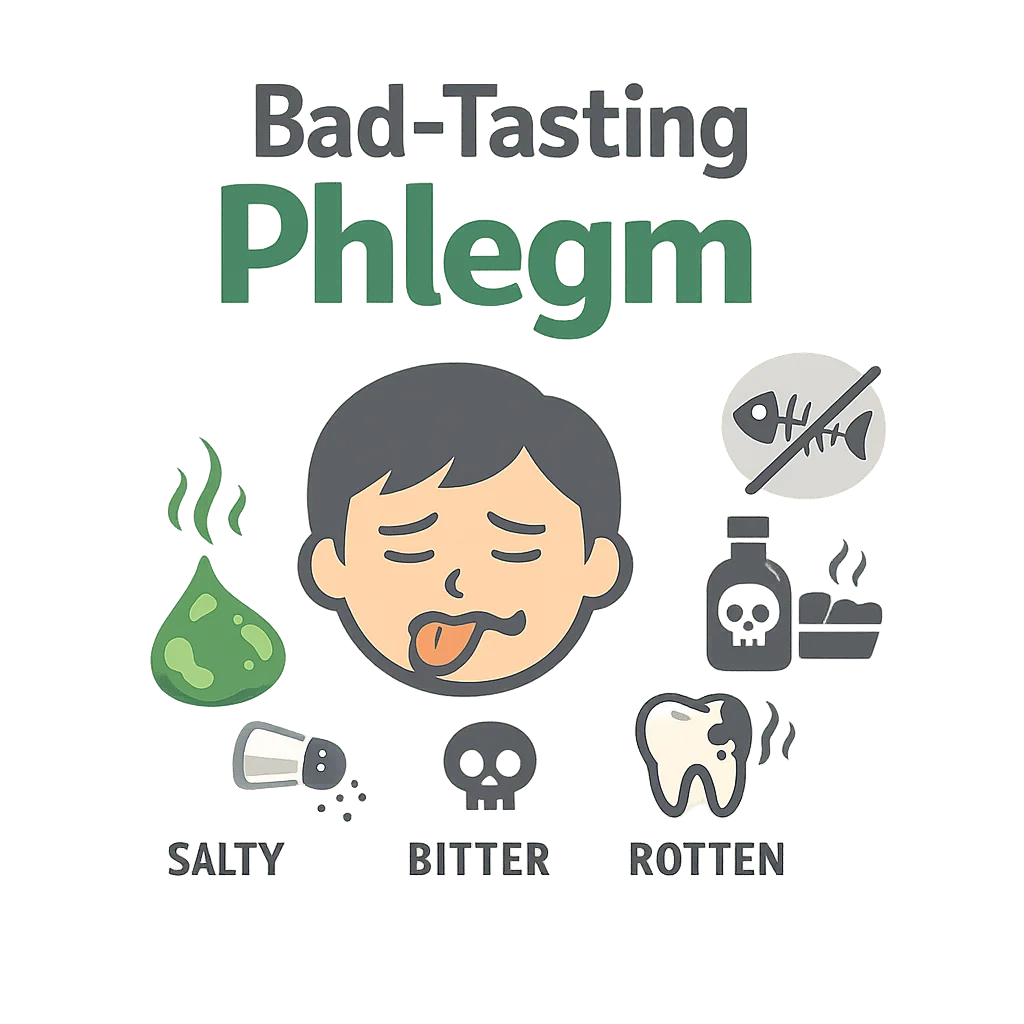
A foul, sour, salty or metallic taste in the mucus you clear from your throat is horrible to live with, but bad tasting phlegm is rarely a sign of anything dangerous. In most people it traces back to one of four ordinary problems: sinus secretions draining down the back of the throat, tonsil stones, acid reflux, or a dental problem such as gum disease.
In this article you’ll learn where the taste comes from, how to tell the common causes apart, what tonsil stones are and why so few people know they exist, why a dentist is sometimes the right person to see rather than a doctor, and the few warning signs that deserve prompt assessment.
Where the bad taste actually comes from
Mucus itself has almost no flavor. What you taste is what it carries.
When bacteria break down proteins in the mouth, throat or sinuses, they release volatile sulfur compounds, the same molecules behind the smell of rotten eggs. Tiny amounts are enough for your nose and tongue to register them as foul.
Two other mechanisms matter. Inflammation adds white blood cells and cell debris, which tastes stale and bitter. Stomach contents reaching the throat add acid, which tastes sour rather than rotten.
There is also a quirk of biology: much of what we call taste is really smell. The National Institute on Deafness and Other Communication Disorders notes that a persistent foul, salty, rancid or metallic taste has its own name, dysgeusia, and that most people who think they have lost their taste in fact have a smell problem.
Post-nasal drip and sinus problems: the commonest explanation
Your nose and sinuses produce mucus continuously, and most of it drains quietly down the back of the throat. When that mucus becomes thicker, more plentiful or infected, you start to feel it and taste it.
This is post-nasal drip, the single most frequent reason phlegm tastes bad. Secretions from the sinuses carry bacteria, inflammatory debris and dead white cells, and they sit at the back of the throat long enough for the taste to register. A cold, allergies, irritants such as smoke and sinus infection can all set it off.
Typical clues are a blocked or runny nose, constant throat clearing, a cough worse at night, facial pressure and mucus you can feel moving at the back of your throat. Some people also notice a cobblestoned look at the back of the mouth, which is irritated lymphoid tissue reacting to the drip; our guide to cobblestone throat covers it.
Most episodes settle as the cold or allergy flare settles. Saline nasal rinses, treating allergies and staying well hydrated are the usual first steps. If symptoms drag on beyond about twelve weeks, that is chronic rhinosinusitis and worth proper assessment. If you are wondering whether you can pass it on, see our article on whether a sinus infection is contagious.
Tonsil stones: the cause most people have never heard of
If your phlegm tastes foul and you occasionally cough up small white or yellowish specks, tonsil stones are a strong possibility. They are common, almost entirely harmless, and badly under-recognized, which is why people spend months looking elsewhere for an explanation.
What tonsil stones are and why they smell
The surface of the tonsils is not smooth; it is folded into deep pits called crypts. Food particles, dead cells, mucus and bacteria collect there, and over time the mixture compacts and calcifies into a small, soft stone. Doctors call them tonsilloliths.
They taste foul for the reason described earlier: the bacteria trapped inside produce volatile sulfur compounds. A stone the size of a grain of rice is enough to cause a persistent bad taste and noticeable bad breath. Many people also describe something stuck in the throat, mild one-sided ear discomfort, or an urge to clear the throat that never quite works.
You may see them as white specks in the crevices of the tonsils under a light, although plenty sit too deep to be visible. Our article on hidden tonsil stones covers those.
What to do, and what not to do
Small stones often dislodge on their own. Gentle salt water gargling after meals, good oral hygiene and, for some people, a water flosser on a low setting near the tonsils are what clinicians commonly suggest to help them work loose.
What you should not do is dig them out. Cotton swabs, toothpicks, bobby pins and fingernails are a genuinely bad idea: tonsil tissue is fragile and richly supplied with blood vessels, so poking at it risks bleeding, tearing and pushing bacteria deeper into the crypt. Persistent, large or recurring stones are a job for a clinician, who can remove them safely and discuss procedures on the tonsils if they keep returning.
One caution: a white or yellow patch on one tonsil that does not shift, especially with a one-sided sore throat, is not a tonsil stone and should be examined. Our page on unilateral tonsillitis explains why.
Dental and gum causes: when a dentist is the right call
This is the cause people miss most often, because a bad taste feels like a throat problem rather than a tooth problem. Frequently it is not.
Periodontal disease is an infection of the tissues that hold the teeth in place. The National Institute of Dental and Craniofacial Research lists persistent bad breath among its symptoms, alongside gums that are red, swollen, tender or bleeding, loose or sensitive teeth, and pain on chewing. Bacteria in the pockets between gum and tooth produce exactly the sulfur compounds that make breath and mucus smell foul.
A dental abscess or infected tooth can be more striking still. People describe a sudden gush of foul or salty fluid, sometimes with relief of pain as pus drains. That taste is pus, and it needs dental treatment rather than mouthwash. Hardened plaque, called calculus or tartar, harbors bacteria in the same way and cannot be brushed away at home, which is why our guide to managing calculus stresses professional cleaning.
The practical rule is simple, and it is probably the most useful thing on this page. If a foul taste comes with bleeding gums, tooth pain, swelling of the face or gum, a taste that seems to come from one spot, or a tooth newly sensitive to pressure, book a dentist rather than waiting. Left alone, dental infections spread, and no amount of throat care will fix them.
Reflux and laryngopharyngeal reflux: the sour taste
When stomach contents travel back up the esophagus to the throat and voice box, the result is a sour, acidic or bitter taste rather than a rotten one. This is gastroesophageal reflux disease; the version that mainly affects the throat is laryngopharyngeal reflux, sometimes called silent reflux because heartburn may be absent.
The pattern is the giveaway. The taste is worse first thing in the morning, after lying flat or after a late meal, and comes with a lump-in-the-throat sensation, frequent throat clearing, fluctuating hoarseness and thick sticky mucus. Our article on acid reflux cough covers the overlap with a persistent cough.
Sensible first steps are unglamorous: smaller evening meals, three hours between eating and lying down, raising the head of the bed, less alcohol, and weight loss where that applies. Medication decisions belong with your doctor, partly because reflux is diagnosed less reliably in the throat than in the esophagus.
Dry mouth, smoking and medications
Saliva is a natural rinse: it dilutes bacterial products and washes debris off the tongue and teeth. When saliva falls, everything that tastes bad becomes more concentrated.
Dry mouth has predictable causes: dehydration, mouth breathing at night, alcohol, and many medications including antihistamines, some antidepressants, diuretics and bladder drugs. The taste is often worst on waking, which is exactly when saliva has been lowest for hours and mouth breathing most likely.
Smoking and vaping contribute three ways at once: they dry the mouth, irritate the airway into producing more mucus, and change its bacterial mix. They also make gum disease harder to treat.
Medicines that change taste
Some drugs alter taste directly. Metronidazole is well known for a strong metallic taste, and several other antibiotics, chemotherapy agents, ACE inhibitors used for blood pressure, and supplements such as iron and zinc can do the same. The metallic quality persists between meals and does not depend on clearing your throat, which helps separate it from bacterial causes. If the timing fits a new medicine, raise it with your prescriber rather than stopping the drug yourself.
Infections can reset taste temporarily. Loss or distortion of taste and smell after COVID-19 and other viral illnesses is well documented; most people recover over weeks to months, but some are left with a lingering unpleasant or metallic taste. That is a taste and smell disturbance rather than genuinely foul mucus, and the distinction changes what is worth investigating.
Chest causes: chronic bronchitis, bronchiectasis and lung abscess
Most bad tasting phlegm never involves the lungs, but a minority does.
Chronic bronchitis, usually smoking-related, produces a productive cough on most days for months, and the sputum can be thick and unpleasant. In bronchiectasis the airways become permanently widened and scarred, so mucus pools instead of clearing. People with it often bring up large volumes of sputum daily, genuinely foul once the pooled mucus is colonized with bacteria. It is a manageable long-term condition that deserves a diagnosis rather than years of assumed chest infections.
Classically putrid sputum, meaning an unmistakably rotten smell, points toward a lung abscess or aspiration of mouth contents into the lung. This is uncommon but important, and it comes with other signs: fever, weight loss, night sweats and feeling genuinely unwell rather than merely annoyed by a taste. It is more likely after episodes of reduced consciousness, swallowing difficulty or advanced dental disease.
Sputum color alone is a poor guide, and green or yellow mucus does not automatically mean bacterial infection. Our article on white mucus covers what color can and cannot tell you, and bloody boogers looks at blood-streaked nasal mucus separately.
Matching what you notice to a likely cause
What you can observe yourself narrows things down well. This table is a guide to likely explanations, not a diagnosis.
| What you notice | What it usually points to | Who to see |
|---|---|---|
| Foul taste with a blocked nose and constant throat clearing | Post-nasal drip from a cold, allergy or sinusitis | Family doctor; ENT if it lasts beyond about 12 weeks |
| Small white specks coughed up, bad breath, something-stuck feeling | Tonsil stones | Family doctor or ENT; never dig them out yourself |
| Sour taste, worse on waking or lying down, with hoarseness | Reflux, including laryngopharyngeal reflux | Family doctor; gastroenterologist or ENT if persistent |
| Foul or salty taste with bleeding gums, tooth pain or gum swelling | Gum disease, decayed tooth or dental abscess | Dentist, promptly |
| Metallic taste between meals, starting after a new medicine | Drug-related taste disturbance | The prescriber who started the medicine |
| Large volumes of thick, discolored, foul sputum most days | Chronic bronchitis or bronchiectasis | Family doctor, who may refer to a chest specialist |
| Putrid sputum with fever, weight loss or night sweats | Needs assessment; possible lung infection or abscess | Doctor, without delay |
When bad tasting phlegm signals something serious
It usually does not. But a handful of symptoms change the picture, and they are worth knowing calmly rather than anxiously. Several are recognized warning signs for head and neck cancers listed by the National Cancer Institute, which stresses that they are far more often caused by less serious conditions and should simply be checked.
See a doctor promptly if bad tasting phlegm comes with any of the following:
- Coughing up blood, even small streaks, on more than one occasion. Hemoptysis always warrants assessment
- Unintentional weight loss
- Drenching night sweats
- Fever together with foul sputum
- New or worsening breathlessness
- A cough that has lasted more than about three weeks
- Difficulty or pain on swallowing
- A sore throat on one side that persists
- A lump in the neck
- Hoarseness lasting more than three weeks
Seek urgent care for severe breathlessness, drooling with inability to swallow, or a rapidly swelling face or neck.
When to see a doctor or a dentist
For a taste that appeared with a cold and is easing, give it a couple of weeks. Hydration, saline nasal rinses, thorough brushing and flossing, gentle tongue cleaning and stopping smoking cover most of what self-care achieves. Soothing measures such as cough drops ease throat irritation but do not treat the cause.
Book a dentist for any gum bleeding, tooth pain, facial or gum swelling, a taste localized to one area, or no check-up in over a year. Book a doctor if the taste has lasted beyond three to four weeks, if you bring up large amounts of sputum, if reflux symptoms are not responding to simple measures, or if any red flag above applies.
Investigation is usually clinical: a look in the nose, mouth and throat, a dental examination, sometimes a flexible camera examination by an ENT specialist or imaging. Blood tests are not how this symptom is diagnosed, though a doctor assessing a possible persistent infection may check markers such as C-reactive protein or a full blood count.
Latest scientific advances in understanding bad-tasting phlegm
Recent research has focused on which causes really account for a foul taste and breath, and how well we can measure and treat them.
A 2024 systematic review and meta-analysis of nine observational studies found a consistent association between periodontitis, the advanced form of gum disease, and measured halitosis, the medical term for bad breath. The link held whether bad breath was judged by a trained assessor or by a device detecting sulfur compounds. What this means for you: if a foul taste comes with any sign of gum trouble, the dentist is the highest-yield place to start, not the throat.
A 2023 systematic review and meta-analysis of 76 studies compared handheld breath-testing devices, called halitometers, with assessment by a trained human nose. They did not agree well, and no device was clearly better. What this means for you: a gadget cannot tell you why your phlegm tastes bad. Examination by a clinician remains how the cause is identified.
A 2023 systematic review and meta-analysis of 25 studies examined the overlap between reflux and chronic rhinosinusitis. Reflux disease was substantially more common in people with chronic sinus inflammation, and pepsin, a stomach enzyme, was detected more often in sinus samples from affected patients. What this means for you: sinus symptoms and reflux frequently coexist, so treating only one may leave the taste unchanged.
A 2024 systematic review and meta-analysis of eleven placebo-controlled trials looked at acid-suppressing medication for chronic cough, a close relative of throat reflux symptoms. The effect was real but small, and extending treatment from four weeks to twelve added nothing. What this means for you: reflux treatment is worth trying when the pattern fits, but if a reasonable trial makes no difference, look for another cause rather than continuing indefinitely.
Frequently asked questions
What are the white things I cough up from the back of my throat?
Almost always tonsil stones. They are small, soft, whitish or yellowish lumps of debris and bacteria that build up in the pits on the surface of the tonsils, and they smell strongly because the bacteria inside produce sulfur compounds. Coughing, sneezing or gargling can dislodge them. They are harmless in themselves. What is not harmless is trying to lever them out with a swab or a sharp object, which can tear tonsil tissue and cause bleeding. If they are large, frequent or bothersome, a clinician can remove them safely.
Should I see a doctor or a dentist for a bad taste with phlegm?
Look at what comes with it. Gum bleeding, tooth pain, gum or facial swelling, a taste that seems to come from one spot in the mouth, or a tooth newly sensitive to biting all point to a dentist, and dental causes are missed surprisingly often because a bad taste feels like a throat problem. Nasal blockage, throat clearing, a cough, hoarseness, reflux symptoms or colored sputum point to a doctor. If you genuinely cannot tell, a dental check-up is quick and rules out a whole category of causes.
When is a bad taste in phlegm serious?
Rarely, and the concerning features are specific rather than vague. Coughing up blood always warrants assessment, even small streaks. So do unintentional weight loss, drenching night sweats, fever alongside foul sputum, new breathlessness, a cough lasting more than about three weeks, difficulty swallowing, a persistent sore throat on one side, a lump in the neck, or hoarseness lasting more than three weeks. These are much more often caused by benign conditions than by anything sinister, but they are the ones that should be checked rather than watched.
Why does my phlegm taste worse in the morning?
Three things stack up overnight. Saliva production drops during sleep, so bacterial products in the mouth are less diluted. Many people breathe through the mouth while asleep, which dries the mouth and throat further. And lying flat makes both post-nasal drip pooling at the back of the throat and reflux from the stomach more likely. A morning-only taste that clears after brushing and breakfast is usually one of these rather than a sign of infection.
Can a bad taste be left over from COVID-19 or another virus?
Yes. Viral infections, including COVID-19, can disturb taste and smell, and a lingering unpleasant, metallic or distorted taste can persist after the infection itself has gone. Most people improve over weeks to months. The distinguishing feature is that the taste is present regardless of whether you clear mucus from your throat, and food often tastes wrong too. If it persists for months, or comes with nasal blockage, it is worth an ear, nose and throat assessment.
Does the color of my phlegm tell me what is wrong?
Less than most people assume. Green or yellow mucus reflects enzymes released by white blood cells and appears in ordinary viral colds as well as bacterial infections, so color alone does not decide whether antibiotics are needed. Volume, how long it has lasted, whether it is foul, and the symptoms accompanying it are all more informative. Blood in mucus is the one change in appearance that consistently deserves medical attention.
Glossary of key terms
| Term | Definition |
|---|---|
| Phlegm | Thick mucus produced in the airways and cleared by coughing or throat clearing |
| Sputum | The medical word for material coughed up from the lower airways and lungs |
| Post-nasal drip | Mucus from the nose and sinuses running down the back of the throat |
| Tonsillolith | A tonsil stone: compacted debris and bacteria formed in a pit on the tonsil surface |
| Halitosis | The medical term for persistent bad breath |
| Dysgeusia | A distorted sense of taste, often described as foul, salty, rancid or metallic |
| Volatile sulfur compounds | Smelly gases made by mouth and throat bacteria breaking down proteins |
| Laryngopharyngeal reflux | Stomach contents reaching the throat and voice box, often without heartburn |
| Periodontitis | Advanced gum disease affecting the tissues and bone that support the teeth |
| Hemoptysis | Coughing up blood, from streaks in sputum to larger amounts |
Sources
- Bad Breath (Halitosis), MedlinePlus, U.S. National Library of Medicine
- Periodontal (Gum) Disease, National Institute of Dental and Craniofacial Research
- Taste Disorders, National Institute on Deafness and Other Communication Disorders
- Head and Neck Cancers, National Cancer Institute
- Nini W, Chen L, Jinmei Z, et al. The association between halitosis and periodontitis: a systematic review and meta-analysis. Clinical Oral Investigations, 2024. https://doi.org/10.1007/s00784-024-05732-0
- Szalai E, Tajti P, Szabo B, et al. Organoleptic and halitometric assessments do not correlate well in intra-oral halitosis: a systematic review and meta-analysis. Journal of Evidence-Based Dental Practice, 2023. https://doi.org/10.1016/j.jebdp.2023.101862
- Aldajani A, Alhussain F, Mesallam T, et al. Association between chronic rhinosinusitis and reflux diseases in adults: a systematic review and meta-analysis. American Journal of Rhinology and Allergy, 2023. https://doi.org/10.1177/19458924231210028
- Floria DE, Obeidat M, Kavasi SB, et al. Systematic review and meta-analysis: proton pump inhibitors slightly decrease the severity of chronic cough. Scientific Reports, 2024. https://doi.org/10.1038/s41598-024-62640-9
Further reading
- Hidden tonsil stones: symptoms, causes and treatments
- Sinus infection: symptoms, causes and treatments
- Acid reflux cough: symptoms and treatments
- White mucus: causes, symptoms and treatments
- Kissing tonsils: causes, symptoms and treatments
Understand your lab results with AI DiagMe
Bad tasting phlegm is diagnosed by examination of the mouth, nose, throat and teeth rather than by a blood test. If your doctor is investigating a persistent infection alongside it, they may order inflammatory markers or a full blood count, and those numbers can be hard to read on your own.
AI DiagMe explains what such results mean in plain language so you can ask better questions at your next appointment. It does not diagnose anything, and it does not replace your doctor or your dentist.
Get your results interpreted in minutes