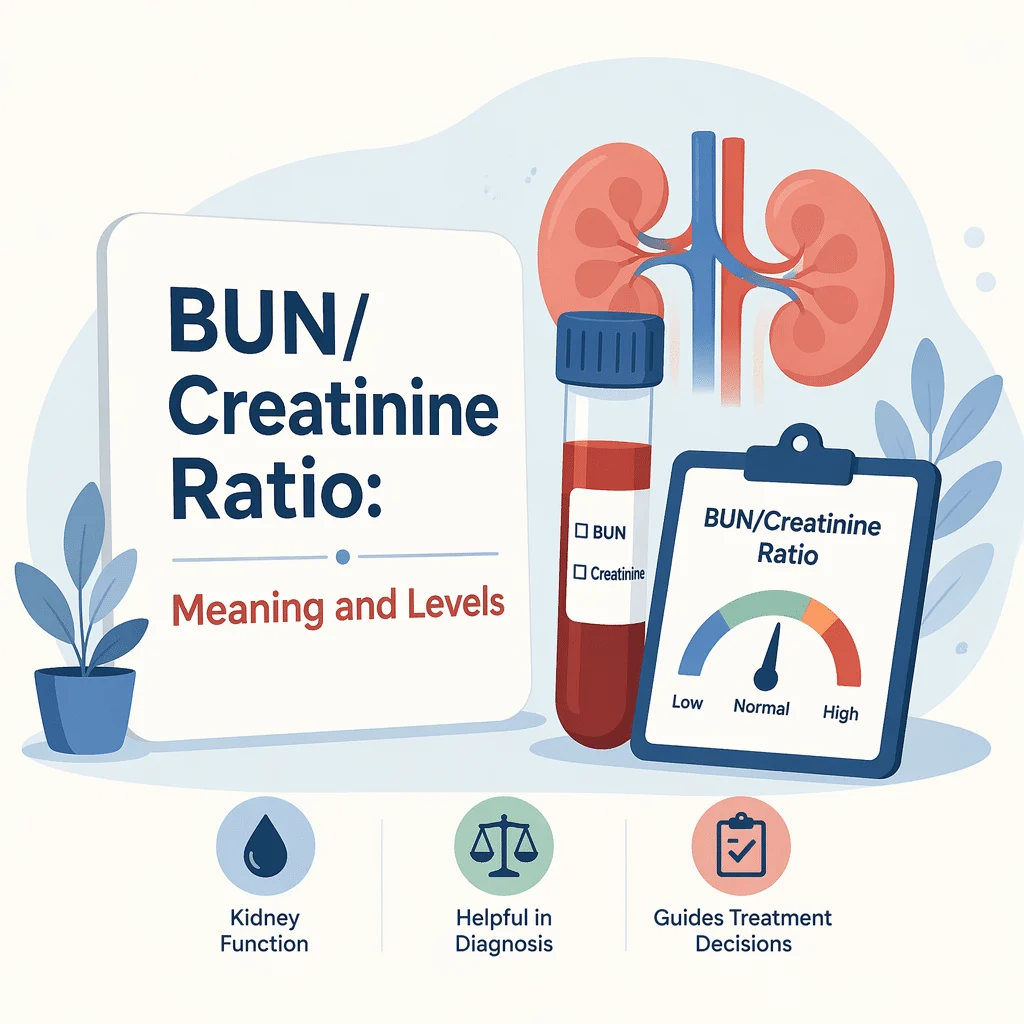
The BUN creatinine ratio is one number produced by one piece of arithmetic: your blood urea nitrogen result divided by your creatinine result. Clinicians calculate it because those two waste products do not always move together, and the gap between them can hint at where a problem sits rather than simply confirming that one exists. A ratio somewhere between 10:1 and 20:1 is widely quoted as typical. A higher figure often raises the question of reduced blood flow reaching the kidneys. A lower figure often raises the question of reduced urea production. All of that is genuinely useful, and none of it is a diagnosis.
In this article you will learn how the ratio is calculated, including a unit trap that catches readers outside the United States, why clinicians compute it, what a high and a low result each suggest, what doctors examine alongside it, when the number misleads, and which symptoms mean you should not wait.
What the BUN/creatinine ratio actually is
The ratio is a comparison, not a measurement. Nothing in your body produces a “ratio”. A laboratory measures two substances in the same blood sample, and either the analyzer or the clinician divides one by the other. Blood urea nitrogen of 18 mg/dL with creatinine of 1.0 mg/dL gives a ratio of 18:1; urea nitrogen of 30 mg/dL with the same creatinine gives 30:1.
That arithmetic matters because the two substances leave the bloodstream by partly different routes. Creatinine is filtered by the kidneys and then largely stays in the urine. Urea is filtered too, but a variable share is reabsorbed back into the blood, and that share rises when the kidney is working to conserve water and salt. So when circulation to the kidney falls, urea climbs faster than creatinine and the ratio widens. That single mechanism explains most of what follows.
A short word on the two ingredients
Blood urea nitrogen reflects the nitrogen carried in urea, the waste compound your liver makes when it breaks down protein. Creatinine is the waste left over from everyday muscle turnover. Both are cleared largely by the kidneys, which is why both appear on a kidney function panel. For the individual markers covered properly rather than in passing, our dedicated pages explain the blood urea nitrogen test and the creatinine blood marker, and a companion article covers high BUN and creatinine levels in full.
The unit trap: mg/dL versus mmol/L
Every familiar ratio figure you will read online assumes both values are in mg/dL, the United States convention. Much of the rest of the world reports urea in mmol/L and creatinine in µmol/L, and often reports urea itself rather than urea nitrogen. Divide those numbers and you get something entirely different — typically around 0.04 to 0.1, which looks alarming next to “10 to 20” and means nothing of the sort.
This is a common source of unnecessary worry. If your report shows urea in mmol/L, the 10:1 to 20:1 band does not apply to your arithmetic. Some laboratories outside the United States report a urea-to-creatinine ratio with its own reference interval, often quoted around 40 to 100 in molar units. Check the units printed beside your values before comparing anything.
Why clinicians calculate the ratio at all
Creatinine alone tells you that filtration has fallen; it does not tell you why. The classic reason for looking at the ratio is to help sort that “why” into broad categories: a problem before the kidney, inside the kidney, or after it.
Prerenal means the kidney tissue is intact but not receiving enough blood, because there is too little fluid in circulation or the heart is not pushing it forward effectively. Intrinsic means the filtering tissue itself is damaged. Postrenal means urine cannot drain away, usually because of an obstruction. Each calls for different next steps, and getting the category right early changes what a clinician does in the next hour.
The ratio contributes because urea reabsorption is sensitive to circulation in a way creatinine is not. A widening ratio therefore leans, weakly, toward the prerenal category. That is the whole of its diagnostic claim: a nudge in a direction, applied alongside blood pressure, pulse, examination findings, urine tests and the trend across previous results.
The typical band, and why it is softer than it looks
Most United States references quote a normal adult range of roughly 10:1 to 20:1, and MedlinePlus lists “BUN to creatinine ratio” among the standard reporting names for the urea nitrogen test. Some sources narrow it, others widen it. Thresholds above 20:1 for “high” and below 10:1 for “low” are conventions, not measured biological boundaries.
Three caveats matter more than the numbers. Laboratories differ in method and in the interval they print, so the band on your report is the one that applies. Age, sex, muscle mass and body size shift the underlying creatinine, and therefore the ratio, without anything being wrong. And a ratio sitting neatly inside the band tells you nothing reassuring if creatinine itself is climbing: both numbers can rise together and hold the ratio steady while filtration falls.
To be blunt: a ratio outside the quoted band is not a diagnosis, cannot be interpreted apart from the individual BUN and creatinine values, and means little without the clinical picture and the trend over time. Grading yourself against a threshold is the one thing this number does not support.
What a high BUN/creatinine ratio suggests
A high ratio, conventionally above about 20:1, means urea has risen out of proportion to creatinine. The explanations divide into two families: the kidney is underperfused, or the body is generating extra urea.
Prerenal states: the kidney is fine, the flow is not
When circulating volume drops, the kidney conserves water and salt aggressively and urea reabsorption rises with it. Fluid loss through vomiting, diarrhea, fever, sweating or diuretic treatment produces exactly this picture, which is why reduced volume also drives changes in blood pressure during dehydration. Significant blood loss does the same by shrinking circulating volume. Reduced cardiac output produces the pattern without any fluid being lost at all, which is why a widened ratio is common in people living with heart failure. Severe liver disease with fluid shifts, and any state of shock, can do likewise.
The upper gastrointestinal bleed pearl
Bleeding into the stomach or upper small intestine raises the ratio twice over. It reduces circulating volume like any hemorrhage, and it delivers a large protein load — digested blood — into the gut, where it is absorbed and converted to urea by the liver. Urea therefore climbs steeply while creatinine barely moves.
Clinically this is genuinely useful: a markedly raised ratio in someone passing black tarry stools shifts suspicion toward the upper digestive tract rather than the lower bowel, and it pairs naturally with the hemoglobin trend on a complete blood count. Darkened stool has far more mundane explanations too, covered in our page on black specks in stool — but combined with a raised ratio and any symptom of blood loss, it is not something to sit on.
Red flags that should not wait
Seek emergency care immediately — call your local emergency number — if a raised BUN/creatinine ratio comes with any of the following:
- Black, tarry or sticky stools
- Vomiting blood, or vomit that looks like coffee grounds
- Passing visible blood from the rectum
- Dizziness, fainting, marked pallor, a racing pulse or cold clammy skin
- Severe abdominal pain, or confusion and drowsiness
- Passing very little urine or no urine at all
These can signal active bleeding or a collapse in circulation. They need assessment now, not an appointment next week. Do not wait to see whether the next blood test looks better.
Other reasons urea runs ahead of creatinine
Not every high ratio involves poor perfusion. Corticosteroids increase protein breakdown and therefore urea production, as does any strongly catabolic state such as severe infection, major burns or trauma. A very high protein load, including tube feeding in hospital, raises urea without touching creatinine, and tetracycline antibiotics can act similarly. Very low muscle mass widens the ratio from the other side by keeping creatinine low.
What a low BUN/creatinine ratio suggests
A low ratio, conventionally below about 10:1, means urea is unusually low relative to creatinine. Again there are two families: too little urea made or retained, or creatinine pushed up disproportionately.
Reduced urea production is the larger group. Urea is manufactured by the liver, so significant liver disease lowers it — which is why abnormal liver function tests alongside a low ratio deserve attention. Low protein intake and malnutrition do the same by supplying less raw material, and a low albumin blood test result often accompanies that picture. Pregnancy lowers urea through increased plasma volume. Urea can also simply be removed: dialysis clears it efficiently, and water-retaining states such as SIADH dilute it.
The other route is a disproportionate rise in creatinine. Rhabdomyolysis — the breakdown of skeletal muscle after crush injury, extreme exertion or certain drug reactions — floods the blood with creatinine while urea lags behind. There the enzyme measured by the CPK creatine phosphokinase blood test rises steeply and is far more informative than the ratio. Very high muscle mass produces a milder version without any illness at all. A low ratio is rarely worrying in itself; it is a signal to look at the liver, at nutrition, and at whether creatinine is the number that has moved.
Reading the ratio in context
The table below shows how the same direction of change means different things depending on what accompanies it. It describes typical clinical reasoning and is not a tool for grading your own result.
| Ratio direction and context | What it points toward | What usually happens next |
|---|---|---|
| High, creatinine normal or barely raised, recent fluid loss | Reduced blood flow reaching the kidneys, tissue intact | History, examination, assessment of fluid status, repeat blood test |
| High, with black tarry stools or vomited blood | Possible bleeding in the upper digestive tract | Emergency assessment, complete blood count, endoscopy |
| High, during steroid treatment, tube feeding or severe illness | Extra urea production rather than a kidney problem | Review of treatment and nutrition context, repeat testing |
| High, with clearly raised creatinine and abnormal urine testing | Kidney tissue involvement alongside reduced perfusion | Urinalysis, urine chemistry, imaging, kidney specialist input |
| Low, with reduced albumin or abnormal liver enzymes | Reduced urea production by the liver, or low protein intake | Liver assessment, nutritional review |
| Low, with sharply raised creatinine, muscle pain, dark urine | Muscle breakdown pushing creatinine up disproportionately | Creatine kinase testing, urine testing, urgent medical review |
| Inside the usual band, but creatinine rising over weeks | A normal-looking ratio while filtration is falling | Trend review, estimated filtration rate, urine albumin testing |
Why the ratio settles nothing on its own
Two things are true at once: the ratio carries real information, and it performs modestly when asked to decide anything by itself. Studies testing it as a standalone discriminator repeatedly find it acceptable at ruling a possibility in when extreme, and poor at ruling anything out when it is not.
So modern assessment leans on the surrounding picture. History and examination come first. Then urine testing, where a dipstick and microscopy can reveal blood, protein or cellular casts pointing to kidney tissue damage — which is also why persistently foamy urine is worth mentioning to a clinician. Then urine chemistry, where urine sodium and the fractional excretion of sodium probe the same physiology more directly; our page covers urine electrolytes in detail. Imaging follows if obstruction is suspected.
Many laboratories no longer print the ratio routinely, for exactly this reason: a derived number with limited standalone accuracy invites over-interpretation. Its absence from your report is a reporting convention, not something withheld from you.
When the ratio is actively misleading
Several everyday situations distort the ratio enough to make it unhelpful. Very low muscle mass keeps creatinine low and inflates the ratio without any circulatory problem; very high muscle mass does the reverse. Stable chronic kidney disease can sit with both values elevated and an ordinary-looking ratio. Some medicines raise creatinine by blocking its secretion into urine without changing filtration, narrowing the ratio artificially. And the ratio always describes one moment: trend beats snapshot every time.
Latest scientific advances in interpreting the BUN/creatinine ratio
Research published between 2023 and 2026 converges on a consistent message: the ratio carries prognostic signal across several conditions, but its diagnostic accuracy taken alone is moderate at best. The following studies are drawn from PubMed.
How well the ratio locates gastrointestinal bleeding
A systematic review and meta-analysis published in 2026 pooled seventeen diagnostic accuracy studies to test whether the ratio can distinguish upper from lower gastrointestinal bleeding. What was found: at its best-performing cut-off the ratio identified roughly two thirds of upper bleeds while correctly excluding about seven in ten lower bleeds. At the stricter, more commonly quoted threshold it became much better at confirming an upper source but missed most of them. The authors described overall discrimination as moderate. What this means for you: a high ratio genuinely raises the probability of bleeding from the upper digestive tract, and it is cheap and instantly available, so emergency teams use it for early triage. A ratio that is not high does not rule an upper bleed out, which is why endoscopy remains the arbiter.
Whether the ratio predicts who needs intervention
A 2024 observational study of 466 emergency department patients with acute upper gastrointestinal bleeding asked whether the ratio could predict who would need an active procedure. What was found: the ratio was independently associated with needing intervention, but on its own its discriminating ability was only slightly better than chance. Combined into a model with hemoglobin and a history of variceal bleeding, performance improved considerably. What this means for you: the ratio adds something when it is one input among several, and very little when it stands alone.
Where a single-center cut-off diverges from the pooled evidence
A 2025 retrospective study of 300 patients admitted with acute gastrointestinal bleeding reported a threshold that separated upper from lower bleeding with very high sensitivity and specificity, and found that patients above it more often needed transfusion and endoscopic treatment. What was found: impressive performance in one hospital population. What this means for you: single-center cut-offs routinely look stronger than they prove to be once pooled across many settings, as the meta-analysis above shows. The authors themselves called for standardized thresholds before wider use, so treat any specific “diagnostic ratio” figure with caution.
The ratio as a prognostic marker in heart failure
A systematic review and meta-analysis published in 2024 combined fourteen studies of people with heart failure. What was found: a higher ratio was consistently associated with a greater risk of death from any cause, in both acute and chronic heart failure and across age groups, though the same analysis did not support it as a predictor of cardiovascular-specific death or of readmission. A separate 2023 cohort of 504 people with chronic heart failure reported the same direction of association. What this means for you: here the ratio behaves as a marker of how strained the circulation is, not as a kidney test, and it gauges risk across a population rather than predicting one person’s course.
Why “low is safe” does not hold either
A 2025 analysis of 1,358 women who underwent coronary artery bypass surgery examined the ratio against five-year survival. What was found: the relationship was not a straight line, and women in the lowest ratio group had a substantially higher risk of death than those in the highest group. What this means for you: a high ratio is not the only direction worth attention. In some populations a low ratio flags frailty, poor nutrition or reduced muscle and liver reserve. Context determines the meaning.
What all of this adds up to
The same limitation recurs across all of these studies. The ratio is reproducible, inexpensive and available within minutes, and it moves in interpretable directions. It is also influenced by muscle mass, diet, liver function, medication and hydration at once, which is exactly why it cannot carry a diagnosis by itself.
Glossary of key terms
| Term | Definition |
|---|---|
| BUN | Blood urea nitrogen: the nitrogen contained in urea, the waste compound the liver makes from protein breakdown. |
| Creatinine | A waste product of everyday muscle turnover, cleared by the kidneys and used to estimate filtration. |
| Prerenal | A problem arising before the kidney, typically too little blood reaching intact kidney tissue. |
| Intrinsic (renal) | A problem within the kidney tissue itself, such as damage to the filtering units or tubules. |
| Postrenal | A problem after the kidney, usually an obstruction preventing urine from draining away. |
| Azotemia | A build-up of nitrogen waste products such as urea and creatinine in the blood. |
| Tubular reabsorption | The process by which the kidney takes filtered substances, including urea and water, back into the blood. |
| Fractional excretion of sodium | A calculation from blood and urine sodium that helps separate reduced kidney blood flow from kidney tissue damage. |
| Rhabdomyolysis | Rapid breakdown of skeletal muscle that releases creatinine and muscle enzymes into the blood. |
| Melena | Black, tarry stool caused by digested blood, typically from bleeding in the upper digestive tract. |
Frequently asked questions
What does a high BUN/creatinine ratio mean?
It means urea has risen more than creatinine has. The commonest explanations are reduced blood flow reaching the kidneys, from fluid loss, blood loss or a heart that is not pumping effectively, and extra urea production from steroid treatment, a high protein load or a severe catabolic illness. Bleeding into the upper digestive tract raises it by both routes at once. What it does not mean is that a specific diagnosis has been made. The same figure carries different weight in a marathon runner, a frail 85-year-old and someone vomiting blood, and only the individual values plus the clinical picture separate them.
Is a low BUN/creatinine ratio bad?
Usually it is not alarming by itself. A low ratio most often reflects less urea being produced, because of liver disease, low protein intake, malnutrition or pregnancy, or urea being removed, as happens with dialysis. It can also appear when creatinine is the number that has risen, notably after significant muscle breakdown. On its own it is a prompt to look at liver tests, nutrition and the creatinine trend, not a finding that demands action in isolation. Discuss it with the clinician who ordered the test rather than acting on the number alone.
Does dehydration change the BUN/creatinine ratio?
Yes, and it is one of the most consistent effects. When circulating fluid volume falls, the kidney reabsorbs more water and salt, and urea is carried back into the blood along with it. Creatinine is far less affected by that process, so urea climbs faster and the ratio widens. This is why a raised ratio is often the first thing considered after vomiting, diarrhea, fever or diuretic treatment. The pattern typically reverses as fluid balance is restored. Do not use this as a reason to change how much you drink on your own initiative — that decision belongs with your clinician, particularly if you have heart or kidney disease.
Can I work out my own ratio from my lab report?
Arithmetically yes, if both values are printed in mg/dL: divide the BUN by the creatinine. The problem is not the math but the meaning. If your report uses mmol/L for urea, as most laboratories outside the United States do, the familiar 10:1 to 20:1 band does not apply and the figure you calculate will look wildly abnormal for no reason. Even with the right units, the result cannot be interpreted without the individual values, your medicines, your muscle mass and how the numbers have moved since last time.
Why did my laboratory not report a BUN/creatinine ratio?
Many laboratories have stopped printing it as a standard item. The reason is that a derived number with modest standalone accuracy tends to be over-interpreted, and both source values are already on the report. Its absence is not an omission and nothing has been hidden. If a clinician wants the ratio for a specific question, they can calculate it in seconds from the values you already have.
My ratio is normal — does that mean my kidneys are fine?
Not necessarily. Both BUN and creatinine can rise together, holding the ratio inside its usual band while filtration steadily declines. This is common in stable chronic kidney disease. A normal ratio also cannot exclude structural problems that show up on urine testing or imaging rather than in blood chemistry. The ratio describes the relationship between two numbers, not the health of the organ, and a rising creatinine over months matters far more than a comfortable-looking ratio today.
Sources
- MedlinePlus, National Library of Medicine. BUN (Blood Urea Nitrogen). https://medlineplus.gov/lab-tests/bun-blood-urea-nitrogen/
- National Institute of Diabetes and Digestive and Kidney Diseases (NIDDK). Chronic Kidney Disease Tests and Diagnosis. https://www.niddk.nih.gov/health-information/kidney-disease/chronic-kidney-disease-ckd/tests-diagnosis
- Centers for Disease Control and Prevention. Testing for Chronic Kidney Disease. https://www.cdc.gov/kidney-disease/testing/
- Simadibrata DM, Koo TH, Murlidhar M, Lamichhane R, Rampengan DDCH, Danpanichkul P, Wong RCK. Blood Urea Nitrogen-to-Creatinine Ratio to Differentiate Upper From Lower Gastrointestinal Bleeding: A Systematic Review and Meta-Analysis. Journal of Gastroenterology and Hepatology, 2026. https://doi.org/10.1111/jgh.70224
- Liu H, Li Y, Liu C, Liu Z, Chen K. Diagnosis Value of the Blood Urea Nitrogen-to-Creatinine Ratio in Determining the Need for Intervention of Acute Upper Gastrointestinal Bleeding. Digestive Diseases, 2024. https://doi.org/10.1159/000538366
- Calim A. The role of BUN/creatinine ratio in determining the severity of gastrointestinal bleeding and bleeding localization. Northern Clinics of Istanbul, 2025. https://doi.org/10.14744/nci.2025.34366
- Zhou Y, Zhao Q, Liu Z, Gao W. Blood urea nitrogen/creatinine ratio in heart failure: Systematic review and meta-analysis. PLOS ONE, 2024. https://doi.org/10.1371/journal.pone.0303870
- Wang Y, Xu X, Shi S, Gao X, Li Y, Wu H, Song Q, Zhang B. Blood urea nitrogen to creatinine ratio and long-term survival in patients with chronic heart failure. European Journal of Medical Research, 2023. https://doi.org/10.1186/s40001-023-01066-x
- Zhang K, Zhang R, Li B, Cui D. Association of blood urea nitrogen to creatinine ratio and long-term outcome among women with coronary artery bypass grafting surgery. BMC Nephrology, 2025. https://doi.org/10.1186/s12882-025-04283-0
Further reading
- Understanding the estimated glomerular filtration rate
- What is included in a comprehensive metabolic panel
- Low BUN levels, causes and risks
- A guide to urine creatinine levels
- Foamy urine, causes and risks
Understand your lab results with AI DiagMe
A BUN/creatinine ratio only makes sense next to the numbers it came from. AI DiagMe reads your report as a whole — BUN, creatinine, estimated filtration rate, complete blood count — and explains in plain language what each value describes and how they relate to one another. It helps you understand your results and prepare better questions for your appointment. It does not diagnose, exclude or treat anything, and it does not replace your doctor.
Get your results interpreted in minutes