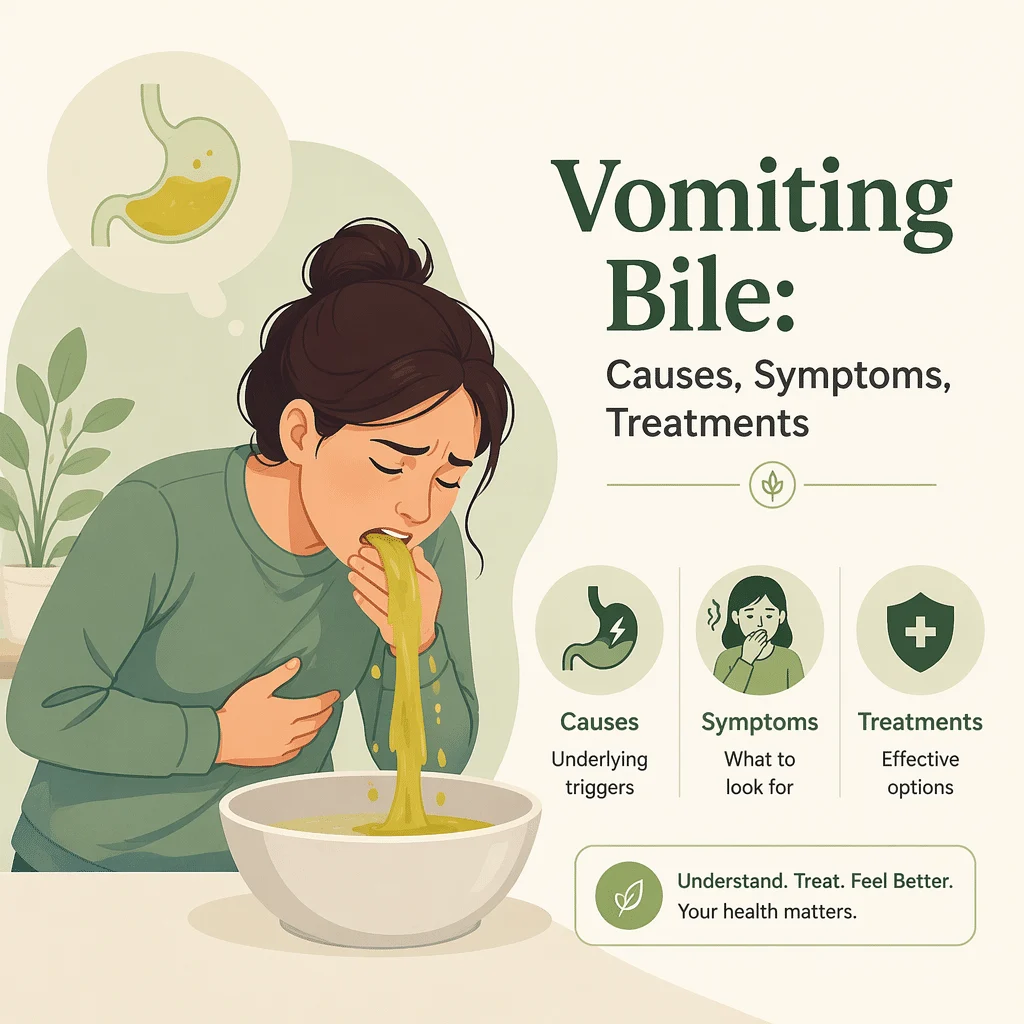
Vomiting bile means bringing up a yellow-green, bitter fluid instead of food. It looks alarming, and most people who see it assume something is badly wrong. Usually it is not. Bile turns up mainly because the stomach is already empty and repeated retching draws fluid back from the first part of the small intestine. The color alone is a weak signal; what decides urgency is everything happening around it.
In this article you’ll learn what bile is, why an empty stomach is the commonest explanation, which conditions genuinely cause bilious vomiting, and the exact pattern that points to a bowel obstruction — the one cause you must not miss. There is also a hard rule about green vomit in babies. First, read the emergency box below: it lists the signs that mean you should be assessed now rather than waited out at home.
⚠️ Seek emergency assessment now if vomiting bile comes with any of the following:
- A swollen or distended abdomen, severe or colicky (gripping, wave-like) pain, or an abdomen that is tender and rigid
- Inability to pass gas or stool for many hours — this combination suggests a bowel obstruction
- Vomiting that will not stop, or keeps returning despite an empty stomach
- Vomiting blood, or vomit that looks like dark coffee grounds
- Black, tarry stools
- Severe dehydration: not passing urine, dizziness on standing, drowsiness or confusion
- Fever with severe abdominal pain
- Vomiting that starts after a head injury
⚠️ GREEN OR BILIOUS VOMITING IN A BABY OR YOUNG INFANT NEEDS IMMEDIATE EMERGENCY ASSESSMENT. In a newborn this is treated as a surgical emergency until proven otherwise.
What bile is and why it ends up in vomit
Bile is a digestive fluid made by the liver, stored in the gallbladder, and released into the duodenum — the first section of the small intestine, just downstream of the stomach. It breaks large fat droplets into smaller ones so that pancreatic enzymes can digest them. Bile is yellow-green because of bilirubin, the pigment left over when old red blood cells are recycled.
Normally bile travels one way: down. A ring of muscle called the pylorus sits between stomach and duodenum and keeps intestinal contents from washing backwards. Vomiting overrides that. Forceful retching reverses movement in the upper gut, and duodenal contents — including bile — get pulled into the stomach and out. This is a mechanical consequence of vigorous vomiting, not a specific disease.
Why an empty stomach is the commonest explanation
The first time you vomit during an illness, food comes up. The second and third time, stomach fluid. By the fourth or fifth episode there is nothing left, the retching continues anyway, and what appears is bile drawn back from the duodenum. This is why bile after several rounds of a stomach bug is rarely sinister on its own — it is simply the last thing available.
The same logic explains bile that shows up early in the morning or after a long gap without food. If you regularly feel sick when the stomach is empty, our guides on nighttime nausea and nausea from hunger cover that pattern in more detail.
Gastroenteritis, alcohol and any prolonged bout of vomiting
Acute gastroenteritis — inflammation of the stomach and intestines, most often viral — is the single most common reason people end up vomiting bile. Norovirus is the leading cause of vomiting and diarrhea in the United States, and the Centers for Disease Control and Prevention notes that most people recover within one to three days. The vomiting is intense and repetitive, which is precisely the setup for bile. Food poisoning behaves the same way.
The real risk here is not the bile — it is fluid loss. The CDC advises drinking plenty of liquids to replace what is lost through vomiting and diarrhea, and warns that severe dehydration may need hospital treatment with fluids given into a vein. Children and older adults dehydrate fastest. Watch for reduced urine output, dry mouth, dizziness on standing, unusual sleepiness, or crying without tears in a child. Our article on dehydration and blood pressure explains why these signs matter.
Alcohol and repeated retching
Heavy drinking irritates the stomach lining, relaxes the valves of the upper gut and triggers vomiting that continues long after the stomach is empty. Bile is a routine feature of a bad hangover for the same mechanical reason as in gastroenteritis. Alcohol also affects the liver over time, which is why liver function tests often form part of the work-up. Violent retching can tear the lining where esophagus meets stomach, so vomit that turns bloody after a prolonged bout needs urgent review.
Bile reflux and vomiting after gallbladder or stomach surgery
Bile reflux differs from acid reflux, although the two often coexist and feel similar. Here bile flows backwards from the duodenum into the stomach — and sometimes the esophagus — outside of any vomiting episode. Over time it inflames the stomach lining, a condition called bile reflux gastritis. Typical symptoms are persistent burning upper abdominal pain, a bitter taste, heartburn that responds poorly to acid-suppressing treatment, and occasional vomiting of yellow-green fluid.
The classic setting is surgery that alters the upper gut. Removal of the gallbladder (cholecystectomy) means bile drips into the duodenum continuously rather than in a pulse after meals, and some people develop reflux symptoms afterwards. Operations on the stomach — partial gastrectomy, pyloroplasty, some weight-loss surgery — can leave the pylorus less able to hold intestinal contents back. Gallstone disease belongs here too; our guide to gallbladder rupture covers the severe end, and bilirubin levels are among the markers checked when bile flow is in question.
Cyclic vomiting syndrome and cannabinoid hyperemesis
Cyclic vomiting syndrome describes repeated, stereotyped attacks of intense nausea and vomiting separated by periods of normal health. The attacks closely resemble each other in onset, duration and ending. Because each episode empties the stomach early then continues, bile is near-universal by the second or third hour. The condition sits on the same biological spectrum as migraine.
Cannabinoid hyperemesis syndrome looks almost identical but has a specific trigger: long-term, regular cannabis use. It is increasingly common and frequently missed, partly because cannabis is widely assumed to relieve nausea rather than cause it. The recognized clue is compulsive hot bathing — people find that long, very hot showers are the only thing easing the retching, and return to them repeatedly during an attack. The only reliable fix is stopping cannabis use, and that is a conversation to have with a doctor rather than a decision to manage alone, because attacks can recur for weeks after stopping and other causes still need excluding.
Neither diagnosis should be assumed on a first attack. Both are recognized by pattern over time, and both require that mechanical causes — an obstruction above all — have been ruled out first.
Gastroparesis, pregnancy, migraine and medicines
Gastroparesis means the stomach empties too slowly even though nothing physically blocks it. The National Institute of Diabetes and Digestive and Kidney Diseases describes the typical picture as feeling full soon after starting a meal, feeling full long after eating, nausea and vomiting; diabetes is the most common known cause. A distinctive clue is vomiting food eaten hours earlier, with bile following once episodes drag on.
Pregnancy is another frequent context. Sickness that goes beyond a queasy hour — hyperemesis gravidarum, the severe form — involves repeated vomiting on an empty stomach and therefore bile. It matters because of dehydration and weight loss rather than the color, and it is a reason to be reviewed rather than endured. Routine blood tests during pregnancy help track how hydration and nutrition are holding up.
Migraine attacks can produce vomiting severe enough to reach the bile stage, sometimes with little headache in children. Many medicines also irritate the stomach or act on the brain’s vomiting center — chemotherapy, some antibiotics, opioid painkillers, certain diabetes and weight-loss drugs that slow stomach emptying, and anti-inflammatories. If bilious vomiting began within weeks of a new prescription, report that timing; do not stop a prescribed medicine on your own.
Bowel obstruction — the cause you must not miss
This is why the color of vomit is worth taking seriously at all. In a bowel obstruction the intestine is physically blocked and everything upstream backs up. When the blockage sits in the small intestine, bile has nowhere to go and bilious vomiting becomes a classic feature. The higher the blockage, the earlier and more copious the bile; a lower one takes longer to cause vomiting but produces more distension.
The National Library of Medicine lists the characteristic combination: severe abdominal pain or cramping, vomiting, bloating, loud bowel sounds, swelling of the abdomen, inability to pass gas, and constipation. A complete intestinal obstruction is a medical emergency and often requires surgery. Hold four features together: bilious vomiting, a distended abdomen, colicky pain in waves, and no flatus or stool. Any two deserve urgent assessment; all four is an emergency.
The commonest cause in adults is adhesions — bands of internal scar tissue left by previous abdominal or pelvic surgery, which can kink a loop of bowel years or decades later. Hernias, tumors, inflammatory bowel disease strictures and, in older adults, impacted stool are other causes. Past abdominal surgery is a critical piece of history: if you have had an abdominal operation and now have bilious vomiting with a swollen belly, say so at the front desk. Assessment typically includes a complete blood count and inflammatory markers such as CRP, looking for signs that bowel tissue is in trouble. Persistent burning low in the belly has its own explanations, covered in our guide to lower abdominal burning.
Babies and young children: the green-vomit rule
Pediatrics has a rule here that admits no exceptions: green, bilious vomiting in a newborn or young infant is a surgical emergency until proven otherwise. The condition being ruled out is malrotation with volvulus, where the intestine has not settled into its normal position during development and can twist on its own blood supply. The NIDDK lists vomiting with bile in it, which makes the vomit green, among the common signs of malrotation in babies under one year, alongside failure to thrive, abdominal tenderness, bloating and blood in the stool.
The urgency is about blood supply. A twisted loop of bowel can lose its circulation within hours, and once tissue dies the situation becomes far more dangerous. Most babies with malrotation are diagnosed in the first month of life, and treatment is surgical. Clinicians do not wait overnight to see how a green-vomiting infant does.
In older children the rule is less absolute but still strict: bilious vomiting with abdominal distension, a tender belly, or a child not passing stool needs same-day assessment. Milder yellow vomit in an older child vomiting all night from a stomach bug carries the same benign meaning as in adults. If you are unsure which situation you are in, that uncertainty is itself a reason to be seen.
Reading the pattern and knowing when to seek care
Bile in vomit is common and often benign, but the accompanying signs decide urgency. The table sets out the combinations that matter most.
| What’s happening | What it may point to | What to do |
|---|---|---|
| Bile after several episodes of vomiting from a stomach bug | An empty stomach with nothing left to bring up | Not alarming on its own; focus on fluids and watch for signs of dehydration |
| Bile with a distended abdomen and no gas or stool passing | Possible bowel obstruction | Emergency assessment now; mention any previous abdominal surgery |
| Green or bilious vomiting in a baby or young infant | Possible malrotation with volvulus | Immediate emergency assessment — treated as a surgical emergency until proven otherwise |
| Bile with severe, constant or colicky abdominal pain, or a rigid abdomen | Obstruction, gallbladder or pancreatic problem | Emergency assessment if pain is severe or the abdomen is tender and rigid |
| Repeated identical attacks, often relieved by long hot showers | Cyclic vomiting syndrome or cannabinoid hyperemesis | Planned appointment; mention cannabis use and the hot-shower pattern openly |
| Bitter yellow vomiting and burning pain after gallbladder or stomach surgery | Bile reflux or bile reflux gastritis | Non-urgent appointment with your doctor to review the anatomy and symptoms |
Outside those emergency signs, contact your doctor if vomiting persists beyond about 24 hours in an adult, if you cannot keep fluid down, if bilious vomiting keeps returning in bouts, or if it comes with unexplained weight loss. A doctor investigating will usually examine the abdomen, arrange imaging if obstruction is suspected, and take blood: electrolytes and kidney function for dehydration, liver enzymes for the biliary system, and amylase and lipase if the pancreas is a candidate.
Latest scientific advances in understanding bilious vomiting
The studies below were identified through PubMed and published between 2023 and 2026. Full references and DOI links appear in Sources.
A large prospective study across hospitals in many countries looked at adults admitted with adhesive small bowel obstruction — blockage from internal scar tissue after earlier surgery. What was found: most patients settled without an operation, and those whose care followed the World Society of Emergency Surgery guidelines spent less time in hospital and more often went home without complications, yet full compliance was uncommon. What this means for you: a bowel obstruction usually does not end in surgery, but it needs managing in hospital under observation, and early assessment keeps the non-surgical route open.
The American Gastroenterological Association published a clinical practice guideline on gastroparesis. What was found: the panel recommended diagnosing it with a gastric emptying study — a scan tracking how quickly a test meal leaves the stomach — run over four hours rather than two, because the shorter version misses cases. It also reserved procedures on the stomach outlet for people whose symptoms resist medical treatment. What this means for you: if you have persistent nausea and vomiting, sometimes bringing up food eaten hours earlier, it is reasonable to ask whether a four-hour study is the right test. A normal two-hour result may be falsely reassuring.
A North American pediatric gastroenterology society issued 2025 guidelines on diagnosing cyclic vomiting syndrome in children, with a separate section on cannabinoid hyperemesis. What was found: the panel recommended screening blood and urine tests plus an upper gastrointestinal radiographic series — an x-ray study of the stomach and small intestine — for every child whose symptoms suggest the syndrome, while concluding that most other screening tests add little. What this means for you: recurrent identical attacks in a child deserve a proper diagnosis, but imaging to exclude a mechanical blockage comes first.
A systematic review pooled published cases of cannabinoid hyperemesis syndrome and proposed a working algorithm for hospital teams. What was found: the anti-nausea medicines reached for first in most emergency departments frequently failed here, while other approaches did better; the authors stress the evidence is still largely case reports. What this means for you: if your attacks resist standard anti-sickness treatment and hot showers are the only relief, tell the clinician about your cannabis use. That one fact changes the working diagnosis, and stopping use is the only step that reliably ends the cycle.
Glossary of key terms
| Term | Definition |
|---|---|
| Bile | A yellow-green digestive fluid made by the liver, stored in the gallbladder and released into the small intestine to help digest fats. |
| Bilious vomiting | Vomiting that contains bile, giving it a yellow-green color and a bitter taste. |
| Duodenum | The first part of the small intestine, just past the stomach, where bile and pancreatic enzymes enter. |
| Pylorus | The muscular ring between the stomach and the duodenum that normally stops intestinal contents washing backwards. |
| Bile reflux gastritis | Inflammation of the stomach lining caused by bile flowing backwards into the stomach, often after gallbladder or stomach surgery. |
| Bowel obstruction | A physical blockage of the intestine that stops contents moving forward; a complete obstruction is a medical emergency. |
| Adhesions | Bands of internal scar tissue, usually from previous abdominal surgery, that can tether or kink loops of bowel. |
| Malrotation and volvulus | A birth defect in which the intestine has not rotated into its normal position and can twist on its blood supply. |
| Gastroparesis | Delayed emptying of the stomach without any physical blockage, causing early fullness, nausea and vomiting. |
| Cannabinoid hyperemesis syndrome | Recurrent attacks of severe vomiting linked to long-term regular cannabis use, often temporarily relieved by hot showers. |
Frequently asked questions
Is vomiting bile serious?
Not by itself. Bile in vomit usually means the stomach is empty and retching has pulled fluid back from the small intestine, which is a mechanical effect rather than a disease. What makes it serious is the company it keeps. Bilious vomiting alongside a swollen abdomen, colicky pain, an inability to pass gas or stool, blood in the vomit, or severe dehydration points to a problem that needs assessing now. In a baby, green vomit is treated as an emergency regardless of how well the child otherwise seems.
What does yellow vomit mean?
Yellow or yellow-green vomit almost always means bile, colored by the pigment bilirubin. It tells you the stomach has already emptied and vomiting has continued past that point. That happens routinely during a stomach bug, after heavy drinking, during a migraine attack, in pregnancy sickness, or first thing in the morning after a long overnight fast. Yellow vomit that appears once or twice at the end of a vomiting episode is expected. Yellow vomit that keeps coming, or that comes with abdominal swelling and pain, is not.
When should I go to the ER for vomiting bile?
Go to the emergency department if bilious vomiting comes with a distended abdomen, severe or gripping abdominal pain, an abdomen that is tender and rigid, or an inability to pass gas or stool — that combination suggests a bowel obstruction. Also go for vomiting blood or coffee-ground material, black tarry stools, vomiting that will not stop, signs of severe dehydration such as not passing urine or confusion, fever with severe abdominal pain, or vomiting after a head injury. Any green vomiting in a baby means going immediately.
Why do I throw up bile in the morning?
An overnight fast leaves the stomach empty while bile keeps trickling into the duodenum. Any nausea strong enough to trigger retching then brings up bile because there is nothing else there. Common contributors include alcohol the night before, pregnancy sickness, migraine, acid or bile reflux, and slow stomach emptying. Occasional morning bile after a rough night is unremarkable. Bitter yellow vomiting most mornings, especially with burning upper abdominal pain or after gallbladder or stomach surgery, is worth a non-urgent appointment to look for bile reflux.
Can vomiting bile happen in pregnancy?
Yes, and it is common. Pregnancy sickness often strikes on an empty stomach, and once vomiting continues past the first episode bile appears. The severe form, hyperemesis gravidarum, involves persistent vomiting with dehydration and weight loss. The color of the vomit is not the concern; the fluid loss is. Contact your maternity team if you cannot keep fluids down for a day, are passing little urine, feel dizzy on standing, or are losing weight. Treatment is available and should not be endured without help.
How long is it normal to keep vomiting bile?
During a viral stomach illness, vomiting usually eases within one to three days, and the bilious phase typically covers only the last part of a bad bout. Bringing up bile intermittently over a few hours at the tail end of that illness is expected. Vomiting that is still going strong beyond 24 hours in an adult, that keeps returning in waves over days, or that stops you keeping any fluid down deserves medical review. Vomiting that continues while the abdomen swells is an emergency, not a waiting game.
Sources
- National Institute of Diabetes and Digestive and Kidney Diseases — Malrotation
- National Institute of Diabetes and Digestive and Kidney Diseases — Gastroparesis
- MedlinePlus, National Library of Medicine — Intestinal Obstruction
- Centers for Disease Control and Prevention — About Norovirus
- Kaplan LJ, Martinez-Casas I, Mohseni S, et al. Small bowel obstruction outcomes according to compliance with the World Society of Emergency Surgery Bologna guidelines. British Journal of Surgery. 2025;112(4). https://doi.org/10.1093/bjs/znaf080 (via PubMed)
- Staller K, Parkman HP, Greer KB, et al. AGA Clinical Practice Guideline on Management of Gastroparesis. Gastroenterology. 2025;169(5):828-861. https://doi.org/10.1053/j.gastro.2025.08.004 (via PubMed)
- Karrento K, Rosen JM, Gelfand AA, et al. North American Society for Pediatric Gastroenterology, Hepatology, and Nutrition 2025 guidelines on the diagnosis of cyclic vomiting syndrome in children. Journal of Pediatric Gastroenterology and Nutrition. 2025;81(5):1346-1359. https://doi.org/10.1002/jpn3.70193 (via PubMed)
- Hsu J, Kashyap S, Hurd C, et al. Treatment of cannabinoid hyperemesis syndrome: A systematic review and treatment algorithm for consultation-liaison psychiatrists. General Hospital Psychiatry. 2025;97:185-191. https://doi.org/10.1016/j.genhosppsych.2025.10.012 (via PubMed)
Further reading
- Nighttime nausea: causes, symptoms and treatments
- Lower abdominal burning: causes and symptoms
- Gallbladder rupture: symptoms, causes and treatments
- Electrolyte panel: what your results mean
- Liver function tests: a complete guide
Understand your lab results with AI DiagMe
If a doctor investigates repeated vomiting, they may check electrolytes, liver enzymes, lipase or a full blood count to see how your body is coping and where the problem sits. Those reports are easy to hold and hard to read. AI DiagMe helps you understand what the numbers in them mean so you can ask better questions at your next appointment.
AI DiagMe interprets lab results only. It does not diagnose, it does not triage symptoms, and it is not for emergencies. If you have the warning signs listed at the top of this page, seek emergency care rather than looking anything up.
Get your results interpreted in minutes