
































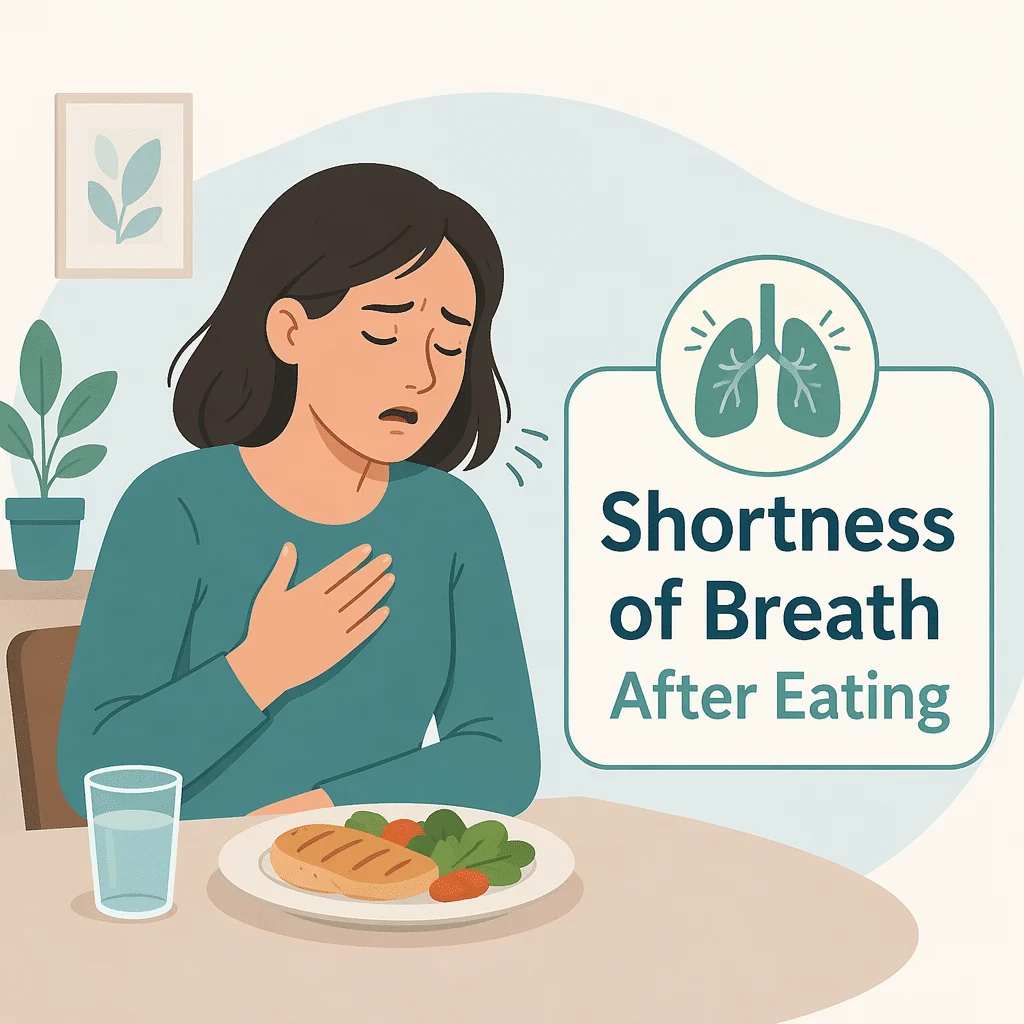
Shortness of breath after eating means feeling breathless or unable to fill your lungs within minutes to an hour of a meal. Usually the explanation is mechanical or digestive. But it is also how a narrowed heart artery and a serious food allergy announce themselves, and both have to be excluded first.
In this article you will learn which patterns point to the heart, which to an allergic reaction, and which to reflux, the stomach, the lungs or meal size. You will also learn the eating-then-exercising pattern missed for years, and what a doctor checks.
Read the emergency box in the next section first. If anything in it matches what is happening right now, stop reading and call 911.
When shortness of breath after eating is an emergency
Breathlessness around meals has two dangerous causes: a heart not getting enough blood, and an allergic reaction closing the airway. Both begin quietly. Neither improves by waiting.
Call 911 now if breathlessness after eating comes with any of the following:
- Chest pain, pressure, tightness or heaviness, or pain spreading to the jaw, neck, back, shoulder or arm
- Swelling of the lips, tongue or throat, hives, wheeze, or feeling faint after eating. Call 911 and use an epinephrine (adrenaline) autoinjector immediately if one has been prescribed for you
- Breathlessness that comes on at rest, or that wakes you from sleep gasping for air
- Coughing up blood
- Blue or gray lips, face or fingertips
- Confusion, drowsiness, or difficulty staying awake
- New swelling of both ankles alongside the breathlessness
- Choking, or a wet, gurgly voice during or straight after meals
Do not drive yourself. Do not wait to see whether it settles on its own.
Two entries deserve emphasis. Lip, tongue or throat swelling with breathlessness after food is anaphylaxis until proven otherwise, and epinephrine works best given early. And in an older adult, a woman or a person with diabetes, breathlessness after meals can be angina or a heart attack with no chest pain.
The heart connection: postprandial angina and heart failure
Why a large meal can starve a narrowed artery
Digestion is expensive. After a large meal much of the circulation is redirected to the gut, so the heart works faster and harder for an hour or more. With healthy arteries this goes unnoticed. Where the coronary arteries are narrowed by atherosclerosis, demand outstrips supply, the heart muscle becomes briefly short of oxygen, a state called ischemia, and the person feels it. Doctors call this postprandial angina: angina brought on by eating rather than by exertion.
The tell-tale pattern appears reliably 15 to 60 minutes after larger meals, eases with rest, and is worse after a heavy or fatty meal. It can also lower your exercise threshold, so an easy walk becomes hard work straight after lunch. Your cholesterol ratio and blood pressure are therefore relevant to a symptom that feels purely digestive.
Breathlessness without chest pain is not reassurance
This is the part that matters most. Angina and heart attacks do not always hurt. When breathlessness appears instead of chest pain, doctors call it an anginal equivalent: the same problem, expressed differently. It happens disproportionately in older adults, in women, and in people with diabetes, in whom nerve damage blunts the pain signal.
The National Heart, Lung, and Blood Institute lists shortness of breath at rest or on light activity among heart attack symptoms, notes it is more common in older adults, and states that heart attacks can occur with very mild symptoms or none at all. So “breathless after meals, no chest pain” is not reassurance. Alongside high blood pressure, raised cholesterol, smoking or diabetes, it is a reason to be assessed. Unusual chest sensations are covered in pain under the left breast.
Heart failure: the questions a doctor will ask you
In heart failure the heart cannot pump enough blood, so fluid backs up into the lungs and legs. A meal worsens this twice over: the abdomen distends against the diaphragm while the circulation works harder. What separates it from an overfull stomach is the company the breathlessness keeps.
- Are you breathless lying flat, so you need two or three pillows to sleep? Doctors call this orthopnea.
- Do you wake in the night suddenly gasping, needing to sit up or go to a window? That is paroxysmal nocturnal dyspnea.
- Are your ankles or lower legs swollen, particularly by the end of the day?
- Has your weight risen by several pounds over a few days without any change in what you eat?
These are the exact questions a cardiologist asks. The NHLBI lists inability to sleep lying flat, ankle, leg and abdominal swelling, and weight gain among heart failure symptoms. If two or more apply, book an appointment. Our page on heart failure goes deeper.
Allergic causes, including the exercise cofactor pattern
Anaphylaxis after food is an emergency
A food allergic reaction that involves breathing is anaphylaxis. It develops within seconds to minutes and can involve wheeze, a tight or hoarse throat, swelling of the face, lips or tongue, hives, vomiting, dizziness or collapse. MedlinePlus is unambiguous: call 911, and if an epinephrine injector is available, help the person use it immediately.
A hoarse or whispered voice warns of dangerous throat swelling. And a reaction can involve the airway with no rash at all, so “no hives, so it cannot be an allergy” is a dangerous assumption.
Food-dependent exercise-induced anaphylaxis
This is the pattern that leaves people baffled for years. The food alone is tolerated and the exercise alone is tolerated. The reaction happens only when the two combine, typically when activity follows a meal within a couple of hours. Wheat is the classic trigger, with omega-5 gliadin the usual culprit protein, though shellfish, celery, nuts and several fruits are described.
Exercise is not the only cofactor: alcohol, nonsteroidal anti-inflammatory painkillers and infection can play the same role, and sometimes two must line up together. That is why the same sandwich is harmless on Tuesday and dangerous after Saturday’s run. Because the food is eaten uneventfully on most days, it is rarely suspected. Ask for an allergy referral rather than experimenting.
Why direct-to-consumer food sensitivity tests are not the answer
Panels sold online measuring IgG antibodies against 90 or 100 foods are marketed as a shortcut to your trigger. They are not validated for diagnosing food allergy. The American Academy of Allergy, Asthma and Immunology states plainly that they have never been scientifically proven to do what they claim, that IgG to a food is likely a normal response to eating it, and that higher IgG4 may reflect tolerance. The harm is not theoretical: people drop a dozen foods on the strength of a printout and still have the symptom. Testing that means something, including specific IgE blood testing and supervised challenge, is chosen by an allergist; eosinophils add context but never diagnose alone.
Reflux, hiatal hernia and gastroparesis
Reflux that reaches the airway
Gastroesophageal reflux disease is a common contributor. Acid rising into the esophagus can irritate the voice box and throat and trigger reflex tightening of the airways, called bronchospasm, producing wheeze and breathlessness rather than heartburn. Many people with reflux-related airway symptoms never get heartburn at all.
It is worse after large or fatty meals, worse lying down and at night, and often keeps company with throat clearing, hoarseness or a dry cough. We cover that cough in our guide to acid reflux cough.
Hiatal hernia
A hiatal hernia is part of the stomach sliding up through the diaphragm into the chest. Small ones are common and silent. Large ones occupy space the lungs need and limit how far the diaphragm can descend, which is why breathlessness after eating is a recognized presentation. Surgical series record measurable gains in lung volumes after repair.
Gastroparesis
Gastroparesis means the stomach empties too slowly with no blockage. Food sits, the stomach stays distended, and diaphragm pressure persists for hours. The National Institute of Diabetes and Digestive and Kidney Diseases lists feeling full soon after starting a meal, feeling full long after eating, nausea, vomiting, bloating, upper abdominal pain and poor appetite.
Long-standing diabetes is the commonest known cause, through vagus nerve damage. Surgery on the esophagus or stomach, hypothyroidism, some autoimmune and neurological conditions and viral infections also feature, and several medicines slow emptying. Never stop a prescribed medicine yourself; raise it with the prescriber. Your glucose levels matter here, and if symptoms cluster at night see nighttime nausea.
Lung causes and aspiration
Asthma triggered around meals
Asthma can be provoked around meals two ways. Reflux is one. The other is sulfites, preservatives in wine, beer, dried fruit and certain juices, which trigger bronchospasm in a minority of people with asthma. If your breathlessness comes with wheeze, tightness and cough and behaves the way your asthma normally does, asthma is the likely mechanism. See our page on asthma.
COPD and the space the diaphragm needs
In chronic obstructive pulmonary disease the lungs are already hyperinflated and the diaphragm flattened rather than domed. A full stomach removes the small margin left. Many people with COPD find a small meal comfortable and a large one impossible. Raise it with the respiratory team rather than quietly eating less.
Aspiration
Aspiration means food or liquid entering the airway instead of the esophagus. It matters most in older adults, after a stroke, and in Parkinson’s disease and dementia. The signs are specific: coughing during or just after swallowing, a wet gurgly voice after drinking, food sticking, or repeated chest infections. It is assessed by a speech and language therapist with a swallow study, not by drinking water to wash food down, which can make matters worse.
If that pattern sounds familiar, read what Parkinson’s disease does and how it is diagnosed.
Meal size, body weight, fitness, and anxiety, which comes last
The mechanics of a big meal
The simplest explanation is often right, once the dangerous ones are excluded. A large meal distends the stomach, pushing the diaphragm upward and splinting it, so the lungs expand less. Swallowed air from eating quickly, carbonated drinks and high-fat meals amplify the effect. It eases within an hour or two and is worse if you slump or lie down, and muscular chest sensations such as rib cramps can accompany it.
Weight, deconditioning and one surgical cause
Extra weight around the abdomen applies that upward pressure permanently, so a meal tips an already loaded system. Deconditioning lowers the threshold at which extra demand registers as breathlessness. Both are modifiable, and neither should be assumed until a cardiac cause has been considered. One more to know: dumping syndrome after gastric or bariatric surgery, where food moves too fast into the small intestine, causing flushing, palpitations, sweating and breathlessness within about 30 minutes.
Anxiety and hyperventilation, honestly placed
Anxiety genuinely causes breathlessness. Over-breathing lowers blood carbon dioxide and produces air hunger, tingling around the mouth and fingers, light-headedness and the sense of not drawing a satisfying breath. Meals are a common setting, especially with health anxiety or past panic attacks.
But anxiety belongs at the end of this list, not the beginning. It is a diagnosis of exclusion. Being told “it is just anxiety” before the heart and the airway have been properly considered is a recognized route by which serious presentations get missed, and women’s cardiac symptoms are more often attributed to anxiety at first contact. If that explanation was given and the symptom persists, ask what else was ruled out.
What you notice, and what to do about it
The pattern of your symptom carries more information than its severity. Use the table below to organize what you tell your doctor.
| What you notice | What it usually suggests | What to do |
|---|---|---|
| Breathless after big meals only, eases within an hour with rest | Diaphragm pressure, possibly reflux | Routine appointment; note meal size and timing |
| Breathless plus chest tightness, or pain in the jaw, neck, back or arm | Possible angina or heart attack | Call 911 now |
| Breathless 15 to 60 minutes after larger meals, eases with rest | Possible postprandial angina, even with no chest pain | Urgent appointment; ask for a cardiac cause to be considered |
| Breathless lying flat, waking at night gasping, ankles swollen | Possible heart failure | Urgent appointment; call 911 if breathless at rest |
| Wheeze, hives, lip or tongue swelling or faintness after a food | Anaphylaxis | Call 911; use an epinephrine autoinjector if prescribed |
| Breathless only when exercising within hours of eating | Possible food-dependent exercise-induced anaphylaxis | Do not self-test; ask for an allergy referral |
| Coughing or a wet, gurgly voice during or after eating | Possible aspiration | Prompt appointment; ask about a swallowing assessment |
| Full within a few mouthfuls, still full hours later, long-standing diabetes | Possible gastroparesis | Appointment; ask about gastric emptying testing |
Assessment starts with timing, the company the symptom keeps, and your risk factors. Expect an examination, oxygen saturation and an electrocardiogram if a cardiac cause is on the table. Blood tests may include troponin, BNP, a full blood count, thyroid function and glucose, or a wider cardiac markers panel. Chest X-ray, lung function tests, echocardiogram, stress testing, a gastric emptying study or endoscopy follow from there.
Latest scientific advances in understanding breathlessness after meals
A 2024 scoping review in European Cardiology Review examined acute coronary syndrome presenting without cardiac chest pain. What was found: across 41 studies, breathlessness was the most frequently reported and most prevalent symptom, alongside fatigue, nausea and sweating, and advancing age was independently associated with presenting this way. These patients had worse outcomes, including higher mortality and longer delays. What this means for you: breathlessness without chest pain is not a milder cardiac event. It is the version diagnosed late, which is why it warrants the same urgency.
A 2024 systematic review and meta-analysis in Cureus compared acute coronary syndrome presentation with and without type 2 diabetes. What was found: across eight studies and around 29,500 patients, people with diabetes were less likely to present with chest pain and more likely to present with shortness of breath, anxiety and neck pain. What this means for you: with diabetes, the absence of chest pain carries even less reassurance. Say the word diabetes early in the consultation.
Two 2023 reviews mapped food-dependent exercise-induced anaphylaxis: a systematic review of phenotypes in The Journal of Allergy and Clinical Immunology: In Practice covering 231 studies and 722 patients, and a diagnostic review in Foods. What was found: patients tolerate the food alone and the exercise alone; exercise is the leading cofactor, followed by nonsteroidal anti-inflammatory drugs and alcohol; most reactions involve hives or swelling but a minority involve neither; and diagnosis needs a careful history plus supervised provocation testing. What this means for you: no rash does not rule out an allergic cause, and food plus exercise means referral, not a home experiment.
The American Gastroenterological Association issued a clinical practice guideline on gastroparesis in 2025. What was found: twelve recommendations, including a conditional recommendation against the two-hour gastric emptying test and in favor of the four-hour version. What this means for you: if gastroparesis is being considered, the length of the emptying test matters, and it is fair to ask which one you are being offered.
Frequently asked questions
Can shortness of breath after eating be my heart?
Yes, and this is the possibility to take seriously first. After a large meal, blood is diverted to the digestive tract and the heart has to work harder, which can expose narrowed coronary arteries and produce ischemia specifically after eating. It can present as breathlessness with no chest pain at all, particularly in older adults, in women and in people with diabetes. If your breathlessness comes on reliably 15 to 60 minutes after larger meals and eases with rest, ask for an urgent appointment and say explicitly that you want a cardiac cause considered. If it comes with chest pressure, or pain in the jaw, neck, back or arm, or if it happens at rest, call 911.
Why do I get breathless after big meals but not small ones?
A full stomach physically pushes the diaphragm upward and limits how far your lungs can expand, so a large meal restricts breathing more than a small one does. Eating quickly, carbonated drinks and high-fat meals that sit in the stomach for longer all amplify the effect. That said, a size-dependent pattern does not by itself rule out a cardiac cause, because postprandial angina is also worse after bigger and fattier meals. If the breathlessness is new, is getting worse, or comes with any of the emergency signs listed earlier, get it assessed rather than simply eating less.
Should I get a food sensitivity test to find the cause?
No. The IgG food sensitivity panels sold directly to consumers are not validated for diagnosing food allergy. The American Academy of Allergy, Asthma and Immunology notes that IgG to a food is likely a normal response to eating it, and that higher IgG4 levels may actually reflect tolerance. Acting on such a result usually means restricting many foods unnecessarily, which costs you nutrition and does not fix a symptom that was never allergic. If a genuine food allergy is suspected, an allergist directs the testing based on your history, using specific IgE testing, skin prick testing or a supervised food challenge.
Can acid reflux make me short of breath without any heartburn?
Yes. Reflux that reaches the throat and voice box can irritate the airway and provoke reflex tightening of the bronchi without ever producing the burning sensation people associate with reflux. The usual clues are hoarseness, frequent throat clearing, a persistent dry cough, and symptoms that worsen lying down or at night. This is a common and treatable contributor, but it is a diagnosis to reach after cardiac and allergic causes have been considered, not instead of considering them.
I feel breathless and my heart races after eating. What does that combination mean?
Several things can produce it. Digestion normally raises the heart rate somewhat. Dumping syndrome after gastric or bariatric surgery causes palpitations, sweating and breathlessness within about half an hour of eating. Anxiety and hyperventilation can do it. So can a cardiac cause, and so can an early allergic reaction. Because the list spans the harmless and the urgent, the deciding factors are the extras: chest pain, faintness, hives or swelling, or breathlessness at rest all mean call 911. Palpitations that are new, frequent, or associated with blackouts should be assessed promptly either way.
How long should breathlessness after eating last before I worry?
There is no safe waiting period when the emergency signs are present, and no duration makes those signs less urgent. Outside of those, breathlessness that is purely mechanical usually eases within one to two hours as the stomach empties. Breathlessness that is new, that is becoming more frequent or more easily triggered, that occurs at rest, that wakes you at night, or that comes with ankle swelling should be assessed within days rather than watched for weeks. Keeping a short note of meal size, timing and accompanying symptoms makes that appointment far more productive.
Glossary of key terms
| Term | Definition |
|---|---|
| Postprandial | Occurring after a meal. Postprandial angina is angina brought on by eating rather than by exertion. |
| Anginal equivalent | A symptom other than chest pain, most often breathlessness, that reflects the same reduced blood flow to the heart muscle. |
| Ischemia | Tissue receiving less blood, and therefore less oxygen, than it needs for the work it is being asked to do. |
| Orthopnea | Breathlessness that comes on when lying flat and improves on sitting up. Often described as needing extra pillows. |
| Paroxysmal nocturnal dyspnea | Waking suddenly from sleep gasping for breath, typically one to two hours after going to bed. |
| Anaphylaxis | A severe, whole-body allergic reaction that can close the airway and drop blood pressure. A medical emergency. |
| Cofactor | Something that must be present alongside the food for a reaction to occur, such as exercise, alcohol, anti-inflammatory painkillers or infection. |
| Bronchospasm | Sudden tightening of the muscle around the airways, narrowing them and causing wheeze and breathlessness. |
| Gastroparesis | Delayed emptying of the stomach in the absence of any blockage, most often linked to long-standing diabetes. |
| Aspiration | Food, drink or saliva passing into the airway instead of the esophagus during or after swallowing. |
Understand your lab results with AI DiagMe
Breathlessness after eating is assessed clinically, through your history, an examination and often an electrocardiogram. No blood test diagnoses it. What a doctor may order alongside that assessment are tests such as troponin, BNP, a full blood count, glucose or thyroid function, and those results are frequently handed over with very little explanation.
AI DiagMe helps you understand what those numbers mean so that your next conversation with your doctor is a better one. It does not diagnose heart or lung disease, it does not replace medical assessment, and it is not for emergencies. If any of the warning signs in this article apply to you, call 911.
Get your results interpreted in minutes
Further reading
- Acid Reflux Cough: Symptoms and Treatments
- Heart Failure: Understanding and Treating It
- Troponin: Cardiac Marker Analysis and Results
- BNP: Cardiac Blood Marker
- Pain Under Left Breast: Causes, Symptoms and Treatments
Sources
- National Heart, Lung, and Blood Institute. Heart Attack Symptoms.
- National Heart, Lung, and Blood Institute. Heart Failure Symptoms.
- National Institute of Diabetes and Digestive and Kidney Diseases. Symptoms and Causes of Gastroparesis.
- MedlinePlus, National Library of Medicine. Anaphylaxis.
- American Academy of Allergy, Asthma and Immunology. The Myth of IgG Food Panel Testing.
- Perona M, Cooklin A, Thorpe C, O’Meara P, Rahman MA. Symptomology, Outcomes and Risk Factors of Acute Coronary Syndrome Presentations without Cardiac Chest Pain: A Scoping Review. European Cardiology Review. 2024.
- Tabowei G, Dadzie SK, Ahmed S, Lohana M, Shahzad M, Zehra SN, Zubair M, Khan A. Comparison of the Clinical Manifestations of Acute Coronary Syndrome Between Diabetic and Non-diabetic Patients: A Systematic Review and Meta-Analysis. Cureus. 2024.
- Kulthanan K, Ungprasert P, Jirapongsananuruk O, et al. Food-Dependent Exercise-Induced Wheals/Angioedema, Anaphylaxis, or Both: A Systematic Review of Phenotypes. The Journal of Allergy and Clinical Immunology: In Practice. 2023.
- Srisuwatchari W, Kanchanaphoomi K, Nawiboonwong J, Thongngarm T, Sompornrattanaphan M. Food-Dependent Exercise-Induced Anaphylaxis: A Distinct Form of Food Allergy. An Updated Review of Diagnostic Approaches and Treatments. Foods. 2023.
- Staller K, Parkman HP, Greer KB, Leiman DA, Zhou MJ, Singh S, Camilleri M, Altayar O. AGA Clinical Practice Guideline on Management of Gastroparesis. Gastroenterology. 2025.