






Normal blood test ranges are the reference values your lab prints next to each result to show what is typical for a healthy person. Seeing a number flagged “high” or “low” can be unsettling, but a result outside the range does not automatically mean something is wrong. This guide explains what these ranges represent, how to read the columns and units on your report, and gives a reference chart of typical adult values for the most common tests — from the complete blood count to cholesterol and thyroid. You will also learn why ranges differ between laboratories and between men, women, and pregnancy, what the difference between “normal” and “optimal” really is, and which results are worth discussing with a doctor sooner rather than later.
What “normal blood test ranges” actually mean
A reference range — sometimes called the “normal range” or “reference interval” — is the band of values that most healthy people fall within for a given test. For the majority of blood tests, the range is built to cover the middle 95% of a healthy reference group. In plain terms, the lab measured a large number of people without known disease, then drew the lines so that 19 out of every 20 of them land inside the range.
That definition has an important consequence. By design, about 1 in 20 perfectly healthy people will fall just outside the range on any given test. So a single flagged value is common and rarely alarming on its own. What matters is the size of the deviation, the pattern across several markers, your symptoms, and your medical history. Learning how to read your blood test results as a whole picture — rather than fixating on one number — is the single most useful habit.
It also helps to know the shorthand. Reports are full of abbreviations like Hgb, WBC, ALT, and eGFR. A quick reference to the common lab test abbreviations makes the rest of the page far easier to follow.
How a reference range is set
Labs do not invent these numbers. To establish a range, international guidelines suggest testing at least 120 healthy volunteers in a defined group (matched for age and sex), measuring the marker, and reporting the central 95% of results. Many labs use ranges supplied and validated by the manufacturer of the testing equipment rather than running their own large study, then confirm the range works on a smaller sample.
Because the method, instruments, and reference population differ from one lab to another, two labs can list slightly different “normal” limits for the same test. This is normal and expected. The practical rule is simple: always compare your value to the range printed on your own report, from the lab that ran your sample.
How to read the numbers: units, columns, and flags
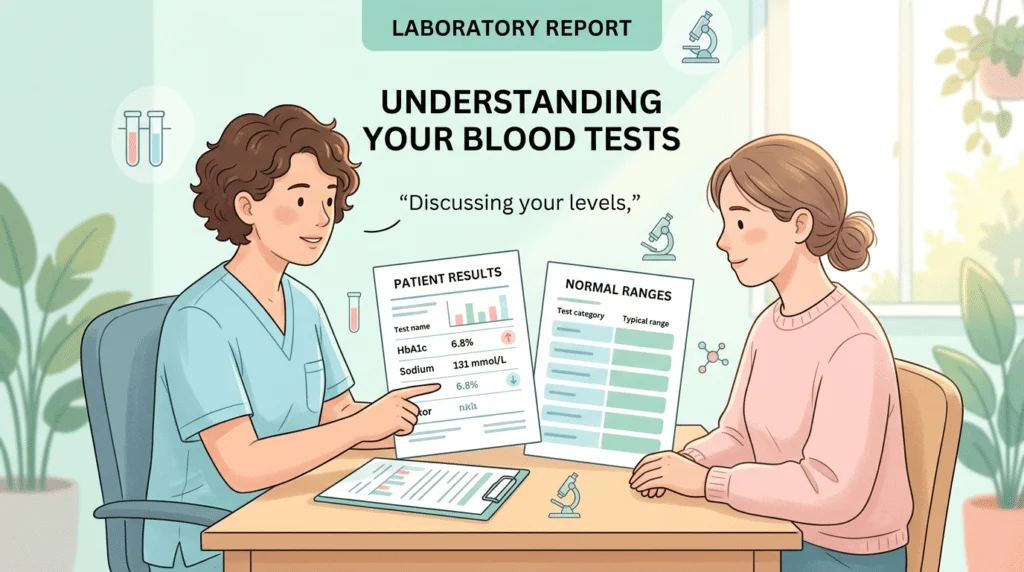
A typical line on a blood report has three parts: your result, the reference range, and the units. A fourth column often shows a flag — usually an “H” for high or “L” for low — when your value sits outside the listed range. An empty flag column generally means the result is within range.
Units matter more than people expect. In the United States, most chemistry results use conventional units such as milligrams per deciliter (mg/dL). Many other countries use SI units such as millimoles per liter (mmol/L). The same glucose value can read as 90 mg/dL or 5.0 mmol/L depending on the system, so never compare a number to a range that uses different units.
A few practical reading tips:
- Check whether the test required fasting (glucose and cholesterol often do). A non-fasting sample can shift the result and how it should be read.
- Look at trends. Comparing today’s value to a previous one is often more telling than a single snapshot.
- Note that some tests, like cholesterol, are judged against target thresholds rather than a typical population range.
A quick worked example helps. Suppose your fasting glucose reads 105 mg/dL against a 70–99 mg/dL range. The report flags it “H,” but 105 is only just above the line and, on its own, does not mean you have diabetes — it may simply prompt a repeat test or an HbA1c check. The same number would mean something very different at 250 mg/dL, or if it came with symptoms. Distance from the limit and context are what turn a flag into a finding.
If your report groups results into panels, each panel has its own logic. The two most common are the complete blood count (which looks at your blood cells) and the comprehensive metabolic panel (which looks at chemistry such as glucose, kidney, and liver markers).
Normal blood test ranges: a reference chart by panel
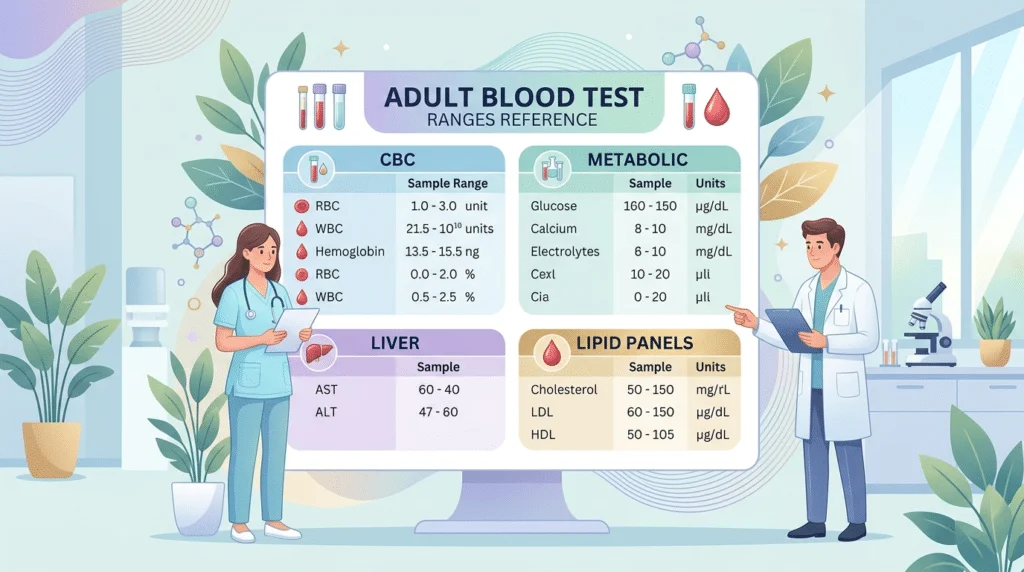
The tables below list typical adult reference ranges in conventional U.S. units. Treat them as a general guide only. Your lab’s printed range is the one that counts, because limits vary by laboratory, method, age, and sex. These figures are consistent with widely used clinical references, but they are not a substitute for your own report or your clinician’s reading of it.
Complete blood count (CBC)
The CBC counts and measures your red cells, white cells, and platelets. It is the most ordered blood test and a frequent source of “out of range” flags.
| Test (abbreviation) | Typical adult range (conventional units) |
|---|---|
| Hemoglobin (Hgb) | 13.5–17.5 g/dL (men); 12.0–15.5 g/dL (women) |
| Hematocrit (Hct) | 41–50% (men); 36–44% (women) |
| White blood cells (WBC) | 4,500–11,000 /µL |
| Red blood cells (RBC) | 4.7–6.1 million/µL (men); 4.2–5.4 (women) |
| Platelets (PLT) | 150,000–400,000 /µL |
| Mean cell volume (MCV) | 80–100 fL |
| Mean cell hemoglobin (MCH) | 27–33 pg |
| MCHC | 32–36 g/dL |
| Red cell distribution width (RDW) | 11.5–14.5% |
Metabolic panel, electrolytes, and kidney
These chemistry markers reflect your blood sugar, salts, and how well your kidneys are filtering. They make up most of the metabolic panel and the electrolyte panel.
| Test (abbreviation) | Typical adult range (conventional units) |
|---|---|
| Fasting glucose | 70–99 mg/dL |
| Sodium (Na) | 135–145 mEq/L |
| Potassium (K) | 3.5–5.0 mEq/L |
| Chloride (Cl) | 98–107 mEq/L |
| Calcium (Ca) | 8.5–10.2 mg/dL |
| Urea nitrogen (BUN) | 7–20 mg/dL |
| Creatinine | 0.6–1.3 mg/dL |
| eGFR | 60 or higher mL/min/1.73 m² |
Creatinine and eGFR are the headline numbers for kidney function, while fasting glucose (alongside HbA1c) is central to blood sugar and diabetes testing.
Liver function and proteins
Liver enzymes rise when liver cells are stressed or inflamed. Bilirubin and albumin add information about how the liver is working overall. These are the core of the liver function tests.
| Test (abbreviation) | Typical adult range (conventional units) |
|---|---|
| Alanine transaminase (ALT) | 7–56 U/L |
| Aspartate transaminase (AST) | 10–40 U/L |
| Alkaline phosphatase (ALP) | 44–147 U/L |
| Total bilirubin | 0.1–1.2 mg/dL |
| Albumin | 3.5–5.0 g/dL |
| Total protein | 6.0–8.3 g/dL |
Cholesterol, thyroid, iron, and inflammation
Some of these tests use targets rather than population ranges. Cholesterol is the clearest example: lower is generally better, so the lipid panel is judged against desirable thresholds.
| Test (abbreviation) | Typical adult value (conventional units) |
|---|---|
| Total cholesterol | Under 200 mg/dL (desirable) |
| LDL cholesterol | Under 100 mg/dL (optimal) |
| HDL cholesterol | 40 or higher (men); 50 or higher (women) |
| Triglycerides | Under 150 mg/dL |
| TSH (thyroid) | 0.4–4.0 mIU/L |
| Ferritin | 24–336 ng/mL (men); 11–307 ng/mL (women) |
| C-reactive protein (CRP) | Under 10 mg/L |
| HbA1c | Under 5.7% |
For these markers, deeper context lives in dedicated guides on thyroid (TSH) ranges and iron studies and ferritin.
Why your ranges may differ: lab, sex, age, and pregnancy
If you compare two reports, the printed limits may not match — and that is not an error. Several factors legitimately move a reference range.
- The laboratory. Different equipment, reagents, and methods produce slightly different limits, which is why the lab’s own range always wins.
- Sex. Men and women have different typical ranges for hemoglobin, hematocrit, creatinine, ferritin, and several hormones.
- Age. Children have different ranges than adults, and some markers (such as ESR) drift upward with age.
- Pregnancy. Blood volume rises and physiology changes, so many values shift during pregnancy. Hemoglobin commonly falls and several other markers move, which is why blood tests in pregnancy are read against pregnancy-specific ranges.
Other day-to-day factors — recent meals, hydration, hard exercise, medications, and even the time of day — can nudge a result. This is one more reason a borderline flag is rarely a verdict.
Common reasons a healthy result lands outside the range
When a single value is flagged and you otherwise feel well, the explanation is often harmless rather than a disease. Frequent, non-worrying causes include:
- A recent meal or sugary drink before a test that needed fasting.
- Intense exercise in the day or two beforehand, which can raise muscle and liver enzymes.
- Dehydration, which concentrates the blood and can nudge several values at once.
- The time of day, since some markers such as iron and cortisol follow a daily rhythm.
- A recent infection or vaccination, which can lift inflammation markers like CRP.
- New or changed medications and supplements.
- Ordinary lab-to-lab variation in the testing method itself.
None of these guarantees a result is benign, but together they explain why clinicians often repeat a borderline test before acting on it.
“Normal” versus “optimal”: what the difference means
People increasingly ask about “optimal” ranges versus “normal” ones, so it is worth being precise. A normal (reference) range is a statistical description: it is simply where most of a healthy population falls. It does not promise that every value inside it is ideal, or that a value just outside it is harmful.
An optimal or target value is a clinical goal, usually set by medical guidelines for a specific purpose. Cholesterol targets, an HbA1c under 5.7% for screening, and vitamin D sufficiency thresholds are examples — these are chosen to lower future risk, not to describe a typical population. The two ideas overlap but are not the same. Chasing “optimal” numbers on your own can cause needless worry, so treat optimal targets as a conversation to have with a clinician who knows your full situation, not as a pass-or-fail line.
What to do when a result is flagged high or low
A flagged value calls for a calm, stepwise look rather than alarm. Use this quick checklist:
- Confirm the units and range. Make sure you are reading your value against the matching range and units on the same report.
- Check how far outside it sits. A value barely past the limit is very different from one that is markedly off.
- Look at the pattern. Is one marker off in isolation, or do several related results point the same way (for example, several liver enzymes together)?
- Factor in context. Did you fast as instructed? Are you unwell, dehydrated, pregnant, or taking new medication?
- Compare with the past. A stable value that has always run slightly outside the range is reassuring; a sudden change is more worth noting.
- Ask your clinician. They can decide whether the result needs a repeat test, monitoring, or further investigation.
This is also where an interpretation tool can help you prepare. It will not diagnose you, but it can translate the numbers into plain language and flag what is worth raising at your appointment.
When to see a doctor about your results
Most out-of-range flags are mild and handled at a routine follow-up. Some situations, however, deserve prompter medical attention. Contact a healthcare professional without delay if a blood result is markedly outside the range, if it is accompanied by symptoms, or if your clinician has asked to be alerted to a specific value.
General signs that warrant timely advice alongside an abnormal result include unexplained or rapid weight loss, persistent fever, severe fatigue or breathlessness, easy bruising or bleeding, yellowing of the skin or eyes, chest pain, or confusion. These are not tied to one specific number — they are reasons to seek care regardless of what a chart says. When results and symptoms point the same way, do not wait for the next scheduled visit. And remember that only a qualified clinician can place your results in the context of your full health and reach a diagnosis.
Glossary
- Albumin: the main protein in blood, made by the liver; low levels can reflect liver, kidney, or nutritional problems.
- CBC (complete blood count): a panel that counts red cells, white cells, and platelets.
- eGFR (estimated glomerular filtration rate): a calculated number that estimates how well the kidneys filter blood.
- Hematocrit (Hct): the percentage of your blood made up of red blood cells.
- HbA1c (glycated hemoglobin): a measure of average blood sugar over roughly the past three months.
- Reference range (reference interval): the band of values most healthy people fall within for a test, usually the central 95%.
- SI units: the international measurement system (for example, mmol/L) used in many countries instead of U.S. conventional units.
- Standard deviation: a statistic describing how spread out values are; reference ranges typically span about two standard deviations from the average.
- TSH (thyroid-stimulating hormone): a hormone used to screen how the thyroid is working.
Frequently asked questions
How are normal ranges for blood tests determined?
Most reference ranges are built by testing a group of healthy people — international guidance suggests at least 120 volunteers matched for age and sex — and then taking the central 95% of their results. The lines are usually set about two standard deviations from the average. Many labs use ranges validated by the equipment manufacturer rather than running their own large study. Because the method and the reference group vary, ranges differ slightly between laboratories, which is why your report’s own range is the reference that matters.
Does a result outside the normal range mean I am sick?
Not necessarily. By definition, roughly 1 in 20 healthy people will have a result just outside the range on any test, simply because of how the range is built. A mild flag is common and often explained by recent food, exercise, hydration, medication, or normal variation. What matters is how far outside the value is, whether several related markers agree, and whether you have symptoms. A single borderline number is best confirmed or interpreted by a clinician rather than treated as a diagnosis.
Why are my blood test ranges different from a friend’s?
Several reasons. Different laboratories use different equipment and methods, so their printed limits vary. Ranges also legitimately differ by sex (men and women differ for hemoglobin, creatinine, ferritin, and more) and by age. Pregnancy shifts many values as well. Because of all this, you should never compare your number to a range from a different report or a different lab — only to the range listed on your own result, in the same units.
What is the difference between “normal” and “optimal” ranges?
A normal (reference) range is statistical: it describes where most healthy people fall. An optimal or target value is a clinical goal set by guidelines to reduce future risk, such as cholesterol or HbA1c targets. A value can be inside the normal range yet not at an optimal target, and the reverse can also happen. Optimal goals depend on your personal risk, so they are best discussed with a clinician rather than judged from a chart alone.
Do I need to fast before a blood test?
It depends on the test. Fasting glucose and a full cholesterol panel are commonly measured after 8–12 hours without food, because eating changes the result. Many other tests, including most of the complete blood count, do not require fasting. Your request form or lab will tell you. If you were supposed to fast and did not, mention it, because it affects how the result should be read.
Can I interpret my blood test results myself?
You can learn a great deal — what each marker means, whether a value is in range, and which results to ask about. Tools and guides make the numbers far less intimidating. What you should not do is self-diagnose or change treatment based on a chart. Reference ranges are general, your situation is specific, and only a qualified clinician can connect your results, symptoms, and history into a diagnosis.
Sources
- Laboratory Tests — MedlinePlus (U.S. National Library of Medicine)
- Laboratory Reference Ranges — Merck Manual Professional Edition
- Blood Tests: Types, Results & How They Work — Cleveland Clinic
Further reading
- How to read your blood test results
- Complete blood count (CBC): how to read it
- Comprehensive metabolic panel explained
- CBC vs CMP: how the two tests differ
- How long do blood test results take?
Understand your lab results with AI DiagMe
A reference chart tells you whether a number is in range, but it cannot tell you what the pattern across your complete blood count, kidney and liver markers, cholesterol panel, or thyroid (TSH) actually means for you. AI DiagMe reads your lab report and explains each result in plain language, helping you see which values are worth discussing and what questions to bring to your clinician. It is designed to help you understand your results — not to diagnose you, and never to replace your doctor. Upload your report to turn a wall of numbers into a clear, calm explanation.
➡️ Get your results interpreted in minutes