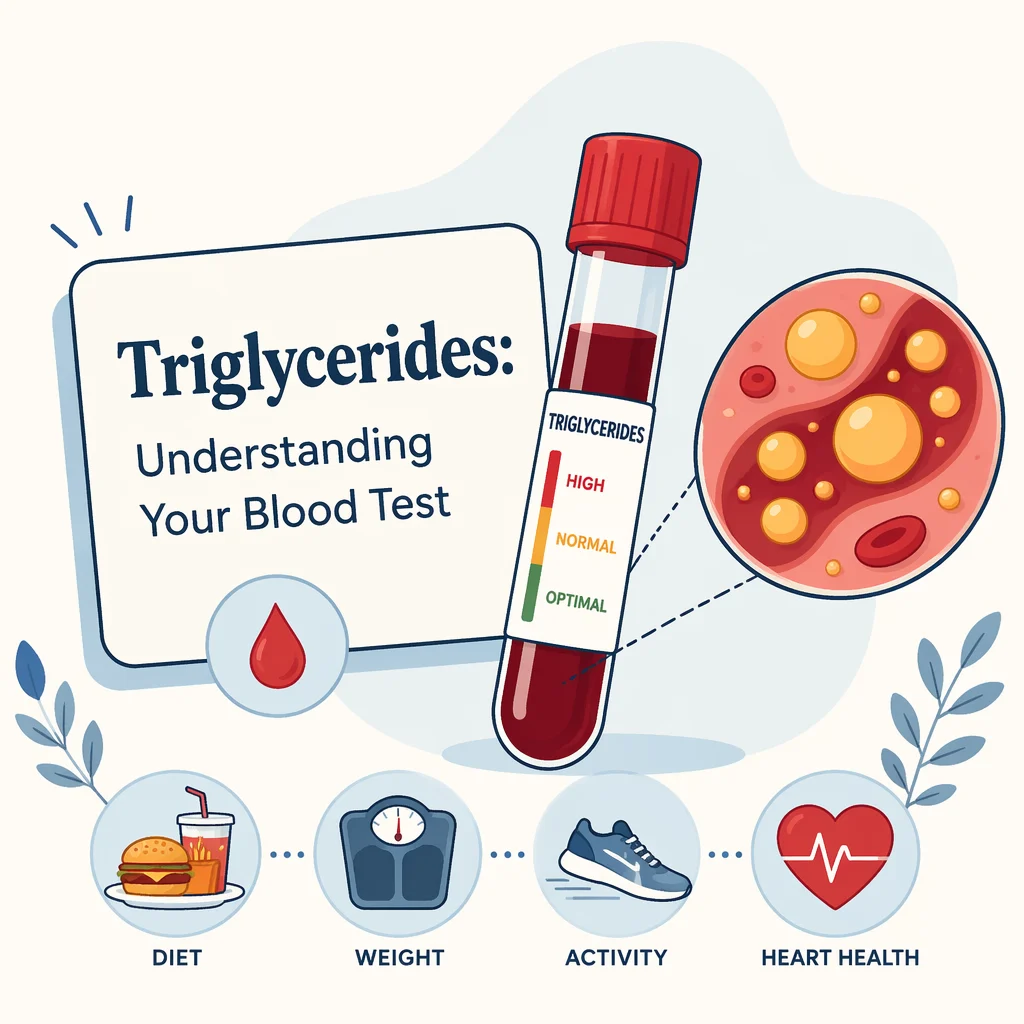
A triglycerides test measures the main type of fat carried in your bloodstream, and it is one of the four numbers reported on a standard lipid panel alongside total cholesterol, LDL, and HDL. Triglycerides come from the food you eat and from fat your liver makes on its own, and your body stores any extra as energy reserves in fat tissue. When levels run high over time, they can raise your risk for heart disease and, at very high levels, for a painful condition called pancreatitis. This guide walks through what a normal, borderline, high, and very high result actually means, why fasting before the test matters less than it used to, what tends to push triglycerides up, and the practical steps that bring them back down.
What triglycerides are and where they come from
Triglycerides are fat molecules made of a glycerol backbone attached to three fatty acid chains. Your body uses them as a compact, high-energy fuel source, storing extra calories from meals as triglycerides in fat cells for later use between meals or during exercise. Two main sources feed your triglyceride level: dietary fat and sugar that your liver converts into triglycerides, and fat your body produces on its own regardless of what you eat.
After a meal, especially one rich in fat or refined carbohydrates, your intestines package fat into particles called chylomicrons that carry triglycerides through the bloodstream to tissues and the liver. Between meals, your liver releases its own triglyceride-carrying particles, called very-low-density lipoprotein particles, into circulation. Both processes are normal, but when the system carries a persistent surplus, triglyceride levels climb and stay elevated, which is what a fasting or non-fasting blood draw is designed to catch.
Normal, borderline, high, and very high triglyceride ranges
Laboratories in the United States report triglycerides in milligrams per deciliter (mg/dL), and clinical guidelines split results into four categories. These ranges apply to adults and are typically interpreted alongside the rest of your lipid panel rather than in isolation, since triglycerides interact with your LDL and HDL numbers to shape overall cardiovascular risk.
| Category | Triglyceride level (mg/dL) | What it generally means |
|---|---|---|
| Normal | Below 150 | Considered healthy for most adults |
| Borderline high | 150 to 199 | Worth addressing through lifestyle changes |
| High | 200 to 499 | Associated with higher cardiovascular risk |
| Very high | 500 and above | Raises pancreatitis risk and usually needs prompt medical attention |
A single elevated result is common and does not automatically signal disease. Triglycerides can shift with recent meals, alcohol, stress, or illness, so clinicians typically look at a pattern across more than one test before making treatment decisions. If your result falls in the borderline or high range, discussing it with your doctor alongside your full cardiovascular risk profile, including blood pressure, weight, and family history, gives a more complete picture than the triglyceride number alone.
Fasting versus non-fasting triglyceride testing
For decades, patients were told to fast for nine to twelve hours before a lipid panel, largely because eating temporarily raises triglycerides. That advice has been changing. Large studies comparing fasting and non-fasting samples found that triglycerides and other lipid values shift only modestly after a normal meal, and major professional groups in the United States, Europe, and elsewhere now endorse non-fasting testing as adequate for routine cardiovascular risk assessment in most adults.
A 2024 analysis of more than 700,000 lipid panels at a major US medical center found that removing the fasting requirement shifted blood draw times later in the day but did not meaningfully change reported triglyceride results, and modern calculation methods kept LDL cholesterol estimates accurate even at higher triglyceride levels. Fasting is still sometimes requested when triglycerides are already known to be very high, when your doctor is diagnosing a specific metabolic condition, or when a repeat test is being compared directly against a prior fasting result. If you are unsure whether to fast before your appointment, a quick call to your lab or clinician settles it, and skipping a planned fast is rarely a reason to reschedule.
Remnant cholesterol: an emerging piece of the puzzle
Alongside the shift toward non-fasting testing, researchers have increasingly focused on a related value called remnant cholesterol, which reflects the cholesterol carried inside triglyceride-rich particles rather than triglycerides themselves. Remnant cholesterol is typically calculated by subtracting your HDL cholesterol and LDL cholesterol from your total cholesterol, and large population studies have linked elevated remnant cholesterol to increased cardiovascular risk independent of LDL levels.
This does not replace a standard lipid panel or change how your triglyceride result is reported, but it helps explain why some people with a triglyceride level that looks only moderately high still carry meaningful cardiovascular risk. If your doctor mentions remnant cholesterol or non-HDL cholesterol alongside your triglyceride result, it reflects this broader view of triglyceride-rich particles rather than a separate blood draw or additional test for you to schedule.
What raises triglycerides
Triglyceride levels respond to a mix of everyday habits and underlying health conditions, and identifying which factors apply to you often points directly toward the most effective next step.
Diet and body weight
Diets high in refined carbohydrates, added sugars, and fried or fatty foods raise triglycerides because your liver converts excess sugar and fat into triglyceride particles for storage. Carrying extra weight, particularly around the abdomen, is closely tied to higher triglycerides and often travels together with insulin resistance, which you can explore further through a HOMA-IR insulin resistance score.
Alcohol intake
Alcohol is metabolized by the liver in a way that promotes triglyceride production, and even moderate regular drinking can push levels up substantially in people who are already prone to high triglycerides. Cutting back on alcohol is one of the fastest ways to see a triglyceride number drop on a repeat test.
Genetics and inherited conditions
Some people inherit a tendency toward high triglycerides regardless of diet, called familial hypertriglyceridemia, or a rarer and more severe form called familial chylomicronemia syndrome. These inherited patterns are usually identified when triglycerides remain very high despite consistent lifestyle efforts, and they may call for specialized care from a lipid specialist.
Underlying medical conditions
Poorly controlled diabetes, an underactive thyroid, kidney disease, and certain medications, including some steroids, beta-blockers, and estrogen-containing therapies, can all raise triglycerides. Checking related markers such as fasting blood glucose or HbA1c alongside your lipid panel helps your doctor sort out whether a metabolic condition is contributing to an elevated result.
Triglycerides, cardiovascular risk, and pancreatitis
High triglycerides contribute to cardiovascular risk in two main ways: directly, through the buildup of triglyceride-rich particles and their cholesterol remnants in artery walls, and indirectly, because high triglycerides commonly cluster with low HDL, high LDL, elevated blood pressure, and insulin resistance, a pattern sometimes grouped under the term metabolic syndrome. Reviewing your triglyceride result alongside your cholesterol ratio or an ApoB test can give a fuller picture of how triglyceride-rich particles factor into your overall cardiovascular risk than triglycerides alone.
Separately, very high triglycerides carry a distinct risk: acute pancreatitis, a sudden and painful inflammation of the pancreas. The 2026 American College of Cardiology and American Heart Association dyslipidemia guideline clarifies that for most people with triglycerides below 500 mg/dL, cardiovascular risk reduction remains the main focus of treatment. Once triglycerides reach 500 mg/dL, and especially once they climb to 1,000 mg/dL or higher, preventing pancreatitis becomes the priority, and the guideline calls for prompt medical evaluation and, often, referral to a registered dietitian for structured nutrition support at that threshold.
When to see a doctor
- Your triglyceride result is 500 mg/dL or higher, particularly if you also have sudden abdominal pain, nausea, or vomiting, which can signal pancreatitis and warrants urgent care.
- Your triglycerides are borderline or high on repeat testing despite consistent diet and exercise efforts.
- You have a family history of very high triglycerides or pancreatitis at a young age.
- You are already being treated for diabetes, thyroid disease, or kidney disease and your triglyceride result has changed noticeably from a previous test.
- You are starting or adjusting a medication known to affect triglycerides and want to confirm your levels remain in a safe range.
Lifestyle levers that lower triglycerides
Because triglycerides respond quickly to daily habits, lifestyle changes are considered the foundation of treatment for most people, even when medication is also part of the plan.
- Reducing added sugars and refined carbohydrates, which are converted into triglycerides by the liver more readily than other nutrients.
- Choosing unsaturated fats, such as those in olive oil, nuts, and fatty fish, over saturated and trans fats.
- Limiting or avoiding alcohol, since even moderate intake can raise triglycerides in susceptible people.
- Reaching and maintaining a weight that works for your body, since modest weight loss of five to ten percent of body weight can meaningfully lower triglycerides.
- Getting regular physical activity, which helps the body clear triglycerides from the bloodstream more efficiently.
- Managing underlying conditions like diabetes and hypothyroidism, since better control of these conditions often brings triglycerides down as a secondary benefit.
For people with very high triglycerides or a strong genetic component, your doctor may add medication, such as fibrates, high-dose prescription omega-3 fatty acids, or niacin, on top of lifestyle changes. The right combination depends on your specific triglyceride level, your cardiovascular risk profile, and whether pancreatitis prevention or heart disease prevention is the primary concern.
Recent scientific advances
Testing habits are changing. Large studies comparing blood drawn after a normal meal with blood drawn after an overnight fast found that triglyceride results differ only modestly between the two, which is why more labs now allow non-fasting draws for routine lipid testing (Langsted et al., 2024). What this means for you: if you forgot to fast, or scheduling made fasting impractical, your triglyceride result is still meaningful for cardiovascular risk assessment in most everyday situations, and you likely will not need to reschedule your appointment.
New medications targeting a liver protein called apolipoprotein C-III are showing early promise for people with very high triglycerides. In a small controlled trial, an investigational therapy substantially lowered both fasting triglycerides and the triglyceride spike that follows a meal, and it sharply reduced the proportion of participants whose levels reached the range associated with the highest pancreatitis risk (Kraaijenhof et al., 2025). What this means for you: for people whose triglycerides remain very high despite diet, exercise, and standard medications, additional treatment options aimed specifically at pancreatitis prevention are moving through clinical development, though most are not yet widely available outside of specialized lipid clinics or clinical trials.
Reviewing management strategies for high triglycerides, a 2025 clinical review noted that triglyceride-rich particles are increasingly recognized as a contributor to residual cardiovascular risk that remains even after LDL cholesterol is well controlled with standard treatment (Toth & Banach, 2025). What this means for you: bringing your LDL cholesterol into a healthy range through diet or statin therapy is important, but it is not the whole picture, and your doctor may continue to monitor your triglycerides even after your other cholesterol numbers look good.
The 2026 American College of Cardiology and American Heart Association dyslipidemia guideline update placed new emphasis on individualized, risk-based management of high triglycerides, recommending that structured nutrition counseling from a registered dietitian be offered more consistently to people with significantly elevated levels, rather than relying on medication alone (Kirkpatrick & Bittner, 2026). What this means for you: if your triglycerides are significantly elevated, asking your doctor about a referral to a registered dietitian is a reasonable and increasingly recommended step, not an indication that your case is unusually severe.
Glossary
| Term | Plain-language meaning |
|---|---|
| Triglycerides | The main type of fat carried in the blood, used for energy storage and fuel between meals. |
| Lipid panel | A blood test that reports triglycerides along with total, LDL, and HDL cholesterol. |
| VLDL (very-low-density lipoprotein) | A particle made by the liver that carries triglycerides through the bloodstream. |
| Remnant cholesterol | The cholesterol carried inside triglyceride-rich particles, calculated from your total, LDL, and HDL cholesterol values. |
| Hypertriglyceridemia | The medical term for a triglyceride level that is higher than the healthy range. |
| Pancreatitis | Sudden inflammation of the pancreas, which can be triggered by very high triglycerides. |
| Metabolic syndrome | A cluster of conditions, including high triglycerides, low HDL, and high blood pressure, that together raise cardiovascular risk. |
| Familial chylomicronemia syndrome (FCS) | A rare inherited condition causing severely elevated triglycerides from birth. |
| Apolipoprotein C-III (ApoC-III) | A liver protein that regulates how quickly triglycerides are cleared from the blood, and a target of newer medications. |
Frequently asked questions
Do I need to fast before a triglycerides test?
Not always. Many labs and clinicians now accept non-fasting samples for routine triglyceride and lipid panel testing, since research shows results differ only modestly after a normal meal. Your doctor may still ask you to fast if your triglycerides are already known to be very high or if a specific diagnosis is being investigated. If you are unsure, ask your clinic ahead of your appointment.
What does it mean if my triglycerides are high but my cholesterol is normal?
Triglycerides and cholesterol are measured separately and can move independently. High triglycerides with otherwise normal cholesterol often points toward diet, alcohol intake, excess weight, or an underlying condition like insulin resistance rather than a cholesterol-specific issue. Your doctor can help sort out which factor is most likely contributing in your case.
Can triglycerides be too low?
Yes, though low triglycerides are far less common as a health concern than high levels. Very low results can occasionally reflect malnutrition, an overactive thyroid, or certain rare genetic conditions, but an isolated low result in someone who otherwise feels well is often not clinically significant.
How quickly can triglycerides change after a diet change?
Triglycerides tend to respond faster than other cholesterol values, including LDL. Meaningful reductions can appear within a few weeks of consistent changes to sugar intake, alcohol use, and physical activity, though the exact pace varies from person to person depending on your starting level and how closely you stick with the changes.
Does a single high triglyceride result mean I have a serious problem?
Not necessarily. Triglycerides fluctuate with recent meals, alcohol, and even short-term stress or illness, so a single elevated reading is common and not automatically alarming. Clinicians typically look for a consistent pattern across more than one test before making treatment decisions.
Are triglycerides the same as fat on my body?
Not exactly. Triglycerides in your blood reflect fat that is being transported or stored, while body fat is where much of that triglyceride ends up being held. The two are related, since diet and weight both influence blood triglyceride levels, but a blood test and a measure of body fat percentage capture different things.
Sources
- Centers for Disease Control and Prevention — About Cholesterol — CDC, 2024 — CDC cholesterol overview
- National Library of Medicine, MedlinePlus — Triglycerides Test — National Institutes of Health, 2023 — MedlinePlus triglycerides test
- Cleveland Clinic — Triglycerides — Cleveland Clinic, 2024 — Cleveland Clinic triglycerides overview
- Blumenthal RS, Morris PB, et al. — 2026 ACC/AHA/Multisociety Guideline on the Management of Dyslipidemia — Circulation, 2026 — PubMed listing
- Kirkpatrick CF, Bittner VA — Lifestyle and pharmacologic interventions for adults with hypertriglyceridemia — Journal of Clinical Lipidology, 2026 — Journal of Clinical Lipidology editorial
- Langsted A, et al. — Worldwide Increasing Use of Nonfasting Rather Than Fasting Lipid Profiles — Clinical Chemistry, 2024 — PubMed listing
- Kraaijenhof JM, et al. — Plasma reduction of apolipoprotein C-III with olezarsen leads to significant reductions in postprandial triglyceride levels — European Journal of Preventive Cardiology, 2025 — PubMed listing
- Toth PP, Banach M — 2025: The year in cardiovascular disease – the year of triglyceride lowering therapies — Archives of Medical Science, 2025 — DOI link
Further reading
- NHLBI: High Blood Triglycerides
- NHLBI: Blood Cholesterol
- American Heart Association: HDL, LDL, and Triglycerides
- MedlinePlus: Triglycerides
- NCBI Bookshelf: Triglycerides
Triglycerides are just one piece of your cardiovascular picture, and results are usually easiest to interpret alongside related values like LDL cholesterol, HDL cholesterol, and fasting glucose. AI DiagMe can help you understand how your triglyceride result fits with these related tests, translating the numbers on your lab report into plain language. This tool is designed to help you understand your results, not to diagnose a condition or replace the guidance of your doctor.
Understand your lab results with AI DiagMe
Get your results interpreted in minutes