







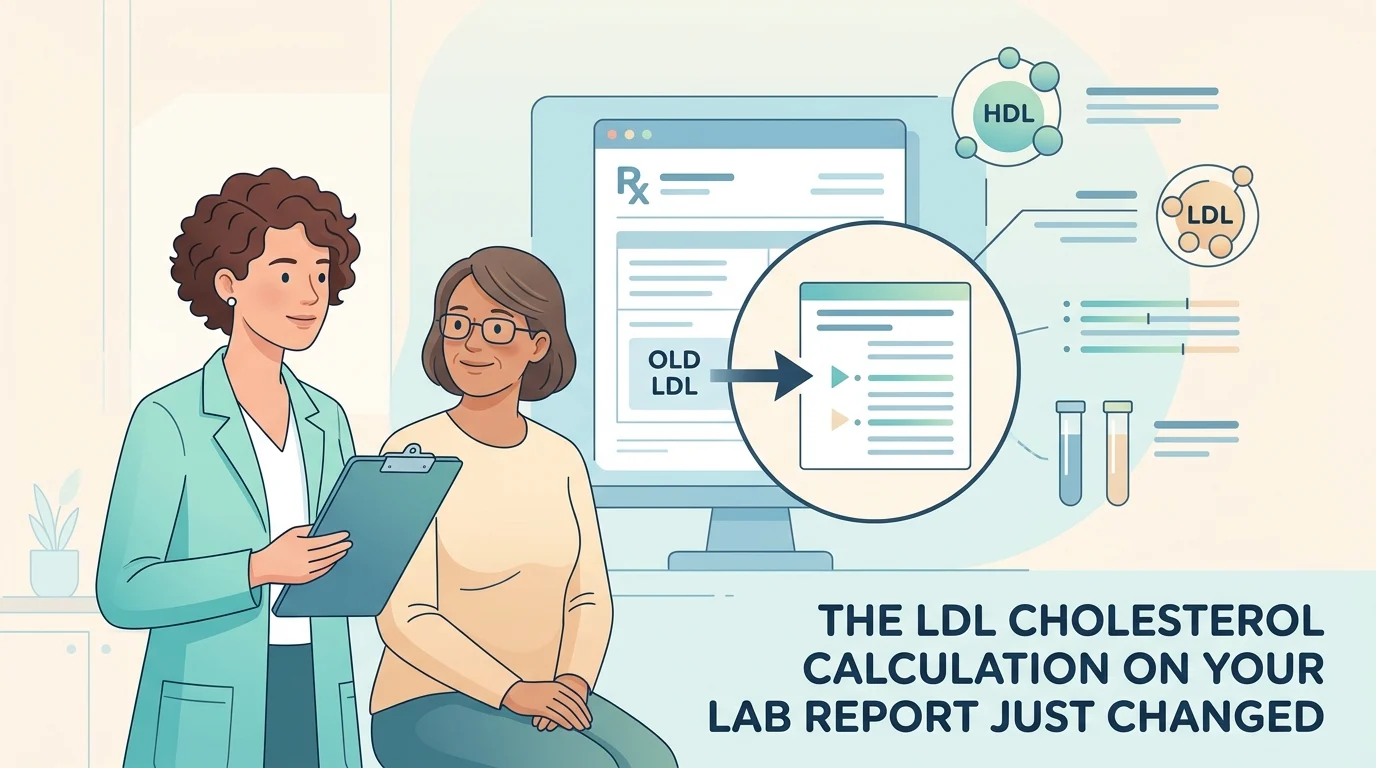
The LDL cholesterol calculation printed on your lab report is usually not a direct measurement. It is an estimate, produced by a formula that uses three other numbers from the same blood sample. On July 15, 2026, researchers at Johns Hopkins Medicine published a simplified, machine-learning version of that formula in JAMA Cardiology, and made the code free for any laboratory to adopt. In this article you will learn what actually changed, why an estimate is used at all, and what it means for the LDL number you already have in hand.
What changed in the LDL cholesterol calculation
Most laboratories do not measure LDL directly. They calculate it from total cholesterol, HDL cholesterol and triglycerides. Two formulas dominate: the Friedewald equation, introduced in the 1970s, and the newer Martin-Hopkins equation from 2013, which the 2026 national dyslipidemia guideline recommends preferentially.
The problem was practical rather than scientific. The Martin-Hopkins equation relies on a large lookup table, which some laboratory information systems struggle to implement. The new study rebuilt that step as a single line of open, transparent code. Tested on blood samples from 4.9 million U.S. children and adults, the machine-learning version matched the original to within 0.5 mg/dL, according to the Johns Hopkins research team.
The authors deliberately avoided a “black box” approach. Laboratories can inspect the code, and there are no patents or licensing restrictions attached to it. That combination is what makes wide adoption realistic over the next few years.
Why your LDL number is estimated rather than measured
Measuring LDL directly requires either a specialized assay or ultracentrifugation, a slow research-grade technique that spins blood at very high speed to separate particles by density. Neither is practical for the millions of routine lipid panels run every year, so calculation became the standard. Our guide details the complete lipid panel.
The estimate works by subtracting HDL cholesterol and an estimate of cholesterol carried in triglyceride-rich particles from your total cholesterol. Friedewald assumes a fixed ratio for that last part. Martin-Hopkins adjusts the ratio according to your individual triglyceride and non-HDL levels, which is where the accuracy gain comes from. A separate article covers high triglyceride levels.
The same logic applies to the other derived values on the report. We also explain the cholesterol ratio.
Where the older formula falls short
The differences between equations are small for most people. They widen sharply in one specific situation: a lipid profile combining high triglycerides with a low LDL value. That is precisely the profile of many people already under cardiovascular treatment, and it is where an underestimate can quietly cost someone a treatment they qualify for.
The table below shows how often each equation placed a sample in the correct treatment category, compared against ultracentrifugation as the reference standard.
| Equation | Correct treatment category, all samples | Correct when triglycerides are 200-399 mg/dL and LDL is under 70 mg/dL |
|---|---|---|
| Martin-Hopkins, machine-learning version | 90% | 84% |
| Martin-Hopkins, original | 90% | 83% |
| Sampson-NIH | 86% | 61% |
| Sampson-NIH, modified | 85% | 72% |
| Friedewald, 1970s | 83% | 40% |
Read the last column carefully. In that demanding scenario, the oldest formula landed in the right category only 40% of the time. The senior author described this profile as the ultimate stress test of the calculation, and noted that a difference of 5, 10 or 20 mg/dL can change whether someone qualifies for treatment.
What this means for your own lab report
First, a reassurance: nothing about your body changed. If your triglycerides are in the normal range, the equations agree closely and your number is dependable either way. Our team also covers normal LDL levels.
Second, check the wording. MedlinePlus notes that an LDL result may be labelled “calculated,” meaning it was estimated from your other lipid values, or “direct,” meaning it was measured. Knowing which one you are looking at tells you how much precision to expect.
Third, context matters more than the single digit. Cholesterol targets in the 2026 guideline sit below 100, 70 or 55 mg/dL depending on overall cardiovascular risk, so the same LDL value can be reassuring for one person and worth acting on for another. Our library covers high cholesterol.
The 2026 guideline also expanded testing beyond the standard panel. Another news article covers lipoprotein(a) screening for every adult.
When to raise it with your doctor
Bringing up the calculation is worthwhile if your triglycerides sit above 200 mg/dL, if your LDL is close to a treatment threshold, if you already take a lipid-lowering medication and are being managed to a low target, or if results from two different laboratories disagree more than you expected. In any of those cases, your clinician can consider a direct LDL measurement or a complementary marker. We describe the ApoB blood test, which counts atherogenic particles instead of estimating the cholesterol they carry.
Latest scientific advances
The 2026 study did not appear in isolation. Several independent teams have compared these equations over the past three years, and the picture they paint is consistent.
A 2025 meta-analysis pooled eight studies covering roughly 192,000 participants and compared both formulas against directly measured LDL. Martin-Hopkins tracked the measured value more closely, and the gap was widest in people with triglycerides above 200 mg/dL or LDL below 70 mg/dL. A meta-analysis combines results from many separate studies, which makes this a relatively strong level of evidence. What this means for you: the advantage of the newer formula is not a single-laboratory finding, it shows up repeatedly across different populations.
A 2023 study of 8,676 samples tested an extended version of the equation designed for triglycerides up to 800 mg/dL, and found it agreed with a direct assay more often than Friedewald did in that range. The authors cautioned that underestimation by older formulas could lead to undertreatment. What this means for you: if your triglycerides run high, the choice of formula is not a technical detail.
A 2024 analysis at a large academic medical center reached a similar conclusion using its own patient data, and reported a practical side effect: switching equations reduced how often the laboratory needed to run an extra direct LDL test. What this means for you: hospitals adopting the newer approach may order fewer repeat tests, not more.
These are validation studies rather than trials of a treatment. They tell us how well a number is estimated, not whether changing the formula by itself prevents heart attacks. That larger question is still settled by the treatment decisions the number informs.
Glossary
| Term | Definition |
|---|---|
| Calculated LDL | An LDL cholesterol value estimated by formula from total cholesterol, HDL and triglycerides rather than measured directly. |
| Direct LDL | An LDL value obtained by measuring the sample with a dedicated assay, without using a formula. |
| Friedewald equation | The original LDL formula from the 1970s. It applies one fixed ratio to everyone, which limits its accuracy at high triglyceride levels. |
| Martin-Hopkins equation | A 2013 formula that adapts the ratio to each person’s triglyceride and non-HDL levels. The 2026 dyslipidemia guideline recommends it preferentially. |
| Sampson-NIH equation | An alternative formula developed at the National Institutes of Health, designed to extend LDL estimation to higher triglyceride ranges. |
| Triglycerides | A type of fat carried in the blood. Their level is the main factor that determines how far the equations diverge. |
| Non-HDL cholesterol | Total cholesterol minus HDL cholesterol. It captures all the cholesterol carried by particles that can build up in arteries. |
| Ultracentrifugation | A laboratory technique that spins blood at very high speed to separate lipoproteins by density. It serves as the reference standard in research. |
| mg/dL | Milligrams per deciliter, the unit used for cholesterol and triglycerides on U.S. lab reports. |
Frequently asked questions
How is LDL cholesterol calculated?
The laboratory starts with your total cholesterol, then subtracts your HDL cholesterol and an estimate of the cholesterol carried by triglyceride-rich particles. The Friedewald equation estimates that last portion as your triglycerides divided by five. The Martin-Hopkins equation replaces that fixed divisor with a value adjusted to your own triglyceride and non-HDL levels, which is why it performs better at the extremes.
What does “calculated” mean next to my LDL result?
It means the number was derived from your other lipid values rather than measured on its own. This is standard practice and perfectly usable for most people. It simply signals that the result inherits a small amount of uncertainty from the three values feeding into it, and that the uncertainty grows when triglycerides are high.
What happens when triglycerides are over 400 mg/dL?
Traditionally, laboratories stop using the Friedewald equation above that level and switch to a direct LDL measurement, because the estimate becomes unreliable. Extended versions of the Martin-Hopkins equation are designed to remain usable at higher triglyceride levels, which is one reason some laboratories are moving to it. Your report or your clinician can tell you which route your laboratory took.
Does the new equation change my target LDL number?
No. Targets are set by clinical guidelines according to your cardiovascular risk, and they did not move because of this study. What may shift slightly is the calculated value being compared against those targets, particularly if you have high triglycerides.
Should I ask which equation my laboratory uses?
It is a reasonable question, especially if you are being treated to a low LDL target or your triglycerides are elevated. Many laboratories state the method on the report or in their test directory. If you are comparing results over time, knowing whether the method changed between two draws helps explain a shift that has nothing to do with your health.
Is a direct LDL test always better?
Not necessarily. Direct assays vary between manufacturers and are not automatically closer to the reference standard than a well-chosen equation. They are most useful in the specific situations where calculation is known to struggle, such as very high triglycerides. Your clinician decides based on your full lipid picture.
Sources
- Park J, Fan L, Sokoll L, et al. — Development and Validation of a Simplified Martin/Hopkins Low-Density Lipoprotein Cholesterol Equation Using Machine Learning — JAMA Cardiology, 2026 — jamanetwork.com
- Johns Hopkins Medicine — Machine Learning Method Enables Easier and Wider Use of Martin-Hopkins Equation to Accurately Assess LDL Cholesterol Risk, 2026 — hopkinsmedicine.org
- MedlinePlus, National Library of Medicine (NIH) — Cholesterol Levels: MedlinePlus Medical Test — medlineplus.gov
- Kostovska I, et al. — Comparative accuracy of LDL-cholesterol estimation: a meta-analysis of the Friedewald and Martin-Hopkins equation — Bulgarian Cardiology, 2025 — consensus.app
- Chung S. — Correlation of extended Martin/Hopkins equation with a direct homogeneous assay in assessing low-density lipoprotein cholesterol in patients with hypertriglyceridemia — Journal of Clinical Laboratory Analysis, 2023 — consensus.app
- Bayes M, et al. — Comparison of Martin/Hopkins, Sampson/NIH, and Friedewald Equations for the Estimation of Low-Density Lipoprotein Cholesterol and its Effect on Treatment Thresholds — American Journal of Clinical Pathology, 2024 — consensus.app
Further reading
- Understanding Normal Triglyceride Levels and Ranges
- High VLDL Levels: Causes, Symptoms, Risks
- Advanced Lipid Panel: What It Tests and Who Needs It
- Apolipoprotein A1: What Your Blood Test Results Mean
- Understanding Low HDL Cholesterol: Causes and Risks
Understand your lab results with AI DiagMe
A lipid panel is a good example of why isolated numbers rarely tell the whole story: your LDL only makes sense alongside your triglycerides, your HDL and your total cholesterol. AI DiagMe reads your blood, urine and stool results and explains what each value means in plain language, in the context of the others. It helps you understand your results and prepare better questions for your appointment. It does not diagnose, and it does not replace your doctor.
Get your results interpreted in minutes