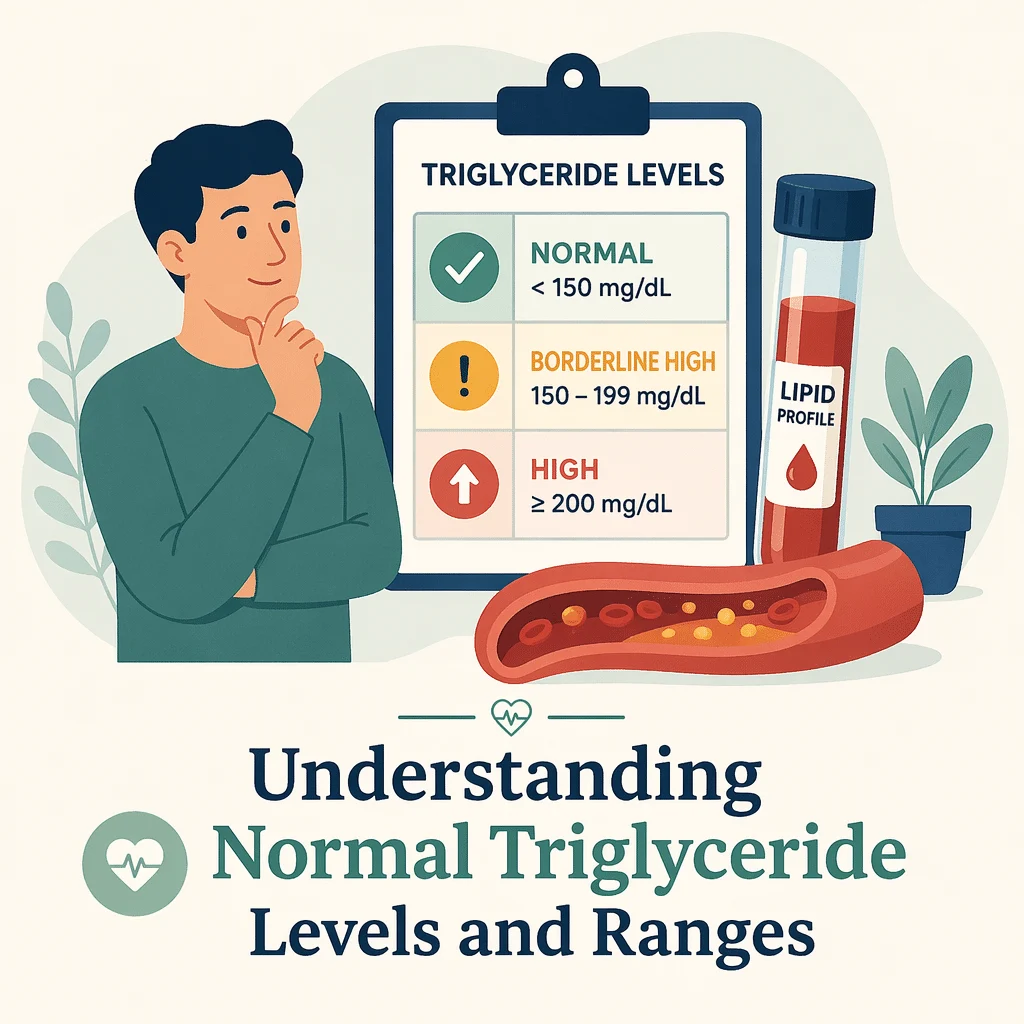
Normal triglyceride levels are one of the four figures on a standard lipid panel, and they are often the number people understand least. Triglycerides are the most common form of fat in the body, and the value on your report reflects both what you have eaten recently and what your liver has been making. A single reading can move a great deal from one week to the next, which is why clinicians rarely act on one result on its own.
In this article you’ll learn what triglycerides are and where they come from, the standard reporting bands and how to convert between mg/dL and mmol/L, why fasting matters less than it used to, which conditions and medicines push the number up, and — most importantly — why a very high result carries an urgent risk that has nothing to do with the heart.
What triglycerides are and where they come from
Triglycerides are fat molecules built from a glycerol backbone with three fatty acids attached. They are the body’s main way of packaging and storing energy. When you eat more calories than you need at that moment, the surplus is converted into triglycerides and parked in fat cells. When energy is needed later, those stores are released back into the bloodstream to fuel muscle and other tissue.
The National Heart, Lung, and Blood Institute (NHLBI) describes two sources. The first is dietary: fats in butter, oils and other foods are absorbed from the gut and carried in large particles called chylomicrons. The second is internal: the liver manufactures triglycerides from surplus calories, particularly from carbohydrate, and exports them in very low-density lipoprotein (VLDL) particles. This second route explains something that surprises many people — a diet low in fat can still produce a high triglyceride reading if the overall calorie and refined-carbohydrate load is high.
Because triglycerides travel inside lipoproteins, they sit alongside cholesterol in the same testing panel. That is why a triglyceride result usually arrives with HDL cholesterol, LDL cholesterol and total cholesterol on the same page. Very high triglycerides can also interfere with the calculation used to estimate LDL cholesterol, which is one reason laboratories sometimes report a non-HDL cholesterol figure instead.
Normal triglyceride levels: the standard bands
The bands most laboratories in the United States print on a report come from the National Cholesterol Education Program Adult Treatment Panel III (NCEP ATP III), and they are echoed by the NHLBI and by the National Library of Medicine’s MedlinePlus service. They apply to adults; children and adolescents are assessed against different cut-offs.
| Result (mg/dL) | What it is called | What it usually means | Typical next step |
|---|---|---|---|
| Below 150 | Normal / desirable | No triglyceride-specific concern; other lipids still matter | Routine retesting on the schedule your clinician sets |
| 150 to 199 | Borderline high | Often reflects weight, alcohol, diet or an untreated condition | Usually a repeat test and a look at the whole risk picture |
| 200 to 499 | High | A search for secondary causes is generally warranted | Clinical review; non-HDL cholesterol often calculated |
| 500 and above | Very high | Pancreatitis risk becomes the priority, not just heart risk | Prompt medical review, whether or not you feel unwell |
Reading mg/dL and mmol/L
Units differ by country, and this trips people up constantly. The United States reports triglycerides in milligrams per deciliter (mg/dL). Most of Europe, Canada, Australia and much of Asia use millimoles per liter (mmol/L). To convert mg/dL to mmol/L, divide by about 88.5; to go the other way, multiply by 88.5.
In practice, that means the 150 mg/dL threshold is roughly 1.7 mmol/L, 200 mg/dL is about 2.3 mmol/L, and the 500 mg/dL mark sits near 5.6 mmol/L. If you are comparing a result from one country with a reference range from another, check the unit before you draw any conclusion — a value of 2.0 means something entirely different in each system.
One further caveat: reference intervals are set by each laboratory and can differ slightly from the classic bands. Always read your number against the range printed on your own report.
Fasting or non-fasting: what has changed
For decades the triglyceride test was ordered as part of a fasting lipid panel, typically after 9 to 12 hours without food. The reasoning was straightforward: triglycerides rise after a meal, so fasting removed that variability. MedlinePlus still notes that your provider may ask you to fast, and will tell you if so.
What has shifted is that major guidelines and consensus statements now accept non-fasting samples for most routine cardiovascular risk assessment. Cholesterol and LDL change relatively little after eating, and the post-meal rise in triglycerides is modest in most people. Non-fasting testing is also far easier on patients, which matters when a missed fasting appointment means no test at all.
That acceptance is not universal, and it is not unconditional. Fasting is still generally preferred when triglycerides are already known to be high, when a very high result needs to be characterized accurately, or when a clinician is following a specific protocol. If your triglycerides blood test request says to fast, follow the instruction you were given rather than a general rule you read online.
What raises triglycerides
Everyday and dietary factors
Alcohol is one of the most reliable drivers, and its effect can be substantial even at intakes many people consider moderate. Refined carbohydrate and added sugar — sweetened drinks in particular — push liver triglyceride production upward. Carrying excess weight and being physically inactive both contribute, as does a persistent calorie surplus regardless of where those calories come from.
These are the factors clinicians most often discuss first, because they are the ones that respond. But the balance between them is individual, and turning a list of contributors into a personal plan is a conversation for your own clinician or a registered dietitian.
Medical conditions
Several conditions raise triglycerides as a side effect of the underlying problem. Poorly controlled diabetes is among the most common, which is why triglycerides are often reviewed alongside HbA1c. An underactive thyroid can raise them too, so a TSH test is a standard part of the workup. Chronic kidney disease, nephrotic syndrome, liver disease, Cushing’s syndrome and some autoimmune conditions such as lupus are also recognized contributors.
Pregnancy raises triglycerides physiologically, particularly in the second and third trimesters, and this rise is expected rather than abnormal. It does, however, matter in women who already have a triglyceride disorder, because the pregnancy-related increase can stack on top of an existing elevation.
Medicines
A number of widely used medicines can raise triglycerides. StatPearls, the peer-reviewed reference hosted by the National Library of Medicine, lists thiazide diuretics, beta blockers, oral estrogens and tamoxifen, combined oral contraceptives, antiretroviral protease inhibitors, atypical antipsychotics, isotretinoin, corticosteroids, bile acid-binding resins and some immunosuppressants such as sirolimus.
Seeing one of your own medicines on that list is not a reason to stop it. Every one of these drugs is prescribed because its benefit was judged to outweigh its effects on lipids, and stopping abruptly can be considerably more dangerous than the triglyceride rise. If you suspect a medicine is contributing, raise it with the prescriber — that is a decision only they can make with you.
Inherited causes of high triglycerides
Some elevations are genetic rather than acquired. Familial hypertriglyceridemia is the more common of the inherited patterns; it involves overproduction of large VLDL particles and is inherited in an autosomal dominant way. Familial combined hyperlipidemia raises triglycerides and LDL together and carries a higher cardiovascular burden. Familial dysbetalipoproteinemia, linked to a defective form of apolipoprotein E, produces roughly parallel elevations in cholesterol and triglycerides.
At the rare and severe end sits familial chylomicronemia syndrome (FCS). A 2025 expert review from the National Lipid Association describes it as an autosomal recessive disorder caused by biallelic variants in the LPL gene or in one of four related genes, producing extreme, sustained hypertriglyceridemia that resists conventional lipid-lowering drugs and carries a high lifetime risk of acute pancreatitis. It typically shows itself young. NHLBI notes that genetic testing may be considered when someone has pancreatitis or very high triglycerides without diabetes or obesity to explain it, or when a close relative has either.
Very high triglycerides and the risk of acute pancreatitis
This is the part of the topic that carries genuine urgency, and it is often buried. Very high triglycerides can trigger acute pancreatitis — sudden, severe inflammation of the pancreas — through a mechanism quite separate from anything to do with arteries. Free fatty acids released from chylomicrons in the pancreatic capillaries, together with the sluggish flow that comes with extremely fat-laden blood, injure pancreatic tissue directly.
StatPearls describes the risk as rising with the triglyceride level, increasing markedly above 500 mg/dL and rising dramatically above roughly 1,500 to 2,000 mg/dL. NHLBI similarly flags levels above 500 mg/dL as raising the risk of acute pancreatitis, and notes that extremely high levels can also cause visible changes in the retinal blood vessels and skin deposits called eruptive xanthomas.
Red flag — seek emergency care now
Severe abdominal pain that radiates through to the back, with nausea and vomiting, in someone known to have very high triglycerides, may be acute pancreatitis. This is a medical emergency. Call your local emergency number or go to an emergency department immediately. Do not wait to see whether the pain settles, and do not try to manage it at home.
Even without any symptoms, a triglyceride result of 500 mg/dL or higher warrants prompt medical review rather than a wait-and-see approach. Contact your clinician without delay so the result can be confirmed and the cause investigated.
If pancreatitis is suspected, the diagnostic workup usually includes amylase and lipase, imaging of the abdomen, and a repeat lipid measurement. You can read more about the condition itself in our guide to pancreatitis symptoms and causes.
Triglycerides and heart risk: an honest picture
Triglycerides are associated with cardiovascular disease. That association is consistent across large populations and is not in dispute. What is more complicated is the causal picture, and it is worth being straight about that.
LDL cholesterol has a well-established causal relationship with atherosclerosis, supported by genetic, observational and trial evidence that all point the same way. For triglycerides, the evidence is less tidy. StatPearls notes that mild to moderate hypertriglyceridemia has been shown in many studies to be an independent risk factor for cardiovascular disease, but that the data do not show definite evidence that cardiovascular risk falls when hypertriglyceridemia is treated. Part of the difficulty is that high triglycerides rarely travel alone — they cluster with low HDL, insulin resistance, central weight gain and elevated apolipoprotein B, and untangling which component drives the risk is genuinely hard.
Current thinking increasingly focuses on remnant cholesterol — the cholesterol carried inside triglyceride-rich lipoprotein remnants — as the more directly atherogenic component. That is one reason clinicians often look at non-HDL cholesterol or apolipoprotein B rather than the triglyceride number alone when they are estimating cardiovascular risk. Treatment decisions in this space are individualized, and they depend on your overall risk profile rather than on the triglyceride figure in isolation.
When to see a doctor about your triglyceride result
Any result at 150 mg/dL or above is worth discussing at your next appointment. A result of 500 mg/dL or above should prompt contact with your clinician without waiting, because of the pancreatitis risk described above. Severe abdominal pain with known very high triglycerides is an emergency, not an appointment.
It is also worth booking a review if you have started a new medicine and your triglycerides have climbed, if you have diabetes or thyroid or liver disease that may not be well controlled, or if a close relative has had unexplained pancreatitis. Bring your report to the appointment, including the units and the laboratory’s own reference range.
One caution about the bands: resist the temptation to treat them as a self-scoring exercise. A single triglyceride value varies substantially with recent meals, alcohol, acute illness and even the time of day. Clinicians routinely repeat the test before concluding anything, and they read it against everything else they know about you.
Latest scientific advances in triglyceride testing
Research published between 2023 and 2026 has sharpened several of the questions above. According to PubMed, the findings below come from peer-reviewed studies; each is attributed and linked in the Sources section.
A 2026 review in Current Opinion in Lipidology set out the case for non-fasting lipid testing. What was found: non-fasting measurement is now recommended by guidelines and consensus statements worldwide and predicts cardiovascular risk at least as well as fasting measurement, partly because remnant lipoprotein cholesterol — which rises after eating — is itself a key predictor of ischemic vascular disease. Adoption, however, lags behind the recommendation, held back by the habit of ordering a fasting glucose alongside the lipid panel and by patient expectations. What this means for you: if you were not asked to fast, that is very likely a deliberate, evidence-based choice rather than an oversight.
Not every group agrees. A 2024 systematic review and meta-analysis in Lipids in Health and Disease pooled eight studies covering 244,665 participants and found statistically significant differences between fasted and non-fasted values for total cholesterol, HDL, LDL and triglycerides. The authors concluded that fasting remains preferable as a conservative approach that reduces variability. What this means for you: the two positions are not really contradictory — non-fasting is good enough for routine risk screening, while fasting still reduces noise when precision matters, which is exactly why practice differs between clinics.
On pancreatitis, a 2025 systematic review in BMC Gastroenterology assembled 77 studies covering 56,617 people with acute pancreatitis. What was found: about one in five cases was attributed to hypertriglyceridemia. Compared with other causes, those patients were younger and more often male, and had higher rates of severe disease and recurrence. Poor long-term triglyceride control and continued smoking stood out as predictors of a repeat episode. What this means for you: triglyceride-related pancreatitis is not a rare curiosity, and preventing a second episode depends heavily on sustained follow-up.
Treatment for the severe end of the spectrum is changing. A pair of phase 3 randomized trials reported in the New England Journal of Medicine in 2025 (CORE-TIMI 72a and CORE2-TIMI 72b) tested olezarsen, an antisense drug that blocks production of apolipoprotein C-III, in 1,061 people with severe hypertriglyceridemia.
What was found: triglycerides, apolipoprotein C-III, remnant cholesterol and non-HDL cholesterol all fell substantially compared with placebo, and the rate of acute pancreatitis was markedly lower on the drug. The higher dose brought more liver-enzyme elevation, low platelet counts and a dose-related rise in liver fat. What this means for you: this is a prescription-only therapy for a specific severe group, and only a specialist can judge whether it is relevant to any individual.
Finally, fish oil. A 2025 systematic review and meta-analysis in Nutrients pooled 21 randomized trials of marine-derived omega-3 supplements in people with metabolic syndrome or its components. What was found: triglycerides fell meaningfully, with the largest reductions at doses above 2,000 mg a day sustained for eight weeks or more. But the picture was mixed elsewhere — effects on HDL and blood pressure were inconsistent, fasting glucose was largely unaffected, and LDL cholesterol rose in some subgroups.
What this means for you: over-the-counter fish oil is not a benign, obviously-beneficial default. Prescription-strength omega-3 preparations are a regulated medicine and differ from supplements sold on a shelf. Whether omega-3 in any form belongs in your care is a decision for your clinician.
Frequently asked questions
Do I need to fast for a triglyceride test?
Often not. Guidelines and consensus statements in the United States and Europe now accept non-fasting lipid panels for routine cardiovascular risk assessment, and many clinics have moved that way. MedlinePlus notes that you may still be asked to fast for 9 to 12 hours, and your provider will tell you if that applies. Fasting is more likely to be requested when your triglycerides are already known to be high, when a previous result needs confirming, or when your clinician is following a protocol that specifies it. The safest approach is simple: follow the instruction printed on your own test request rather than a general rule.
Are high triglycerides dangerous?
It depends heavily on how high. In the borderline and high bands, the concern is a contribution to long-term cardiovascular risk, assessed alongside your other lipids, blood pressure, smoking status, diabetes and family history — not something that requires action today. Above roughly 500 mg/dL the situation changes character, because the risk of acute pancreatitis becomes real and grows sharply at higher values. That is why a very high reading warrants prompt medical review even when you feel completely well, and why severe abdominal pain in that setting is treated as an emergency.
Does fish oil help lower triglycerides?
Omega-3 fatty acids do lower triglycerides — that effect is well documented, and it is dose-dependent, with meaningful reductions generally requiring gram-level intakes rather than a small daily capsule. What is far less clear is whether taking a supplement translates into better cardiovascular outcomes; trial results have been mixed, and some analyses find LDL cholesterol rises. NHLBI also draws an important distinction: concentrated omega-3 preparations available on prescription are regulated medicines and are made differently from over-the-counter omega-3 supplements, which are not approved to treat high triglycerides. AI DiagMe does not recommend supplements. Discuss it with your clinician.
What is a normal triglyceride level for women?
The standard adult bands are the same for men and women, so below 150 mg/dL is the usual normal cut-off for both. In practice, population surveys have found triglycerides tend to run somewhat higher in men than in women until around age 70, and levels drift upward with age in both. Pregnancy raises triglycerides substantially in the second and third trimesters, and that increase is physiological rather than a sign of disease. Your clinician interprets your figure against your age, life stage and everything else on the panel.
How quickly can triglycerides change?
Faster than most lipid measurements. Triglycerides respond within hours to a large meal or to alcohol, and they can be pushed up temporarily by acute illness or infection. That short-term volatility is precisely why one out-of-range value is rarely acted on in isolation, and why clinicians typically repeat the test — often under standardized conditions — before deciding what it means. Longer-term habits, body weight, and any underlying condition set the baseline that a single reading fluctuates around.
Why did my lab report triglycerides in mmol/L?
Because unit conventions differ by country. The United States uses mg/dL, while most of Europe, Canada, Australia and much of Asia use mmol/L. Divide mg/dL by roughly 88.5 to get mmol/L, or multiply mmol/L by 88.5 to go the other way. So 150 mg/dL is about 1.7 mmol/L and 500 mg/dL is about 5.6 mmol/L. If you are comparing results from two countries, or reading a reference range you found online, check the unit first — the same numeral means completely different things in the two systems.
Glossary of key terms
| Term | Definition |
|---|---|
| Triglyceride | The most common type of fat in the body, made of glycerol with three fatty acids attached, used to store and transport energy. |
| Lipid panel | A blood test that reports total cholesterol, LDL cholesterol, HDL cholesterol and triglycerides together. |
| Chylomicron | A large particle made in the intestine that carries dietary fat from a meal into the bloodstream. |
| VLDL | Very low-density lipoprotein; the particle the liver uses to export triglycerides it has manufactured. |
| Remnant cholesterol | The cholesterol carried inside partly broken-down triglyceride-rich particles, increasingly viewed as a driver of arterial disease. |
| Non-HDL cholesterol | Total cholesterol minus HDL cholesterol; often used instead of LDL when triglycerides are high. |
| Hypertriglyceridemia | The medical term for a triglyceride level above the normal range. |
| Acute pancreatitis | Sudden inflammation of the pancreas, causing severe abdominal pain; a recognized complication of very high triglycerides. |
| Familial chylomicronemia syndrome | A rare inherited disorder of triglyceride clearance that causes extreme levels and a high lifetime risk of pancreatitis. |
| Apolipoprotein B | A protein present on each atherogenic lipoprotein particle; a count of these particles, sometimes measured when triglycerides are raised. |
Sources
- National Heart, Lung, and Blood Institute. High Blood Triglycerides. https://www.nhlbi.nih.gov/health/high-blood-triglycerides
- MedlinePlus, National Library of Medicine. Triglycerides Test. https://medlineplus.gov/lab-tests/triglycerides-test/
- Karanchi H, Muppidi V, Wyne K. Hypertriglyceridemia. StatPearls, NCBI Bookshelf, National Library of Medicine. https://www.ncbi.nlm.nih.gov/books/NBK459368/
- Xiang P, Hanjani K, Francis GA. Nonfasting lipid testing: all the good reasons to do it, and potential physician and patient behaviors preventing its implementation. Current Opinion in Lipidology, 2026. Retrieved from PubMed. https://doi.org/10.1097/MOL.0000000000001028
- Zaid AB, Awad SM, El-Abd MG, et al. Unraveling the controversy between fasting and nonfasting lipid testing in a normal population: a systematic review and meta-analysis of 244,665 participants. Lipids in Health and Disease, 2024. Retrieved from PubMed. https://doi.org/10.1186/s12944-024-02169-y
- Lu J, Wang Z, Mei W, et al. A systematic review of the epidemiology and risk factors for severity and recurrence of hypertriglyceridemia-induced acute pancreatitis. BMC Gastroenterology, 2025. Retrieved from PubMed. https://doi.org/10.1186/s12876-025-03954-4
- Marston NA, Bergmark BA, Alexander VJ, et al. Olezarsen for Managing Severe Hypertriglyceridemia and Pancreatitis Risk. New England Journal of Medicine, 2025. Retrieved from PubMed. https://doi.org/10.1056/NEJMoa2512761
- Basirat A, Merino-Torres JF. Marine-Based Omega-3 Fatty Acids and Metabolic Syndrome: A Systematic Review and Meta-Analysis of Randomized Controlled Trials. Nutrients, 2025. Retrieved from PubMed. https://doi.org/10.3390/nu17203279
- Javed F, Hegele RA, Garg A, et al. Familial chylomicronemia syndrome: An expert clinical review from the National Lipid Association. Journal of Clinical Lipidology, 2025. Retrieved from PubMed. https://doi.org/10.1016/j.jacl.2025.03.013
Further reading
- High triglyceride level: causes, risks and management
- Low triglyceride level: causes, risks and benefits
- Advanced lipid panel: ApoB and heart risk
- Total cholesterol test: understanding your results
- Fasting blood glucose levels: a guide to interpretation
Understand your lab results with AI DiagMe
A triglyceride figure rarely means much on its own. It sits next to HDL, LDL and glucose on the same report, and those numbers only make sense read together. AI DiagMe turns that page of values into plain language you can actually follow, so you arrive at your appointment with better questions. It helps you understand your results; it does not diagnose anything and it does not replace your doctor.
Get your results interpreted in minutes