








































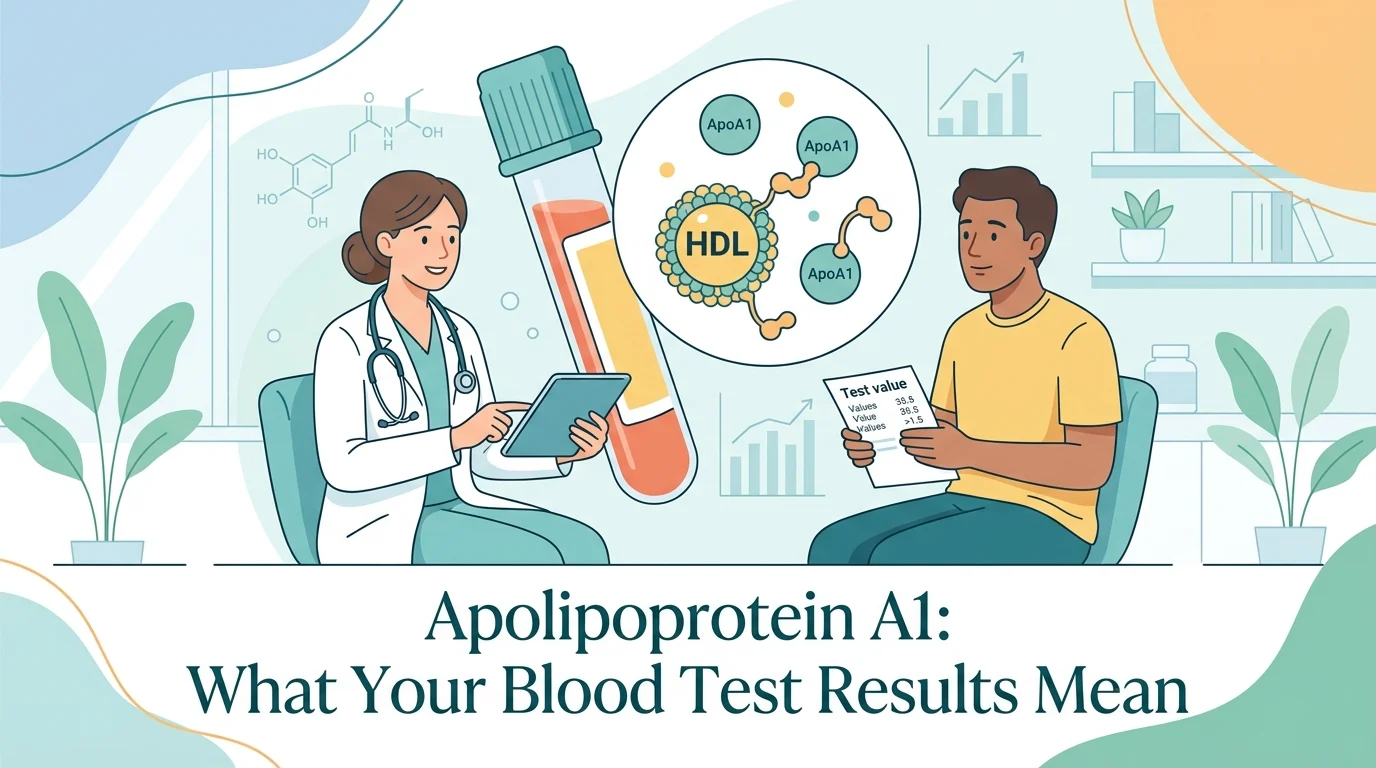
Apolipoprotein A1 is the main protein in HDL, the “good” cholesterol that helps clear excess fat from your arteries. If this line showed up on your blood test, you are probably wondering whether your number is high, low, or normal, and what that means for your heart. This guide explains, in plain language, what apolipoprotein A1 does, why a doctor might measure it, and how to read your result. You will also see how it differs from HDL cholesterol and lipoprotein(a), why the ApoB/ApoA1 ratio can sharpen a heart-risk estimate, and practical steps that may help raise a low level. The focus throughout is on understanding your result calmly, not on self-diagnosis.
Key points to keep in mind:
- Apolipoprotein A1 (ApoA1) is the structural protein of HDL, your protective cholesterol.
- A normal or high level is generally reassuring; a low level is linked to higher heart risk.
- Reference ranges differ between labs, and women usually run higher than men.
- The ApoB/ApoA1 ratio compares harmful and protective particles, and may predict risk better than cholesterol numbers alone.
What is apolipoprotein A1?
Apolipoprotein A1 is the major protein found in high-density lipoprotein (HDL) particles, the carriers most people know as “good” cholesterol. Your liver and small intestine make it, and it accounts for the bulk of the protein in every HDL particle. Each HDL particle carries roughly two to five apolipoprotein A1 molecules, and this protein gives the particle its shape and lets it do its job.
The main task of apolipoprotein A1 is a process called reverse cholesterol transport. Think of HDL as a fleet of small taxis and apolipoprotein A1 as the driver. The protein helps HDL collect surplus cholesterol from your tissues and artery walls, then carries it back to the liver, which clears it from the body. This is one of the few ways your body removes cholesterol it no longer needs, and it helps slow the buildup of fatty deposits that drives heart disease. When this clearing system runs well, your blood vessels stay healthier, which is part of why a low level of HDL cholesterol concerns doctors.
Apolipoprotein A1 does more than ferry cholesterol. It also calms inflammation in the cells that line your blood vessels, carries antioxidant activity, and helps vessels relax so blood flows more easily. These extra effects are part of the reason the protein is considered protective for the heart and circulation.
Apolipoprotein A1 versus HDL cholesterol
People often assume apolipoprotein A1 and HDL cholesterol are the same thing. They are closely related but measure different things. An HDL cholesterol result tells you how much cholesterol is being carried inside your HDL particles. An apolipoprotein A1 result instead reflects the protein itself, which tracks the number and function of those particles. Because the amount of cholesterol packed into each HDL particle varies, apolipoprotein A1 is not a one-to-one stand-in for HDL cholesterol, and it can occasionally add information that a standard lipid panel does not capture on its own.
Why doctors order an apolipoprotein A1 blood test
An apolipoprotein A1 test is not part of a routine checkup. Most cardiovascular screening still relies on the standard cholesterol numbers, so this protein is usually measured only when a doctor wants a closer look. Common reasons include a personal or family history of high cholesterol or early heart disease, an unusual cholesterol pattern that needs clarifying, or a check on whether cholesterol-lowering treatment is working. Learning how to read your blood test results makes these extra markers far less intimidating.
Apolipoprotein A1 also appears in some specialized scoring panels used to estimate liver scarring (fibrosis), where a lower value can be one of several inputs. If you see it alongside liver function tests, that does not automatically mean your liver is unwell; it simply reflects how the panel is built. Your doctor interprets the whole picture, not one number.
The test itself is straightforward. A technician draws a small blood sample from a vein in your arm, and the lab measures the protein in your serum. Many labs ask you to fast for 8 to 12 hours beforehand, especially when apolipoprotein A1 is collected together with a full lipid panel that includes triglycerides. Always follow the preparation instructions on your lab slip, since fasting rules can vary.
Apolipoprotein A1 normal range
Reference ranges for apolipoprotein A1 depend on the laboratory, the testing method, and your sex and age, so your report will list the specific range your lab uses. As a general guide, women tend to have higher values than men, and higher results are usually the favorable direction. Results are most often reported in milligrams per deciliter (mg/dL) in the United States, or in grams per liter (g/L) elsewhere; to convert mg/dL to g/L, divide by 100 (for example, 130 mg/dL equals 1.3 g/L).
| Group | Typical reference range | Generally desirable level |
|---|---|---|
| Men | about 110–180 mg/dL (1.1–1.8 g/L) | above roughly 120 mg/dL |
| Women | about 110–205 mg/dL (1.1–2.05 g/L) | above roughly 140 mg/dL |
These figures are a broad orientation, not a verdict. Some sources, such as Cleveland Clinic, describe a normal range closer to 100–150 mg/dL, which shows how much labs can differ. What matters most is where your value sits within your own lab’s range, how it compares to past results, and how it fits your overall heart-risk profile. Use the table to understand the general direction, then confirm the meaning of your specific number with your doctor.
What high and low apolipoprotein A1 levels mean
Because apolipoprotein A1 supports a protective process, the interpretation is fairly intuitive: more is generally better, and less is generally less favorable. The detail matters, though, so it helps to look at each direction.
When apolipoprotein A1 is low
A low apolipoprotein A1 level suggests weaker reverse cholesterol transport and is associated with a higher risk of heart and blood vessel disease. Notably, a low value can flag increased risk even when an HDL cholesterol number looks acceptable, which is part of why doctors sometimes reach for this protein. A single low result is not a diagnosis; it is a prompt to look at the bigger picture and often to repeat the test.
Many things can lower apolipoprotein A1, including:
- Uncontrolled diabetes, insulin resistance, or metabolic syndrome
- Excess weight and a sedentary lifestyle
- Smoking
- A diet very high in refined carbohydrates or trans fats
- Certain medicines, such as androgens, anabolic steroids, some beta-blockers, and some diuretics
- Chronic kidney disease, nephrotic syndrome, or liver disease
- Acute illness or significant inflammation
- Rare inherited conditions that reduce HDL, such as Tangier disease or familial apolipoprotein A1 deficiency
An extremely low value (below about 20 mg/dL) is uncommon and points toward liver disease or a genetic disorder, which a doctor will investigate specifically. For most people, a modestly low result reflects everyday, modifiable factors, and it often improves alongside efforts to raise a low HDL cholesterol.
When apolipoprotein A1 is high
A high apolipoprotein A1 level is usually a welcome sign, pointing to a robust supply of functional HDL particles. Common reasons include regular aerobic exercise, weight loss, higher estrogen (including during pregnancy), and treatment with certain lipid medicines. Some people simply inherit naturally high levels, a pattern sometimes called familial hyperalphalipoproteinemia.
One nuance is worth keeping in mind. A high apolipoprotein A1 or HDL value is not an absolute guarantee against heart disease, and very high HDL is not always more protective than moderately high HDL. Your full risk profile, including LDL cholesterol, blood pressure, blood sugar, and family history, still matters. Treat a high result as encouraging rather than as a reason to ignore other numbers.
The ApoB/ApoA1 ratio: a sharper view of heart risk
To understand the ApoB/ApoA1 ratio, you first need its partner. Apolipoprotein B (ApoB) is the main protein on the particles that drive artery clogging, including LDL, VLDL, and intermediate-density lipoproteins. Crucially, each of these harmful particles carries exactly one ApoB molecule, so an ApoB blood test effectively counts how many artery-damaging particles you have.
Dividing ApoB by apolipoprotein A1 compares the harmful particles against the protective ones in a single number. A higher ratio means the balance has tipped toward risk; a lower ratio means protection has the upper hand. Large studies support its value: in the Swedish AMORIS cohort, which followed about 137,100 people for an average of nearly 18 years, a higher ApoB/ApoA1 ratio was linked to earlier heart attacks and strokes, and abnormal ratios were detectable roughly two decades before events occurred. Some researchers consider the ratio at least as informative as the familiar total-cholesterol-to-HDL cholesterol ratio, and it is a standard part of an advanced lipid panel.
| Risk category | Men | Women |
|---|---|---|
| Lower risk | below about 0.7 | below about 0.6 |
| Moderate | about 0.7–0.9 | about 0.6–0.8 |
| Higher risk | above about 0.9 | above about 0.8 |
As with every lipid marker, these cutoffs vary by laboratory and guideline, and they are meant to be read in context by a clinician. The ratio is a tool for refining a risk estimate, not a stand-alone score that decides treatment.
Apolipoprotein A1 versus lipoprotein(a) and other lipid markers
Lipid reports are crowded with similar-sounding names, and apolipoprotein A1 is easy to confuse with lipoprotein(a), often written Lp(a). They are not the same and, in fact, point in opposite directions. Apolipoprotein A1 is protective and sits on HDL, while lipoprotein(a) is a largely inherited, LDL-like particle that raises heart risk. The table below sorts out the markers you are most likely to see together.
| Marker | What it measures | A higher level generally means |
|---|---|---|
| Apolipoprotein A1 (ApoA1) | The main protein of HDL; reflects protective particle number and function | Lower heart risk (protective) |
| HDL cholesterol | Cholesterol carried inside HDL particles | Usually protective |
| Apolipoprotein B (ApoB) | The number of artery-clogging particles (LDL, VLDL, IDL, Lp(a)) | Higher heart risk |
| LDL cholesterol | Cholesterol carried inside LDL particles | Higher heart risk |
| Lipoprotein(a), Lp(a) | A mostly inherited, LDL-like particle | Higher heart risk (genetic) |
Reading these markers as a set is far more useful than fixating on any single line. Your LDL cholesterol and triglycerides describe the burden of fats and harmful particles, while apolipoprotein A1 and HDL describe your defenses. The contrast between the two sides is exactly what the ApoB/ApoA1 ratio tries to summarize.
How to raise your apolipoprotein A1
Because apolipoprotein A1 rises and falls with HDL, the habits that lift one tend to help the other. Lifestyle changes usually produce modest shifts rather than dramatic jumps, but they also improve the rest of your risk profile, which is the real goal. Evidence-supported steps include:
- Aerobic exercise, aiming for at least 150 minutes of moderate activity each week
- Stopping smoking, which alone can improve HDL function
- Losing excess weight if your doctor advises it
- Replacing saturated and trans fats with unsaturated fats from olive oil, nuts, and fatty fish
- Adding soluble fiber from oats, beans, and legumes
- Managing diabetes, insulin resistance, and blood pressure
When lifestyle is not enough, doctors sometimes use medicines that influence these proteins. Statins mainly lower ApoB and the number of harmful particles, while certain other drugs can nudge apolipoprotein A1 upward; any medication decision belongs to your clinician, who weighs your full cholesterol picture. Avoid chasing a single number with supplements or extreme diets, and make changes you can sustain.
When to talk to your doctor
Apolipoprotein A1 is one piece of a larger heart-health puzzle, and the most reliable interpretation comes from a professional who knows your history. Consider booking a conversation if any of the following apply:
- Your result falls outside your lab’s range, or has changed noticeably from a previous test.
- You have a family history of early heart attack, stroke, or very abnormal cholesterol.
- You already live with diabetes, metabolic syndrome, kidney disease, or liver disease.
- Your apolipoprotein A1 looks normal but other markers, such as ApoB or LDL, are concerning.
- You have symptoms such as chest pain or breathlessness, which call for prompt assessment and may involve a cardiac markers panel.
A doctor can confirm whether a repeat test is needed, place your numbers in context, and decide whether any further evaluation or treatment makes sense for you.
Glossary
| Term | Definition |
|---|---|
| Apolipoprotein | A protein that combines with fats to form lipoproteins, the particles that carry cholesterol and triglycerides through the blood. |
| Apolipoprotein B (ApoB) | The main protein on artery-clogging particles such as LDL; one ApoB sits on each particle, so it reflects how many harmful particles you have. |
| ApoB/ApoA1 ratio | A number comparing harmful particles (ApoB) with protective ones (apolipoprotein A1); a higher ratio suggests greater heart risk. |
| Atherosclerosis | The gradual buildup of fatty plaques inside artery walls, which can narrow vessels and lead to heart attack or stroke. |
| HDL cholesterol | “Good” cholesterol; HDL particles help carry excess cholesterol back to the liver for removal. |
| Lipid panel | A common blood test that measures total cholesterol, LDL, HDL, and triglycerides to estimate heart-disease risk. |
| Lipoprotein(a), Lp(a) | A largely inherited, LDL-like particle that raises cardiovascular risk and is measured separately from apolipoprotein A1. |
| Reverse cholesterol transport | The process by which HDL, guided by apolipoprotein A1, removes surplus cholesterol from tissues and returns it to the liver. |
Frequently asked questions
Is a high apolipoprotein A1 always a good sign?
Usually, yes. A higher level points to plenty of functional HDL particles and is generally linked to lower heart risk. It is not an absolute guarantee, though. Very high HDL is not always more protective than moderately high HDL, and a strong apolipoprotein A1 does not cancel out problems like high LDL cholesterol, high blood pressure, or smoking. Read a high result as encouraging, then keep an eye on your other numbers and overall risk profile rather than relying on this single marker.
Can my apolipoprotein A1 and HDL cholesterol disagree?
They can. HDL cholesterol measures the cholesterol carried inside HDL particles, while apolipoprotein A1 reflects the protein and the particles themselves. Because the amount of cholesterol per particle varies from person to person, the two numbers do not always move in lockstep. Occasionally one looks normal while the other is borderline. This is exactly why a doctor sometimes orders both: comparing them can reveal information that a single value would miss. Your clinician interprets any mismatch in the context of your full results.
How long does it take to raise apolipoprotein A1?
There is no fixed timeline, and changes are usually gradual. Lifestyle measures such as regular aerobic exercise, quitting smoking, weight loss, and a better fat balance often take several weeks to a few months to show up on a blood test, and the size of the change is typically modest. Doctors generally recheck cholesterol-related markers after a meaningful interval rather than within days. Consistency matters more than speed, and sustainable habits tend to produce the most durable improvement.
Is apolipoprotein A1 deficiency inherited?
It can be. Most low results come from everyday, modifiable factors such as metabolic syndrome, inactivity, smoking, or certain medicines. A small number of people, however, have inherited conditions, such as Tangier disease or familial apolipoprotein A1 deficiency, that lower HDL and apolipoprotein A1 from birth. These are rare and often suspected when levels are extremely low or when several family members are affected. If your doctor suspects an inherited cause, they may suggest additional testing or a referral to a specialist.
Do I need to fast before an apolipoprotein A1 test?
It depends on the lab and on what else is being measured. Apolipoprotein A1 on its own may not strictly require fasting, but many laboratories still recommend it, and fasting is commonly needed when the protein is drawn together with a full lipid panel that includes triglycerides. The safest approach is to follow the exact instructions printed on your lab slip or given by your clinic, which usually means avoiding food and drinks other than water for 8 to 12 hours.
Should I worry about a single low result?
One low value is rarely cause for alarm on its own. Lab results can be influenced by recent illness, inflammation, diet, or normal day-to-day variation, so doctors often confirm an unexpected finding with a repeat test. What matters is the overall trend and how the number fits with your other markers and risk factors. Rather than focusing on a single line, bring the result to your doctor, who can decide whether retesting or any further steps are appropriate.
Sources
- Apolipoprotein A1 (ApoA1) — Cleveland Clinic
- Apolipoprotein A — University of Rochester Medical Center Health Encyclopedia
- Apolipoprotein A1, Serum — Mayo Clinic Laboratories
Further reading
- Lipid Panel Explained: Cholesterol, LDL & HDL
- Understanding Low HDL Cholesterol: Causes & Risks
- ApoB Blood Test and Heart Disease Risk
- Lipoprotein(a): A Cardiovascular Risk Marker
- Cholesterol Ratio Explained: Meaning and Risks
Understand your lab results with AI DiagMe
Markers like apolipoprotein A1 rarely mean much in isolation, and a single abnormal line can be hard to place without context. AI DiagMe helps you make sense of a cholesterol panel, apolipoprotein A1 and B, and your HDL and LDL cholesterol, turning a page of numbers into clear, readable explanations. It is built to help you understand your results and ask better questions, not to diagnose you or replace your doctor. If your latest report left you uncertain, AI DiagMe can walk you through what each value means.
➡️ Get your results interpreted in minutes