





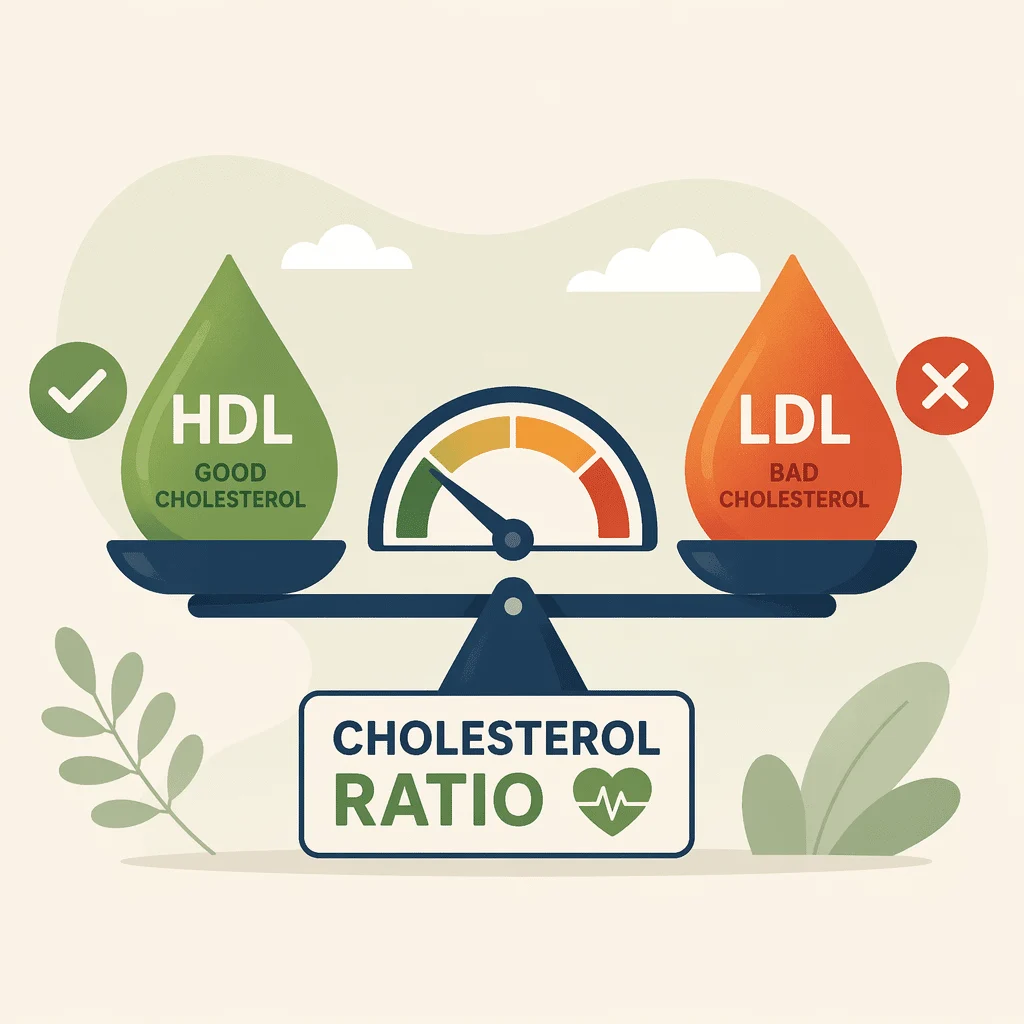
Your cholesterol ratio is one number on your lab report divided by another, and it is probably the least useful figure on the page. It is a shorthand, and modern cholesterol guidance has largely moved past it: treatment decisions in the United States rest on absolute cholesterol numbers and an estimated cardiovascular risk, not on a ratio.
In this article you’ll learn which three ratios you may meet and what each divides by what, why a reassuring ratio can conceal a high LDL, what US guidelines use instead, how to work out your non-HDL cholesterol from your own report, what apolipoprotein B and lipoprotein(a) add, why a high HDL is not the safety margin it seems, and which results warrant urgent care.
What a cholesterol ratio is, and the three you may see
A lipid panel measures total cholesterol, HDL, LDL and triglycerides. A ratio takes two of those numbers and divides one by the other. Nothing new is measured; the arithmetic compresses two facts into one. Three versions circulate, and laboratories report them inconsistently.
Total cholesterol to HDL
This is total cholesterol divided by HDL cholesterol. If your total cholesterol is 200 mg/dL and your HDL is 50 mg/dL, the ratio is 4.0. It is the version most often printed on US reports, sometimes labelled CHOL/HDL.
LDL to HDL
This is LDL cholesterol divided by HDL cholesterol. It leaves out the cholesterol carried in triglyceride-rich particles, so it describes a narrower slice of the picture than the total-to-HDL version.
Triglyceride to HDL
This divides triglycerides by HDL cholesterol. It is used less as a cholesterol measure than as a rough signal of insulin resistance, and it is the ratio most affected by what you ate yesterday, because triglyceride levels and their ranges move quickly with meals and alcohol.
In every case, a lower ratio is meant to signal that a smaller share of your cholesterol sits in particles that deposit in artery walls, relative to those that carry it away. A higher ratio signals the opposite. That is the whole idea, and it is where the trouble starts.
Why a good cholesterol ratio can hide a high LDL
A ratio is a fraction, and HDL sits in the denominator. Anything that raises HDL therefore pulls the ratio down and makes it look better, even when the cholesterol that actually drives arterial plaque has not moved at all.
Consider two people tested at the same lab on the same morning. The first has a total cholesterol of 240 mg/dL, an HDL of 80 mg/dL and an LDL of 145 mg/dL: total divided by HDL gives 3.0, which most charts call reassuring. The second has a total cholesterol of 190 mg/dL, an HDL of 40 mg/dL and an LDL of 130 mg/dL: total divided by HDL gives 4.75, which the same charts flag.
The first person has the higher LDL, 145 against 130. The first person also has the higher non-HDL cholesterol, 160 against 150. On the two numbers that track the particles which build plaque, the person with the flattering ratio is carrying more, not less. The generous HDL simply flattered the fraction.
This matters because the ratio is not what anybody treats. Decisions rest on the absolute LDL value and your overall estimated risk; what counts as a healthy LDL result is covered in our guide to normal LDL levels and healthy ranges. The point here is narrower: a ratio can move in the reassuring direction while nothing that matters has improved.
What guidelines actually use to decide
For years, US cholesterol care ran on the 2018 AHA/ACC multisociety blood cholesterol guideline, which paired an absolute LDL cholesterol value with a 10-year risk estimate from the Pooled Cohort Equations, published in 2013.
In late 2023 the American Heart Association published the PREVENT equations, short for Predicting Risk of cardiovascular disease EVENTs. They are sex-specific, race-free, apply from ages 30 to 79, and estimate 10-year and 30-year risk of total cardiovascular disease, meaning atherosclerotic events plus heart failure. Crucially they added kidney function, measured as estimated glomerular filtration rate, alongside age, blood pressure, smoking, diabetes and cholesterol. If you have wondered why a cardiologist cares about your BUN and creatinine results, this is why.
Then, in March 2026, the ACC, the AHA and nine partner societies published a Guideline on the Management of Dyslipidemia that formally retires and replaces the 2018 blood cholesterol guideline. Risk assessment is now performed with the PREVENT-ASCVD score, giving 10-year risk and, for adults aged 30 to 59, 30-year risk; the Pooled Cohort Equations are no longer the reference tool. The guideline also recommends measuring lipoprotein(a) at least once in a lifetime, supports selective apolipoprotein B testing, and reintroduces treatment goals expressed as LDL cholesterol, non-HDL cholesterol and apolipoprotein B in selected cases.
Notice what is missing. No ratio appears anywhere in that framework. HDL enters as its own number, alongside total cholesterol, not as a denominator. Your glucose results, blood pressure, smoking status and kidney function all carry weight no ratio can express.
What has largely replaced ratios: non-HDL, apoB and Lp(a)
If the ratio is a blunt instrument, three better numbers have taken its place. Two may already be on your lipid panel; one you can calculate yourself.
Non-HDL cholesterol, the number you can work out yourself
Non-HDL cholesterol is total cholesterol minus HDL cholesterol. That is the entire formula, and the National Heart, Lung, and Blood Institute lists it among the useful extra numbers a lipoprotein panel provides.
What makes it better than a ratio is what it captures. Subtracting HDL leaves the cholesterol in every particle that can lodge in an artery wall: LDL, but also very-low-density and intermediate-density lipoprotein, remnant particles and lipoprotein(a). It is a sum, not a fraction, so a generous HDL cannot disguise it, and it needs no fasting.
NHLBI describes a healthy lipid profile as having non-HDL cholesterol below 130 mg/dL, with HDL of at least 40 mg/dL in men and 50 mg/dL in women. Your own target depends on your overall risk and is set with your clinician, not read off a chart.
Apolipoprotein B, the particle count
Every atherogenic particle carries exactly one apolipoprotein B molecule on its surface. Measuring apolipoprotein B therefore counts particles rather than weighing the cholesterol inside them.
That matters because particles vary in how much cholesterol they carry. Someone can have a modest LDL value carried in a large number of small, cholesterol-poor particles: the LDL number looks acceptable, the particle count does not. This mismatch is called discordance, and it is commoner when triglycerides are raised or in metabolic syndrome, precisely where LDL cholesterol understates risk.
Lipoprotein(a), the one you inherit
Lipoprotein(a) is an LDL-like particle with an extra protein attached. Your level is set almost entirely by the genes you inherit. NHLBI notes that it is unlikely to change much from childhood to old age, which is why diet, exercise and weight loss do not meaningfully shift it.
Because the level is stable for life, a single measurement usually settles the question, which is the logic behind the 2026 recommendation to check lipoprotein(a) once in adulthood. NHLBI notes a provider may order it if you have a family history of stroke or early heart disease, or do not know your family history.
Why HDL is not simply good cholesterol
The good cholesterol label is the most persistent piece of outdated lipid folklore, and it is exactly what a flattering ratio reinforces.
The relationship between HDL and outcomes is not a straight line. It is U-shaped. Low HDL is associated with worse outcomes, as expected. But very high HDL is also associated with higher all-cause and cardiovascular mortality, not lower. The association turns unfavourable at the top of the range as well as at the bottom.
Two further lines of evidence point the same way. Drugs designed to raise HDL, including niacin preparations and cholesteryl ester transfer protein inhibitors, largely failed to reduce cardiovascular events despite raising the number. And Mendelian randomization studies, which test whether genetically higher HDL translates into fewer events, have not supported a causal protective effect.
None of this means HDL is meaningless. It means the reasoning “my HDL is high, so I am fine” does not hold, and a good-looking ratio is one of the main things that encourages it.
How to read your own lipid report sensibly
Before reading anything into a single panel, three practical points are worth knowing.
Fasting is no longer a routine requirement. A non-fasting sample is acceptable for most screening, and non-HDL cholesterol can be measured either fasting or not. Some clinics still ask for an 8 to 12 hour fast, and a fasting sample is preferred when triglycerides are high, so ask what applies to you.
Results also vary between draws. Biological variation, recent illness, weight change, alcohol and the time of day all move lipid values, so a single abnormal panel is usually repeated before any decision is made.
Finally, lipids do not exist in isolation. Untreated hypothyroidism raises LDL, which is why a TSH test often accompanies a lipid panel, along with liver function tests. Chronic inflammation, tracked with high CRP levels, clusters with metabolic problems, as do gout and, in some men, raised testosterone. The table below translates the patterns people actually see.
| What your report shows | What it actually means | What to ask your doctor |
|---|---|---|
| A good-looking ratio, but LDL is high | A generous HDL in the denominator is flattering the fraction. The particle load that builds plaque has not changed. | What are my LDL and non-HDL in absolute numbers, and what does my estimated risk look like? |
| A poor ratio driven mainly by high triglycerides | Triglycerides push total cholesterol up and often travel with a low HDL, so the ratio worsens for reasons that are not only about LDL. | Are my triglycerides driving this, and should the sample be repeated fasting? |
| A good ratio with a very high HDL | Very high HDL is not a bonus. The association with mortality is U-shaped, and the top of the range is not protective. | Does my high HDL change anything about how you read the rest of my panel? |
| Normal LDL with high apoB or high triglycerides | Classic discordance. The number of atherogenic particles can be higher than the cholesterol value suggests. | Would measuring apolipoprotein B add anything useful in my case? |
| A high lipoprotein(a) | Largely inherited and stable across life. It is not modified by diet, exercise or weight change. | Does this change my overall risk assessment, and should my relatives be screened? |
Supplements, red yeast rice and what the evidence shows
Red yeast rice deserves a sober, factual description rather than a recommendation either way.
It is produced by fermenting a mould, usually Monascus purpureus, on rice. Depending on the strain and fermentation conditions, it can contain substances called monacolins. One of them, monacolin K, is structurally identical to the prescription statin lovastatin. A red yeast rice capsule containing meaningful monacolin K is, chemically, a statin.
The problem is that nobody knows the dose. The National Center for Complementary and Integrative Health reports a 2017 analysis of 28 red yeast rice brands from mainstream US retailers: none listed the monacolin K content on the label, two contained none at all, and among the 26 that did the amount varied more than 60-fold, from 0.09 to 5.48 mg per 1,200 mg of product. NCCIH adds that products with significant monacolin K carry the same muscle, kidney and liver effects and drug interactions as statin medicines, and that some are contaminated with citrinin, a kidney toxin. The FDA holds that red yeast rice with enhanced or added lovastatin cannot legally be marketed as a dietary supplement.
Put plainly: it is a statin at an unknown dose, without prescription or monitoring. That is a description, not advice.
Other supplement claims deserve the same sobriety. Plant sterols and stanols and soluble fibre have modest, measurable effects on cholesterol. Omega-3 preparations act mainly on triglycerides, and the evidence differs sharply between prescription formulations and over-the-counter fish oil. Our overview of cholesterol supplements, benefits and risks goes through the individual claims. Tell whoever prescribes for you about any supplement you take, because the interactions are real.
When to get checked, and when to seek urgent care
High cholesterol produces no symptoms, so the only way to know your numbers is to have them measured. The CDC advises most healthy adults to check every four to six years, more often with heart disease, diabetes or a family history.
Some situations are not routine. If a lipid result arrives alongside symptoms, the symptoms come first: cardiac markers such as troponin are what a hospital measures when the concern is an event happening now, not a risk over the next decade.
Seek emergency or urgent care, not a repeat blood test, if any of the following applies.
- Chest pain or pressure, especially with breathlessness, sweating, nausea, or pain spreading to the jaw or arm. Call 911.
- Sudden weakness on one side, facial droop, or difficulty speaking or understanding speech. Call 911.
- Cramping calf pain that comes on when you walk and eases when you rest. Arrange prompt medical assessment.
- A very high triglyceride result together with abdominal pain, because of the risk of pancreatitis. Seek urgent care.
Separately, a family history of heart attack or stroke at an unusually young age, or thickened tendons at the Achilles or over the knuckles (tendon xanthomas), can point to familial hypercholesterolemia, an inherited condition. Both warrant assessment, and relatives may need screening.
Latest scientific advances in cholesterol testing
Five findings from the past three years stand out.
A new US guideline replaced the old framework. In March 2026 the ACC, the AHA and nine partner societies published a Guideline on the Management of Dyslipidemia retiring the 2018 blood cholesterol guideline. Risk is now estimated with the PREVENT-ASCVD score rather than the Pooled Cohort Equations, lipoprotein(a) is recommended at least once in a lifetime, and apolipoprotein B testing is endorsed selectively. What this means for you: the framework your clinician works from contains absolute values and a risk score, and no cholesterol ratio anywhere in it.
Two people with identical LDL numbers are not carrying identical risk. A UK Biobank analysis of nearly 294,000 adults without cardiovascular disease, followed for a median of eleven years, found that at any given LDL, non-HDL or triglyceride value, apolipoprotein B varied widely between individuals, and those with more of it had more cardiovascular events. None of the three, the authors concluded, is an adequate substitute for apolipoprotein B. What this means for you: your LDL number describes cholesterol weight, not how many particles carry it.
A systematic review settled the comparison. Across fifteen discordance studies covering more than 590,000 treated and untreated participants, apolipoprotein B was a more accurate marker of atherosclerotic risk than LDL cholesterol in every direct comparison, and more accurate than non-HDL cholesterol in most. What this means for you: if a clinician suggests apolipoprotein B, that is real added information, not an extra test for its own sake.
Very high HDL is not a bonus. An analysis of nearly 430,000 UK Biobank participants, followed for a median of almost fourteen years, set HDL cholesterol against the ten leading causes of death. The associations were U-shaped for several, including ischaemic heart disease, diabetes and kidney disease, and extremely high HDL was linked to a higher risk of death from several causes. How HDL functions, the authors argued, matters more than how much of it there is. What this means for you: a high HDL is not a safety margin, and a ratio that looks good because of it is not reassurance.
Lipoprotein(a) still adds something when the risk score looks fine. A study combining the Multi-Ethnic Study of Atherosclerosis and the UK Biobank, more than 314,000 people, found the PREVENT equations performed well overall, including in those with raised lipoprotein(a). But raised lipoprotein(a) remained independently associated with higher event rates and modestly improved prediction, particularly at the lower and borderline end of calculated risk. What this means for you: a reassuring risk estimate does not rule out an inherited risk a one-off test can identify.
Frequently asked questions
What is a good cholesterol ratio?
There is no ratio value that determines your care, which is why this question has no satisfying answer. Figures such as “below 4” or “below 3.5” circulate widely on charts, but they are not treatment thresholds in current US guidance, and the 2026 dyslipidemia guideline does not use a ratio at all. The direction is also easy to misread: because HDL sits underneath, a high HDL improves the ratio without changing the particle load that builds plaque. If you want one number to watch, watch your non-HDL cholesterol, and discuss your absolute LDL and your estimated risk with your clinician.
Is a high HDL always good?
No. The relationship between HDL and outcomes is U-shaped, not linear. Low HDL is associated with worse outcomes, but so is very high HDL, which has been linked in large cohorts to higher all-cause and cardiovascular mortality. Medicines that successfully raised HDL largely failed to reduce cardiovascular events, and genetic studies have not supported a causal protective effect. HDL is a useful marker, but it is not a shield, and “my HDL is high, so I am fine” is not sound reasoning.
Do I need to fast for a cholesterol test?
Usually not. A non-fasting sample is acceptable for routine screening, and non-HDL cholesterol can be measured whether you have eaten or not. Some clinics still ask for an 8 to 12 hour fast, and a fasting sample is generally preferred when triglycerides are high or when a calculated LDL value needs to be as accurate as possible. The practical answer is to ask your clinic what they want before you go, because turning up in the wrong state usually means going back.
How do I work out my non-HDL cholesterol?
Take your total cholesterol and subtract your HDL cholesterol. Both are on the panel, both are in the same units, and the result is your non-HDL cholesterol. If total cholesterol is 210 mg/dL and HDL is 55 mg/dL, non-HDL is 155 mg/dL. That single subtraction captures the cholesterol in every particle capable of lodging in an artery wall, including remnants and lipoprotein(a), which is more than either LDL alone or any ratio tells you.
My ratio changed between two tests. Does that mean something?
Often not much. Lipid values vary between draws for ordinary reasons: recent illness, alcohol, a change in weight, the time of day, even how long you were seated before the draw. Because a ratio combines two variable numbers, it swings more than either one alone, which makes it look more dramatic than it is. A single change is rarely acted on. Clinicians usually repeat a panel before drawing conclusions, and they look at the absolute values rather than the ratio.
Should I ask for an apoB or lipoprotein(a) test?
They are reasonable things to raise, and the 2026 US guideline supports lipoprotein(a) measurement at least once in adulthood and selective apolipoprotein B testing. Apolipoprotein B is most informative when triglycerides are raised, in metabolic syndrome, or when an LDL result looks acceptable but something in the picture does not fit. Lipoprotein(a) is worth knowing once because it is inherited and stable. Whether either changes anything in your case is a conversation for your clinician, not a decision to make from a chart.
Glossary of key terms
| Term | Definition |
|---|---|
| Cholesterol ratio | One lipid value divided by another, most often total cholesterol divided by HDL cholesterol. A summary, not a measurement. |
| Atherogenic | Capable of contributing to plaque formation in artery walls. Used to describe LDL and other particles that carry apolipoprotein B. |
| Non-HDL cholesterol | Total cholesterol minus HDL cholesterol. Captures the cholesterol in every atherogenic particle and needs no fasting. |
| Apolipoprotein B (apoB) | A protein carried once by each atherogenic particle, so measuring it counts particles rather than weighing their cholesterol. |
| Lipoprotein(a) | An LDL-like particle whose level is largely inherited and stable through life, and which lifestyle changes do not meaningfully alter. |
| Discordance | A mismatch between two lipid markers, such as an acceptable LDL cholesterol alongside a high apolipoprotein B. |
| PREVENT equations | American Heart Association risk equations released in 2023 that estimate 10-year and 30-year cardiovascular risk and include kidney function. |
| Pooled Cohort Equations | The 2013 risk equations used by the 2018 US cholesterol guideline, now superseded by PREVENT in the 2026 dyslipidemia guideline. |
| Monacolin K | A compound found in some red yeast rice products that is structurally identical to the prescription statin lovastatin. |
| Familial hypercholesterolemia | An inherited condition causing very high cholesterol from birth, sometimes signalled by early heart disease in the family or tendon xanthomas. |
Sources
- National Heart, Lung, and Blood Institute. Blood Cholesterol: Diagnosis
- Centers for Disease Control and Prevention. Testing for Cholesterol
- National Center for Complementary and Integrative Health. Red Yeast Rice: What You Need To Know
- American Heart Association. The AHA PREVENT Online Calculator
- Blumenthal RS, Morris PB, et al. 2026 ACC/AHA/AACVPR/ABC/ACPM/ADA/AGS/APhA/ASPC/NLA/PCNA Guideline on the Management of Dyslipidemia. Circulation. 2026
- Abramov D, Minhas AMK, Shapiro MD, et al. Primary Prevention of Dyslipidemia: 10 Practice-Changing Takeaways from the 2026 ACC/AHA Multisociety Guideline. Current Atherosclerosis Reports. 2026
- Khan SS, Matsushita K, Sang Y, et al. Development and Validation of the American Heart Association’s PREVENT Equations. Circulation. 2024
- Sniderman AD, Dufresne L, Pencina KM, et al. Discordance among apoB, non-high-density lipoprotein cholesterol, and triglycerides: implications for cardiovascular prevention. European Heart Journal. 2024
- Sehayek D, Cole J, Bjornson E, et al. ApoB, LDL-C, and non-HDL-C as markers of cardiovascular risk. Journal of Clinical Lipidology. 2025
- Soffer DE, Marston NA, Maki KC, et al. Role of apolipoprotein B in the clinical management of cardiovascular risk in adults: an Expert Clinical Consensus from the National Lipid Association. Journal of Clinical Lipidology. 2024
- Shi S, Lin Z, Song Y, et al. Association of High-Density Lipoprotein Cholesterol with the Top 10 Causes of Death. European Journal of Preventive Cardiology. 2025
- Bhatia HS, Ambrosio M, Razavi AC, et al. AHA PREVENT Equations and Lipoprotein(a) for Cardiovascular Disease Risk: Insights From MESA and the UK Biobank. JAMA Cardiology. 2025
- Razavi AC, Mehta A, Jain V, et al. High-Density Lipoprotein Cholesterol in Atherosclerotic Cardiovascular Disease Risk Assessment: Exploring and Explaining the U-Shaped Curve. Current Cardiology Reports. 2023
- Endo Y, Fujita M, Ikewaki K. HDL Functions: Current Status and Future Perspectives. Biomolecules. 2023
Further reading
- Total cholesterol test: a complete guide to understanding results
- HDL cholesterol test and what good cholesterol really means
- Understanding low HDL cholesterol, causes and risks
- Advanced lipid panel, apoB and heart risk
- High cholesterol: understand it, prevent it, act on it
Understand your lab results with AI DiagMe
A lipid report lists total cholesterol, LDL, HDL, triglycerides and often non-HDL cholesterol, in units and abbreviations that rarely explain themselves. AI DiagMe turns those lines into plain language so you can see what was measured and arrive at your appointment with better questions. It does not diagnose, it does not assess your cardiovascular risk, and it does not replace your doctor.
Get your results interpreted in minutes