If your lab report flags high VLDL levels, the first thing worth knowing is that the number was almost certainly never measured. On a standard lipid panel, VLDL cholesterol is calculated from your triglycerides, most often by dividing them by five. That single fact changes how much weight the line deserves: in most cases, a high VLDL result is a restatement of a high triglyceride result rather than a separate finding. In this article you will learn what very-low-density lipoprotein actually is, why the calculation exists and when it stops being reliable, what pushes the number up, what the real risks are, and when the result deserves a conversation with your doctor. The tone here is deliberately measured, because one elevated line on one panel is not a diagnosis.
Why your VLDL number is a calculation, not a measurement
Most people assume every line on a blood test corresponds to something a machine counted. For VLDL cholesterol, that is not the case. The MedlinePlus entry from the National Library of Medicine states plainly that there is no direct way of measuring VLDL in routine practice. Laboratories estimate it instead, and the estimate is derived from a number that was measured: your triglycerides.
The triglycerides-divided-by-five shortcut
The classic method comes from the Friedewald equation, developed in the 1970s and still widely used. It assumes that in a fasting sample, the cholesterol carried inside VLDL particles is roughly one fifth of the total triglyceride value when both are expressed in mg/dL. So a triglyceride result of 150 mg/dL produces a reported VLDL of about 30 mg/dL. Cleveland Clinic describes the same relationship from the other direction: triglycerides are generally about five times higher than the VLDL figure.
The practical consequence is worth stating clearly. If your triglycerides are high, your VLDL will be reported as high, automatically, by arithmetic. The two lines are not independent pieces of evidence. Reading them as two separate abnormal findings overstates what the panel actually showed. Our team explains the full lipid panel and what each line measures.
When the estimate stops being reliable
A fixed ratio is a simplification, and simplifications break down at the edges. MedlinePlus notes that the estimate becomes inaccurate once triglycerides climb above roughly 400 mg/dL, which is exactly the situation in which people most want an accurate answer. The ratio also assumes a fasting sample. Eating shortly before the draw raises triglycerides temporarily, which inflates the calculated VLDL without anything having changed about your underlying metabolism.
This is why a single elevated VLDL line, especially on a non-fasting sample, is rarely enough to act on. Repeating the panel under proper conditions is a routine and reasonable next step. This guide covers normal triglyceride levels and ranges.
Newer formulas and direct measurement
Laboratory medicine has not stood still. Because the fixed one-fifth ratio misclassifies patients, researchers have built equations that adjust the ratio to each person’s own triglyceride and non-HDL values rather than applying one number to everyone. Direct measurement of lipoprotein fractions by ultracentrifugation exists too, but it is slow and expensive, so it stays largely inside research and reference laboratories. Our team also covers the recent change in how labs calculate LDL cholesterol.
What VLDL actually is and what it carries
Very-low-density lipoprotein is a particle your liver builds and releases into the bloodstream. Its job is transport. Fats do not dissolve in blood, so the body wraps them in a protein-and-phospholipid shell that can travel safely through the circulation. A VLDL particle is mostly triglycerides by weight, with a smaller amount of cholesterol along for the ride.
As VLDL circulates, enzymes on the walls of blood vessels strip triglycerides out of it to supply muscle and fat tissue with energy. The particle shrinks, loses much of its fat cargo, and becomes proportionally richer in cholesterol. Some of these shrunken particles are cleared by the liver. Others continue down the pathway and are eventually converted into LDL.
How VLDL compares with LDL and HDL
The three particles are best understood by what they mainly carry and which direction they move. VLDL leaves the liver loaded with triglycerides. LDL is what remains further along the same pathway, carrying mostly cholesterol toward the tissues. HDL runs the other way, collecting excess cholesterol and returning it to the liver. Our team describes normal LDL levels and healthy ranges, and this guide explains the causes and risks of low HDL cholesterol.
Why remnant particles matter to your arteries
The partly emptied VLDL particles are called remnants, and the cholesterol they still carry is called remnant cholesterol. Unlike a full-size VLDL particle, a remnant is small enough to slip into the artery wall, and once there it can be retained rather than washed back out. Retained cholesterol-rich particles trigger inflammation and contribute to the plaque that narrows arteries over time. This is the biological reason a persistently elevated VLDL line is not simply a cosmetic number on a report.
What causes high VLDL levels
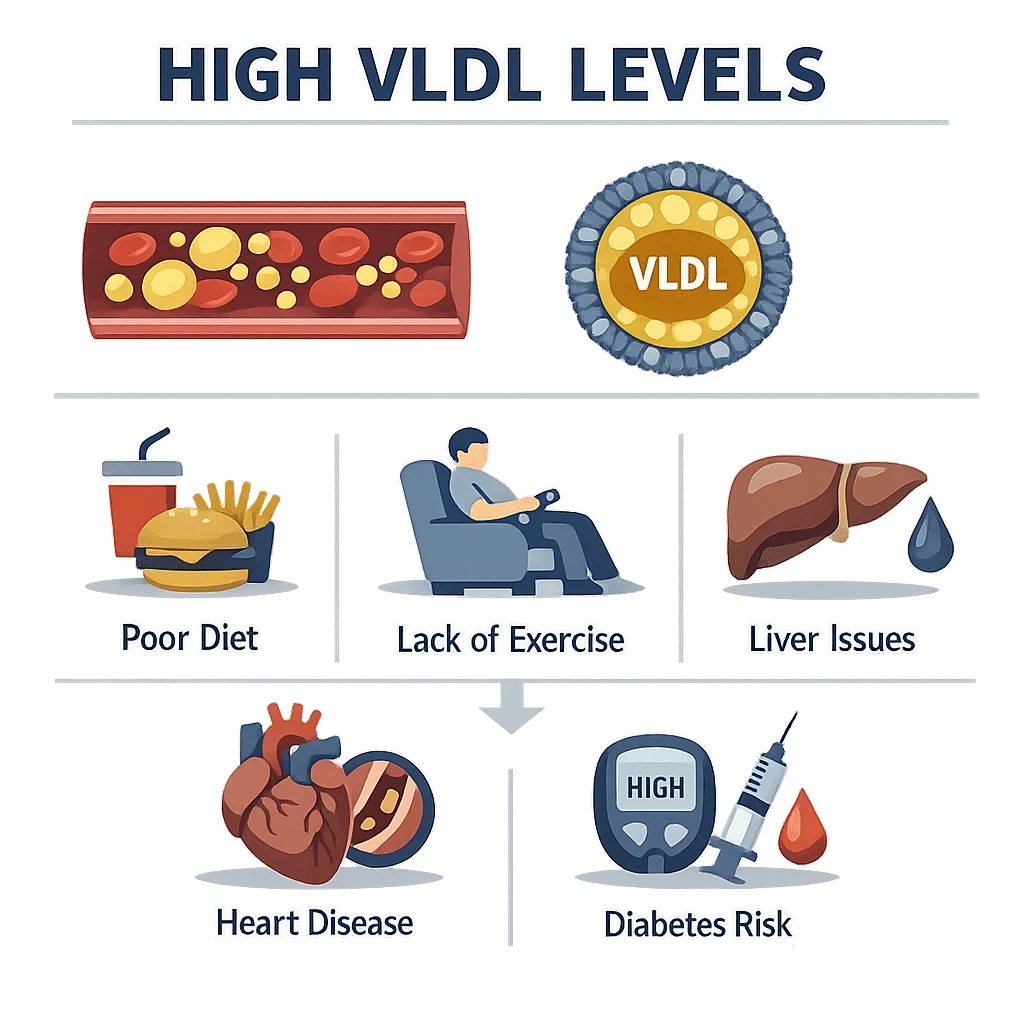
Because the reported figure tracks triglycerides, anything that raises triglycerides raises VLDL. The causes fall into a few recognizable groups, and more than one often applies at the same time.
Metabolic causes
- Insulin resistance, in which cells respond poorly to insulin and the liver produces more triglyceride-rich particles than it clears
- Type 2 diabetes that is untreated or not well controlled
- Excess body weight, particularly fat carried around the abdomen
- Metabolic syndrome, the cluster of raised blood pressure, raised blood sugar, abdominal weight, and an unfavorable lipid pattern
This group explains the majority of cases seen in general practice. Our team covers the causes, symptoms, and treatments of diabetes, and another guide explains the A1C conversion chart and average glucose levels.
Diet, alcohol, and body weight
Very high intakes of refined carbohydrates and added sugars push the liver to manufacture more triglycerides, and alcohol does the same through a separate route. Both effects can be substantial, and both can appear within days rather than years. A recent heavy meal or a weekend of drinking before a blood draw can move the number noticeably, which is another argument for interpreting a single result cautiously. Diet and activity are the areas clinicians most commonly address first, though the specifics belong in a conversation with your own doctor.
Other conditions and medications
- Hypothyroidism, in which an underactive thyroid slows the clearance of circulating lipids
- Chronic kidney disease and nephrotic syndrome
- Liver conditions affecting how fats are produced and handled
- Pregnancy, which raises triglycerides physiologically
- Certain medications, including some steroids, hormone treatments, immunosuppressants, and antiretroviral drugs
- Inherited lipid disorders such as familial combined hyperlipidemia, in which the pattern runs in families and appears earlier in life
This article explains the symptoms, diagnosis, and treatment of hypothyroidism. Never stop or change a prescribed medication because of a lipid result; if you suspect a drug is contributing, raise it with the prescriber.
Symptoms of high VLDL levels: the honest answer
There usually are none. This is the part that most articles on the subject handle poorly, and it deserves a direct statement: elevated VLDL produces no sensation, no pain, and no visible change in the overwhelming majority of people. It is found on a blood test, not felt. Anyone searching for symptoms to confirm or rule out a high result will not find a reliable list, because one does not exist.
Visible signs do appear, but only when triglycerides reach extreme levels, far above the thresholds at which VLDL is first reported as high. These include eruptive xanthomas, small yellowish bumps that can appear on the skin of the back, buttocks, or limbs, and lipemia retinalis, a milky appearance of the retinal blood vessels that an eye examination can detect. Severe abdominal pain in someone with very high triglycerides is a different matter entirely and needs urgent assessment rather than watchful waiting.
The real risks behind high VLDL levels
Atherosclerotic cardiovascular disease
The main long-term concern is atherosclerosis, the gradual buildup of plaque in artery walls that underlies heart attack, ischemic stroke, and peripheral artery disease. Cleveland Clinic lists coronary artery disease, cerebrovascular disease, peripheral artery disease, and aortic aneurysm among the conditions associated with elevated VLDL. The mechanism is the remnant particle described earlier rather than VLDL itself in its full-size form.
Risk here is cumulative and probabilistic, not immediate. A high reading does not mean damage has occurred; it means one contributor to long-term risk is currently elevated. Clinicians weigh it alongside blood pressure, smoking status, blood sugar, family history, and the rest of the lipid profile. We also cover the advanced lipid panel and ApoB testing.
Pancreatitis at very high triglycerides
The second risk is more acute and depends on how high triglycerides climb. MedlinePlus classifies triglycerides of 500 mg/dL and above as very high, and it is in this territory that clinicians begin watching for acute pancreatitis, a sudden and painful inflammation of the pancreas. This is uncommon at moderately raised levels and becomes a genuine concern at extreme ones. Our team explains the symptoms and causes of pancreatitis.
Reading your VLDL result in context
The table below gathers the figures that published US sources attach to these lines. Treat them as guidance a clinician interprets in the context of your whole history, not as a self-diagnosis tool. Laboratories also vary slightly in the ranges they print.
| Lab line | Value in mg/dL | What it generally indicates |
|---|---|---|
| VLDL cholesterol | 2 to 30 | Normal range given by MedlinePlus; remember the figure is estimated, not measured |
| VLDL cholesterol | 30 or above | Described as high by Cleveland Clinic; in practice this mirrors triglycerides of about 150 or more |
| Triglycerides | Below 150 | Healthy range per MedlinePlus |
| Triglycerides | 150 to 199 | Borderline high |
| Triglycerides | 200 to 499 | High |
| Triglycerides | Above 400 | MedlinePlus notes the VLDL estimate is no longer accurate in this range |
| Triglycerides | 500 or above | Very high; the range in which clinicians watch for pancreatitis |
Three habits make a lipid report easier to read. Check whether the draw was fasting, because a non-fasting sample inflates triglycerides and therefore VLDL. Look at the triglyceride line first, since the VLDL line is derived from it. And compare against your own previous results rather than a single snapshot, because a trend carries far more information than one value. We also explain the causes, risks, and management of high triglyceride levels.
When to see a doctor
Book a routine appointment to review the result if any of the following apply.
- Your triglycerides are repeatedly above 200 mg/dL on fasting samples
- The elevation is new compared with your previous panels
- You have diabetes, kidney disease, thyroid disease, or a family history of early heart disease
- You take a medication known to affect lipids
- You are unsure whether your sample was fasting and want the panel repeated properly
Seek urgent care instead if you develop severe pain in the upper abdomen that may spread to the back, especially with nausea or vomiting and a known history of very high triglycerides. That combination needs same-day assessment.
Latest scientific advances
Research over the past three years has moved on two fronts that matter to anyone holding a lipid report: how accurately these numbers are calculated, and how much the particles behind them actually contribute to risk. According to PubMed, the following findings are among the most relevant.
A 2023 systematic review from Johns Hopkins compared 23 different equations for estimating lipid values against a laboratory reference method, using clinical data from more than five million patients. The classic Friedewald approach placed results in the correct category about 83 percent of the time, while a newer equation that adjusts the ratio to each individual reached roughly 90 percent. What this means for you: the calculation printed on your report is a good approximation for most people, but it is least dependable exactly when triglycerides are high, which is when a high VLDL line appears in the first place.
A 2023 study in the journal Atherosclerosis looked specifically at estimating VLDL cholesterol in people with an inherited lipid disorder, comparing several formulas against VLDL separated directly in the laboratory. Newer equations tracked the true value more closely than the older one, particularly in people with raised triglycerides. What this means for you: if your triglycerides are substantially elevated or a family pattern is suspected, your doctor may not take the printed VLDL figure at face value and may order additional testing.
A 2023 analysis of the UK Biobank, a research cohort of half a million volunteers followed over time, used genetic variation to separate the effect of remnant particles from that of LDL. Particle for particle, the remnants left behind by VLDL appeared substantially more atherogenic, meaning more capable of contributing to plaque, than LDL particles. What this means for you: the triglyceride-rich side of the lipid panel is not a minor footnote next to LDL, even though LDL still receives most of the clinical attention.
A 2024 review in Frontiers in Endocrinology drew together the evidence on triglyceride-rich lipoproteins and cardiovascular disease, noting that the risk they carry is concentrated in people with obesity, metabolic syndrome, diabetes, or chronic kidney disease. A separate 2024 study in Nature Communications, again using the UK Biobank, found that raised remnant cholesterol and triglycerides were linked to a greater chance of accumulating more than one cardiometabolic condition over time, such as developing type 2 diabetes after heart disease. What this means for you: these results reinforce treating a high VLDL line as a prompt to look at the metabolic picture as a whole rather than at one number in isolation. Both remain observational findings about groups of people, not predictions about any individual.
Glossary
| Term | Definition |
|---|---|
| VLDL | Very-low-density lipoprotein. A particle made by the liver that carries mostly triglycerides into the bloodstream. |
| Triglycerides | The main type of fat circulating in blood and stored in fat tissue. The body uses them for energy. |
| Lipid panel | The routine blood test that reports total cholesterol, LDL, HDL, triglycerides, and usually a calculated VLDL. |
| Friedewald equation | The formula introduced in the 1970s that estimates VLDL cholesterol as triglycerides divided by five. |
| Remnant cholesterol | The cholesterol still carried by VLDL particles after they have released much of their triglyceride cargo. |
| Atherosclerosis | The slow buildup of fatty plaque inside artery walls, which narrows them and stiffens them over years. |
| Insulin resistance | A state in which cells respond poorly to insulin, so the body produces more of it to keep blood sugar in range. |
| Hypertriglyceridemia | The medical term for a raised triglyceride level in the blood. |
| Non-HDL cholesterol | Total cholesterol minus HDL. It captures all the particles thought to contribute to plaque, including VLDL remnants. |
| Pancreatitis | Inflammation of the pancreas. The acute form causes sudden severe abdominal pain and needs urgent care. |
Frequently asked questions
What does it mean if my VLDL cholesterol is high?
In most cases it means your triglycerides were high on that sample, because the VLDL figure on a standard panel is calculated from them. It is one signal about how your body is handling fats and sugars, and it is most informative when it repeats across several fasting tests. On its own, a single high VLDL value does not diagnose anything. Your doctor will read it next to your LDL, HDL, blood sugar, blood pressure, weight, and family history before drawing any conclusion.
What is a normal VLDL range?
MedlinePlus gives a normal VLDL cholesterol range of about 2 to 30 mg/dL, and Cleveland Clinic describes 30 mg/dL or above as high. Laboratories print slightly different ranges depending on their methods, so always read the reference interval shown on your own report rather than a figure found online. Because the value is derived from triglycerides rather than measured, small differences between labs are common and rarely meaningful on their own.
Is VLDL cholesterol good or bad?
VLDL itself is neither. Transporting triglycerides from the liver to tissues that need energy is a normal and necessary job. The concern is quantity and what happens downstream: when a lot of VLDL circulates, more remnant particles are produced, and those remnants can lodge in artery walls. So the useful question is not whether VLDL is bad but whether yours is persistently elevated and why.
Does VLDL change with age?
Triglycerides, and therefore calculated VLDL, do tend to drift upward through adulthood, largely because weight, activity levels, and insulin sensitivity change with age. There is no separate age-adjusted VLDL scale in routine use, however. The same reference range is applied to adults, and clinicians interpret it alongside your overall cardiovascular risk rather than against an age-specific target.
My triglycerides and VLDL are both high. Is that two problems?
Almost always it is one. On a standard panel the VLDL line is generated by dividing triglycerides by five, so the two rise and fall together by construction. Seeing both flagged is the expected result of a single underlying finding, not confirmation of two separate abnormalities. Focus the conversation with your doctor on the triglyceride value and what is driving it.
Do I need to fast before a VLDL test?
Usually yes, if the VLDL and triglyceride lines matter to the decision being made. MedlinePlus notes that you may be asked not to eat or drink for 9 to 12 hours before the draw. Eating beforehand raises triglycerides temporarily, which inflates the calculated VLDL and can make a normal metabolism look abnormal. Follow the specific instructions your provider gives you, and tell the lab if you did not fast so the result can be read correctly.
Sources
- National Library of Medicine — VLDL test — MedlinePlus Medical Encyclopedia, 2025 — medlineplus.gov
- National Library of Medicine — Triglycerides Test — MedlinePlus Medical Test, 2025 — medlineplus.gov
- Cleveland Clinic — What Is VLDL Cholesterol? — Cleveland Clinic Health Library, 2025 — my.clevelandclinic.org
- Centers for Disease Control and Prevention — About Cholesterol — CDC, 2024 — cdc.gov
- Samuel C, Park J, Sajja A, et al. — Accuracy of 23 Equations for Estimating LDL Cholesterol in a Clinical Laboratory Database of 5,051,467 Patients — Global Heart, 2023 — doi.org/10.5334/gh.1214
- Zubirán R, Vargas-Vazquez A, Del Razo Olvera F, et al. — Performance of the enhanced Sampson-NIH equation for VLDL-C and LDL-C in a population with familial combined hyperlipidemia — Atherosclerosis, 2023 — doi.org/10.1016/j.atherosclerosis.2023.117364
- Björnson E, Adiels M, Taskinen MR, et al. — Triglyceride-rich lipoprotein remnants, low-density lipoproteins, and risk of coronary heart disease: a UK Biobank study — European Heart Journal, 2023 — doi.org/10.1093/eurheartj/ehad337
- Xu D, Xie L, Cheng C, et al. — Triglyceride-rich lipoproteins and cardiovascular diseases — Frontiers in Endocrinology, 2024 — doi.org/10.3389/fendo.2024.1409653
- Zhao Y, Zhuang Z, Li Y, et al. — Elevated blood remnant cholesterol and triglycerides are causally related to the risks of cardiometabolic multimorbidity — Nature Communications, 2024 — doi.org/10.1038/s41467-024-46686-x
Further reading
- High cholesterol: understand, prevent, and act
- Cholesterol ratio explained: meaning and risks
- Liver function tests: how to read your liver panel
- Kidney function panel: how to read your renal blood tests
- Fasting before a blood test: rules, timing, and what is allowed
Understand your lab results with AI DiagMe
A VLDL line makes far more sense once you can see how it connects to the triglycerides, LDL, HDL, and blood sugar values printed beside it. AI DiagMe reads your lab report and explains each result in plain language, including which numbers are derived from others and which ones are worth tracking over time. It is built to help you understand what you are looking at and to prepare better questions for your appointment. It does not diagnose, and it does not replace your doctor.
Get your results interpreted in minutes