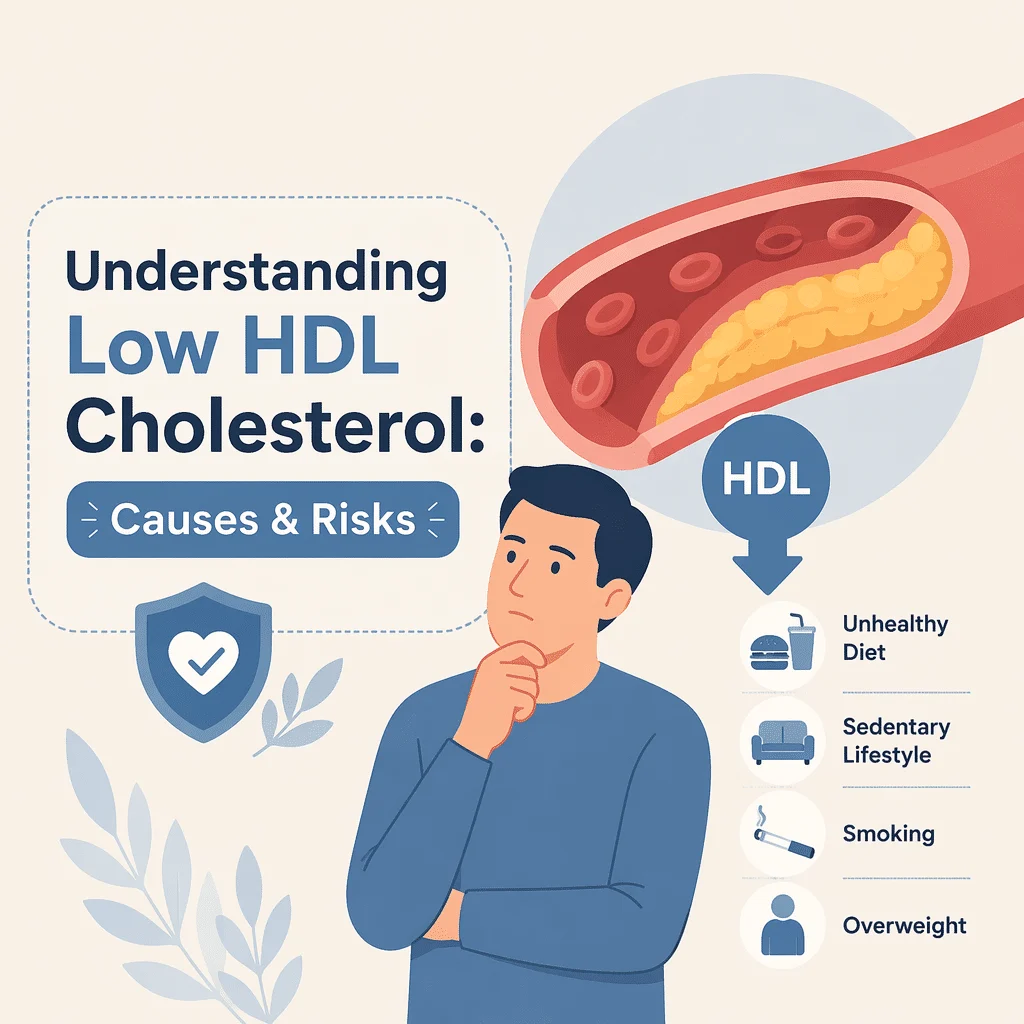
Low HDL cholesterol means your blood carries less high-density lipoprotein than the level usually considered protective. It is one of the most common findings on a routine lipid panel, and one of the most misunderstood. For thirty years HDL was called the good cholesterol, with the implication that raising it would protect your heart. The evidence has moved on. A low value is a genuine warning sign, but the number itself has turned out to be a poor thing to treat.
In this article you will learn what the thresholds mean, why the finding travels with high triglycerides and insulin resistance, what happened when large trials raised HDL directly, and which numbers a clinician genuinely acts on.
What low HDL cholesterol means on a lipid panel
HDL is not a type of cholesterol but a particle that carries it, and the figure on your report, HDL-C, measures the cholesterol inside those particles, not the particles themselves. HDL collects excess cholesterol from tissues, including artery walls, and returns it to the liver. That process, reverse cholesterol transport, is how HDL earned its reputation.
Your result arrives alongside total cholesterol, LDL cholesterol and triglycerides. Our team explains how the HDL cholesterol test is performed and read. Because the values are calculated partly from one another, a single low figure is rarely meaningful alone; this guide covers the complete lipid panel and how its values relate.
The thresholds used in risk assessment
The commonly cited cut-offs come from national health bodies and from the criteria defining metabolic syndrome. The Centers for Disease Control and Prevention describes desirable HDL as at least 40 mg/dL in men and 50 mg/dL in women; Mayo Clinic gives the same boundaries in metric units. They sort people into risk categories rather than drawing a pass or fail line: a value a point either side changes very little.
| HDL-C value | Label | Metric equivalent | How it is used |
|---|---|---|---|
| Below 40 mg/dL (men) | Low | Below about 1.0 mmol/L | Counts as a risk factor in cardiovascular scoring |
| Below 50 mg/dL (women) | Low | Below about 1.3 mmol/L | Same use; women average higher HDL-C |
| 40-59 mg/dL | Intermediate | About 1.0-1.5 mmol/L | Neither a risk factor nor protective |
| 60 mg/dL and above | Historically protective | About 1.6 mmol/L and above | Once counted as protective; treated more cautiously today |
| Above 100 mg/dL | Very high | Above about 2.5 mmol/L | Mayo Clinic links very high HDL to higher, not lower, risk |
Two practical points follow. HDL-C fluctuates between draws, so a single borderline value deserves a repeat. And women average roughly 10 mg/dL more HDL-C from puberty onward, which is why their threshold sits higher.
Marker or target: what the trials actually showed
This is where most published advice is a decade out of date. Observational studies consistently find that people with lower HDL-C have more cardiovascular events, which is why the number stayed on lab reports. Researchers then asked whether raising it would prevent those events. The answer, tested repeatedly and expensively, has been no.
Mayo Clinic states the position plainly: clinical trials have not shown that increasing HDL cholesterol with medicines reduces the risk of heart attack. High-dose niacin raised HDL-C substantially and failed to reduce events when added to statin therapy. CETP inhibitors, designed specifically to raise HDL-C, raised it dramatically across several large trials without delivering the expected benefit. A 2023 review in Current Atherosclerosis Reports concluded that neither approach has convincingly improved cardiovascular outcomes.
Genetics points the same way. Some inherited variants lower HDL-C with no matching increase in coronary risk, and analyses using inherited differences as a natural experiment have not supported a simple causal chain. A 2025 analysis in Atherosclerosis of nearly three thousand people with primary hypercholesterolemia found more deaths in the low HDL-C group, yet once the usual risk factors were accounted for, HDL-C was no longer independently linked to mortality.
The honest reading is neither dismissal nor alarm. A low value earns its place as a signal that something else is going on, usually in how your body handles sugar and fat. It is not the thing to fix.
What causes low HDL cholesterol
Insulin resistance, type 2 diabetes and central weight
The most common explanation is metabolic. When cells respond poorly to insulin, the liver exports more triglyceride-rich particles and HDL falls as a consequence. This is why low HDL-C, raised triglycerides, a larger waist, higher blood pressure and higher fasting glucose cluster together as metabolic syndrome. It also occurs in people who are not overweight, and our team details the HOMA-IR insulin resistance score.
High triglycerides and the reciprocal relationship
Triglycerides and HDL-C move in opposite directions, and the mechanism explains much of what you see on a report. Cholesteryl ester transfer protein, or CETP, swaps cargo between lipoprotein particles: triglycerides move into HDL, cholesterol moves out. When triglycerides are high there is more of this exchange, so HDL particles end up triglyceride-loaded, cholesterol-poor and cleared faster. The lower reading is then largely a consequence of the triglyceride level, which is why lowering triglycerides usually lifts HDL-C on its own. Our team describes high triglyceride levels and what drives them.
Medications and medical conditions
Several widely used drugs lower HDL-C as a side effect. The National Library of Medicine lists anabolic steroids and testosterone, progestins, some beta-blockers and benzodiazepines. Uncontrolled diabetes lowers it, as do chronic inflammatory states, kidney disease and some liver disease, partly because the liver makes the main HDL protein. Acute illness and recent surgery depress it temporarily, which is why a panel drawn during an infection can mislead. To clarify that picture, our team outlines a CRP inflammation test and what it measures.
Inherited causes
Genetics sets much of your baseline. Cleveland Clinic lists familial combined hyperlipidemia, apolipoprotein A-I deficiency and Tangier disease among inherited causes. They are uncommon, and they matter for a reason: some lower HDL-C markedly without the excess heart disease you would predict if the number itself were doing the damage. Very low values, roughly under 20 mg/dL, with no metabolic explanation are worth discussing with a doctor.
What a low value means for your risk
Low HDL cholesterol produces no symptoms. It is found on testing rather than suspected from how you feel. Anything you feel alongside a low result is far more likely to come from its cause, such as poorly controlled blood sugar or thyroid disease.
As a risk indicator it works best in combination. The CDC notes that high triglycerides together with either low HDL or high LDL raises the risk of heart attack and stroke. Formal risk calculators include HDL-C because it improves prediction, which is a different claim from saying it causes the risk. Comparing values against each other adds more than any single figure; this article explains the cholesterol ratio and its limits.
Higher is not always better
The assumption that more HDL is always safer has not survived. Several large cohorts describe a U-shaped curve, with mortality rising again at the top of the range. Mayo Clinic notes that people with naturally very high HDL cholesterol, above roughly 100 mg/dL, appear to be at higher risk of heart disease. Cleveland Clinic adds that an unusually high value can itself point to a lipid disorder, heavy alcohol use or an overactive thyroid.
What to check next when HDL is low
Because the value is a signal rather than a target, read it alongside numbers a clinician can act on. Non-HDL cholesterol is total cholesterol minus HDL-C, so it needs no extra test, and it captures every cholesterol-carrying particle that can lodge in an artery wall. ApoB counts those particles directly. A 2026 review in Cardiovascular Diabetology describes both as superior markers where triglycerides are raised, exactly the situation that produces low HDL-C. Our team explains the apoB blood test and what it adds to LDL.
| What to look at | Why it matters when HDL is low | Where it comes from |
|---|---|---|
| Non-HDL cholesterol | Sums all atherogenic particles in one number, and guides treatment decisions | Calculated from your existing panel |
| ApoB | Counts atherogenic particles directly; beats LDL-C when triglycerides are high | A separate blood test |
| Triglycerides | Usually the reason HDL-C is low; lowering them tends to raise it | Standard lipid panel |
| HbA1c and fasting glucose | Tests the insulin-resistance explanation, the commonest one | Routine blood test |
| TSH | An underactive thyroid alters lipids and is easily missed | Routine blood test |
| Liver and kidney function | Both shape lipoprotein handling and can lower HDL-C | Standard panels |
The metabolic checks are the highest-yield follow-up. This guide covers how A1C converts into an average glucose figure. An underactive thyroid shifts a lipid profile quietly, and our team details normal thyroid levels and their ranges.
A standard lipid panel no longer requires fasting for most people, because non-fasting values predict risk at least as well; it is still asked for when triglycerides are very high or a calculated LDL-C is needed. Our team sets out the current rules on fasting before a blood test.
When to see a doctor
A single low HDL-C reading on an otherwise unremarkable panel is a conversation at your next appointment, not an urgent matter. Ask sooner if any of these applies.
- Your HDL-C is very low, roughly under 20 mg/dL, with no metabolic explanation.
- Low HDL-C comes with raised triglycerides, a larger waist or a high fasting glucose.
- You have a family history of heart attack or stroke before 55 in men or 65 in women.
- You already have diabetes, chronic kidney disease or an inflammatory condition.
- You take a medication known to lower HDL-C that no one has reviewed against your lipid results.
- Chest pain, breathlessness on exertion or reduced exercise tolerance has appeared. These need prompt assessment whatever your lipids show.
Lifestyle factors associated with HDL levels
Several everyday factors track with HDL-C, and they are worth knowing even though the target is your overall risk, not the number. Smoking lowers HDL-C, and the National Library of Medicine notes that secondhand smoke does too; stopping is followed by a rise and cuts cardiovascular risk through many routes at once. Regular aerobic activity is associated with modestly higher values, and losing weight around the abdomen with an increase. Replacing refined carbohydrate and reducing alcohol both tend to lower triglycerides, which indirectly lifts HDL-C.
Two cautions belong here. Alcohol raises HDL-C without evidence of cardiovascular benefit, so it is not a strategy. And no supplement has been shown to reduce cardiovascular events by raising HDL. Any change to medication is your doctor’s decision, made from your whole risk profile rather than one line on a report.
Latest scientific advances
Research on HDL has shifted from how much you have to how well it works. Here is where things stand, in plain terms.
Function is starting to matter more than quantity
Researchers can now measure how efficiently HDL particles pull cholesterol out of cells, a property called cholesterol efflux capacity. A 2024 review in International Immunopharmacology gathered the evidence that this tracks cardiometabolic risk in ways the plain HDL-C number does not. What this means for you: two people can share an identical HDL-C result while their particles behave quite differently. It is a research measure, not a test to request.
Very high HDL is not automatically reassuring
A 2026 study in the European Journal of Clinical Investigation found that among people with HDL-C above 80 mg/dL, those with established artery disease had poorer cholesterol efflux despite matching values; the group was small, so it needs confirmation. A 2024 analysis in JACC: Advances followed people with very high HDL-C for about ten years: half had calcium visible in their coronary arteries, and their risk of death was roughly three and a half times higher. What this means for you: a high number does not guarantee the particles are working, and a coronary calcium scan, an imaging test that spots hardened deposits in the heart arteries, told clinicians more than the traditional risk factors did.
The U-shape reaches people with diabetes too
The Fremantle Diabetes Study followed nearly 1,500 Australians with type 2 diabetes for roughly a decade, reported in Cardiovascular Diabetology in 2024. It found the same curve seen in the general population, with risk raised at both ends rather than falling steadily as HDL-C rose. What this means for you: with type 2 diabetes, a high HDL-C is no reason to relax about the rest of your lipid profile. Our team covers fasting blood glucose levels and what they indicate.
Where the field has moved instead
With HDL-raising strategies having repeatedly disappointed, attention has turned to the harmful particles rather than the helpful ones. The 2026 Cardiovascular Diabetology review argues for treating all atherogenic lipoproteins, using non-HDL cholesterol and apoB as the guiding numbers. What this means for you: if your HDL-C is low, the productive conversation with your doctor is about those two values and about blood sugar.
Glossary
| Term | Definition |
|---|---|
| HDL (high-density lipoprotein) | The particle that collects excess cholesterol and carries it to the liver. HDL-C is the cholesterol inside it. |
| LDL (low-density lipoprotein) | The particle that delivers cholesterol to tissues. In excess it accumulates in artery walls. |
| Non-HDL cholesterol | Total cholesterol minus HDL cholesterol: every particle capable of contributing to artery disease. |
| ApoB (apolipoprotein B) | A protein present once on each artery-damaging particle, so measuring it counts those particles directly. |
| Triglycerides | The main form in which fat circulates and is stored; high levels typically accompany low HDL cholesterol. |
| Cholesterol efflux capacity | A research measure of how well HDL removes cholesterol from cells: function rather than quantity. |
| CETP (cholesteryl ester transfer protein) | A protein that exchanges cargo between lipoproteins, linking high triglycerides to low HDL cholesterol. |
| Metabolic syndrome | A cluster of low HDL cholesterol, high triglycerides, raised blood pressure, high fasting glucose and waist size. |
| Insulin resistance | A state in which cells respond poorly to insulin, driving low HDL cholesterol with high triglycerides. |
| Coronary artery calcium | Calcified deposits in the heart arteries, seen on a CT scan and used to refine risk estimates. |
Frequently asked questions
Is low HDL cholesterol dangerous?
It is best understood as a warning light rather than a danger in itself. People with low HDL-C do experience more cardiovascular events on average, so the finding deserves attention. What it usually signals is an underlying pattern, most often insulin resistance or raised triglycerides, and that pattern is what carries the risk and what can be addressed. Trials raising HDL-C directly did not reduce events, which tells you the number is a messenger. Treat it as a prompt to look at your full lipid profile, your blood sugar and your other risk factors with your doctor.
What if my HDL is low but everything else is normal?
This is a common and generally reassuring combination. If LDL cholesterol, non-HDL cholesterol, triglycerides, blood pressure and blood sugar are all in range, an isolated low HDL-C carries much less weight than the same value inside a metabolic cluster. It may simply reflect your genetics. Worth checking are the things that lower HDL-C quietly, including medications, thyroid function and recent illness. Most clinicians will repeat the panel, confirm the isolated finding and monitor rather than intervene.
Can low HDL cholesterol cause fatigue or weight gain?
No. Low HDL cholesterol produces no symptoms of any kind. If you feel tired or your weight has changed, the explanation lies elsewhere, and several of the usual candidates also lower HDL-C, which is why the symptoms and the result appear together. Thyroid disease, poorly controlled diabetes and chronic inflammation all fit that description. That makes the symptoms worth investigating on their own merits, rather than being attributed to the HDL value.
Is low HDL cholesterol a sign of cancer?
Low HDL cholesterol is not a cancer screening test and should not be read as one. Cholesterol values, HDL included, can fall during serious illness of many kinds because inflammation and altered liver metabolism change how lipoproteins are made and cleared. That is a general consequence of being unwell, not a specific pointer to cancer, and the overwhelming majority of low HDL results reflect ordinary metabolic causes. Any unexplained weight loss, persistent symptoms or abrupt change in your lipid profile should be assessed by a doctor on its own merits.
How quickly can HDL cholesterol change?
Slowly, and by modest amounts. Stopping smoking, sustained aerobic activity and losing weight around the waist are each associated with rises measured over weeks to months, typically of a few mg/dL rather than a transformation. Lowering high triglycerides tends to lift HDL-C more reliably than anything aimed at HDL directly. Values also vary between draws for reasons that have nothing to do with you, so a repeat test after several months gives a fairer comparison than one taken a fortnight later.
Should I take a supplement to raise HDL?
No supplement has been shown to reduce heart attacks or strokes by raising HDL cholesterol. The clearest evidence comes from high-dose niacin, which raises HDL-C substantially and was tested in large trials on top of statin therapy without reducing cardiovascular events. Products sold for cholesterol support are not held to that standard of evidence at all. If your HDL-C is low, the questions worth raising with your doctor concern your non-HDL cholesterol, your triglycerides and your blood sugar.
Sources
- Centers for Disease Control and Prevention — About Cholesterol, 2024 — cdc.gov
- National Library of Medicine, MedlinePlus — HDL: The Good Cholesterol — medlineplus.gov
- Mayo Clinic — HDL cholesterol: How to boost your good cholesterol — mayoclinic.org
- Cleveland Clinic — HDL: Why It’s Good Cholesterol — my.clevelandclinic.org
- Begue F, et al. — HDL as a Treatment Target: Should We Abandon This Idea? — Current Atherosclerosis Reports, 2023 — PubMed
- Brandts J, et al. — Lipid management in type 2 diabetes and non-HDL-cholesterol: target all atherogenic lipoproteins — Cardiovascular Diabetology, 2026 — PubMed
- Kang H, et al. — HDL regulates the risk of cardiometabolic and inflammatory-related diseases: focusing on cholesterol efflux capacity — International Immunopharmacology, 2024 — PubMed
- Padro T, et al. — HDL function and composition in atherothrombotic cardiovascular disease with very high HDL-C — European Journal of Clinical Investigation, 2026 — PubMed
- Razavi AC, et al. — Coronary Artery Calcium for Risk Stratification Among Persons With Very High HDL Cholesterol — JACC: Advances, 2024 — PubMed
- Davis TME, et al. — The relationship between serum HDL-cholesterol, cardiovascular disease and mortality in community-based people with type 2 diabetes: the Fremantle Diabetes Study phase 2 — Cardiovascular Diabetology, 2024 — PubMed
- Bea AM, et al. — Association of HDL cholesterol with all-cause and cardiovascular mortality in primary hypercholesterolemia — Atherosclerosis, 2025 — PubMed
Further reading
- Total cholesterol test: what your results mean
- High cholesterol: symptoms, causes, numbers and treatment
- Lipoprotein(a): reading your heart risk level
- High VLDL levels: what they mean, causes and risks
- How to read your blood test results
Understand your lab results with AI DiagMe
A low HDL figure only makes sense next to the values around it. AI DiagMe reads your lipid panel as a whole, putting HDL cholesterol alongside your triglycerides, your LDL and non-HDL cholesterol, and your blood sugar markers, then explains in plain language what the combination suggests and which questions are worth raising. It helps you understand your results. It does not diagnose and it does not replace your doctor.
Get your results interpreted in minutes