





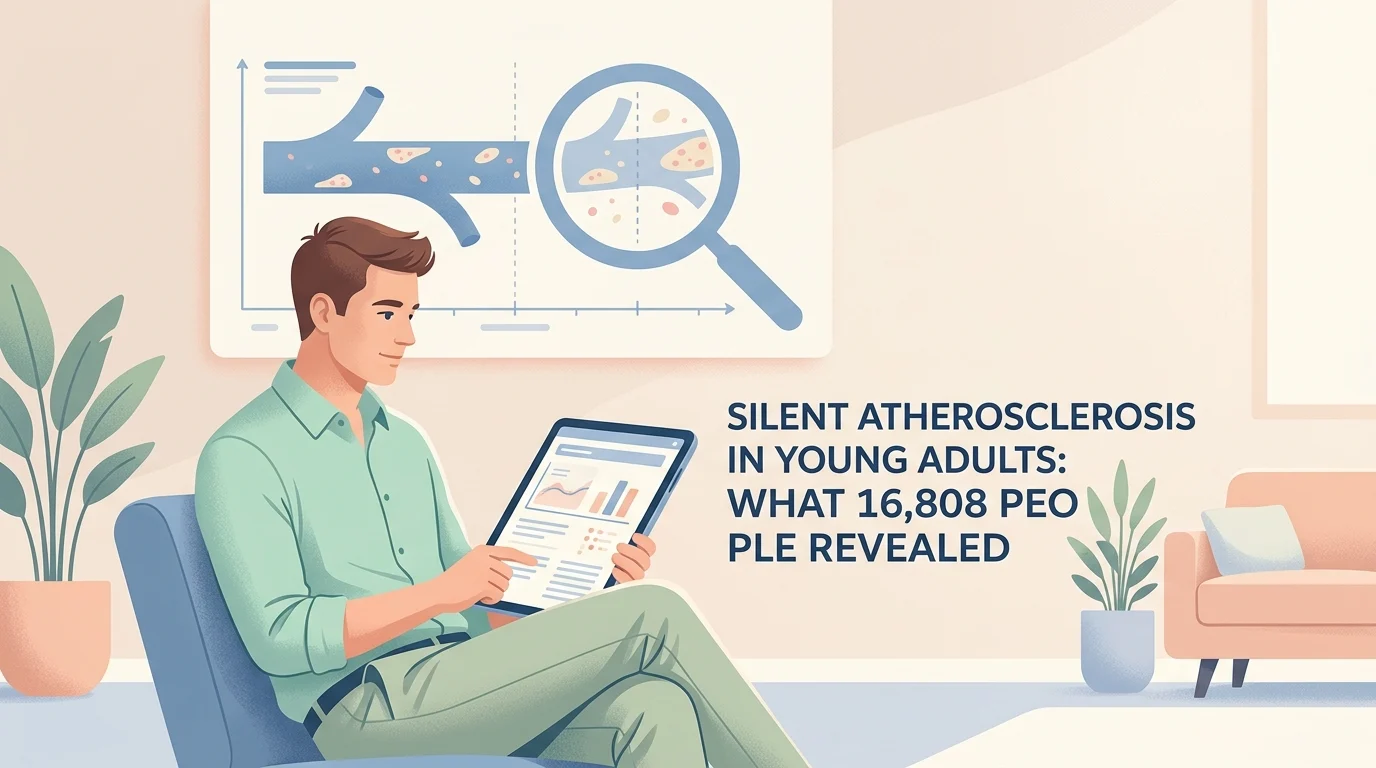
Silent atherosclerosis, the build-up of fatty plaque inside artery walls before any symptom appears, is far more common than most people assume, and it starts earlier than doctors once thought. Researchers behind the REACT study, published in the New England Journal of Medicine and presented at the European Society of Cardiology congress in August 2026, scanned the arteries of 16,808 adults with no known heart disease. More than half had plaque somewhere, and about 1 in 13 people aged 18 to 29 already did. This article explains what the study actually shows, what it does not show yet, and what a routine blood test can tell you about your arteries today.
What the REACT study found about silent atherosclerosis
REACT enrolled adults aged 18 to 70 in Denmark and Spain who had never been diagnosed with cardiovascular disease and had no symptoms. Instead of estimating risk from a questionnaire and a blood test, the team imaged three arterial regions directly: the carotid arteries in the neck, the femoral arteries in the legs, and the coronary arteries of the heart.
The headline results, as reported by the study team and the press coverage of the congress, were:
- 57.1% of the participants had atherosclerotic plaque in at least one of the three regions.
- About 1 in 13 adults aged 18 to 29 (roughly 7.7%) already showed plaque.
- Around 9 in 10 people aged 60 to 70 had it.
- Men showed plaque 5 to 10 years earlier than women, while in women the steepest rise came between 40 and 60, around the menopause.
Most people with plaque in the coronary arteries also had it in the carotid or femoral arteries, which suggests the disease tends to be widespread rather than local.
What “silent” means, and why plaque appears so early
According to the National Heart, Lung, and Blood Institute, plaque starts building slowly in childhood and progresses with age, driven by high blood cholesterol, lifestyle habits and genes. Because arteries can narrow a great deal before blood flow drops enough to cause chest pain or breathlessness, the condition often produces no symptom for years. That is why the word “silent” matters: feeling well is not proof of clear arteries.
It is also important to be precise about what the scans detected. Finding plaque is not the same as having a blockage, and a small plaque in a 25-year-old is not a heart attack waiting to happen. The study measured how common plaque is, not how often it leads to events.
Why standard risk scores miss silent atherosclerosis
In Europe, doctors commonly estimate cardiovascular risk with a calculator called SCORE2, which combines age, sex, blood pressure, cholesterol and smoking. The REACT investigators reported that such conventional estimates identify only a small share of the people who already have silent plaque. Young adults are a good example: at 28, almost everyone is “low risk” on paper because age weighs heavily in the formula, even when plaque is present.
That does not mean the scores are useless. They predict events over the next ten years, which is a different question from whether plaque exists today. The study simply highlights the gap between the two.
What blood tests can and cannot tell you about your arteries
A blood test cannot see plaque. It can, however, measure several of the factors that drive it, which is where a lab report becomes useful. The table below summarizes the markers most often discussed in this context.
| Blood marker | यह क्या दर्शाता है | Why it matters for arteries |
|---|---|---|
| एलडीएल कोलेस्ट्रॉल | Cholesterol carried by the particles that can settle in artery walls | Main modifiable driver of plaque; targets depend on your overall risk |
| एपोलिपोप्रोटीन बी (एपोबी) | The number of plaque-forming particles, not just their cholesterol content | Can differ between two people with the same LDL result |
| लिपोप्रोटीन(ए) | A largely inherited particle that stays stable through life | Raises risk independently of usual cholesterol; one test is usually enough |
| फास्टिंग ग्लूकोज (Fasting Glucose) और HbA1c | Blood sugar control over time | Diabetes is a recognized risk factor for artery disease |
As we reported in our update on the new guideline, the 2026 ACC/AHA dyslipidemia guideline now recommends that every adult be tested once for lipoprotein(a). To understand how that particle is read, see our guide to lipoprotein(a) as a cardiovascular risk marker. For the more familiar numbers, read our explanation of LDL cholesterol levels, ranges and risks.
Latest scientific advances on detecting silent plaque
Several recent studies help put REACT in context. None of them proves that scanning everyone is worthwhile, but together they show why researchers take early plaque seriously.
A long follow-up of young Finnish adults, in their early thirties at the start, used neck-artery ultrasound to look for early plaque or a thickened artery wall. Those with such signs went on to develop heart disease more often over the following decade and a half than those without, and the signs added information beyond the usual risk calculator. This was an observational cohort, so it shows an association, not that treating the plaque changes the outcome (Raitakari et al., 2024, Atherosclerosis).
In older adults without symptoms, a large American study found that the amount of plaque in the neck arteries and the amount of calcium in the heart arteries were each linked to earlier death, independently of cholesterol or blood pressure. Plaque that grew over time carried extra weight. The participants were in their late sixties on average, so the results do not transfer directly to young adults (Fuster et al., 2024, Journal of the American College of Cardiology).
A critical review of how to detect silent disease concluded that carotid plaque, coronary calcium and a low ankle blood pressure are all valid indicators, though they are not interchangeable (Garg et al., 2023, Arteriosclerosis, Thrombosis, and Vascular Biology). A 2025 narrative review adds that a heart CT calcium score can refine risk in people without symptoms and that a very low score is reassuring (Gómez-Díaz et al., 2025, Journal of Cardiovascular Development and Disease).
What this changes for you: seeing plaque on a scan should start a conversation about prevention, not a diagnosis of illness. And as one REACT investigator pointed out, detecting silent atherosclerosis only helps if something useful can be done about it. A follow-up randomized trial called REACT-PROTECT is planned to test exactly that.
What you can do now to protect your arteries
The NHLBI notes that most people can prevent or delay atherosclerosis with heart-healthy living, and that it can sometimes be partly reversed through lifestyle changes and medicines. In practice, the building blocks are well established: not smoking, regular physical activity, a balanced diet, a healthy weight, and keeping blood pressure, cholesterol and blood sugar in range. The only way to know where your cholesterol and blood sugar stand is a blood test, and the results mean more when you read them together rather than one number at a time.
Whether a scan such as a calcium score is useful for you is an individual decision. For a broader view of the cholesterol side of the picture, see our overview of high cholesterol symptoms, causes and treatment.
अपने डॉक्टर से कब बात करें
Book an appointment if any of the following applies to you:
- A parent, brother or sister had a heart attack or stroke at a young age.
- You have never had a cholesterol or blood sugar test, or the last one was several years ago.
- Your lipid panel was abnormal, or you have high blood pressure, diabetes or a smoking history.
- You have chest pain, unusual breathlessness on effort, or pain in the legs when walking. These need prompt medical attention, and chest pain with sweating or breathlessness at rest is an emergency.
शब्दकोष
- atherosclerosis: gradual build-up of fatty plaque in artery walls.
- Silent (subclinical) atherosclerosis: plaque present without any symptom.
- Carotid arteries: the arteries in the neck that supply the brain.
- Coronary arteries: the arteries that supply the heart muscle.
- SCORE2: a European calculator estimating the ten-year risk of cardiovascular events.
- Coronary artery calcium score: a CT measurement of calcified plaque in the heart arteries.
सवाल-जवाब (FAQ)
Can I have atherosclerosis without any symptoms?
Yes. Plaque often causes no symptom until an artery is significantly narrowed or a plaque ruptures.
Does 1 in 13 mean 1 in 13 young adults will have a heart attack?
No. The figure describes how many young adults had detectable plaque on imaging, not how many will have an event. Risk depends on the size of the plaque, your risk factors and how they are managed.
Can a blood test detect atherosclerosis?
No blood test shows plaque directly. Tests such as LDL cholesterol, ApoB, lipoprotein(a) and HbA1c measure risk factors that contribute to it.
Should every young adult get a scan?
Not on the current evidence. REACT measured prevalence, and its planned follow-up trial is meant to find out whether imaging-guided prevention improves outcomes.
Can plaque go away?
The NHLBI says atherosclerosis can sometimes be partly reversed with lifestyle changes and medicines. Your doctor can tell you what is realistic in your situation.
सूत्रों का कहना है
- National Heart, Lung, and Blood Institute (NIH): Atherosclerosis
- CDC: About Heart Disease
- CNIC press release, 29 August 2026: REACT study on silent atherosclerosis
- Healio: More than half of healthy adults have silent atherosclerosis
- ScienceDaily: 1 in 13 adults under 30 already had hidden artery plaque
- Raitakari et al. (2024), Subclinical atherosclerosis in young adults predicting cardiovascular disease: the Cardiovascular Risk in Young Finns Study, Atherosclerosis
- Fuster et al. (2024), Influence of subclinical atherosclerosis burden and progression on mortality, Journal of the American College of Cardiology
- Garg et al. (2023), Assessment of subclinical atherosclerosis in asymptomatic people in vivo, Arteriosclerosis, Thrombosis, and Vascular Biology
- Gómez-Díaz et al. (2025), Role of coronary artery calcium score CT in risk stratification of asymptomatic individuals, Journal of Cardiovascular Development and Disease
अन्य लेख
- Lipoprotein(a) screening: what the new 2026 guideline recommends
- लिपोप्रोटीन(a): अपने हृदय जोखिम स्तर को समझें
- LDL कोलेस्ट्रॉल: स्तर, सामान्य सीमा और जोखिम
- उच्च कोलेस्ट्रॉल: लक्षण, कारण, स्तर और उपचार
AI DiagMe के साथ अपने ब्लड टेस्ट के नतीजे खुद समझें
Your lipid panel, glucose and HbA1c say more about your arteries when they are read together. AI DiagMe की मदद से अपने लैब परिणामों को समझें, an AI interpretation reviewed by a committee of doctors, with data hosted in France.