



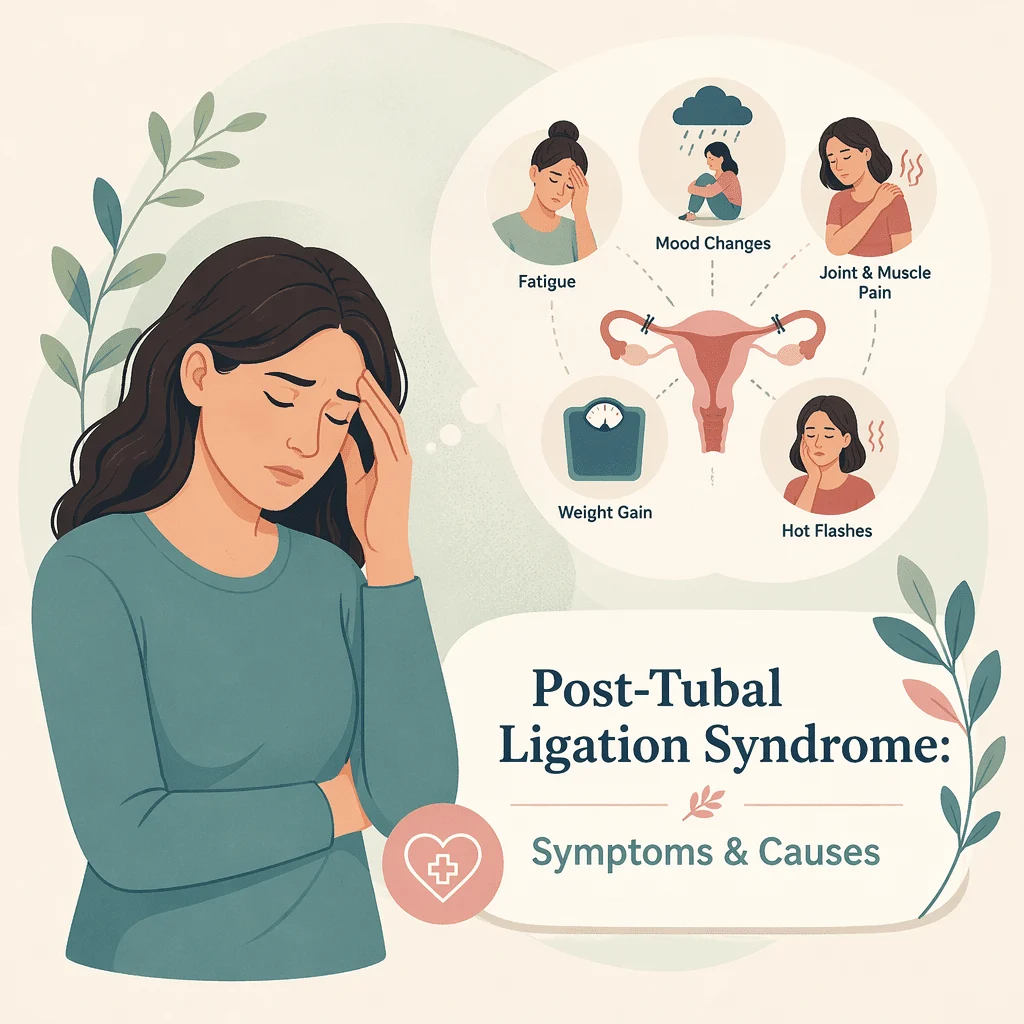
Post-tubal ligation syndrome is the name women give to a cluster of symptoms — heavier periods, cramping, hot flashes, mood swings, lower libido, fatigue — that show up in the months after tubal sterilization. It is not a recognized medical diagnosis, and the larger studies that went looking for a distinct hormonal syndrome after the procedure did not find one. That does not mean the symptoms are imaginary. It means the label rarely points to the real cause, and the real cause is usually identifiable and treatable.
In this article you’ll learn what a tubal ligation does and does not do to your ovaries, which explanations account for most of what women report, which lab tests separate those explanations from one another, and which warning signs need same-day attention rather than a wait-and-see approach.
Why post-tubal ligation syndrome is not a formal diagnosis
No medical classification system lists post-tubal ligation syndrome as a condition. It has no agreed definition, no diagnostic criteria and no test that confirms it. The idea took hold decades ago, when sterilization techniques destroyed far more tissue than modern ones do, and when the women being operated on were rarely compared with similar women who had not had surgery.
When researchers finally ran those comparisons, the picture changed. Major medical centers now state plainly that the procedure does not alter the menstrual cycle. Johns Hopkins Medicine tells patients they will still have their periods and their sex life as before. Mayo Clinic says directly that tubal ligation does not affect your menstrual cycle.
What the label gets wrong
Calling a set of symptoms a syndrome implies a single mechanism. Here there is no established one. Worse, once a woman and her clinician settle on the syndrome label, the search usually stops — and a thyroid disorder, an iron deficiency or a uterine condition that would have responded to treatment goes unaddressed for years.
What the label gets right
Something genuinely changed for many of these women, and the timing is not a coincidence. The mistake is assuming the surgery itself did it. Several things typically happen at once around a sterilization, and untangling them is the useful work.
What a tubal ligation actually changes
The procedure in plain terms
A tubal ligation blocks, cuts, seals or clips the fallopian tubes so an egg and sperm cannot meet. The ovaries stay where they are. The uterus stays where it is. Nothing that produces estrogen or progesterone is removed.
Your ovaries keep working
This is the crux of the debate. The concern has always been that operating close to the tubes might disturb the small vessels running through the tissue that connects the tube to the ovary, reducing blood flow and hormone output. Modern techniques stay close to the tube itself and away from that supply. Your ovaries continue to release eggs and produce hormones on the same cycle they always did; the egg is simply reabsorbed instead of traveling down the tube.
Because the ovaries carry on, the hormonal picture stays the same. Our guide decodes the estradiol hormone marker if you want to see how that hormone is actually read.
Ligation versus removal of the tubes
Many surgeons now remove the fallopian tubes entirely rather than tying them, an operation called opportunistic salpingectomy. The reason is not contraceptive: most cases of the most common type of ovarian cancer are now thought to begin in the fallopian tube, so removing it lowers that risk. Our library also covers the symptoms and testing for ovarian cancer.
What women describe after the procedure
The reports are remarkably consistent, which is exactly why they deserve investigation rather than dismissal:
- Periods that are heavier, longer or more painful than they were before
- Cycles that have become irregular or unpredictable
- Cramping and pelvic pain between periods
- Hot flashes and night sweats
- Mood swings, irritability, low mood or anxiety
- Reduced sex drive
- Persistent fatigue that sleep does not fix
- Headaches, joint aches or weight change
Read that list again and something becomes obvious: it is almost identical to the list for perimenopause, the list for an underactive thyroid, and the list for iron deficiency. That overlap is the whole problem — and the whole opportunity.
The explanations that account for most of these symptoms
You stopped hormonal contraception at the same time
This is the single biggest explanation, and it is the one most often missed. Women who choose sterilization usually stop the pill, the patch, the ring, the injection or a hormonal IUD in the same week. Those methods had been thinning the uterine lining, shortening bleeding, smoothing out cramps and imposing a regular schedule — sometimes for fifteen or twenty years.
Remove that, and your cycle reverts to whatever it was always going to be, at the age you are now. Periods get heavier because they are no longer being suppressed. Cramps return because the hormone that was blunting them is gone. Mood and libido shift because the steady daily dose stopped. None of that is damage from the surgery. It is the removal of a treatment you had forgotten was a treatment.
Your age is doing what age does
Most sterilizations happen in the mid-thirties to mid-forties — exactly the window when the menopausal transition begins. Cycles shorten then lengthen, bleeding becomes unpredictable, hot flashes start, sleep fragments. Our team explains the symptoms and stages of menopause in detail, and also covers the causes of perimenopause nausea, one of its less discussed features.
If you were on hormonal contraception through your late thirties, it may have masked the earliest years of that transition entirely. Stopping it does not start perimenopause; it reveals it.
Your thyroid may be off
Thyroid disease is common in women of this age and produces almost every symptom on the list: heavy or irregular periods, fatigue, mood change, weight change, temperature intolerance. It is also one of the easiest things to check and treat. Our guide sets out the normal ranges for thyroid hormones, and our library covers the symptoms and treatment of hypothyroidism.
Heavier bleeding has drained your iron
If your periods got heavier after stopping contraception, you may be losing more iron every month than you replace. Iron deficiency causes exhaustion, breathlessness, poor concentration, hair shedding and low mood long before it causes textbook anemia. Our team explains the causes of low ferritin and describes the symptoms and causes of anemia.
A uterine condition was already there
Adenomyosis, fibroids and endometriosis all cause heavy, painful periods, and hormonal contraception is a standard treatment for all three. Stop the treatment and the condition becomes visible again. It was not caused by the surgery; it was being suppressed until the week of the surgery. Our library covers the diagnosis and treatment of endometriosis.
The decision itself carries weight
Sterilization is meant to be permanent, and permanence has a psychological cost that no one should be embarrassed about. Some women feel relief. Others feel grief, or a sense of a door closing, or renewed distress if the decision was made under pressure, during a difficult delivery, or very young. That is not weakness and it is not imaginary — low mood, poor sleep and reduced libido are the ordinary physical expression of it, and they are worth naming out loud with your clinician.
Matching what you notice to what is worth checking first
Use this as a starting point for the conversation, not as a self-diagnosis. The right order of testing depends on your age, your history and your examination.
| What you are noticing | Explanations worth checking first | What usually helps sort it out |
|---|---|---|
| Periods much heavier or longer than before | Return to your natural cycle after stopping hormonal birth control; fibroids or adenomyosis; thyroid disorder | Cycle diary, complete blood count with ferritin, thyroid panel, pelvic ultrasound |
| Irregular or skipped cycles | Perimenopause; thyroid disorder; pregnancy | Pregnancy test first, then thyroid panel, then FSH with estradiol |
| Hot flashes and night sweats | Perimenopause; loss of the steady hormone dose from the pill, patch or ring; overactive thyroid | FSH and estradiol timed to your cycle, thyroid panel |
| Constant fatigue that sleep does not fix | Iron deficiency from heavier bleeding; thyroid disorder; disturbed sleep | Complete blood count, ferritin, thyroid panel |
| Pelvic pain or worsening cramps | Adenomyosis, fibroids or endometriosis unmasked once hormonal contraception stopped | Pelvic examination and ultrasound, gynecology referral |
| Low libido or mood changes | Stopping hormonal contraception; perimenopause; the emotional weight of a permanent decision; untreated anemia or thyroid disease | Thyroid panel, complete blood count with ferritin, an open conversation about mood and support |
| A missed period, or one-sided pelvic pain | Pregnancy, including ectopic pregnancy | Pregnancy test today and same-day medical assessment |
The lab tests that separate the possibilities
This is where an unexplained syndrome turns into an answer. Four groups of tests do most of the work.
Thyroid function
A TSH with free T4 is usually the first test, because thyroid disease mimics almost the entire symptom list and responds well to treatment.
Complete blood count and ferritin
If bleeding got heavier, these two show whether you are losing more iron than you replace. Ferritin falls before hemoglobin does, so it catches the problem early — a normal blood count with a low ferritin is a common and very treatable finding. Our team explains how to read a complete blood count.
A pregnancy test
Any missed or unusual period after a tubal ligation warrants a test, even years later, and even if you have been told the procedure is permanent. Our guide explains how to interpret a home pregnancy test, and our library reviews the causes of a period five days late.
FSH and estradiol
When perimenopause is the question, these two read together give the clearest picture, interpreted alongside your age and cycle pattern rather than in isolation. Our team details the role of follicle-stimulating hormone.
What AMH can and cannot tell you
Anti-Mullerian hormone estimates how large your remaining egg pool is. Together with FSH it sketches your ovarian reserve, which is useful context. Neither test predicts the date of your last period, and no combination of them does. Be cautious with any service that offers to tell you exactly when you will reach menopause.
Warning signs that need urgent assessment
Most symptoms after a sterilization are not emergencies. These are.
- A missed period or a positive pregnancy test after a tubal ligation. Sterilization can fail, rarely, and when a pregnancy does occur afterward it is much more likely to be ectopic — implanted outside the uterus, usually in a tube. Get assessed the same day.
- One-sided pelvic or abdominal pain, with or without bleeding, in someone who could be pregnant. An ectopic pregnancy is a medical emergency and can be life-threatening if the tube ruptures. Do not wait to see whether it settles.
- Shoulder-tip pain, faintness, dizziness or collapse alongside pelvic pain. Seek emergency care immediately.
- Bleeding heavy enough to soak through a pad or tampon every hour for several hours, or passing large clots.
- Fever, worsening pain, or redness and discharge from the incision in the days after the procedure.
Latest scientific advances
Recent research has moved away from hunting for a hormonal syndrome and toward two more useful questions: does removing or blocking the tubes affect the ovaries, and how do women feel about the decision afterward. Here is what the last three years have added, in plain terms.
Removing the tubes does not appear to harm the ovaries
A randomized controlled trial published in 2026 followed women having both tubes removed for permanent contraception and measured their ovarian reserve — the size of the remaining egg pool — before surgery and three months after, using a blood marker and an ultrasound count of small follicles. Neither measure dropped, whichever surgical route was used. What this means for you: the operation that removes more tissue than a classic tubal ligation still left the ovaries measurably intact. This was a small, short trial, so it is reassuring rather than final.
A second 2026 study looked at women having their uterus removed along with both tubes and found some hormone markers shifting at three months while the follicle count held steady — and, notably, their menstrual symptoms improved. What this means for you: that was a much bigger operation than a sterilization, so the findings do not transfer directly, but even there the ovarian picture was mixed rather than clearly damaged.
Removing the tubes has become the preferred approach
A 2025 review of permanent contraception describes how removing the fallopian tubes has become the favored method rather than tying them, mainly because most cases of the most common ovarian cancer are now believed to start in the tube. What this means for you: if you are considering sterilization, this is a specific question worth asking your surgeon.
About one in five later wishes it could be undone
An analysis of nationally representative United States survey data covering 2006 to 2023 found that roughly one in five women who had a tubal sterilization later reported wanting it reversed — down from about one in four in 2006. Fewer than one in a hundred of those women actually had reversal surgery. The wish was more common among women sterilized before age 30, those who had no children, and those on low incomes. What this means for you: if you feel regret, you are in substantial company, it is a recognized outcome rather than a personal failing, and it deserves proper support rather than silence.
Sterilization is highly effective, but not absolute
A 2024 commentary in NEJM Evidence re-examined how effective modern tubal sterilization really is and concluded that pregnancies afterward are less rare than many women are led to expect. What this means for you: this does not make sterilization a poor choice — it remains one of the most effective methods available. It means a missed period after the procedure should be tested, not dismissed.
Glossary
| Term | Definition |
|---|---|
| Tubal ligation | A procedure that blocks, cuts or seals the fallopian tubes so egg and sperm cannot meet. The ovaries and uterus stay in place. |
| Salpingectomy | Complete removal of the fallopian tubes rather than tying them. Often preferred now because it also lowers the risk of one type of ovarian cancer. |
| Ovarian reserve | The pool of eggs remaining in the ovaries. It is estimated from blood tests and an ultrasound count, never measured directly. |
| AMH (anti-Mullerian hormone) | A blood marker made by small ovarian follicles. It reflects the size of the remaining egg pool but cannot predict when menopause will happen. |
| FSH (follicle-stimulating hormone) | A pituitary hormone that rises as the ovaries become less responsive. One of the markers used when perimenopause is the question. |
| Antral follicle count | An ultrasound count of the small fluid-filled sacs visible in the ovaries early in a cycle, used alongside AMH to estimate ovarian reserve. |
| Perimenopause | The transition of several years before periods stop for good, marked by fluctuating hormones, irregular cycles and hot flashes. |
| Adenomyosis | A condition in which uterine lining tissue grows into the muscular wall of the uterus, often causing heavy and painful periods. |
| Ferritin | The blood marker that reflects your iron stores. It falls before hemoglobin does, so it reveals iron deficiency early. |
| Ectopic pregnancy | A pregnancy that implants outside the uterus, most often inside a fallopian tube. It is a medical emergency. |
Frequently asked questions
Is post tubal ligation syndrome a real diagnosis?
It is a real description of real symptoms, but it is not a formal diagnosis. No classification system recognizes it, there are no diagnostic criteria, and studies comparing sterilized women with similar women who were not sterilized have not identified a distinct hormonal syndrome. The symptoms still deserve a proper workup — they simply usually have a different, findable cause.
How long do symptoms last after a tubal ligation?
It depends entirely on what is causing them. Bruising and soreness from the operation settle within a couple of weeks. Cycle changes that follow stopping hormonal contraception often take three to six months to find a new pattern and may then persist, because that pattern is your own. Symptoms driven by thyroid disease or iron deficiency continue until those problems are treated, then improve. Symptoms driven by perimenopause follow the transition itself. That is why identifying the cause matters more than waiting.
How common is post-tubal ligation syndrome?
There is no meaningful prevalence figure, because there is no agreed definition to count. What is measurable is how often women report new symptoms after sterilization, and how often those symptoms are explained by something else — most often the end of hormonal contraception, the menopausal transition, thyroid disease or iron deficiency.
Can a test confirm post-tubal ligation syndrome?
No test confirms it, because there is no defined condition to confirm. Tests are still valuable, but for the opposite purpose: a thyroid panel, a complete blood count with ferritin, a pregnancy test and hormone markers such as FSH and estradiol let your clinician rule explanations in and out one by one, rather than leaving you with a label and no plan.
Does tubal ligation cause weight gain?
There is no evidence that the procedure itself causes weight gain. Weight change around the same period is usually explained by something else: stopping hormonal contraception, an underactive thyroid, the metabolic shifts of perimenopause, or the ordinary weight trend of the mid-thirties to mid-forties. A thyroid panel is a reasonable first check.
Can a tubal ligation bring on early menopause?
The ovaries are not removed and continue to work, so the procedure does not trigger menopause. What frequently happens is that a woman stops hormonal contraception at the same time and discovers she is already in perimenopause — the contraception had been masking it. If hot flashes, night sweats or irregular cycles appear, FSH and estradiol read alongside your age and cycle pattern will help clarify where you are.
Sources
- MedlinePlus Medical Encyclopedia — Tubal ligation — U.S. National Library of Medicine, 2025 — medlineplus.gov
- Mayo Clinic — Tubal ligation: what you can expect — Mayo Foundation for Medical Education and Research — mayoclinic.org
- Johns Hopkins Medicine — Tubal Ligation — Health Library — hopkinsmedicine.org
- Centers for Disease Control and Prevention — Contraception and Birth Control Methods — cdc.gov
- MedlinePlus — Ectopic Pregnancy — U.S. National Library of Medicine — medlineplus.gov
- Yildiz E, Coskun ES, Timur GY, et al. — When Performing vNOTES Salpingectomy, Are We Damaging the Ovarian Reserve? Results From a Randomized, Controlled Trial — Journal of Minimally Invasive Gynecology, 2026 — doi.org/10.1016/j.jmig.2026.02.009
- Radu T, Mar M, Gliga M, Marginean C — The Impact of Bilateral Salpingectomy on Ovarian Reserve: A Prospective Analysis of Hormonal, Ultrasound and Clinical Correlations — Medical Sciences, 2026 — doi.org/10.3390/medsci14030416
- Kaak K, Crebessa R, Zite N — Permanent Contraception: Epidemiology and Access — Obstetrics and Gynecology Clinics of North America, 2025 — doi.org/10.1016/j.ogc.2024.12.007
- Chiang AY, Gariepy AM, Leon-Martinez D, Treder KM, Schwarz EB — Desire for reversal after tubal sterilization in the United States, 2006-2023 — F&S Reports, 2026 — doi.org/10.1016/j.xfre.2026.02.002
- Tasset J, Rodriguez M — “Permanent” Contraception: Reexamining Modern Tubal Sterilization Effectiveness — NEJM Evidence, 2024 — doi.org/10.1056/EVIDe2400263
Further reading
- Female hormone panel: reading FSH, LH, estradiol and prolactin together
- Night sweats before a period: causes and treatments
- High ferritin levels: causes, symptoms and risks
- PCOS: symptoms, causes, diagnosis and tests
- Luteinizing hormone (LH): understanding your blood results
Understand your lab results with AI DiagMe
If your periods, energy or mood changed after a sterilization, the fastest route out of uncertainty is to look at the numbers rather than the label. A thyroid panel, a complete blood count with ferritin, a pregnancy test and hormone markers such as FSH and estradiol usually separate the plausible explanations within a single round of testing. AI DiagMe helps you understand what those results mean in plain language, so you arrive at your appointment with clear questions. It does not diagnose you and it does not replace your doctor.
Get your results interpreted in minutes