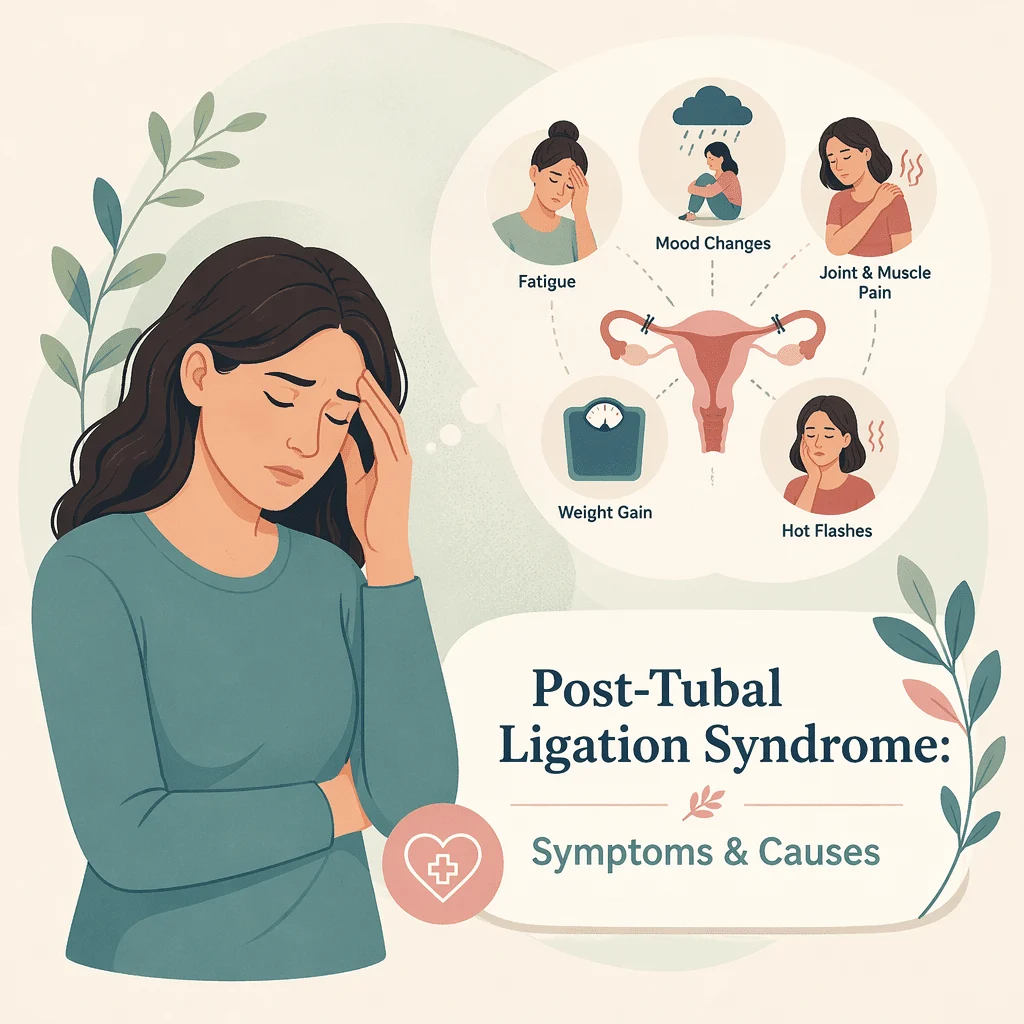
Post-tubal ligation syndrome is the name women give to a cluster of symptoms — heavier periods, cramping, hot flashes, mood swings, lower libido, fatigue — that show up in the months after tubal sterilization. It is not a recognized medical diagnosis, and the larger studies that went looking for a distinct hormonal syndrome after the procedure did not find one. That does not mean the symptoms are imaginary. It means the label rarely points to the real cause, and the real cause is usually identifiable and treatable.
In this article you’ll learn what a tubal ligation does and does not do to your ovaries, which explanations account for most of what women report, which lab tests separate those explanations from one another, and which warning signs need same-day attention rather than a wait-and-see approach.
Why post-tubal ligation syndrome is not a formal diagnosis
No medical classification system lists post-tubal ligation syndrome as a condition. It has no agreed definition, no diagnostic criteria and no test that confirms it. The idea took hold decades ago, when sterilization techniques destroyed far more tissue than modern ones do, and when the women being operated on were rarely compared with similar women who had not had surgery.
When researchers finally ran those comparisons, the picture changed. Major medical centers now state plainly that the procedure does not alter the menstrual cycle. Johns Hopkins Medicine tells patients they will still have their periods and their sex life as before. Mayo Clinic says directly that tubal ligation does not affect your menstrual cycle.
What the label gets wrong
Calling a set of symptoms a syndrome implies a single mechanism. Here there is no established one. Worse, once a woman and her clinician settle on the syndrome label, the search usually stops — and a thyroid disorder, an iron deficiency or a uterine condition that would have responded to treatment goes unaddressed for years.
What the label gets right
Something genuinely changed for many of these women, and the timing is not a coincidence. The mistake is assuming the surgery itself did it. Several things typically happen at once around a sterilization, and untangling them is the useful work.
What a tubal ligation actually changes
The procedure in plain terms
A tubal ligation blocks, cuts, seals or clips the fallopian tubes so an egg and sperm cannot meet. The ovaries stay where they are. The uterus stays where it is. Nothing that produces estrogen or progesterone is removed.
Your ovaries keep working
This is the crux of the debate. The concern has always been that operating close to the tubes might disturb the small vessels running through the tissue that connects the tube to the ovary, reducing blood flow and hormone output. Modern techniques stay close to the tube itself and away from that supply. Your ovaries continue to release eggs and produce hormones on the same cycle they always did; the egg is simply reabsorbed instead of traveling down the tube.
Because the ovaries carry on, the hormonal picture stays the same. Our guide decodes the estradiol hormone marker if you want to see how that hormone is actually read.
Ligation versus removal of the tubes
Many surgeons now remove the fallopian tubes entirely rather than tying them, an operation called opportunistic salpingectomy. The reason is not contraceptive: most cases of the most common type of ovarian cancer are now thought to begin in the fallopian tube, so removing it lowers that risk. Our library also covers the symptoms and testing for ovarian cancer.
What women describe after the procedure
The reports are remarkably consistent, which is exactly why they deserve investigation rather than dismissal:
- Periods that are heavier, longer or more painful than they were before
- Cycles that have become irregular or unpredictable
- Cramping and pelvic pain between periods
- Hedeture og nattesved
- Mood swings, irritability, low mood or anxiety
- Reduced sex drive
- Persistent fatigue that sleep does not fix
- Headaches, joint aches or weight change
Read that list again and something becomes obvious: it is almost identical to the list for perimenopause, the list for an underactive thyroid, and the list for iron deficiency. That overlap is the whole problem — and the whole opportunity.
The explanations that account for most of these symptoms
You stopped hormonal contraception at the same time
This is the single biggest explanation, and it is the one most often missed. Women who choose sterilization usually stop the pill, the patch, the ring, the injection or a hormonal IUD in the same week. Those methods had been thinning the uterine lining, shortening bleeding, smoothing out cramps and imposing a regular schedule — sometimes for fifteen or twenty years.
Remove that, and your cycle reverts to whatever it was always going to be, at the age you are now. Periods get heavier because they are no longer being suppressed. Cramps return because the hormone that was blunting them is gone. Mood and libido shift because the steady daily dose stopped. None of that is damage from the surgery. It is the removal of a treatment you had forgotten was a treatment.
Your age is doing what age does
Most sterilizations happen in the mid-thirties to mid-forties — exactly the window when the menopausal transition begins. Cycles shorten then lengthen, bleeding becomes unpredictable, hot flashes start, sleep fragments. Our team explains the symptoms and stages of menopause in detail, and also covers the causes of perimenopause nausea, one of its less discussed features.
If you were on hormonal contraception through your late thirties, it may have masked the earliest years of that transition entirely. Stopping it does not start perimenopause; it reveals it.
Your thyroid may be off
Thyroid disease is common in women of this age and produces almost every symptom on the list: heavy or irregular periods, fatigue, mood change, weight change, temperature intolerance. It is also one of the easiest things to check and treat. Our guide sets out the normal ranges for thyroid hormones, and our library covers the symptoms and treatment of hypothyroidism.
Heavier bleeding has drained your iron
If your periods got heavier after stopping contraception, you may be losing more iron every month than you replace. Iron deficiency causes exhaustion, breathlessness, poor concentration, hair shedding and low mood long before it causes textbook anemia. Our team explains the causes of low ferritin and describes symptomerne og årsagerne til anæmi.
En livmodertilstand var der i forvejen
Adenomyose, fibromer og endometriose giver alle kraftige, smertefulde menstruationer, og hormonel prævention er en standardbehandling for alle tre. Stop behandlingen, og tilstanden bliver synlig igen. Den blev ikke forårsaget af operationen – den var blot undertrykt frem til ugen for operationen. Vores bibliotek dækker diagnosen og behandlingen af endometriose.
Selve beslutningen vejer tungt
Sterilisation er tænkt som permanent, og permanens har en psykologisk pris, som ingen behøver at skamme sig over. Nogle kvinder føler lettelse. Andre føler sorg, en fornemmelse af at en dør lukkes, eller fornyet uro, hvis beslutningen blev truffet under pres, under en svær fødsel eller meget ung. Det er ikke svaghed, og det er ikke indbildt – nedtrykthed, dårlig søvn og nedsat sexlyst er det normale fysiske udtryk for det, og det er værd at sætte ord på over for sin læge.
Sæt det, du bemærker, i forbindelse med, hvad der er værd at undersøge først
Brug dette som udgangspunkt for samtalen – ikke som selvdiagnose. Den rigtige rækkefølge for prøver afhænger af din alder, din sygehistorie og din undersøgelse.
| Hvad du bemærker | Forklaringer, der er værd at undersøge først | Hvad der normalt hjælper med at afklare det |
|---|---|---|
| Menstruationer, der er meget kraftigere eller længere end tidligere | Tilbagevenden til din naturlige cyklus efter stop af hormonel prævention; fibromer eller adenomyose; skjoldbruskkirtelsygdom | Menstruationsdagbog, komplet blodtælling med ferritin, skjoldbruskkirtelprøver, bækkenultralyd |
| Uregelmæssige eller udebleven menstruationer | Præmenopause; skjoldbruskkirtelsygdom; graviditet | Graviditetstest først, derefter skjoldbruskkirtelprøver, derefter FSH med østradiol |
| Hedeture og nattesved | Præmenopause; tab af den stabile hormondosis fra p-pille, p-plaster eller p-ring; overaktiv skjoldbruskkirtel | FSH og østradiol afstemt til din cyklus, skjoldbruskkirtelprøver |
| Vedvarende træthed, som søvn ikke afhjælper | Jernmangel på grund af kraftigere blødning; skjoldbruskkirtelsygdom; forstyrret søvn | Komplet blodtælling, ferritin, skjoldbruskkirtelprøver |
| Bækkensmerter eller forværrede menstruationssmerter | Adenomyose, fibromer eller endometriose, der kommer til udtryk, når hormonel prævention stoppes | Bækkenundersøgelse og ultralyd, henvisning til gynækolog |
| Nedsat sexlyst eller humørsvingninger | Stop af hormonel prævention; præmenopause; den følelsesmæssige byrde ved en permanent beslutning; ubehandlet anæmi eller skjoldbruskkirtelsygdom | Skjoldbruskkirtelprøver, komplet blodtælling med ferritin, en åben samtale om humør og støtte |
| Udeblevne menstruation eller ensidig bækkensmerter | Graviditet, herunder ektopisk graviditet | Graviditetstest i dag og lægevurdering samme dag |
De laboratorieprøver, der adskiller mulighederne
Her er stedet, hvor et uforklaret syndrom bliver til et svar. Fire grupper af prøver udfører det meste af arbejdet.
Skjoldbruskkirtelens funktion
TSH med frit T4 er normalt den første prøve, fordi sygdomme i skjoldbruskkirtlen efterligner næsten hele symptomlistens og reagerer godt på behandling.
Komplet blodtælling og ferritin
Hvis blødningen er blevet kraftigere, viser disse to, om du taber mere jern, end du erstatter. Ferritin falder, før hæmoglobin gør det, så det opdager problemet tidligt – en normal blodprøve med lavt ferritin er et almindeligt og meget behandleligt fund. Vores team forklarer hvordan man læser en komplet blodtælling.
En graviditetstest
En udeblevet eller usædvanlig menstruation efter en sterilisation bør give anledning til en test, selv år senere, og selv hvis du har fået at vide, at indgrebet er permanent. Vores guide forklarer hvordan man tolker en hjemmegraviditetstest, og vores bibliotek gennemgår årsagerne til en menstruation, der er fem dage forsinket.
FSH og østradiol
Når spørgsmålet er overgangsalder, giver disse to tilsammen det klareste billede, når de fortolkes i sammenhæng med din alder og dit cyklusmønster frem for isoleret. Vores team beskriver follikelstimulerende hormones rolle.
Hvad AMH kan og ikke kan fortælle dig
Anti-Mülleriansk hormon giver et skøn over, hvor stor din resterende ægbeholdning er. Sammen med FSH tegner det et billede af din ovarielle reserve, hvilket er nyttig sammenhæng. Ingen af prøverne forudsiger datoen for din sidste menstruation, og ingen kombination af dem gør det heller. Vær forsigtig med enhver tjeneste, der tilbyder at fortælle dig præcis, hvornår du når overgangsalderen.
Advarselstegn, der kræver øjeblikkelig vurdering
De fleste symptomer efter en sterilisation er ikke akutte. Disse er.
- En udeblevet menstruation eller en positiv graviditetstest efter en sterilisation. Sterilisation kan sjældent svigte, og når en graviditet opstår efterfølgende, er den langt oftere ektopisk – implanteret uden for livmoderen, som regel i et æggeleder. Søg vurdering samme dag.
- One-sided pelvic or abdominal pain, with or without bleeding, in someone who could be pregnant. An ectopic pregnancy is a medical emergency and can be life-threatening if the tube ruptures. Do not wait to see whether it settles.
- Shoulder-tip pain, faintness, dizziness or collapse alongside pelvic pain. Seek emergency care immediately.
- Bleeding heavy enough to soak through a pad or tampon every hour for several hours, or passing large clots.
- Fever, worsening pain, or redness and discharge from the incision in the days after the procedure.
Seneste videnskabelige fremskridt
Recent research has moved away from hunting for a hormonal syndrome and toward two more useful questions: does removing or blocking the tubes affect the ovaries, and how do women feel about the decision afterward. Here is what the last three years have added, in plain terms.
Removing the tubes does not appear to harm the ovaries
A randomized controlled trial published in 2026 followed women having both tubes removed for permanent contraception and measured their ovarian reserve — the size of the remaining egg pool — before surgery and three months after, using a blood marker and an ultrasound count of small follicles. Neither measure dropped, whichever surgical route was used. What this means for you: the operation that removes more tissue than a classic tubal ligation still left the ovaries measurably intact. This was a small, short trial, so it is reassuring rather than final.
A second 2026 study looked at women having their uterus removed along with both tubes and found some hormone markers shifting at three months while the follicle count held steady — and, notably, their menstrual symptoms improved. What this means for you: that was a much bigger operation than a sterilization, so the findings do not transfer directly, but even there the ovarian picture was mixed rather than clearly damaged.
Removing the tubes has become the preferred approach
A 2025 review of permanent contraception describes how removing the fallopian tubes has become the favored method rather than tying them, mainly because most cases of the most common ovarian cancer are now believed to start in the tube. What this means for you: if you are considering sterilization, this is a specific question worth asking your surgeon.
About one in five later wishes it could be undone
An analysis of nationally representative United States survey data covering 2006 to 2023 found that roughly one in five women who had a tubal sterilization later reported wanting it reversed — down from about one in four in 2006. Fewer than one in a hundred of those women actually had reversal surgery. The wish was more common among women sterilized before age 30, those who had no children, and those on low incomes. What this means for you: if you feel regret, you are in substantial company, it is a recognized outcome rather than a personal failing, and it deserves proper support rather than silence.
Sterilization is highly effective, but not absolute
A 2024 commentary in NEJM Evidence re-examined how effective modern tubal sterilization really is and concluded that pregnancies afterward are less rare than many women are led to expect. What this means for you: this does not make sterilization a poor choice — it remains one of the most effective methods available. It means a missed period after the procedure should be tested, not dismissed.
Ordliste
| Begreb | Definition |
|---|---|
| Tubal ligation | A procedure that blocks, cuts or seals the fallopian tubes so egg and sperm cannot meet. The ovaries and uterus stay in place. |
| Salpingectomy | Complete removal of the fallopian tubes rather than tying them. Often preferred now because it also lowers the risk of one type of ovarian cancer. |
| Ovarian reserve | The pool of eggs remaining in the ovaries. It is estimated from blood tests and an ultrasound count, never measured directly. |
| AMH (anti-Mullerian hormone) | A blood marker made by small ovarian follicles. It reflects the size of the remaining egg pool but cannot predict when menopause will happen. |
| FSH (follicle-stimulating hormone) | A pituitary hormone that rises as the ovaries become less responsive. One of the markers used when perimenopause is the question. |
| Antral follicle count | An ultrasound count of the small fluid-filled sacs visible in the ovaries early in a cycle, used alongside AMH to estimate ovarian reserve. |
| Perimenopause | The transition of several years before periods stop for good, marked by fluctuating hormones, irregular cycles and hot flashes. |
| Adenomyosis | A condition in which uterine lining tissue grows into the muscular wall of the uterus, often causing heavy and painful periods. |
| Ferritin | The blood marker that reflects your iron stores. It falls before hemoglobin does, so it reveals iron deficiency early. |
| Ectopic pregnancy | A pregnancy that implants outside the uterus, most often inside a fallopian tube. It is a medical emergency. |
Ofte stillede spørgsmål
Is post tubal ligation syndrome a real diagnosis?
It is a real description of real symptoms, but it is not a formal diagnosis. No classification system recognizes it, there are no diagnostic criteria, and studies comparing sterilized women with similar women who were not sterilized have not identified a distinct hormonal syndrome. The symptoms still deserve a proper workup — they simply usually have a different, findable cause.
How long do symptoms last after a tubal ligation?
It depends entirely on what is causing them. Bruising and soreness from the operation settle within a couple of weeks. Cycle changes that follow stopping hormonal contraception often take three to six months to find a new pattern and may then persist, because that pattern is your own. Symptoms driven by thyroid disease or iron deficiency continue until those problems are treated, then improve. Symptoms driven by perimenopause follow the transition itself. That is why identifying the cause matters more than waiting.
How common is post-tubal ligation syndrome?
There is no meaningful prevalence figure, because there is no agreed definition to count. What is measurable is how often women report new symptoms after sterilization, and how often those symptoms are explained by something else — most often the end of hormonal contraception, the menopausal transition, thyroid disease or iron deficiency.
Can a test confirm post-tubal ligation syndrome?
No test confirms it, because there is no defined condition to confirm. Tests are still valuable, but for the opposite purpose: a thyroid panel, a complete blood count with ferritin, a pregnancy test and hormone markers such as FSH and estradiol let your clinician rule explanations in and out one by one, rather than leaving you with a label and no plan.
Does tubal ligation cause weight gain?
There is no evidence that the procedure itself causes weight gain. Weight change around the same period is usually explained by something else: stopping hormonal contraception, an underactive thyroid, the metabolic shifts of perimenopause, or the ordinary weight trend of the mid-thirties to mid-forties. A thyroid panel is a reasonable first check.
Can a tubal ligation bring on early menopause?
The ovaries are not removed and continue to work, so the procedure does not trigger menopause. What frequently happens is that a woman stops hormonal contraception at the same time and discovers she is already in perimenopause — the contraception had been masking it. If hot flashes, night sweats or irregular cycles appear, FSH and estradiol read alongside your age and cycle pattern will help clarify where you are.
Kilder
- MedlinePlus Medical Encyclopedia — Tubal ligation — U.S. National Library of Medicine, 2025 — medlineplus.gov
- Mayo Clinic — Tubal ligation: what you can expect — Mayo Foundation for Medical Education and Research — mayoclinic.org
- Johns Hopkins Medicine — Tubal Ligation — Health Library — hopkinsmedicine.org
- Centers for Disease Control and Prevention — Contraception and Birth Control Methods — cdc.gov
- MedlinePlus — Ectopic Pregnancy — U.S. National Library of Medicine — medlineplus.gov
- Yildiz E, Coskun ES, Timur GY, et al. — When Performing vNOTES Salpingectomy, Are We Damaging the Ovarian Reserve? Results From a Randomized, Controlled Trial — Journal of Minimally Invasive Gynecology, 2026 — doi.org/10.1016/j.jmig.2026.02.009
- Radu T, Mar M, Gliga M, Marginean C — The Impact of Bilateral Salpingectomy on Ovarian Reserve: A Prospective Analysis of Hormonal, Ultrasound and Clinical Correlations — Medical Sciences, 2026 — doi.org/10.3390/medsci14030416
- Kaak K, Crebessa R, Zite N — Permanent Contraception: Epidemiology and Access — Obstetrics and Gynecology Clinics of North America, 2025 — doi.org/10.1016/j.ogc.2024.12.007
- Chiang AY, Gariepy AM, Leon-Martinez D, Treder KM, Schwarz EB — Desire for reversal after tubal sterilization in the United States, 2006-2023 — F&S Reports, 2026 — doi.org/10.1016/j.xfre.2026.02.002
- Tasset J, Rodriguez M — “Permanent” Contraception: Reexamining Modern Tubal Sterilization Effectiveness — NEJM Evidence, 2024 — doi.org/10.1056/EVIDe2400263
Videre læsning
- Female hormone panel: reading FSH, LH, estradiol and prolactin together
- Night sweats before a period: causes and treatments
- High ferritin levels: causes, symptoms and risks
- PCOS: symptoms, causes, diagnosis and tests
- Luteinizing hormone (LH): understanding your blood results
Forstå dine laboratoriesvar med AI DiagMe
If your periods, energy or mood changed after a sterilization, the fastest route out of uncertainty is to look at the numbers rather than the label. A thyroid panel, a complete blood count with ferritin, a pregnancy test and hormone markers such as FSH and estradiol usually separate the plausible explanations within a single round of testing. AI DiagMe helps you understand what those results mean in plain language, so you arrive at your appointment with clear questions. It does not diagnose you and it does not replace your doctor.
Get your results interpreted in minutes