





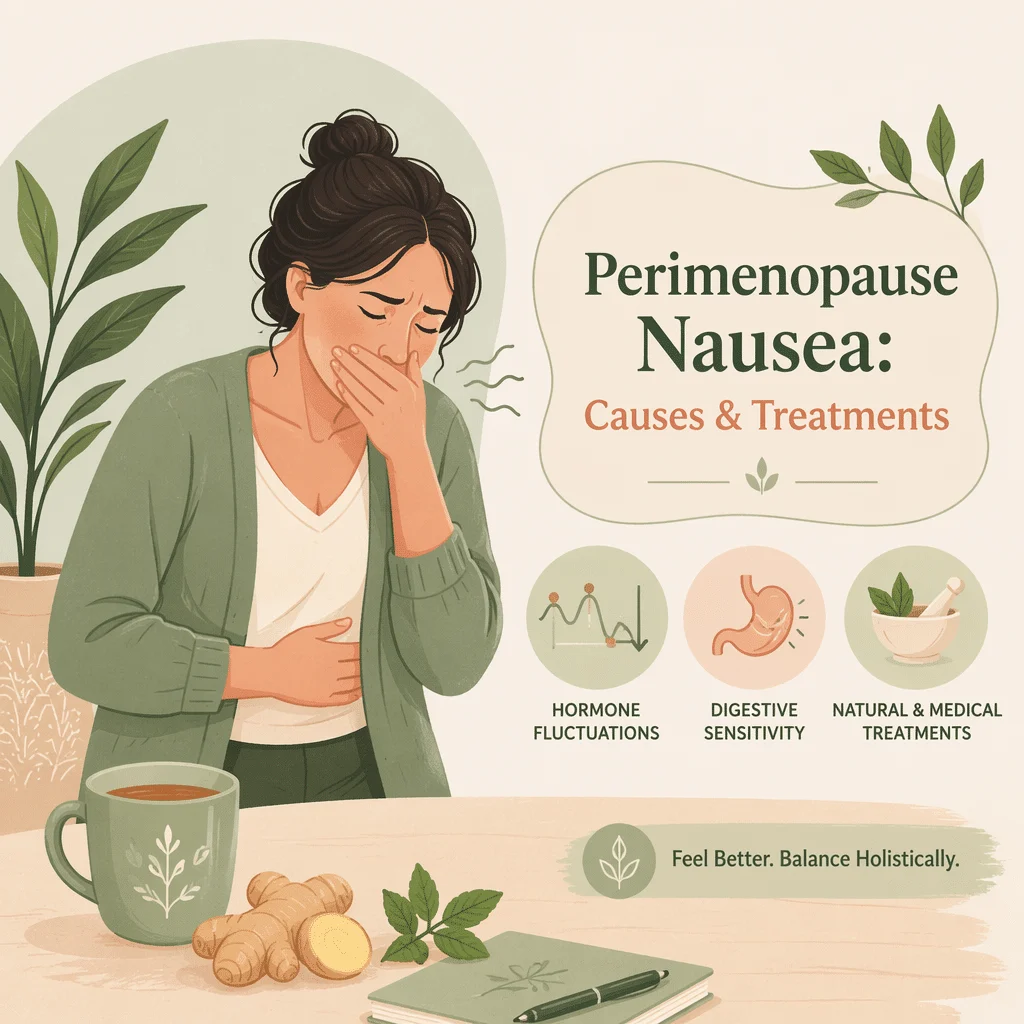
Perimenopause nausea is the queasy, unsettled, sometimes car-sick feeling that can show up in the years before periods stop for good, often from the mid-forties onward. It rarely arrives alone. It usually sits alongside irregular cycles, broken sleep, hot flashes and headaches, which is exactly why it gets dismissed, blamed on stress, or attributed to something you ate. In this article you’ll learn why this phase of life produces queasiness, what your hormones are actually doing, which everyday triggers make it worse, what a clinician checks, why hormone blood tests are far less useful here than most people expect, and the warning signs that mean you should be seen promptly.
What perimenopause nausea is, and where it fits in the transition
Perimenopause is the transition leading up to menopause. Menopause itself is a single point in time: twelve consecutive months without a menstrual period. Everything before that is perimenopause. According to the National Institute on Aging, most women begin the menopausal transition between 45 and 55, and Mayo Clinic notes it commonly starts in the forties, though it can begin earlier or later.
Nausea here is a symptom, not a diagnosis. It can be a brief wave on waking, a rolling queasiness lasting most of a day, or a sharp episode tied to a headache or hot flash. Some people never experience it. Our library also maps out the full arc of menopause symptoms and stages.
Fluctuating hormones, not simply low hormones
This is the part most explanations get backwards. Estrogen does not glide smoothly downward through perimenopause. It swings. Cleveland Clinic describes perimenopausal hormones as rising and falling erratically rather than declining in a straight line, and that instability, rather than a low level on any given day, is what most closely tracks with symptoms. A cycle where estrogen climbs high then drops sharply can feel far worse than one where it stays modestly low.
That explains a pattern many people find confusing: symptoms cluster, vanish for six weeks, then return without warning. It also explains why a single blood test summarizes so little, a point covered below.
If your queasiness follows a clear cycle pattern
Not every wave of nausea in your forties belongs to perimenopause. If yours reliably lands around mid-cycle, roughly two weeks before a bleed, a separate guide covers the causes of mid-cycle ovulation nausea. If it clusters in the days just before a period alongside other premenstrual changes, another article explains the hormonal shifts behind frequent urination before a period. Perimenopausal nausea is distinguished by the loss of that predictability.
Why perimenopause nausea happens
The mechanisms are not fully mapped. Several plausible routes are recognized, and more than one is usually at work at once.
Hormone swings and the digestive tract
Estrogen and progesterone both act on the gut, influencing how quickly the stomach empties and how strongly the gut signals the brain. When hormone levels move quickly rather than sitting steady, that signaling appears to become less orderly. The result can feel like queasiness, early fullness after a few mouthfuls, bloating, or a stomach that sits heavy for hours. This is a plausible mechanism rather than a proven one.
Migraine triggered by estrogen withdrawal
Nausea is a core feature of migraine, not an optional extra, and a sharp fall in estrogen is a long-recognized migraine trigger. During perimenopause those falls become more frequent and less predictable, so attacks cluster and grow harder to anticipate. If your queasiness arrives with head pain, light or sound sensitivity, or visual disturbance, migraine deserves consideration in its own right. Our library covers the causes, symptoms and treatments of migraine.
Hot flashes, anxiety and the nausea reflex
A hot flash is a sudden surge in the body’s heat-regulating response, with a racing heart, sweating and flushing. Some people feel a distinct wave of nausea at its peak that fades as the flash passes. Anxiety and panic reach the stomach through overlapping nerve pathways and can produce the same sensation with no hot flash at all, and the two feed each other during this transition. We also discuss the symptoms and causes of anxiety.
Sleep that keeps breaking
Night sweats, early waking and lighter sleep are common in perimenopause, and sustained fatigue lowers the threshold at which the body registers nausea. Queasiness worst on waking, or building through the evening, often has a sleep component. Another guide addresses the causes of nausea that strikes at night.
Everyday triggers that overlap with the hormonal picture
Ordinary triggers do not disappear in perimenopause. They stack on top of it, and several become more troublesome in midlife:
- Alcohol. Tolerance often drops in this decade; a quantity that was fine at 35 can produce next-morning queasiness at 47.
- Skipped or delayed meals. Long gaps without food reliably trigger both nausea and hormone-related headache.
- Caffeine on an empty stomach, or a sharp increase to offset poor sleep.
- Reflux, which becomes more common with age. Acid rising into the esophagus produces nausea, an acid taste, a night cough and burning behind the breastbone. A dedicated page describes the symptoms and treatments of acid reflux cough.
- Large late meals, or lying down within two to three hours of eating.
- Medications. Several common prescriptions list nausea as a side effect, including some used for hot flashes and mood. Check the leaflet before assuming hormones are responsible.
What a clinician checks, and why hormone tests can mislead
No blood test returns a result reading “perimenopause.” Diagnosis rests on your age, your cycle pattern and your symptoms. That surprises people expecting a definitive number, and it is the most useful thing to understand before asking for a hormone panel.
Why a single FSH or estradiol result proves very little
Follicle-stimulating hormone tends to rise as ovarian function declines, and estradiol falls overall across the transition. Both statements are true on average and over years. Neither is reliable on a single day. Both hormones move week to week, and a normal FSH result does not rule out perimenopause any more than a high one confirms it.
Cleveland Clinic states plainly that hormone testing is not necessary to diagnose perimenopause, that levels fluctuate so much the tests are not reliable, and that FSH results in this phase can be misleading. MedlinePlus similarly notes FSH levels change through the month and that routine FSH testing is generally not needed from age 45 onward. Testing has a clearer role when periods stop unusually early or when symptoms have no obvious explanation. Our team explains the FSH blood test and how to read its result, and we also describe the estradiol blood test and what its values mean.
The tests that are genuinely useful here
When nausea is the main complaint, testing usually aims to exclude conditions that imitate perimenopause or need their own treatment. Thyroid disease in particular is common in midlife women and produces fatigue, cycle changes and digestive upset that look almost identical to the transition. This guide lists the normal thyroid hormone ranges used by most laboratories.
A pregnancy test comes early, because perimenopause is not infertility. Ovulation still occurs, unpredictably, until periods have stopped for a full year. Our team reviews the accuracy and timing of home pregnancy tests. If bleeding has been heavy or erratic, iron stores are worth checking too, since iron deficiency causes fatigue, headache and queasiness in its own right. We explain the causes, symptoms and treatment of low ferritin.
| Test | What it measures | Why it may be ordered when nausea appears in midlife |
|---|---|---|
| TSH (thyroid-stimulating hormone) | How hard the pituitary is pushing the thyroid gland | Thyroid disease is common in midlife women and mimics perimenopause closely, so it is excluded first |
| Pregnancy test (hCG) | The hormone produced in early pregnancy | Ovulation continues irregularly, so pregnancy remains possible and is ruled out early |
| Ferritin and iron studies | Stored and circulating iron | Heavy or unpredictable bleeding is frequent here, and iron deficiency causes fatigue, headache and queasiness |
| Liver enzymes (ALT, AST) | Signs of liver cell irritation or damage | Persistent nausea with appetite loss or yellowing skin points to a liver cause, not a hormonal one |
| Kidney function (creatinine, eGFR) | How efficiently the kidneys filter waste | Reduced kidney function causes ongoing nausea and fatigue that hormones cannot explain |
| Fasting glucose or HbA1c | Blood sugar level and longer-term control | Both high and low blood sugar cause queasiness, and metabolic risk rises through midlife |
| FSH and estradiol | Pituitary and ovarian reproductive hormones | Sometimes requested, but single values are unreliable because they swing week to week |
Red flags: nausea that needs prompt attention
Most perimenopausal queasiness is mild, comes and goes, and settles without treatment. But some nausea in midlife is not hormonal at all, and this is exactly the age at which that distinction matters most. Heart attacks in women frequently present without the classic crushing chest pain, and nausea can be a leading symptom. Do not talk yourself out of seeking help because you are “probably just perimenopausal.”
Seek urgent or emergency care if nausea comes with any of the following:
- Discomfort in the chest, jaw, arm, neck or upper back, breathlessness, light-headedness or a cold sweat. Call emergency services rather than waiting.
- Vomiting that stops you keeping fluids down, or that continues beyond 24 hours.
- A new headache that is severe or the worst you have had, or a headache with weakness, confusion, slurred speech or loss of vision.
- Blood in the vomit, or vomit that looks like coffee grounds.
- Severe or persistent abdominal pain.
- Yellowing of the skin or the whites of the eyes, dark urine or pale stools.
- Unexplained weight loss.
- Any vaginal bleeding that occurs after twelve consecutive months without a period.
- Fever with a stiff neck, or a rash that does not fade under pressure.
Book a routine appointment if nausea persists beyond a few weeks, disrupts eating or working, or comes with bleeding heavy enough to soak through protection hourly.
What genuinely helps day to day
Eating and drinking patterns
Small, regular meals hold up better than three large ones, and going more than four or five hours without food is a common avoidable trigger. Keep something plain and dry within reach for the morning, and sip fluids steadily rather than drinking a large volume at once. Reduce alcohol and see whether the pattern changes over two or three weeks. If reflux is part of the picture, avoid lying down for two to three hours after eating.
Sleep, stress and the nervous system
Treating broken sleep is not a distraction from the nausea; it is part of managing it. A cool bedroom, a consistent wake time and limiting evening alcohol all help. Cognitive behavioral therapy has been recommended for sleep problems, anxiety and hot flashes in the menopausal transition, and it is a legitimate option to raise with a clinician rather than a last resort.
A symptom diary beats a one-off hormone panel
Because hormone levels move so much, two months of well-kept notes tell a clinician more than a single blood draw. Record the date, the cycle day if you can still track it, what you ate, alcohol, hours slept, any headache or hot flash, and a nausea score out of ten. Patterns emerge quickly, and that record is the strongest argument you can bring if your symptoms have been minimized.
Prescription options are a conversation, not a self-selection
Menopausal hormone therapy is prescribed for some perimenopausal symptoms, and whether it suits you depends on your medical history, including migraine with aura, cardiovascular and breast health, and how the medication would be delivered. It is a discussion to have with a clinician who knows that history, not something to select from a symptom list. Non-hormonal prescription medicines also exist for hot flashes, and nausea appears among their common side effects, which matters when nausea is your main complaint. Short courses of anti-nausea medicine are sometimes prescribed once a cause is identified.
Supplements and herbal products
Reviews of herbal and complementary products for menopausal symptoms consistently find the evidence for their effectiveness and safety remains weak. That is not the same as saying they do nothing, but no product in this category has earned the right to be called a treatment for nausea. These products can also interact with prescription medicines, so tell your clinician and pharmacist exactly what you take.
Latest scientific advances
Research into this phase has expanded quickly, though nausea has received less attention than hot flashes or mood. Here is what recent work adds, in plain terms.
Nausea in menopause is under-researched, not disproven
A 2025 scoping review, a study type that maps how much research exists on a question rather than answering it, gathered 122 studies of digestive symptoms in natural perimenopause and postmenopause. Constipation had been examined in dozens of them; vomiting appeared in only a handful. What this means for you: if you have been told there is “no evidence” that perimenopause causes nausea, the more accurate statement is that this symptom has barely been studied. That is an evidence gap, not proof that your experience is imaginary.
Instability of estrogen, not low estrogen, drives midlife migraine
Two recent reviews of migraine across the menopausal transition, published in 2025 and 2026, reach the same conclusion: it is the variability of estrogen during perimenopause, rather than simply a lower level, that makes attacks more frequent and harder to predict. Both note that migraine with aura, meaning visual or sensory warning symptoms before the headache, tends to persist after menopause and carries its own vascular risk. What this means for you: queasiness arriving with head pain or visual disturbance may be migraine, which is treatable in its own right. Tell your clinician if you experience aura, because it changes which options are appropriate.
Sleep and mood belong in the same conversation
A 2025 review in a leading US obstetrics and gynecology journal set out sleep disruption, mood change and cognitive complaints as core features of the transition, not side issues. What this means for you: raising insomnia or low mood at the same appointment as the nausea is not changing the subject. Poor sleep lowers your tolerance for queasiness, and improving one often improves the other.
Real non-hormonal options exist, but the over-the-counter ones are not the proven ones
A 2023 review of non-estrogen and complementary treatments concluded that several non-hormonal prescription medicines are effective for hot flashes, that cognitive behavioral therapy is recommended for anxiety, sleep problems and vasomotor symptoms, and that the evidence for herbal remedies remains weak. The same review lists nausea among the common side effects of those prescription medicines. What this means for you: there is more than one route beyond hormone therapy, but a medicine that helps hot flashes may unsettle your stomach at first, a trade-off worth naming at the appointment.
All four are reviews of existing studies rather than new trials in women whose main symptom is nausea, so they indicate direction rather than certainty.
Glossary of key terms
| Term | Definition |
|---|---|
| Perimenopause | The transition leading up to menopause, when ovarian hormone levels fluctuate and cycles become irregular. It usually begins in the forties and ends twelve months after the final period. |
| Menopause | A single point in time, defined as twelve consecutive months without a menstrual period. |
| Estradiol (E2) | The main form of estrogen during the reproductive years, produced mostly by the ovaries. Levels swing widely through perimenopause. |
| FSH (follicle-stimulating hormone) | A pituitary hormone that prompts the ovaries to mature eggs. It tends to rise as ovarian function declines, but it varies week to week during the transition. |
| TSH (thyroid-stimulating hormone) | A pituitary hormone measured to assess thyroid function. It is commonly tested when midlife symptoms could be thyroid-related. |
| Ferritin | A protein that reflects the body’s iron stores. Low values suggest iron deficiency, which often follows heavy periods. |
| Vasomotor symptoms | The medical term for hot flashes and night sweats. |
| Aura | Visual or sensory warning symptoms that precede some migraine attacks, such as flickering lights, zigzag lines or a blind spot. |
| Menopausal hormone therapy | Prescription estrogen, often combined with a progestogen, used to treat certain menopausal symptoms. Suitability depends on individual medical history. |
| Antiemetic | A medicine prescribed to reduce nausea and vomiting. |
Frequently asked questions
Does perimenopause cause nausea?
Nausea is reported by many people during the menopausal transition, and the leading explanations are hormone fluctuation acting on the digestive tract, migraine triggered by estrogen withdrawal, hot flashes, anxiety and disrupted sleep. It is not among the classic textbook symptoms in the way hot flashes and irregular periods are, partly because it has been studied far less. That does not make it less real, but it does mean a clinician will reasonably look for other explanations before settling on hormones.
How long does perimenopause nausea last?
There is no fixed duration, and honest sources will not give you one. Individual episodes may last minutes to hours. The tendency toward queasiness generally tracks the transition itself, which the National Institute on Aging describes as lasting a variable number of years and differing greatly between individuals. Many people find symptoms ease once cycles stop entirely and hormone levels settle at a steady low. Nausea that lasts continuously for weeks, or that keeps getting worse, should be assessed rather than waited out.
Could this be pregnancy rather than perimenopause?
It could. Perimenopause is not infertility, and ovulation continues, unpredictably, until you have gone twelve months without a period. Irregular cycles make a missed period a weak signal on its own, so a pregnancy test is a sensible early step if there is any possibility. Both conditions can produce nausea, breast tenderness and fatigue, so symptoms alone cannot separate them.
Why is the nausea worse in the morning?
Morning queasiness in this phase usually reflects the long overnight gap without food, dropping blood sugar, reflux that has built up while lying flat, a migraine that started during sleep, or simply a poor night. Eating something plain soon after waking, raising the head of the bed and keeping a consistent wake time often help. Morning nausea alone does not indicate pregnancy, but if pregnancy is possible, test rather than assume.
Why do I feel sick after eating?
Feeling queasy or uncomfortably full soon after a meal can reflect slower stomach emptying, reflux, or portion size. Larger meals, high-fat meals, alcohol and eating late all make it more likely. Smaller, more frequent meals are the first thing to try. If it happens after nearly every meal, comes with weight loss or difficulty swallowing, or has been going on for weeks, ask for an assessment rather than adjusting your diet indefinitely.
Can a blood test confirm perimenopause?
Not reliably. Cleveland Clinic states that hormone testing is not necessary to diagnose perimenopause because levels fluctuate too much for the tests to be dependable, and MedlinePlus notes that routine FSH testing is generally not needed from age 45 onward. Testing is more useful for excluding other conditions, such as thyroid disease, pregnancy or iron deficiency, or when periods stop unusually early. Your age, cycle history and symptoms remain the strongest evidence.
Sources
- Cleveland Clinic — Perimenopause: age, stages, signs, symptoms and treatment — https://my.clevelandclinic.org/health/diseases/21608-perimenopause
- National Institute on Aging, National Institutes of Health — What Is Menopause? — https://www.nia.nih.gov/health/menopause/what-menopause
- Mayo Clinic — Perimenopause: symptoms and causes — https://www.mayoclinic.org/diseases-conditions/perimenopause/symptoms-causes/syc-20354666
- MedlinePlus, US National Library of Medicine — Follicle-Stimulating Hormone (FSH) Levels Test — https://medlineplus.gov/lab-tests/follicle-stimulating-hormone-fsh-levels-test/
- Shaw N, Abbott R, Pettinger C — The volume and characteristics of research on gastrointestinal symptoms in “natural” peri- and postmenopause: a scoping review — Women’s Health (London), 2025 — https://doi.org/10.1177/17455057251387470
- Korn TF, Bernstein C — Migraine across the menopausal transition and beyond: a narrative review — Headache, 2026 — https://doi.org/10.1111/head.70071
- Waliszewska-Prosol M, Grandi G, Ornello R, et al. — Menopause, perimenopause, and migraine: understanding the intersections and implications for treatment — Neurology and Therapy, 2025 — https://doi.org/10.1007/s40120-025-00720-2
- Williams M, Maki PM — A review of cognitive, sleep, and mood changes in the menopausal transition: beyond vasomotor symptoms — Obstetrics and Gynecology, 2025 — https://doi.org/10.1097/AOG.0000000000005914
- Al Wattar BH, Talaulikar V — Non-oestrogen-based and complementary therapies for menopause — Best Practice and Research: Clinical Endocrinology and Metabolism, 2023 — https://doi.org/10.1016/j.beem.2023.101819
Further reading
- Night sweats before a period: causes and treatments
- The iron studies panel: ferritin, serum iron and transferrin saturation
- The kidney function panel and how to read renal blood tests
- Glucose levels: causes, symptoms and treatments
- ALT levels: meaning, causes and normal ranges
Understand your lab results with AI DiagMe
When queasiness arrives in your forties, the useful question is rarely “are my hormones low” but “what else could this be.” That is where a lab report earns its place: a thyroid test, a pregnancy test, an iron panel and a basic check of liver, kidney and blood sugar values can settle most of the alternatives in one draw. AI DiagMe reads those results back to you in plain language, so you walk into your appointment knowing which numbers are outside range and which questions are worth asking. It helps you understand your results; it does not diagnose you and it does not replace your doctor.
Get your results interpreted in minutes