
































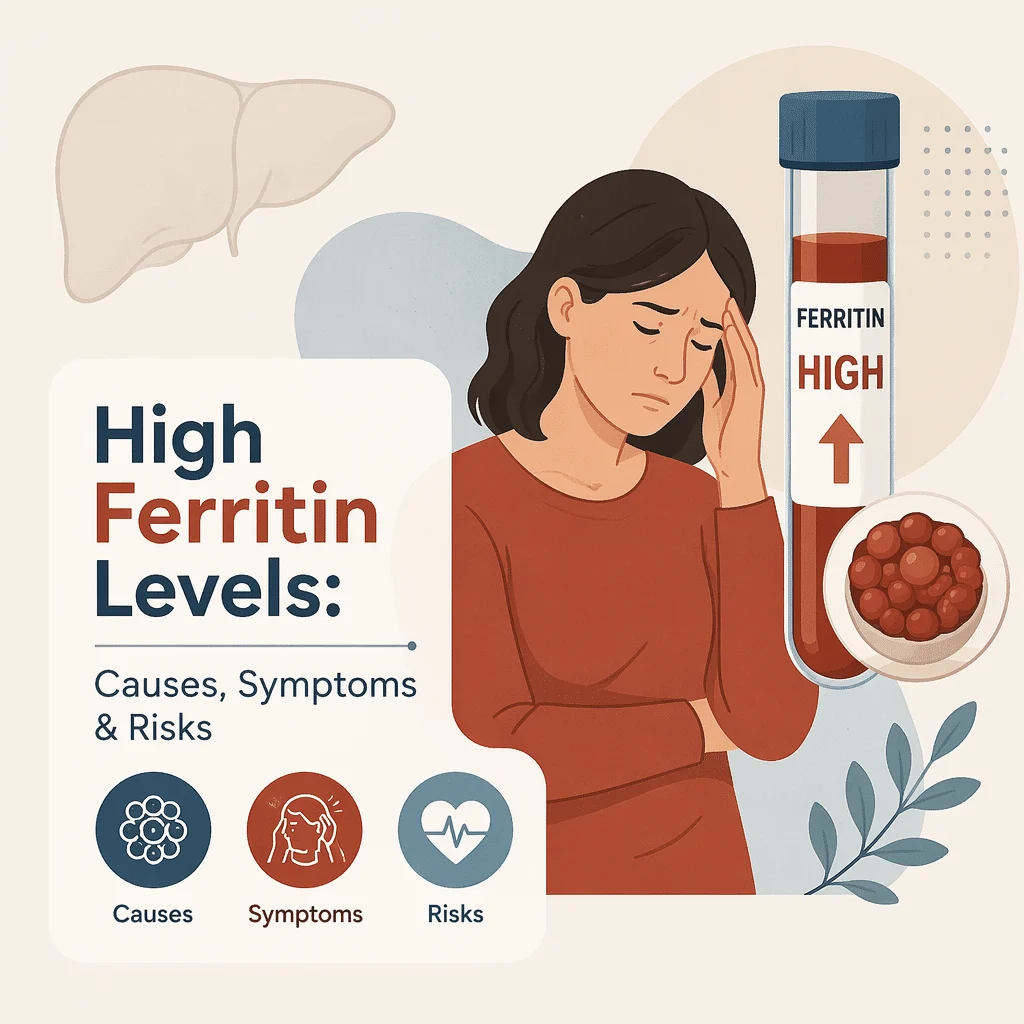
High ferritin levels on a blood test mean that the protein your body uses to store iron is more concentrated in your blood than the laboratory expects. That single number rarely tells the whole story. Ferritin rises when the body stores too much iron, but it also rises during inflammation, infection, liver stress, regular alcohol use and several metabolic conditions. In this article you will learn what ferritin measures, how to read your own result against typical reference ranges, which causes doctors consider first, which follow-up tests separate genuine iron overload from a temporary reaction, and which warning signs deserve a prompt appointment. The tone here is practical rather than alarming: an isolated high ferritin result is common, and most causes are manageable once identified.
What high ferritin levels actually mean
Ferritin is a hollow, ball-shaped protein that holds iron in a safe, inactive form inside your cells, mostly in the liver, spleen and bone marrow. A small amount leaks into the bloodstream, and that circulating fraction is what a serum ferritin test measures. Because the amount in blood usually tracks the amount stored in tissue, ferritin became the standard way to estimate the body’s iron reserves.
Ferritin as a measure of iron stores
When iron accumulates faster than the body can use or lose it, ferritin production increases and the blood level climbs. This is the interpretation most people expect when they see a high result, and it is the pattern seen in hereditary hemochromatosis, in people who receive repeated blood transfusions, and in those taking iron supplements they do not need. Understanding storage requires more than one number, though. Our team also explains the complete iron studies panel, which reads ferritin alongside serum iron, transferrin and total iron-binding capacity.
Ferritin as an inflammation marker
Ferritin is also an acute-phase reactant, meaning the liver produces more of it whenever the body mounts an inflammatory response. An infection, a recent surgery, an autoimmune flare, obesity or a chronic inflammatory condition can all push ferritin up while iron stores stay perfectly normal. This dual role is the single most important thing to understand about a high result, and it is why doctors almost never act on ferritin alone. The same logic applies to other inflammatory markers, and our team explains the C-reactive protein inflammation marker in a companion guide.
Ferritin reference ranges and how to read your result
Reference ranges differ between laboratories because they depend on the analyzer and the local population, so always compare your value with the range printed on your own report. Results may appear as micrograms per liter (mcg/L) or nanograms per milliliter (ng/mL); the two units are numerically identical, so a value of 400 means the same thing in either notation. The table below combines the ranges published by Mayo Clinic with the result patterns doctors use to narrow down a cause.
| Who or which pattern | Typical reference range | What a result above the range may suggest |
|---|---|---|
| Adult men | 24 to 336 mcg/L | Iron overload, fatty liver disease, regular alcohol use, inflammation, or a combination of these |
| Adult women | 11 to 307 mcg/L | The same causes; values tend to sit lower before menopause because monthly blood loss removes iron |
| High ferritin with high transferrin saturation | Saturation above the usual range | Genuine iron overload becomes more likely; hereditary hemochromatosis is investigated |
| High ferritin with normal or low transferrin saturation | Saturation within or below the usual range | Inflammation, infection, liver disease or a metabolic cause is more likely than excess stored iron |
| High ferritin with raised liver enzymes | ALT or AST above the range | Fatty liver disease, alcohol-related liver injury or viral hepatitis is usually explored first |
| Markedly high ferritin | Several times the upper limit | Warrants prompt medical evaluation; blood and rheumatic conditions become more frequent as values climb |
Why a single high value is not a diagnosis
MedlinePlus puts it plainly: a ferritin result outside the normal range does not always mean you have a condition that needs treatment. Ferritin can rise for a few weeks after an infection or an operation and then settle on its own. This is why a repeat test after several weeks, taken when you are well, is often the most informative next step. You can read the full patient explanation from MedlinePlus, the patient information service of the National Library of Medicine.
What causes high ferritin levels
The causes fall into a handful of groups. Most people turn out to have one of the first three.
Inflammation and infection
Any active inflammatory process raises ferritin. Common triggers include respiratory and urinary infections, recent surgery, rheumatoid arthritis and other autoimmune conditions, and obesity, which produces a low-grade inflammatory state. In these situations ferritin behaves as a signal of immune activity rather than a measure of iron.
Metabolic and liver-related causes
Metabolic dysfunction-associated steatotic liver disease (MASLD), the current term for fatty liver linked to metabolic health, is one of the most frequent explanations for a mildly raised ferritin in adults. Insulin resistance, type 2 diabetes, raised triglycerides and central weight gain often travel together with it. Because liver enzymes are usually checked at the same time, our team explains how to read a liver panel, and a dedicated article covers the meaning of ALT levels.
Alcohol
Regular or heavy alcohol intake raises ferritin through several routes at once: direct liver irritation, increased iron absorption and an inflammatory response. Ferritin often falls noticeably within weeks of reducing or stopping alcohol, which makes it a useful marker to recheck.
Hereditary hemochromatosis and other genetic causes
Hereditary hemochromatosis is an inherited condition in which the body absorbs more iron from food than it needs, storing the excess in the liver, heart, pancreas, endocrine glands and joints. According to the National Institute of Diabetes and Digestive and Kidney Diseases, gene mutations cause the most common form, and finding two copies of the HFE gene carrying the C282Y mutation confirms the diagnosis. The condition is far less common than inflammation or fatty liver as an explanation for raised ferritin, but it matters because it is treatable and runs in families. You can read the overview published by the National Institute of Diabetes and Digestive and Kidney Diseases.
Other recognized causes
- Repeated blood transfusions, which deliver iron the body cannot easily remove
- Iron supplements taken without a demonstrated deficiency
- Hyperthyroidism
- Some blood cancers, including leukemia and Hodgkin lymphoma
- Porphyria, a group of conditions affecting the nervous system and skin
- Chronic kidney disease and its treatments
Symptoms and health effects
Raised ferritin caused by inflammation usually produces no symptoms of its own; you feel whatever the underlying condition causes. Symptoms attributable to iron itself appear only when genuine overload has built up over years. The National Institute of Diabetes and Digestive and Kidney Diseases lists tiredness or weakness, joint pain, loss of interest in sex or erectile dysfunction, pain in the abdomen over the liver, and a darkening of skin color.
Left untreated, long-standing iron overload can damage the liver, heart, pancreas, endocrine glands and joints. That is the reason doctors take a persistently high ferritin seriously even when someone feels entirely well. Fatigue deserves a note of caution: it is extremely common and has many explanations, so it should not be read as evidence of iron overload on its own. Iron problems in the opposite direction cause fatigue too, and a companion article covers the causes of low ferritin.
How doctors find the cause: the tests that come next
Transferrin saturation, the decisive second test
Transferrin saturation is the percentage of your iron-carrying protein that is actually loaded with iron, and it is the test that most efficiently separates the two main interpretations of a high ferritin. When saturation is high alongside ferritin, stored iron is the likely issue. When saturation is normal or low, inflammation, liver disease or a metabolic cause moves to the front of the list. This guide covers the normal range for transferrin saturation, and a separate article describes the role of transferrin in iron transport.
Liver, metabolic and inflammatory tests
A typical second round includes liver enzymes, a complete blood count, blood glucose or HbA1c, a lipid profile, an inflammatory marker such as C-reactive protein, and hepatitis B and C testing. Reviews of mildly raised liver enzymes place iron, total iron-binding capacity and ferritin squarely in this first round of investigations, with fatty liver disease and alcohol-related liver disease as the leading explanations and hereditary hemochromatosis as an uncommon one.
Genetic testing and imaging
If iron overload still looks likely, HFE genetic testing follows. Imaging such as MRI can estimate liver iron without a biopsy, and a liver biopsy is now reserved for cases where the picture remains unclear or the extent of liver damage needs to be established.
Treatment and management
Treating the underlying cause
When inflammation, alcohol or metabolic disease explains the result, the treatment is aimed at that condition rather than at the ferritin number. Weight loss, better blood sugar control, reduced alcohol intake and treatment of an autoimmune condition typically bring ferritin down over months, and repeat testing confirms the trend.
Phlebotomy and chelation
For confirmed iron overload, the standard treatment is phlebotomy: drawing about a pint of blood on a regular schedule, which the National Institute of Diabetes and Digestive and Kidney Diseases describes as the most direct and safe way to lower the body’s iron stores. Sessions are frequent at first, then spaced out for long-term maintenance. Iron chelation medicines, which bind iron so it can be excreted, are used mainly when phlebotomy is not suitable, such as in people with anemia. Our team details the safe ways to lower high iron levels.
Diet and everyday measures
Diet alone will not correct established iron overload, but it supports treatment. Useful measures include moderating red meat and organ meats, avoiding iron and high-dose vitamin C supplements unless prescribed, limiting alcohol, and avoiding raw shellfish, which carries a specific infection risk for people with iron overload. Tea and coffee with meals modestly reduce iron absorption.
When to see a doctor
Book a routine appointment if your ferritin is above the reference range on a single test, so that a repeat test and a transferrin saturation can be arranged. Arrange an appointment sooner if any of the following apply:
- Your ferritin is several times the upper limit of the reference range
- Ferritin stays high on a repeat test taken weeks later while you feel well
- You have joint pain, persistent fatigue, abdominal pain over the liver, or skin that has darkened without sun exposure
- A parent, brother or sister has hereditary hemochromatosis
- Your liver enzymes are raised at the same time
- You have had many blood transfusions
Seek urgent medical care for a very high ferritin combined with fever, night sweats, unexplained weight loss, easy bruising or yellowing of the eyes or skin. These combinations need same-week assessment rather than watchful waiting.
Latest scientific advances
Research from the past three years has refined how doctors interpret a raised ferritin. The findings below are summarized in plain language, and their limits are stated alongside them.
High ferritin points to a wide range of conditions, not mainly to iron
A 2025 review of more than two thousand hospital patients with clearly raised ferritin found that solid organ cancers accounted for roughly a third of cases, infections for about one in four, and blood disorders for about one in seven. As ferritin climbed higher, blood and rheumatic conditions became progressively more common. What this means for you: these were patients already admitted to a hospital, which is very different from a routine check-up in someone who feels well, so the numbers should not be read as your own odds. The useful lesson is that a high ferritin is a prompt to look for a cause, and that iron is only one of many possibilities.
Genetics beyond the classic hemochromatosis gene
When the usual explanations have been excluded, some cases remain unexplained. A 2026 study sequenced a broad panel of genes in just over a hundred such patients and found a relevant gene variant in about two thirds of them. HFE, the classic hemochromatosis gene, was the most common, but variants in genes governing liver metabolism and copper handling also appeared, and roughly a third of those with findings carried variants in two or more genes at once. What this means for you: for the small group whose raised ferritin has no explanation after standard testing, broader genetic testing is becoming a realistic next step in specialist clinics. This does not change the approach for the large majority of people.
Iron status and fatty liver disease
Two recent lines of work link iron to liver health. An analysis of a large United States health survey found that higher ferritin tracked with more liver fat and greater liver stiffness in adults, with a relationship that was not a straight line and that differed by age and sex. A 2026 study using a genetics-based method designed to separate cause from coincidence pointed toward higher iron status actively raising the risk of fatty liver disease and scarring, rather than simply accompanying it. What this means for you: if your ferritin is raised and you carry metabolic risk factors, your doctor is likely to assess your liver, and improving metabolic health is a reasonable goal in its own right. These methods are indirect, and the conclusions still need confirmation in treatment studies.
A caution about over-interpreting ferritin
A 2026 analysis pooled individual data from twenty-one studies covering more than ten thousand adults and examined whether iron markers relate to thickening of the carotid artery wall, an early marker of artery disease. Ferritin and transferrin showed a relationship only in women and only within certain ranges. When the researchers tested the question genetically in a much larger group, no causal link appeared, and they concluded that their observational findings likely reflected other factors rather than iron causing the change. What this means for you: this is a good example of why a raised ferritin should not be treated as a cardiovascular alarm on its own, and why careful interpretation matters more than any single number.
Glossary
| Term | Definition |
|---|---|
| Ferritin | A protein that stores iron inside cells in a safe, inactive form, mainly in the liver, spleen and bone marrow. |
| Serum ferritin | The small amount of ferritin circulating in blood, which a laboratory measures to estimate the body’s iron stores. |
| Acute-phase reactant | A substance whose blood level changes during inflammation. Ferritin is one, which is why infection or injury can raise it. |
| Transferrin saturation | The percentage of the iron-carrying protein transferrin that is currently loaded with iron. It helps separate iron overload from inflammation. |
| Iron overload | A build-up of more iron in body tissues than they can safely hold, which can damage organs over many years. |
| Hereditary hemochromatosis | An inherited condition in which the intestine absorbs more iron from food than the body needs, leading to gradual accumulation. |
| HFE gene | The gene most often involved in hereditary hemochromatosis. Two copies of its C282Y mutation confirm the most common form. |
| Phlebotomy | Removing a set volume of blood on a schedule to lower the body’s iron stores. It is the standard treatment for iron overload. |
| Chelation therapy | Medicine that binds iron so the body can remove it, used mainly when phlebotomy is not suitable. |
| MASLD | Metabolic dysfunction-associated steatotic liver disease, the current name for fatty liver disease linked to metabolic health. |
Frequently asked questions
What is the most common cause of high ferritin levels?
In adults having routine blood work, the most frequent explanations are inflammation of any kind, metabolic dysfunction-associated steatotic liver disease and regular alcohol intake. Hereditary hemochromatosis attracts a lot of attention because it is inheritable and treatable, but it accounts for a minority of raised results. The practical way to tell them apart is to measure transferrin saturation and repeat the ferritin when you are well, since inflammation-driven rises often settle on their own.
What is considered a dangerously high ferritin level?
There is no single number that separates safe from dangerous, because context changes the meaning. A value close to the top of the range in someone recovering from an infection is interpreted very differently from the same value in someone with joint pain and a family history of hemochromatosis. As a general principle, the higher the result and the longer it stays high, the more thorough the search for a cause becomes. Values several times the upper limit of the reference range warrant prompt medical assessment rather than a wait-and-see approach.
Can high ferritin cause fatigue?
Fatigue is reported both in iron overload and in many of the conditions that raise ferritin through inflammation, so the two are often linked in practice. However, fatigue is one of the least specific symptoms in medicine, and thyroid problems, sleep disruption, depression, anemia and dozens of other causes are far more common. Fatigue alongside a raised ferritin is worth investigating, but it is not by itself evidence that iron is the culprit.
What causes high ferritin in women?
The causes are the same as in men, though the balance differs. Before menopause, monthly blood loss keeps iron stores lower, so a raised ferritin in a younger woman more often reflects inflammation, metabolic dysfunction-associated steatotic liver disease, obesity or alcohol than iron accumulation. After menopause, iron stores rise naturally and hereditary hemochromatosis becomes easier to detect, which is why the condition is often diagnosed later in women than in men.
How can I lower my ferritin levels?
The right approach depends entirely on the cause. If inflammation is responsible, treating the underlying condition lowers ferritin without any iron-specific measure. If alcohol or metabolic disease is responsible, cutting alcohol and improving metabolic health usually brings the number down over several months. If genuine iron overload is confirmed, scheduled phlebotomy is the established treatment. Diet helps but does not replace treatment, and stopping unnecessary iron supplements is often the simplest first step.
Does a high ferritin mean I have cancer?
For most people, no. Ferritin rises in many benign situations, and a mildly raised result in someone who feels well is far more likely to reflect inflammation, fatty liver disease or alcohol than a cancer. Certain blood cancers and some solid tumors can raise ferritin, which is one reason doctors investigate values that remain high without explanation, particularly when accompanied by fever, night sweats or unexplained weight loss. Investigation is a precaution, not a prediction.
Sources
- MedlinePlus, National Library of Medicine — Ferritin Blood Test — https://medlineplus.gov/lab-tests/ferritin-blood-test/
- National Institute of Diabetes and Digestive and Kidney Diseases — Diagnosis of Hemochromatosis — https://www.niddk.nih.gov/health-information/liver-disease/hemochromatosis/diagnosis
- Mayo Clinic — Ferritin test — https://www.mayoclinic.org/tests-procedures/ferritin-test/about/pac-20384928
- Lee LE, Lee SW, Song JJ, Park YB, Jung SM — Unraveling the differential diagnosis of hyperferritinemia: insights from a retrospective study at a tertiary care hospital — Postgraduate Medical Journal, 2025 — https://doi.org/10.1093/postmj/qgae194
- Morel P, Silva Rodriguez M, Benmouffek C, et al. — Clinical exome sequencing in unexplained hyperferritinemia reveals digenic and oligogenic inheritance beyond iron homeostasis — Liver International, 2026 — https://doi.org/10.1111/liv.70646
- Li C, Qu M, Tian X, et al. — Epidemiological and transcriptome data identify association between iron overload and metabolic dysfunction-associated steatotic liver disease and hepatic fibrosis — Nutrition Research, 2024 — https://doi.org/10.1016/j.nutres.2024.09.011
- Yue W, Yang Y, Ma J, et al. — Mendelian randomization analysis of systemic iron status and risk of metabolic dysfunction-associated steatotic liver disease — Metabolites, 2026 — https://doi.org/10.3390/metabo16060356
- Ruban Agarvas A, Sparla R, Atkins JL, et al. — Ferritin and transferrin predict common carotid intima-media thickness in females: a machine-learning informed individual participant data meta-analysis — BMC Cardiovascular Disorders, 2026 — https://doi.org/10.1186/s12872-026-05796-8
- Langan RC, Hines-Smith KA — Mildly elevated liver transaminase levels: causes and evaluation — American Family Physician, 2024 — https://pubmed.ncbi.nlm.nih.gov/39700361/
Further reading
- Iron studies panel: ferritin, serum iron, TIBC and transferrin saturation explained
- Low ferritin: causes, symptoms and treatment
- Complete blood count: how to read your results
- AST/ALT ratio: what it means and how to read it
- High CRP levels: causes, symptoms and treatments
Understand your lab results with AI DiagMe
A raised ferritin only becomes meaningful when it is read next to the rest of your results. AI DiagMe reads your report in context, connecting ferritin with transferrin saturation, liver enzymes such as ALT and AST, your complete blood count and inflammatory markers, then explains in plain language what the pattern suggests and which questions are worth raising at your next appointment. It is built to help you understand your results, not to diagnose you, and it does not replace your doctor.
Get your results interpreted in minutes