

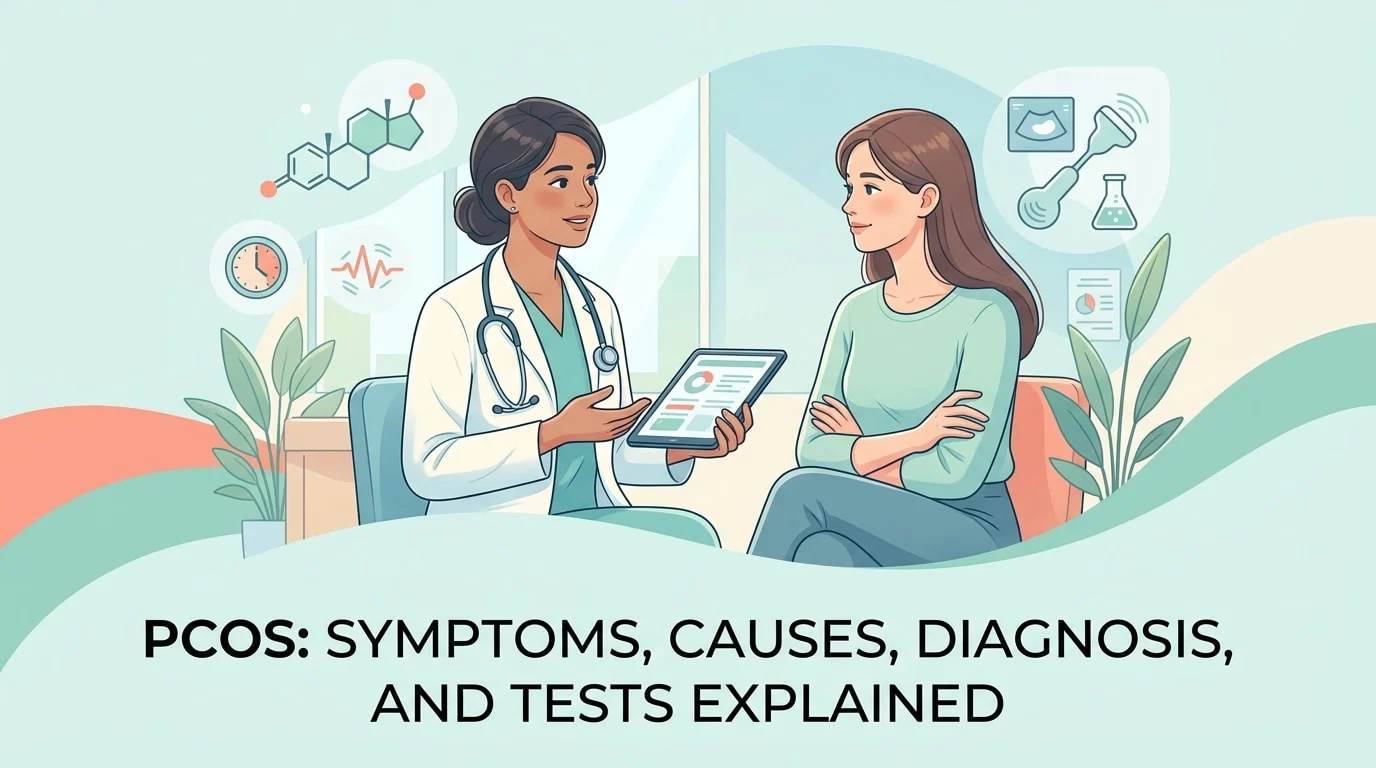
PCOS symptoms are one of the most common reasons people of reproductive age talk to a doctor about irregular periods, acne, or unwanted hair. Polycystic ovary syndrome (PCOS) is a hormonal and metabolic condition that affects roughly 1 in 10 women of childbearing age, and it remains a leading, treatable cause of infertility. Because the signs overlap with many other conditions, PCOS is often diagnosed years after the first symptoms appear. In this article you’ll learn what PCOS is, what causes it, how the Rotterdam criteria and blood tests are used to reach a diagnosis, and what current research and guidelines say about managing it.
What is PCOS and how common is it?
Polycystic ovary syndrome is a condition in which the ovaries and several hormone systems fall out of balance. Many women with PCOS produce higher levels of androgens, sometimes called male hormones, which all bodies make in small amounts. This imbalance can disrupt ovulation, so eggs may not develop or release the way they should. The result is often missed or irregular periods, and in some cases small fluid-filled follicles that can be seen on an ultrasound. According to the Office on Women’s Health, PCOS affects between 5% and 10% of women aged 15 to 44, and most people learn they have it in their twenties or thirties, often after PCOS symptoms prompt a first visit.
The name can be misleading. You do not need visible ovarian cysts to have PCOS, and not everyone with cysts has the syndrome. PCOS is better understood as a whole-body condition involving reproductive hormones, insulin, and metabolism, which is why it is linked to longer-term concerns such as type 2 diabetes and heart health. If your scan shows a fluid-filled sac, you can read our guide to ovarian cyst size and risks.
Common PCOS symptoms
PCOS symptoms vary widely from person to person and can change over time. Some women have pronounced signs, while others notice very little until they try to conceive. A few features show up most often, and recognizing them early can help you start a conversation with your clinician.
Signs you may notice
- Irregular, infrequent, or absent periods, sometimes with heavy bleeding when they do occur
- Excess hair on the face, chest, or abdomen, a pattern called hirsutism that affects up to 70% of women with PCOS
- Acne on the face, chest, and upper back that can persist beyond the teenage years
- Thinning hair or hair loss on the scalp
- Weight gain or difficulty losing weight, particularly around the abdomen
- Dark, velvety patches of skin on the neck, groin, or under the breasts, and small skin tags
These PCOS symptoms reflect the underlying hormone shifts rather than the ovaries alone. High androgen activity drives the hair and skin changes, while metabolic factors influence weight and energy. Weight that fluctuates with your cycle is common as well, and you can learn more from our guide to period weight gain and management. Because each sign can also point to other conditions, a doctor looks at the overall pattern instead of any single feature.
What causes PCOS?
The exact cause of PCOS is not known, and most experts believe several factors work together. Genetics appear to play a role, since the condition often runs in families. Two mechanisms stand out in the way doctors describe it: excess androgens and insulin resistance.
Insulin is the hormone that helps your cells turn food into energy. In insulin resistance, cells respond poorly to insulin, so the body produces more of it to keep blood sugar in range. Higher insulin levels can prompt the ovaries to make extra androgens, which in turn disrupt ovulation. This loop helps explain why weight, blood sugar, and many PCOS symptoms are so closely connected. To see how blood sugar is measured over time, read our explainer on the HbA1c normal range and target levels, and for day-to-day readings, see our overview of glucose levels and what they mean.
How PCOS symptoms are diagnosed and the Rotterdam criteria
Because PCOS symptoms overlap with other conditions, there is no single test that confirms PCOS. Instead, clinicians make the diagnosis by combining your history, a physical exam, blood tests, and sometimes a pelvic ultrasound, while ruling out other conditions that can mimic it. The most widely used framework is the Rotterdam criteria.
Under the Rotterdam criteria, a diagnosis of PCOS is considered when at least two of the following three features are present, once other causes have been excluded: irregular or absent ovulation, often seen as irregular periods; clinical or laboratory signs of high androgens, such as hirsutism, acne, or elevated blood testosterone; and polycystic ovaries on ultrasound. Because only two of the three are required, two people with PCOS can look quite different. The 2023 International Evidence-based Guideline also recognizes anti-Mullerian hormone (AMH) as an alternative to ultrasound for detecting polycystic ovarian morphology in adults.
Hormone and metabolic tests used in a PCOS workup
To support the diagnosis and check for related risks, a doctor may order a panel of blood tests. The table below outlines markers commonly assessed and what each one can indicate. Reference ranges vary by laboratory, so results are always interpreted in context by a clinician.
| Test | What it can indicate |
|---|---|
| Total testosterone and free androgen index | Screens for elevated androgens that can drive hirsutism and acne |
| Luteinizing hormone (LH) and follicle-stimulating hormone (FSH) | Assesses the balance of reproductive hormones that regulate ovulation |
| Anti-Mullerian hormone (AMH) | Reflects the number of small follicles; may support diagnosis in adults |
| Sex hormone-binding globulin (SHBG) | Often lower in PCOS; helps gauge how much active testosterone is circulating |
| Prolactin | Helps rule out a pituitary cause of irregular periods |
| Thyroid-stimulating hormone (TSH) | Helps rule out thyroid disease, which can mimic some PCOS symptoms |
| Fasting glucose and HbA1c | Screens for insulin resistance, prediabetes, or type 2 diabetes |
| Lipid panel | Checks cholesterol and triglycerides linked to long-term heart risk |
For a broad reproductive overview, your doctor may order a female hormone panel, and when conceiving is the focus, a fertility blood test. To interpret individual markers, see our pages on the role of luteinizing hormone, the FSH follicle-stimulating hormone blood test, and high testosterone in women. A separate guide also addresses low testosterone in women.
When periods are irregular, a clinician may also check for high prolactin levels and confirm that your thyroid sits within normal thyroid levels. To understand how much active testosterone your body carries, our explainer covers sex hormone-binding globulin levels.
PCOS, insulin resistance, and long-term health
Insulin resistance sits at the center of the metabolic side of PCOS, and it shapes many of the long-term risks. According to the Office on Women’s Health, more than half of women with PCOS develop diabetes or prediabetes before the age of 40. The condition is also associated with higher blood pressure, unfavorable cholesterol, sleep apnea, and a greater risk of endometrial changes. None of these outcomes is inevitable, and addressing PCOS symptoms early gives you and your care team more options.
This is why a workup looks beyond reproductive hormones. Tracking blood sugar and cholesterol over time helps you and your doctor watch for early shifts. If your results point toward elevated glucose, you can review our overview of diabetes causes, symptoms, and treatments. A dedicated page explains glucose levels and what they mean, and a separate guide explains ovarian cyst size and risks.
Latest scientific advances
Research on PCOS has moved quickly, and several recent findings help frame how the condition is assessed and managed. The summaries below describe the type and size of each study so you can weigh them appropriately. They are general information, not medical advice, and decisions about care belong with your clinician.
The 2023 International Evidence-based Guideline for the Assessment and Management of Polycystic Ovary Syndrome, published in the Journal of Clinical Endocrinology and Metabolism in 2023, consolidated 254 recommendations and practice points using the GRADE framework. It endorsed anti-Mullerian hormone as an alternative to ultrasound for detecting polycystic ovarian morphology in adults and reaffirmed structured hormonal and metabolic assessment.
On metabolism, a 2023 systematic review and Mendelian randomization analysis in Human Reproduction, pooling 63 observational studies alongside genetic data, found that higher body fat and markers of hyperinsulinaemia and insulin resistance were linked to greater odds of PCOS, with overweight associated with roughly a fourfold increase in odds. This reinforces the long-observed connection between insulin and the syndrome rather than proving cause in any individual.
For supplements, a 2022 systematic review and meta-analysis of 15 controlled trials in Obesity Science and Practice reported that inositol supplementation produced a small reduction in body mass index, with a more pronounced effect among participants who had PCOS and used myo-inositol. The authors framed inositol as a possible adjunct rather than a standalone treatment.
On newer medicines, a 2024 meta-analysis of four randomized controlled trials with 176 participants in the Journal of Diabetes and Its Complications found that GLP-1 receptor agonists reduced body mass index by about 2.4 points and waist circumference by about 5 cm compared with placebo in women with PCOS and obesity, while also improving some androgen and insulin markers. These results are promising but based on small, short trials.
When to see a doctor
You do not need to wait for a formal diagnosis to seek advice. Consider booking an appointment if you notice any of the following:
- Periods that are consistently irregular, very far apart, or absent
- New or worsening excess hair growth, persistent acne, or scalp hair loss
- Difficulty getting pregnant after several months of trying
- Unexplained weight gain, strong sugar cravings, or darkened skin patches that may signal insulin resistance
- A family history of PCOS, type 2 diabetes, or early heart disease alongside any of the symptoms above
A clinician can order the right tests, interpret PCOS symptoms in context, and rule out conditions that resemble PCOS. Early assessment also makes it easier to monitor metabolic health over the years that follow.
Glossary
| Term | Definition |
|---|---|
| Androgens | A group of hormones, including testosterone, that all bodies make; higher levels can drive acne and excess hair |
| Anovulation | When the ovaries do not release an egg during a menstrual cycle |
| Hirsutism | Excess hair growth in a male pattern, such as on the face, chest, or abdomen |
| Insulin resistance | A state in which cells respond poorly to insulin, prompting the body to make more of it |
| Anti-Mullerian hormone | A hormone produced by small ovarian follicles that can support a PCOS diagnosis in adults |
| Rotterdam criteria | A diagnostic framework requiring at least two of three features to consider PCOS |
| SHBG | Sex hormone-binding globulin, a protein that binds testosterone and is often lower in PCOS |
| Hyperandrogenism | Higher than typical androgen activity, shown clinically or on blood tests |
Frequently asked questions
What is PCOS?
PCOS, or polycystic ovary syndrome, is a common hormonal and metabolic condition that affects how the ovaries work. It often causes irregular periods, signs of higher androgens such as acne or excess hair, and in some cases small follicles visible on ultrasound. It is one of the most common, and treatable, causes of infertility.
What causes PCOS?
The exact cause is unknown, but genetics, excess androgen production, and insulin resistance all appear to contribute. Higher insulin can push the ovaries to make more androgens, which disrupts ovulation. Lifestyle and family history influence risk, though no single factor explains the condition on its own.
How is PCOS diagnosed?
There is no single test. Clinicians use the Rotterdam criteria, diagnosing PCOS when at least two of three features are present after ruling out other causes: irregular ovulation, signs of high androgens, and polycystic ovaries on ultrasound. Blood tests for hormones and blood sugar help support the picture.
Can you get pregnant with PCOS?
Yes. Many people with PCOS conceive, sometimes with support to encourage ovulation. Because PCOS can make periods and ovulation less predictable, your doctor may suggest lifestyle steps, medication, or assisted reproduction. PCOS can also raise certain pregnancy risks, so planning ahead with a clinician is helpful.
Is PCOS genetic?
There is a clear hereditary component. Having a mother, sister, or aunt with PCOS raises your likelihood of having it, and researchers have linked several genes to the condition. Genetics interact with metabolic factors such as weight and insulin resistance rather than acting alone.
Is PCOS a chronic illness?
Yes, PCOS is a long-term condition without a cure, but its symptoms can be managed effectively. Some features ease around menopause, while metabolic risks such as diabetes can persist or grow with age. Ongoing care focuses on symptoms, fertility goals, and long-term heart and metabolic health.
Sources
- Office on Women’s Health, U.S. Department of Health and Human Services. Polycystic ovary syndrome. womenshealth.gov
- Mayo Clinic. Polycystic ovary syndrome (PCOS) – Symptoms and causes. mayoclinic.org
- Cleveland Clinic. Polycystic ovary syndrome (PCOS). my.clevelandclinic.org
- Teede HJ, et al. Recommendations From the 2023 International Evidence-based Guideline for the Assessment and Management of Polycystic Ovary Syndrome. J Clin Endocrinol Metab. 2023. doi.org/10.1210/clinem/dgad463 (via PubMed)
- Dobbie LJ, et al. Childhood, adolescent, and adulthood adiposity are associated with risk of PCOS: a Mendelian randomization study with meta-analysis. Hum Reprod. 2023. doi.org/10.1093/humrep/dead053 (via PubMed)
- Zarezadeh M, et al. Inositol supplementation and body mass index: a systematic review and meta-analysis of randomized clinical trials. Obes Sci Pract. 2022. doi.org/10.1002/osp4.569 (via PubMed)
- Abdalla MA, et al. The efficacy and safety of GLP-1 agonists in PCOS women living with obesity in promoting weight loss and hormonal regulation: a meta-analysis of randomized controlled trials. J Diabetes Complications. 2024. doi.org/10.1016/j.jdiacomp.2024.108834 (via PubMed)
Further reading
- Explore the female hormone panel
- Understand the HbA1c normal range and targets
- Read about high testosterone in women
- Learn about sex hormone-binding globulin levels
- See how to read your blood test results
Understand your lab results with AI DiagMe
A PCOS workup can involve several numbers at once, from testosterone and the LH and FSH balance to anti-Mullerian hormone and HbA1c. AI DiagMe reads blood, urine, and stool results with AI validated by a medical board, hosted under European data rules, and explains what each marker means in plain language. It is built to help you understand your results and prepare for your appointment, not to diagnose a condition or replace your doctor.
Get your results interpreted in minutes