



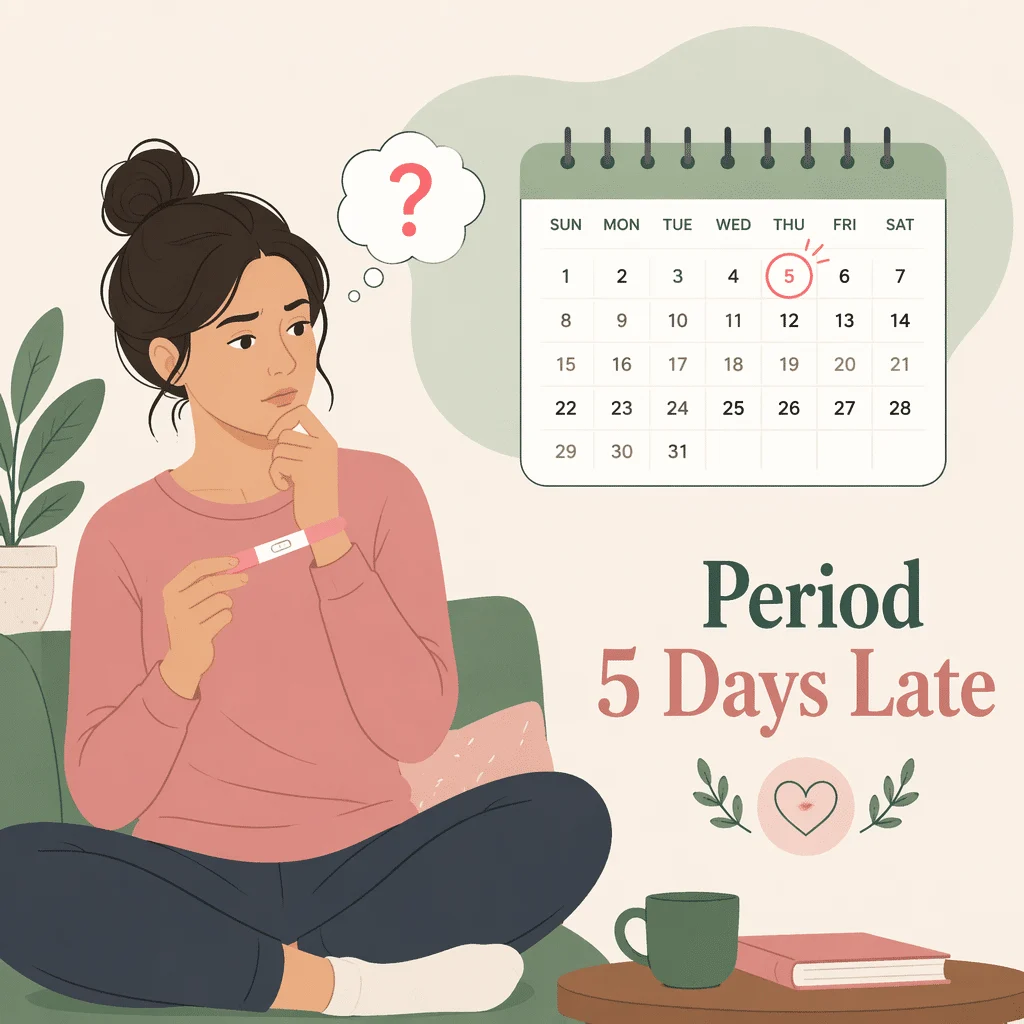
If your period is 5 days late, the most useful thing you can do first is simple: for anyone who could be pregnant, take a pregnancy test. At this point in the cycle a home test is generally reliable, so the result — whichever way it goes — actually tells you something. It is also worth knowing straight away that cycle length varies normally, and five days is a common amount of variation.
In this article you’ll learn when a home pregnancy test becomes dependable and what to do if it is negative, how much cycle variation is normal, which everyday and medical causes delay a period, why an absent period should not be left unexplained for months, and which symptoms mean you need to be seen today. Those urgent signs sit in a bordered box below — read them first if you have pain or bleeding now.
Start with a pregnancy test — and when it is reliable
Human chorionic gonadotropin, or hCG, is the hormone produced once an embryo attaches to the wall of the uterus. Home tests look for it in urine. It appears shortly after attachment and then rises quickly, which is why timing matters far more than brand.
If a blood test has given you a number rather than a line, our guide to hCG levels week by week explains how to read it.
The US Food and Drug Administration notes that in a 28-day cycle hCG can usually be detected in urine around 12 to 15 days after ovulation. By the time a period is five days late, that window has normally passed. A negative test at this stage is therefore real information rather than a guess.
Real information is not the same as a final answer. A small but genuine share of pregnancies are still missed on the day a period first falls due, usually because ovulation happened later than assumed. Using first morning urine, when hCG is most concentrated, improves your chances of a clear result.
What to do if the test is negative
If the test is negative and your period still has not arrived about a week later, test again. This is not superstition. Ovulation can shift by several days in an otherwise ordinary cycle, and if it happened later than you thought, a pregnancy would simply have been too early to detect the first time. A repeat test a week on settles most of these cases.
Until you have a clear answer, the FDA advises treating a single negative result as provisional. If you are unsure how to read yours, our guide to pregnancy test accuracy and interpretation covers what the lines mean and how results get misread. If you tracked ovulation this cycle, a positive ovulation test result helps pin down when ovulation actually happened, which tells you whether your period is genuinely overdue.
If the test is positive, contact a healthcare provider to arrange follow-up. Whichever result you get, and whichever result you were hoping for, read the urgent signs below before you do anything else.
How much cycle variation is normal?
The 28-day cycle is an average, not a rule. In adults, cycles of roughly 21 to 35 days are generally treated as normal, and a difference of a few days between months is extremely common. Five days late, on its own, in someone whose cycles are usually regular, is very often nothing more than ordinary variation.
The Office on Women’s Health describes a cycle as irregular when it is consistently shorter than 24 days or longer than 38 days, or when its length swings by more than 20 days between months. Those thresholds are useful because they separate ordinary month-to-month wobble from a pattern that deserves investigation.
Cycle length also changes across a lifetime. It tends to shorten through the twenties and thirties, then lengthen and become noticeably more variable approaching menopause. A cycle that feels unfamiliar at 44 may be entirely expected for that stage of life.
Two things decide when your period arrives: when you ovulated, and how long the luteal phase — the stretch between ovulation and bleeding — lasts. The luteal phase is relatively stable for most people, so the first half of the cycle is where the variation lives. That is why a late ovulation produces a late period, and why the date you circled was always an estimate.
Everyday reasons a period is late
Most late periods in healthy people trace back to something temporary that delayed ovulation:
- Psychological stress — a bereavement, exams, a job crisis, or sustained pressure over several weeks
- Illness, including a heavy viral infection or a fever in the weeks before the expected date
- Disrupted sleep, night shifts, or a rota that keeps changing
- Travel across several time zones
- A marked change in training load, either a sharp increase or a sudden stop
- A meaningful change in body weight, in either direction, over a short period
Stress is the one people most often wave away, and it should not be. The hypothalamus, which sets the rhythm of the reproductive cycle, sits alongside the systems handling threat and energy balance. When those are loudly occupied, the hormone pulses that trigger ovulation become less frequent, ovulation is pushed back, and the period follows late. This is a normal, reversible response. A cortisol blood test is sometimes used when a clinician wants to look at the stress axis directly.
Short-term weight change around the period itself is a separate phenomenon, driven mostly by fluid rather than fat, and we cover it in our guide to period weight gain.
Hormonal and medical causes of a late period
When late periods become a pattern rather than a one-off, an underlying condition becomes more likely. These are the ones clinicians look for most often.
Thyroid disease affects the cycle in both directions. An underactive thyroid is classically linked with heavier, longer bleeding; an overactive thyroid tends to make periods lighter and less frequent. Either can delay them. A TSH test is usually the first check, and our page on hypothyroidism explains the wider symptom picture.
Polycystic ovary syndrome is among the most common reasons for cycles that are persistently long or unpredictable, because ovulation happens irregularly or not at all. It often travels with acne, unwanted hair growth or difficulty conceiving. Our guide to PCOS symptoms, causes and diagnosis sets out how it is assessed.
Hyperprolactinemia — too much of the hormone prolactin — suppresses ovulation directly. Causes include a benign pituitary growth, an underactive thyroid, or certain medicines. Milky nipple discharge when you are not breastfeeding is a classic clue, though many people have none. See high prolactin levels for the detail.
Perimenopause, the transition before periods stop for good, typically begins in the forties, sometimes earlier. Cycles lengthen, shorten and skip in a way that can feel alarming but is expected. Our menopause symptoms guide describes the pattern.
Poorly controlled diabetes can disrupt the cycle, and periods often settle once glucose is better managed. Untreated celiac disease is another under-recognised cause: malabsorption and low body weight can push periods late or stop them. See gluten intolerance and celiac disease for the accompanying symptoms.
Contraception, medications and breastfeeding
Hormonal contraception changes bleeding patterns by design. The implant, the injection and hormonal coils commonly make periods lighter, less predictable or absent entirely — an expected effect, not a problem. Missed or late combined pills can shift a withdrawal bleed, and emergency contraception often moves the next period by several days in either direction.
Coming off contraception can also cause a gap. After stopping the injection in particular, cycles can take some months to return.
Some prescription medicines raise prolactin and so delay or stop periods. Several antipsychotics do this, as do some antidepressants and anti-nausea drugs. If a late period began after a medication change, raise it with your prescriber rather than stopping the drug yourself.
Breastfeeding suppresses ovulation for many people, and periods may not return until feeds reduce or stop. Timing varies widely between individuals and between pregnancies. Ovulation returns before the first period does, so its absence tells you nothing definite about fertility, and anyone who does not want to conceive again soon should discuss contraception with their clinician.
When low energy availability stops periods
This is the cause most commonly missed, and it deserves plain language. When energy taken in from food is persistently low relative to energy used — through training, work or daily life — the body downgrades reproduction as non-essential. Hormone pulses from the hypothalamus slow, ovulation stops, and periods become infrequent or disappear. The clinical name is functional hypothalamic amenorrhea.
It is common in endurance and aesthetic sports, after a sharp increase in training, and in people restricting food, whether deliberately or because of an eating disorder. It also happens to people who are not underweight at all, which is why body weight alone is a poor screening test.
This matters beyond the inconvenience of an absent period. The low-estrogen state that comes with it affects bone density, raising the risk of stress fractures, and is linked to unfavourable cardiovascular markers. Periods that stop for this reason are a signal about whole-body health, not a bit of luck or an efficiency.
There is no judgement in raising it, and it is treatable. Recovery generally means increasing energy intake, moderating rather than abandoning training, and addressing the psychological side where relevant. If this sounds familiar, say it out loud to a clinician — it is far easier to reverse early than late.
A negative test and still no period: what to do next
Here is the trap. The test comes back negative, the immediate question feels answered, and the absent period gets filed away as solved. Months pass. But a negative test only tells you that you are probably not pregnant. It says nothing about why you are not menstruating, and the absence itself is the finding that needs explaining.
If a period has not returned after another week, repeat the test and book an appointment. If three cycles pass with no bleeding, that meets the definition of amenorrhea and warrants investigation however well you feel. Waiting months for it to sort itself out delays the diagnosis of thyroid disease, high prolactin, PCOS and low energy availability — all easier to treat sooner.
One thing not to do: no herb, tea, supplement, or high-dose vitamin has been shown to bring on a period safely or effectively. Some preparations sold for this purpose are actively unsafe, and none of them address the reason bleeding stopped. A period that is persistently absent needs a cause found, not a remedy applied.
| Your situation | What it usually means | What to do |
|---|---|---|
| Five days late, negative test, cycles normally regular | Most often ordinary variation — ovulation probably happened later than usual this cycle | Wait about a week. If your period has not started by then, test again. |
| Five days late, positive test | A home test at this stage is generally reliable | Contact a healthcare provider to arrange follow-up and confirm dating. |
| Negative test, still no period a week later | Either ovulation was much later than assumed, or something else has interrupted the cycle | Repeat the test and book an appointment. Do not leave it unexplained. |
| Late period with severe or one-sided pelvic pain | Could be an ectopic pregnancy or another urgent problem | Seek emergency care now. Do not wait for a test result. |
| No period at all for three months | Meets the definition of amenorrhea and needs a cause identified | See a clinician and ask about thyroid, prolactin and other hormone tests. |
When to see a doctor — and when to seek emergency care
Get emergency medical help now — call 911 or go to an emergency department — if a late period comes with any of the following, with or without a positive pregnancy test:
- Severe pelvic or abdominal pain, especially if it is concentrated on one side
- Pain at the tip of the shoulder
- Dizziness, feeling faint, or collapsing
- Unusual vaginal bleeding, particularly alongside pain
- A positive pregnancy test together with pain or bleeding
These can indicate an ectopic pregnancy — a pregnancy that has implanted outside the uterus, most often in a fallopian tube. It cannot continue safely, and if it ruptures it causes internal bleeding that is life-threatening. A negative home test does not rule it out, so do not delay care to test again.
Book a non-urgent appointment, but do not ignore, if you have no period for three months, periods that stop before age 40, or a missed period alongside milky nipple discharge, hot flashes, marked weight change, new facial or body hair, headaches, or changes in your vision.
Outside those situations, guidance from bodies such as the American College of Obstetricians and Gynecologists and the Office on Women’s Health points to three practical triggers for booking an appointment: three or more missed periods in a row, periods consistently more than 35 days apart, or any missed period accompanied by other symptoms. Regular cycles that suddenly turn irregular are worth mentioning too.
What a doctor may check
Assessment usually starts with a history — cycles, contraception, medicines, weight, training, stress — then a pregnancy test, the first thing to establish or exclude. Blood tests depend on what the history suggests.
Thyroid function and prolactin are checked in most cases, because both are common, treatable and easy to miss. FSH and LH help separate a problem at the ovary from one at the pituitary or hypothalamus, and are informative when early menopause is possible. Where PCOS is suspected, androgens including testosterone are added, and a pelvic ultrasound may follow.
Latest scientific advances in understanding cycle variation
Recent research confirms what many already suspected: cycles are far less uniform than textbooks implied.
A 2024 study in Scientific Reports analysed self-reported cycle data from millions of period-tracking app users across the reproductive lifespan. What it found: cycle length and its variability follow a clear pattern with age, shortening through the twenties and thirties, then lengthening and becoming markedly more variable approaching the menopausal transition. What this means for you: a cycle that has begun to shift may reflect your stage of reproductive life rather than a new problem — though a change from your own established pattern is still worth mentioning.
A 2023 study in Medicina tracked luteinizing hormone and a progesterone metabolite in urine across several thousand cycles. What it found: calculated cycle lengths were consistently shorter than users reported, and the follicular phase — the stretch before ovulation — varied substantially between individuals and shortened with age. The authors argued directly against over-reliance on a standard 28-day model. What this means for you: the day you expect your period is an estimate built on assumed ovulation, so if ovulation ran late, your period will too.
A 2024 review in Nutrients examined the dietary and lifestyle management of functional hypothalamic amenorrhea. What it found: menstrual function is closely tied to energy availability — energy taken in relative to energy expended — and restoring periods generally depends on increasing intake and moderating training load rather than on medication. What this means for you: if periods stopped alongside heavy training or restricted eating, the route back runs through eating more, not through supplements.
A 2024 review in the Annals of the New York Academy of Sciences examined the hypothalamic signalling behind the same condition, focusing on kisspeptin, a neuropeptide regulating the pulses that drive the reproductive axis. What it found: functional hypothalamic amenorrhea is one of the most common causes of secondary amenorrhea, and the low-estrogen state it produces carries measurable consequences for bone and cardiovascular health. What this means for you: an absent period from this cause is a health issue in its own right, worth treating rather than tolerating.
A 2023 review in the International Journal of Molecular Sciences, from authors at the US National Institute of Environmental Health Sciences, mapped how thyroid hormones act on the female reproductive axis. What it found: thyroid dysfunction affects multiple points along that axis and is associated with menstrual irregularity, PCOS and reduced fertility. What this means for you: a thyroid test is a reasonable early step when periods become unreliable, because the fix is often straightforward.
Glossary of key terms
| Term | Definition |
|---|---|
| hCG | Human chorionic gonadotropin, the hormone produced in pregnancy that home urine tests detect. |
| Ovulation | The release of an egg from the ovary, roughly midway through a cycle, though the timing varies. |
| Follicular phase | The first part of the cycle, from the start of bleeding until ovulation. Its length varies most. |
| Luteal phase | The stretch between ovulation and the next period. It is relatively stable in most people. |
| Amenorrhea | The absence of periods. Three or more missed cycles in a row generally meets the definition. |
| Oligomenorrhea | Infrequent periods, typically cycles consistently longer than about 35 days. |
| Hyperprolactinemia | A raised level of the hormone prolactin, which can suppress ovulation and stop periods. |
| Functional hypothalamic amenorrhea | Periods stopping because energy intake is persistently low relative to energy used. |
| Ectopic pregnancy | A pregnancy implanted outside the uterus. It is a medical emergency and cannot continue safely. |
| Perimenopause | The transition before periods stop permanently, when cycles commonly become irregular. |
Frequently asked questions
Can I be pregnant with a negative test at 5 days late?
It is unlikely, but not impossible. By five days past your expected date, hCG has usually risen far enough for a home test to pick it up, so a negative result carries real weight. The exception is when ovulation happened later than you assumed — if you ovulated a week or so after you thought, the pregnancy would still be too early to detect. That is why the practical advice is to retest in about a week if your period has not started. Using first morning urine gives the clearest result.
Can stress delay a period by 5 days?
Yes, and a five-day shift is well within what stress can produce. The hypothalamus, which sets the pace of the reproductive cycle, sits alongside the brain systems that respond to threat and to energy shortage. Under sustained pressure, the hormone pulses that trigger ovulation slow down. Ovulation is pushed back, and because the second half of the cycle stays roughly the same length, the period arrives late by however long ovulation was delayed. It is a normal, reversible response, and cycles usually settle once the pressure eases.
When should I see a doctor about a late period?
Book an appointment if you have missed three or more periods in a row, if your cycles are consistently more than 35 days apart, or if a missed period comes with other symptoms — milky nipple discharge, hot flashes, significant weight change, new facial or body hair, headaches or visual changes. Also see someone if your periods stop before age 40, or if previously regular cycles have become unpredictable. Seek emergency care rather than an appointment if there is severe or one-sided pelvic pain, shoulder-tip pain, dizziness or fainting.
Is there anything that safely brings a period on faster?
No. Despite how often they are recommended online, herbal teas, parsley, high-dose vitamin C and similar remedies have not been shown to bring on a period, and some are unsafe — particularly in an undetected pregnancy. More importantly, they treat the symptom rather than the reason. If your period is persistently absent, the useful step is finding out why, because the common causes such as thyroid disease, raised prolactin and low energy availability all have specific treatments.
Why is my period late but I have cramps and no bleeding?
Cramping without bleeding is common when ovulation has been delayed. The uterine lining builds as usual and produces familiar premenstrual sensations, but bleeding cannot begin until the hormonal signal arrives, so the symptoms appear to stall. It can also occur in early pregnancy. Mild, symmetrical cramping that resolves is rarely concerning on its own. Severe pain, pain on one side, or cramping with dizziness or unusual bleeding is different and needs urgent assessment.
Do irregular periods mean I will have trouble getting pregnant?
Not necessarily, though persistently irregular cycles do make it harder to predict fertile days and can indicate that ovulation is unreliable. Conditions such as PCOS, thyroid disease and functional hypothalamic amenorrhea affect ovulation and are among the more treatable causes of difficulty conceiving. That is an argument for getting irregular cycles assessed rather than waiting. If you have been trying to conceive without success, mention the cycle pattern to your clinician — it often points to the answer.
Understand your lab results with AI DiagMe
If a clinician has already run bloods — thyroid function tests, prolactin, FSH and LH among them — the numbers on the report can be hard to place. AI DiagMe explains what each marker measures and what your value means in context, so you arrive at your appointment with better questions. It helps you understand results: it does not diagnose, it cannot confirm or exclude pregnancy, and it is not for emergencies.
Get your results interpreted in minutes
Further reading
- Normal thyroid levels: understanding the ranges
- 17-OH progesterone blood test guide
- Low testosterone in women: causes, symptoms and treatments
- Low ferritin: causes, symptoms and treatment
- Understanding perimenopause nausea: causes and treatments
Sources
- Office on Women’s Health, US Department of Health and Human Services — Period problems
- MedlinePlus, US National Library of Medicine — Absent menstrual periods, secondary
- US Food and Drug Administration — Home-use tests: pregnancy
- Cunningham AC, Pal L, Wickham AP, Prentice C, Goddard FGB, Klepchukova A, Zhaunova L. Chronicling menstrual cycle patterns across the reproductive lifespan with real-world data. Scientific Reports, 2024
- Hills E, Woodland MB, Divaraniya A. Using hormone data and age to pinpoint cycle day within the menstrual cycle. Medicina, 2023
- Dobranowska K, Plińska S, Dobosz A. Dietary and lifestyle management of functional hypothalamic amenorrhea: a comprehensive review. Nutrients, 2024
- Patel AH, Koysombat K, Pierret A, Young M, Comninos AN, Dhillo WS, Abbara A. Kisspeptin in functional hypothalamic amenorrhea: pathophysiology and therapeutic potential. Annals of the New York Academy of Sciences, 2024
- Brown EDL, Obeng-Gyasi B, Hall JE, Shekhar S. The thyroid hormone axis and female reproduction. International Journal of Molecular Sciences, 2023