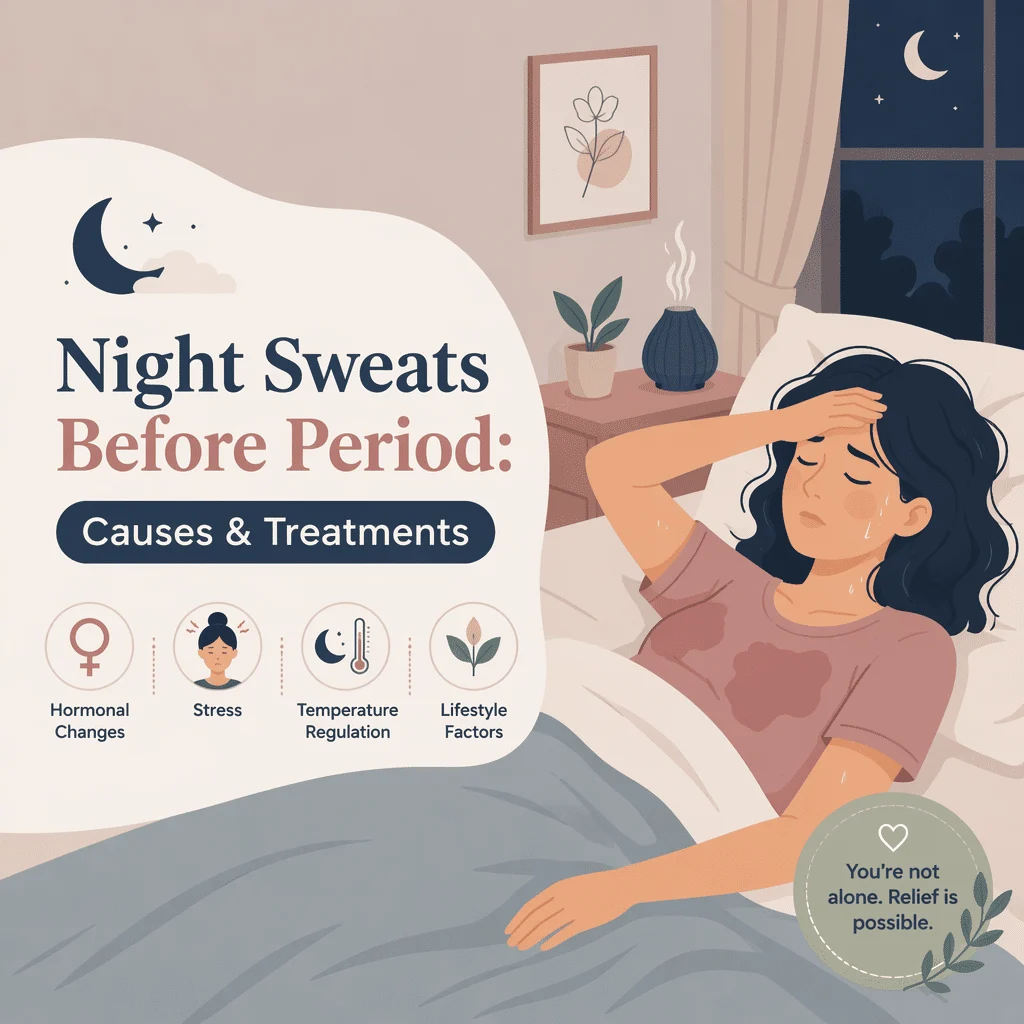
Night sweats before your period are common, and they usually trace back to a predictable hormonal shift rather than to anything dangerous. In the second half of the menstrual cycle, progesterone rises and nudges your core body temperature up by a few tenths of a degree. When progesterone then falls in the days before bleeding starts, the system that controls your temperature has to readjust, and sweating is part of how it does that. Most of the time the pattern is cyclical, predictable, and harmless. Sometimes it is not. In this article you’ll learn what drives premenstrual sweating, how to tell cyclical sweats apart from perimenopausal ones, which episodes deserve a prompt appointment, and which blood tests help clarify the picture when the pattern does not fit.
Why night sweats before period happen
Your menstrual cycle is not just a reproductive rhythm. It is also a temperature rhythm. Understanding that second rhythm explains most premenstrual sweating.
Progesterone raises your baseline temperature
After ovulation, the ovary releases progesterone. Progesterone acts on the hypothalamus, the part of the brain that works like a thermostat, and shifts your set point slightly upward. The result is a measurable rise in basal body temperature that lasts through the luteal phase, the roughly two-week stretch between ovulation and your period. This is why cycle-tracking apps ask you to take your temperature first thing in the morning: the shift is real and repeatable.
Research on thermoregulation during the menstrual cycle has confirmed how consistent this effect is. In a 2025 study in the Journal of Thermal Biology, women exercising in a heat chamber ran a measurably higher core temperature in the mid-luteal phase than in the early follicular phase, alongside higher estrogen and progesterone. Your body genuinely runs warmer in the two weeks before your period.
The progesterone drop is the trigger
If progesterone only raised your temperature, you might feel warm but not soaked. What produces the sweating is the change. In the last few days before bleeding begins, progesterone falls sharply and estrogen fluctuates. Your hypothalamus reads the new signal and lowers the set point again, which means your body is suddenly running hotter than its new target. It corrects the gap the fastest way it can: by widening blood vessels near the skin and switching on sweat glands.
The correction is more noticeable at night because core temperature naturally dips during sleep, widening the mismatch, and because bedding traps the heat you are trying to shed. The same event by day may register only as feeling flushed.
What a typical premenstrual sweating pattern looks like
Cyclical night sweats have a signature. Recognizing it is the single most useful thing you can do before deciding whether to worry.
- Timing: episodes cluster in the three to five days before bleeding starts, and often stop within a day or two of the period beginning.
- Repetition: the pattern repeats across cycles. One bad night in isolation is not a pattern.
- Company: they usually arrive with other premenstrual symptoms such as breast tenderness, bloating, irritability, cramping, or disrupted sleep.
- Scale: you may wake damp, or need to change a shirt. Soaking through bedding several nights in a row is less typical.
- Recovery: you feel normal for the rest of the month.
Sleep disruption around this window is well documented. A 2023 review in Sleep Medicine Clinics concluded that poorer sleep quality in the premenstrual phase and during menstruation is common among women who have premenstrual symptoms or painful cramps, even though objectively measured sleep continuity stays fairly stable across an untroubled cycle. In other words, feeling that you slept badly that week is a real and recognized phenomenon, not imagination.
Cyclical, perimenopausal, or a red flag?
Most confusion about premenstrual night sweats comes from three very different situations producing one shared symptom. The table below separates them by the pattern you can observe at home, the clues that travel with each one, and what is usually worth discussing with a clinician.
| Type | Typical pattern | Other clues | What to discuss testing |
|---|---|---|---|
| Cyclical premenstrual night sweats | Three to five nights before bleeding, every cycle, stopping once the period starts | Regular cycles; breast tenderness, bloating, irritability, cramps in the same window; normal the rest of the month | Often none. If sweats are severe or newly worse: thyroid panel, ferritin with a blood count |
| Perimenopausal night sweats | Scattered across the month, not locked to one cycle phase; often with daytime hot flashes | Usually late 30s to 40s; cycles shortening, lengthening or skipping; sleep fragmentation, mood shifts, vaginal dryness | FSH and estradiol may help before age 45; thyroid tests to exclude a look-alike cause |
| Red-flag night sweats | Drenching, night after night, unrelated to the cycle, often worsening over weeks | Unexplained weight loss, persistent fever, swollen lymph nodes, a lasting cough, severe fatigue | Prompt clinical review: blood count with differential, inflammatory markers, thyroid tests, plus whatever the exam suggests |
The middle row is the one most often misread. Vasomotor symptoms, the medical name for hot flashes and night sweats, are the hallmark of the menopausal transition. A 2023 review in The BMJ noted that these symptoms are most pronounced during the first four to seven years of that transition but can persist for more than a decade, and that the link to menopause is sometimes not obvious to the person experiencing it.
Night sweats before period in your 20s, 30s, and 40s
Age does not change the underlying mechanism, but it changes which explanation is most likely.
Your 20s and early 30s
At this age, cyclical premenstrual sweating is by far the most common answer, and perimenopause is unlikely. If the sweats are severe, look first at what else is happening in the same window. Marked premenstrual mood and physical symptoms may point toward premenstrual dysphoric disorder, a more intense form of premenstrual syndrome. Heavy periods are also worth flagging, because sustained blood loss depletes iron stores, and low iron drives fatigue and poor temperature tolerance. Our library explains the causes of low ferritin and describes what an iron studies panel measures.
Your late 30s and 40s
This is where the two patterns overlap, and where reading the calendar matters most. Perimenopause can begin in the late 30s and commonly starts in the 40s. Sweats that were once tied to one week of the month and now appear randomly, alongside cycles that are getting shorter, longer or unpredictable, suggest the transition rather than ordinary premenstrual physiology. A 2026 review in Sleep Medicine Clinics reported that sleep disturbance affects roughly 40 to 60 percent of women around menopause, driven largely by falling estrogen and by vasomotor symptoms. If nausea, dizziness and sleep changes are stacking up too, our guide covers perimenopause nausea.
Other causes worth ruling out
Several conditions produce night sweats that coincide with a period and get blamed on hormones. Most are worth excluding because they are straightforward to treat.
Thyroid problems
An overactive thyroid speeds up metabolism and heat production, causing sweating, heat intolerance, palpitations, anxiety and weight loss. An underactive thyroid can also disturb cycles and sleep. Two blood tests usually settle the question. Our team explains normal thyroid levels, and a separate guide covers what the free T4 test adds to a TSH result.
Iron deficiency
Low iron is common in menstruating women, particularly with heavy periods, and it can develop long before anemia shows up. It causes fatigue, breathlessness on stairs, poor sleep and reduced tolerance of temperature swings. Ferritin measured alongside a complete blood count gives the clearest picture.
Night-time blood sugar dips
A drop in blood sugar during the night triggers an adrenaline response, and sweating with a racing heart is a classic sign. This matters most for people taking insulin or certain diabetes medications, but it can also follow alcohol in the evening or a long gap without eating. Our library explains what blood glucose levels mean, and a companion guide provides an A1C conversion chart.
Medications, alcohol, anxiety, and your bedroom
Antidepressants, particularly SSRIs and SNRIs, are a frequent and underrecognized cause of night sweats, as are some pain relievers, steroids and hormone treatments. Alcohol widens skin blood vessels and fragments the second half of the night. Anxiety and panic episodes during sleep produce sweating that feels indistinguishable from a hormonal flush, and a warm bedroom amplifies all of it. Most clinicians will ask about these before ordering any test.
When to get tested, and which tests help
Blood tests are not needed for classic, mild, cyclical sweats. They become useful when the pattern breaks, when symptoms are severe, or when something else does not add up. These are the tests most often used to sort it out.
- TSH and free T4: the first-line check on thyroid function, and the highest-yield test when sweating comes with palpitations, tremor, heat intolerance or unexplained weight change.
- Ferritin with a complete blood count: ferritin shows iron stores, while the blood count reveals anemia and flags infection or inflammation through the white cell pattern. Our guide explains how to read a complete blood count.
- FSH and estradiol: potentially informative if perimenopause is suspected before age 45, though levels swing widely during the transition and a single result rarely settles the question. Our library covers the FSH blood test and the role of estradiol, and a separate page describes a broader female hormone panel.
- HbA1c or fasting glucose: worth checking if night sweats come with shakiness, hunger or a pounding heart on waking.
- CRP: a general marker of inflammation, useful when infection is a consideration. Our team explains what high CRP levels indicate.
Timing matters. FSH and estradiol are usually drawn on days two to four of the cycle so results can be compared against a standard reference point. Thyroid, ferritin and inflammatory markers can be drawn at any point.
When to see a doctor
Use this short decision path rather than trying to judge severity in the moment.
- Seek care promptly if night sweats come with unexplained weight loss, a fever that will not settle, swollen lymph nodes, a cough lasting more than three weeks, or drenching sweats every night regardless of your cycle. These combinations need prompt assessment.
- Book a routine appointment if sweats are disturbing your sleep most cycles, if they are clearly worse than they used to be, if they come with palpitations, tremor or weight change, or if your periods have become heavy, irregular or unpredictable.
- Track for two or three cycles first if episodes are mild, tied reliably to the week before your period, and not affecting your daytime function. Note the date, the severity, and what else you felt. That record is far more useful to a clinician than a general description.
- Review your medication list at any stage, especially if the sweats started within weeks of a new prescription or a dose change. Never stop a prescribed medication on your own.
How to reduce night sweats before your period
Cyclical sweats rarely disappear completely, but the discomfort is very responsive to practical changes.
Your bedroom and your bedtime
Keep the room cool, around 65 to 68 degrees Fahrenheit. Choose breathable cotton or linen bedding over synthetics, in layers you can push off without waking fully. Keep water and a spare shirt within reach so a wet night does not become an hour of lost sleep. A cool shower before bed lowers core temperature and speeds sleep onset.
Daytime habits
Alcohol in the evening, large late meals, spicy food and caffeine after mid-afternoon all make premenstrual sweating worse for many women. Regular aerobic exercise improves temperature regulation and sleep quality, though a hard workout within two hours of bedtime can backfire. Stopping smoking is associated with fewer and less severe vasomotor symptoms, and paced breathing is a modest but free addition.
Medical options
If self-care is not enough, several options are worth discussing with a clinician rather than self-prescribing. Combined hormonal contraception can flatten the hormonal swing that triggers cyclical sweats for some women. Treating an identified cause, whether a thyroid disorder or iron deficiency, often resolves the symptom entirely. For perimenopausal vasomotor symptoms, both hormonal and non-hormonal prescription treatments exist, and the right choice depends on your age, medical history and preferences.
Latest scientific advances
Research over the past three years has sharpened the picture in a few useful ways.
The luteal temperature rise is measurable, not theoretical. The 2025 Journal of Thermal Biology study described earlier tracked women through two long heat-chamber sessions and found core temperature ran higher in the mid-luteal phase than in the early follicular phase, matching their hormone levels. What this means for you: if you feel hotter in the two weeks before your period, that perception has a physical basis and is not a sign that something is wrong.
Premenstrual sleep problems are being mapped in finer detail. A 2025 study in Sleep Medicine tracked sleep brainwave patterns across a full cycle in women with premenstrual dysphoric disorder and found differences in deep sleep and in the brief bursts of activity called sleep spindles, some of them tracking core body temperature and mood. Only six women were in the affected group, so it points a direction rather than proving a mechanism. What this means for you: if your worst sleep reliably falls in the premenstrual week, clinicians increasingly treat that as a physiological pattern worth addressing, not simply as stress.
Metabolic health appears to influence when vasomotor symptoms start. A 2026 analysis in The Journal of Clinical Endocrinology and Metabolism, drawn from the long-running Study of Women’s Health Across the Nation, found that women with higher fasting insulin at age 47 tended to develop hot flashes and night sweats earlier and to have them for longer. Insulin is the hormone that moves sugar out of the bloodstream, and a raised fasting level is an early sign the body is working harder to do that. The finding is observational, so it shows an association rather than proving cause. What this means for you: the everyday measures that support blood sugar control may also shape how the menopausal transition feels.
Hormonal IUDs do not appear to impair heat loss. A 2024 study in The Journal of Physiology measured whole-body heat loss directly and found that users of progestin-releasing intrauterine devices shed heat during exercise essentially as well as non-users, contrary to a longstanding assumption about synthetic progestins. What this means for you: if you use a hormonal IUD and sweat at night, the device is unlikely to be the explanation, so look at the other causes described above.
Sleep complaints in women are being recognized as phase-specific. Two 2026 reviews, in The Medical Clinics of North America and in Sleep Medicine Clinics, stressed that sleep problems differ by reproductive stage, and that the overlap between premenstrual, perimenopausal and general sleep complaints leads to misdiagnosis and undertreatment. What this means for you: telling your clinician exactly where in your cycle the symptoms fall is genuinely useful clinical information, so bring your tracking notes.
Glossary
| Term | Definition |
|---|---|
| Basal body temperature | Your body temperature at complete rest, measured before getting out of bed. It rises slightly after ovulation and stays up until your period begins. |
| Luteal phase | The second half of the menstrual cycle, from ovulation until bleeding starts, usually around 12 to 14 days. Progesterone is at its highest during this phase. |
| Follicular phase | The first half of the cycle, from the start of a period until ovulation. Estrogen rises through this phase while progesterone stays low. |
| Progesterone | A hormone released by the ovary after ovulation. It prepares the lining of the uterus for a possible pregnancy and raises core body temperature slightly. |
| Vasomotor symptoms | The medical term for hot flashes and night sweats. They happen when blood vessels near the skin widen suddenly to release heat. |
| Perimenopause | The transition period before menopause when hormone levels fluctuate and cycles become irregular. It can last several years. |
| PMDD (premenstrual dysphoric disorder) | A severe form of premenstrual syndrome with marked mood and physical symptoms in the luteal phase that interfere with daily life. |
| Ferritin | A protein that stores iron. A blood ferritin level reflects how much iron your body has in reserve, and it falls before anemia appears. |
| TSH (thyroid-stimulating hormone) | A pituitary hormone that tells the thyroid how much hormone to make. It is the usual first test of thyroid function. |
| Hyperhidrosis | Excessive sweating beyond what the body needs for cooling. It can affect the whole body or specific areas such as the palms or underarms. |
Frequently asked questions
Are night sweats before your period normal?
Yes, mild to moderate sweating in the days before a period is common and is explained by the fall in progesterone and the temperature readjustment that follows. What makes it normal is the pattern: it repeats cycle after cycle, sits in the same window each month, arrives with other premenstrual symptoms, and resolves once bleeding starts. Sweats that are drenching every single night, that ignore your cycle, or that come with fever, weight loss or swollen glands are a different situation and should be assessed.
Can night sweats mean pregnancy rather than an approaching period?
They can, because progesterone stays high in early pregnancy instead of falling, and that sustained level keeps body temperature elevated. Some women notice feeling warm or sweating at night in the first weeks. However, sweating on its own is a poor pregnancy signal, since the same hormone drives the premenstrual version. If your period is late and pregnancy is possible, a home test taken from the first day of the missed period is far more reliable than reading symptoms.
Does hormonal birth control stop premenstrual night sweats?
It can help. Combined hormonal contraception smooths the hormonal peaks and troughs of the cycle, and for some women that reduces cyclical sweating considerably. Results vary, and some people find that a particular formulation makes symptoms worse rather than better. Hormonal IUDs work differently, releasing progestin mainly within the uterus, and a 2024 study measuring whole-body heat loss found they did not impair the body’s ability to shed heat. Discuss the options with a clinician who knows your history.
Why do night sweats sometimes continue during and after the period?
Prostaglandins, the inflammatory messengers released as the uterine lining sheds, can produce a mild feverish, achy feeling in the first days of bleeding, and sweating often accompanies that. Blood loss can also lower iron temporarily, which affects how well the body handles temperature. Sweats that persist well past the end of a period, or that continue through the whole month, deserve a closer look, particularly at thyroid function and iron stores.
How long do premenstrual night sweats usually last each cycle?
Most women who experience them notice episodes across roughly three to five nights, starting in the second half of the luteal phase and easing within a day or two of the period beginning. The exact window varies from person to person but tends to be consistent for any one individual. If your own pattern changes noticeably, becoming longer, more intense or detached from your cycle, that change is the signal worth acting on rather than the sweating itself.
Can PCOS cause night sweats around your period?
Polycystic ovary syndrome does not cause night sweats directly, but it is associated with irregular or absent ovulation, which makes cycles unpredictable and can produce sweating at times that seem unconnected to a period. PCOS is also linked to insulin resistance, and blood sugar swings overnight can trigger sweating with a racing heart. If you have PCOS and night sweats, it is reasonable to review both cycle patterns and glucose control with your clinician.
Sources
- MedlinePlus, National Library of Medicine — Sweating — https://medlineplus.gov/ency/article/003218.htm
- Office on Women’s Health, U.S. Department of Health and Human Services — Premenstrual syndrome (PMS) — https://www.womenshealth.gov/menstrual-cycle/premenstrual-syndrome
- Mayo Clinic — Night sweats — https://www.mayoclinic.org/symptoms/night-sweats/basics/definition/sym-20050768
- Johns Hopkins Medicine — Introduction to Menopause — https://www.hopkinsmedicine.org/health/conditions-and-diseases/introduction-to-menopause
- Eunice Kennedy Shriver National Institute of Child Health and Human Development — Menstruation and Menstrual Problems — https://www.nichd.nih.gov/health/topics/menstruation
- Christison KS, Gurney SC, Williamson-Reisdorph CM, Covington AC, Dumke CL — Menstrual cycle effects on thermoregulation while exercising in the heat — Journal of Thermal Biology, 2025 — https://doi.org/10.1016/j.jtherbio.2024.104036
- Alzueta E, Baker FC — The Menstrual Cycle and Sleep — Sleep Medicine Clinics, 2023 — https://doi.org/10.1016/j.jsmc.2023.06.003
- Duralde ER, Sobel TH, Manson JE — Management of perimenopausal and menopausal symptoms — BMJ, 2023 — https://doi.org/10.1136/bmj-2022-072612
- Moderie C, Boudreau P, Pérez Medina Carballo R, Boivin DB — Altered sleep EEG spectral dynamics across the menstrual cycle in premenstrual dysphoric disorder — Sleep Medicine, 2025 — https://doi.org/10.1016/j.sleep.2025.108679
- Athar F, Gregory S, Houston EJ, Templeman NM — Insulin levels early in perimenopause inform vasomotor symptom incidence across the menopausal transition — The Journal of Clinical Endocrinology and Metabolism, 2026 — https://doi.org/10.1210/clinem/dgaf699
- Kirby NV, Meade RD, Richards BJ, Notley SR, Kenny GP — Hormonal intrauterine devices and heat exchange during exercise — The Journal of Physiology, 2024 — https://doi.org/10.1113/JP285977
- Cherukuri CM, Padia H, Hassan F — Overview of Sleep and Gender Differences — Sleep Medicine Clinics, 2026 — https://doi.org/10.1016/j.jsmc.2026.02.001
- Yuel VI, Ajayakumar A, Hansdak SG, Samuel CJ — Sleep in Women: The Current Status and Nuances in Management — The Medical Clinics of North America, 2026 — https://doi.org/10.1016/j.mcna.2026.01.005
Further reading
- Menopause symptoms, stages, and treatment
- Frequent urination before a period
- Period diarrhea: causes, symptoms, treatments
- A period five days late: causes and next steps
- Anemia: symptoms, causes and blood tests
Understand your lab results with AI DiagMe
When night sweats stop following your cycle, the answer often sits in a handful of routine blood tests: thyroid function, iron stores, a blood count, and sometimes blood sugar or an inflammation marker. Those results arrive as numbers and abbreviations that are hard to place next to what you are actually feeling. AI DiagMe reads your lab report and explains, in plain language, what each value means and which ones sit outside the usual range. It helps you understand your results and prepare better questions for your appointment. It does not make a diagnosis and it does not replace your doctor.
Get your results interpreted in minutes