Brain tumor symptoms can be confusing because they often look like everyday problems, such as headaches, tiredness, or trouble concentrating. A brain tumor is a growth of abnormal cells inside the brain or the tissues around it, and the warning signs depend mostly on where the growth sits and how fast it changes. Most headaches are not caused by a tumor, and many brain tumors are not cancer, so a single symptom rarely means the worst. In this article you will learn the common signs, the main tumor types, the red flags that should prompt a visit, and how blood work fits into a careful workup.
What is a brain tumor?
A brain tumor forms when cells in or near the brain grow in an uncontrolled way and build up into a mass. According to MedlinePlus, these growths can be benign, meaning they contain no cancer cells, or malignant, meaning they contain cancer cells that tend to grow more quickly. Tumors that begin in the brain are called primary brain tumors. Tumors that start somewhere else in the body, such as the lung or breast, and then spread to the brain are called metastatic or secondary brain tumors, and they are actually more common in adults than primary ones.
Because the skull is a closed, rigid space, even a small mass can raise pressure inside the head or press on nearby structures. That pressure, rather than the tumor itself, often produces the first noticeable effects. The brain controls movement, speech, vision, balance, mood, and memory in specific regions, which is why two people with similar tumors can experience very different complaints.
Benign versus malignant: what the labels mean
The words benign and malignant describe whether a growth contains cancer cells, but in the brain the distinction is not the whole story. A benign tumor can still cause serious problems if it grows in a confined area and pushes on vital tissue. Doctors also assign a grade from 1 to 4 that reflects how abnormal the cells look and how fast the tumor is likely to grow. Grade and location together shape the outlook far more than the benign label alone.
Common brain tumor symptoms to know
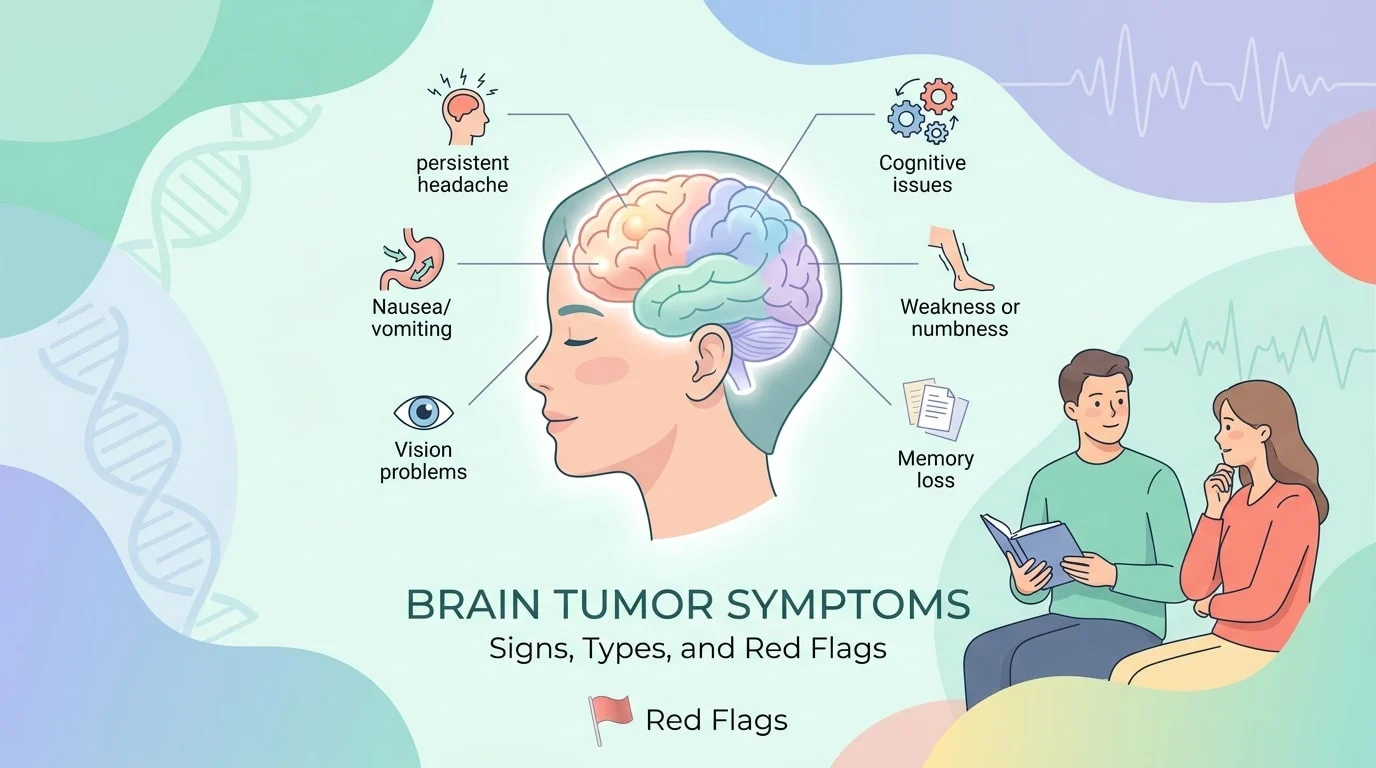
Brain tumor symptoms vary widely, but several patterns appear often enough to recognize. The Mayo Clinic notes that new or changing headaches, nausea, vision or speech changes, balance problems, and seizures are among the more frequent signs. The key word is change: a headache that is new for you, becomes more frequent, or feels different from your usual headaches carries more weight than an isolated bad day.
- Headaches that are new, worsening, or worse in the morning or when lying down
- Nausea or vomiting that is not explained by another illness
- Seizures, including a first-ever seizure in an adult
- Gradual loss of movement or feeling in an arm or a leg, often on one side
- Trouble with speech, vision, or hearing
- Problems with balance, coordination, or walking
- Changes in memory, thinking, personality, or mood
- Unusual tiredness or drowsiness
None of these signs is unique to a tumor. Headaches far more often trace back to tension, migraine, or even raised blood pressure, and you can explore our overview of hypertension and headache symptoms. What matters is the overall pattern, how quickly it appears, and whether several symptoms build at once.
When brain tumor symptoms come and go
Intermittent signs catch many people off guard. Seizures, episodes of weakness, speech difficulty, or visual disturbances can flare and then settle, which makes it tempting to dismiss them. Pressure-related headaches may ease during the day and return overnight. Intermittent symptoms are not reassuring on their own, especially when they recur in the same form. A pattern that keeps returning deserves the same attention as one that stays constant.
Are brain tumor symptoms different in women?
Core brain tumor symptoms are broadly similar across sexes, since they depend on tumor location. Some tumor types differ in frequency, however. Meningiomas, which arise from the membranes covering the brain, are diagnosed more often in women, and certain pituitary tumors can disturb hormones that affect menstrual cycles, fertility, or milk production. Hormone-related changes that do not fit an obvious cause are worth discussing with a clinician.
Main types of brain tumors
There are more than one hundred recognized types of central nervous system tumors, but a handful account for most adult diagnoses. The table below compares four that patients hear about most. It is a simplified guide, not a diagnostic tool, and only imaging and laboratory analysis of tissue can confirm a specific type.
| Tumor type | Usual nature | Who it tends to affect | Typical features |
|---|---|---|---|
| Glioma and glioblastoma | Often malignant; glioblastoma is high grade | Adults, with glioblastoma more common after age 50 | Arise from glial support cells; symptoms can develop over weeks to months; glioblastoma grows fast |
| Meningioma | Usually benign and slow growing | More common in women and with older age | Grow from the brain coverings; may be found by chance; cause symptoms by pressing on nearby tissue |
| Pituitary adenoma | Almost always benign | Adults of any age | Affect the hormone-producing pituitary gland; can disrupt hormones or vision |
| Metastatic (secondary) | Malignant; spread from another cancer | Adults with a known or hidden primary cancer | Often multiple; commonly spread from lung, breast, or skin cancers |
Gliomas are the most common malignant primary brain tumors in adults, and glioblastoma is the most aggressive form. Because some cancers reach the brain after starting elsewhere, understanding the original disease matters too. For that context you can read our patient guide to lung cancer as well as our overview of breast cancer.
What causes brain tumors?
For most people, the honest answer is that no clear cause is found. Researchers describe risk factors that raise the odds slightly rather than direct triggers. The strongest established risk factor is exposure to high doses of ionizing radiation, such as previous radiation therapy to the head. A small share of tumors links to inherited genetic syndromes, and many tumor types become more common with age, though some occur in children.
Widely discussed worries, including cell phone use, head injuries, and food additives, have not been proven to cause brain tumors in large reviews. Having a risk factor does not mean a tumor will develop, and most people diagnosed have none at all. This uncertainty is normal in oncology and is a reason to focus on recognizing symptoms rather than chasing a single cause.
When to see a doctor
Brain tumor symptoms overlap with many harmless conditions, so the goal is not to panic over every headache but to recognize patterns that need prompt evaluation. Seek medical care, and treat some signs as urgent, in the following situations.
- A first-ever seizure at any age, which warrants emergency assessment
- A sudden, severe headache unlike any you have had before
- Headaches that steadily worsen over days or weeks, or that wake you from sleep
- New weakness, numbness, or clumsiness on one side of the body
- New trouble speaking, understanding words, or seeing clearly
- Persistent nausea or vomiting with no clear cause
- Noticeable changes in personality, memory, or behavior noticed by you or those close to you
If any of these appear suddenly or together, contact a healthcare professional without delay. Trust your sense of what is normal for your own body, since you are often the first to notice that something has shifted.
How brain tumors are diagnosed
A brain tumor is fundamentally a clinical and imaging diagnosis. The process usually begins with a neurological examination that tests strength, reflexes, vision, balance, and coordination. If findings raise concern, imaging follows. Magnetic resonance imaging, known as MRI, is the main scan used to look for brain tumors, sometimes with a computed tomography scan, and a biopsy of tissue confirms the exact type when needed.
Where blood and lab tests fit in
Blood work does not by itself detect or rule out a brain tumor, and no routine blood test diagnoses one. Even so, laboratory tests play a real supporting role. They help doctors rule out conditions that can mimic tumor symptoms, such as low sodium, thyroid problems, liver or kidney disorders, infection, or anemia, which can all cause headaches, confusion, or fatigue. When a pituitary tumor is suspected, hormone panels measure chemicals the gland controls.
Before surgery, a metabolic panel and a blood count check that the body is ready for an operation, and you can review our explainer on the complete blood count. To see what these blood proteins can and cannot show, read our guide to tumor markers explained. It also helps to interpret a results sheet in general terms: if you are unsure what a flagged value means, you can consult our walkthrough on how to read blood test results, compare figures against the usual normal blood test ranges, and learn what tends to drive abnormal blood test results. Curious readers can also follow our description of the blood test process.
How common are brain tumors?
Brain tumors are far less common than cancers of the breast, lung, or prostate. According to the National Cancer Institute, gliomas are the most common malignant primary brain tumors in adults, yet primary brain and other nervous system cancers still make up only a small fraction of cancer diagnoses each year, and tumors that spread to the brain from elsewhere are more frequent than primary ones in adults. Because the absolute numbers are low, an isolated symptom is far more likely to have a benign explanation, which is why pattern and persistence matter more than any single sign.
Latest scientific advances
Research on brain tumors has moved quickly in recent years. The findings below add context, but they describe progress in specialized care rather than anything you would act on from a lab report.
A landmark phase 3 randomized trial published in the New England Journal of Medicine in 2023, the INDIGO trial, tested the targeted drug vorasidenib in 331 adults and adolescents with grade 2 gliomas carrying IDH1 or IDH2 mutations after surgery. According to the National Cancer Institute, the median time before the tumor worsened was 27.7 months with vorasidenib versus 11.1 months with placebo, and the Food and Drug Administration approved the drug in August 2024 for this group. This was the first targeted therapy developed specifically for these brain tumors, although it is not a cure and applies only to a defined subset.
Liquid biopsy is an active research direction. According to PubMed, a 2024 review in Current Opinion in Neurology summarized how circulating tumor DNA in blood or, more often, cerebrospinal fluid may help detect molecular changes such as IDH and MGMT alterations. The authors stress that levels in blood are frequently low, so these techniques remain largely investigational and are not a substitute for imaging or biopsy today.
Surgery is being refined as well. According to PubMed, a 2025 systematic review in Child’s Nervous System examined 5-aminolevulinic acid, a compound that makes high-grade glioma tissue glow under special light so surgeons can see tumor margins during fluorescence-guided surgery. Across 23 studies and 281 young patients, strong fluorescence appeared far more often in high-grade gliomas than in low-grade tumors, supporting the technique mainly for aggressive tumors while underscoring the need for larger trials.
Clinical trials continue to test new options. According to ClinicalTrials.gov, a phase 3 trial known as NCT06388733 is recruiting adults with newly diagnosed glioblastoma whose tumors lack MGMT methylation, comparing the drug niraparib with standard temozolomide. Trial participation is a personal decision made with a specialist and is not right for everyone.
Glossary
| Term | Definition |
|---|---|
| Benign tumor | A growth that does not contain cancer cells, though it can still cause symptoms by pressing on tissue |
| Malignant tumor | A growth that contains cancer cells and tends to grow and invade more aggressively |
| Glioma | A tumor that arises from the glial cells that support neurons in the brain |
| Glioblastoma | The most aggressive, high-grade form of glioma |
| Meningioma | A usually benign tumor that grows from the membranes covering the brain and spinal cord |
| Pituitary adenoma | A typically benign tumor of the pituitary gland that can disturb hormones |
| Metastatic tumor | A tumor that has spread to the brain from a cancer that started elsewhere |
| MRI | Magnetic resonance imaging, the main scan used to look for brain tumors |
| Biopsy | Removal of a small tissue sample to identify the exact tumor type |
| Tumor grade | A score from 1 to 4 describing how abnormal cells look and how fast a tumor is likely to grow |
Frequently asked questions
What causes brain tumors?
In most cases no specific cause is identified. The clearest established risk factor is exposure to high doses of ionizing radiation, for example earlier radiation treatment to the head. A minority of tumors relate to inherited genetic conditions, and the odds of several tumor types rise with age. Concerns such as cell phone use have not been shown to cause brain tumors in large reviews. Most people who are diagnosed have no identifiable risk factor, which is why recognizing symptoms matters more than searching for one trigger.
How do you know if you have a brain tumor?
You cannot confirm a brain tumor from symptoms alone, because the warning signs overlap with many ordinary conditions. Doctors reach a diagnosis through a neurological examination, imaging that is mainly MRI, and a tissue biopsy when needed. What should prompt evaluation is a pattern: symptoms that are new, steadily worsening, or clustering together, such as a first seizure, one-sided weakness, or headaches that wake you at night. If you notice such a pattern, see a healthcare professional who can decide whether scans are warranted.
What does a brain tumor feel like?
There is no single sensation that signals a brain tumor, and many cause no pain at all because the brain itself has no pain receptors. When symptoms occur they reflect pressure or the affected region, so people may notice unfamiliar headaches, episodes of weakness or numbness, difficulty finding words, blurred or double vision, unsteadiness, or changes in mood and memory. Some experience a seizure as the first sign. These feelings are most meaningful when they are new for you or keep returning in the same form.
Can brain tumor symptoms come and go?
They can. Seizures, brief episodes of weakness or speech trouble, and visual disturbances may appear and then fade, and pressure-related headaches can ease during the day and return at night. Intermittent symptoms are not a sign that nothing is wrong, particularly when they recur in the same way. A symptom that keeps coming back deserves the same medical attention as one that is constant, so note how often episodes happen before you speak with a clinician.
Are brain tumors treatable?
Many are, and treatment depends heavily on the type, grade, and location. Options include watchful waiting for slow-growing benign tumors, surgery, radiation therapy, chemotherapy, and newer targeted therapies for tumors with specific genetic changes. Some benign tumors that cause no symptoms are simply monitored over time. Outcomes range widely, from tumors managed for years to aggressive types that remain difficult to treat. Decisions about care are made with a specialist team, and this article does not replace personalized medical advice.
How common are brain tumors?
They are relatively uncommon compared with cancers of the breast, lung, or prostate. Primary brain and other nervous system cancers account for only a small share of cancer diagnoses, and tumors that spread to the brain from elsewhere are more frequent in adults than tumors that begin there. Because the underlying numbers are low, any single symptom is far more likely to stem from a benign cause than from a tumor. That is reassuring, yet it does not remove the value of acting on a clear pattern of warning signs.
Sources
- MedlinePlus, National Library of Medicine, Brain Tumors
- Mayo Clinic, Brain tumor: Symptoms and causes
- National Cancer Institute, Vorasidenib Treatment Shows Promise for Some Low-Grade Gliomas
- Mellinghoff et al., Vorasidenib in IDH1- or IDH2-Mutant Low-Grade Glioma, New England Journal of Medicine, 2023 (INDIGO trial), PubMed
- Ruda et al., Blood and cerebrospinal fluid biomarkers in neuro-oncology, Current Opinion in Neurology, 2024, PubMed
- Collins et al., 5-Aminolevulinic acid in paediatric brain tumour surgery: a systematic review, Child’s Nervous System, 2025, PubMed
- ClinicalTrials.gov, Niraparib versus temozolomide in MGMT unmethylated glioblastoma, NCT06388733, 2024
Further reading
- Tumor markers explained
- Complete blood count
- How to read blood test results
- Multi-cancer early detection test
- Multiple sclerosis, a complex neurological disease
Understand your lab results with AI DiagMe
A brain tumor is diagnosed through examination and imaging, but blood work is part of the wider picture, helping doctors rule out look-alike conditions and prepare for treatment. AI DiagMe lets you make sense of everyday panels in plain language, including a complete blood count, a metabolic panel, hormone levels, and tumor markers. It helps you understand your results, it does not diagnose, and it does not replace your doctor.
Get your results interpreted in minutes