





Tumor markers are substances your body makes that can offer clues about cancer, but a single number rarely tells the whole story. If a value on your lab report looks high, it is natural to feel worried — yet a raised marker does not, on its own, mean you have cancer. This guide explains, in plain language, what tumor markers measure, how doctors actually use them, and where their limits lie. You will learn about the most common markers (such as PSA, CA-125 and CEA), why levels can rise without cancer, what a high result does and does not mean, and when to talk to your doctor. The goal is simple: help you read this part of your results with less fear and more understanding.
What are tumor markers, and what do they actually measure?
A tumor marker is any substance in or produced by your body that carries information about a cancer. Most tumor markers are proteins. Some are made in larger amounts by cancer cells, while others are made by healthy cells reacting to a tumor. Increasingly, doctors also use genomic markers, meaning changes in the DNA of tumor cells.
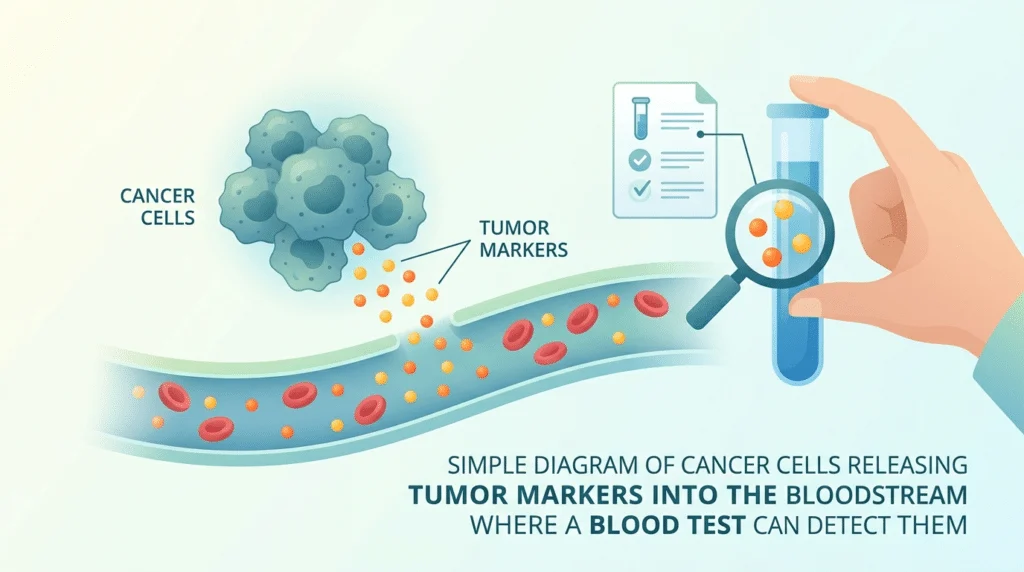
These substances can turn up in blood, urine, stool, or in a piece of tumor tissue. A tumor marker test simply measures how much of one specific substance is present. Used the right way, this is genuinely helpful: it gives doctors a quick, repeatable window on what a cancer is doing over time. The skill lies in knowing what a marker can and cannot tell you, which is the focus of the rest of this guide.
It helps to know there are two broad groups:
- Circulating markers travel in body fluids such as blood, urine, or bone marrow. Most blood tests look for these.
- Tissue markers sit inside the tumor itself and are found by examining a tissue sample taken during a biopsy.
So when a report lists a tumor marker, it is measuring the level of one substance — not scanning your whole body for cancer. To see how this fits with the rest of your panel, our guide on how to read your blood test results explains reference ranges and what an abnormal value really means.
The most common tumor markers and what they are used for
Many tumor markers exist, and each is linked to certain cancers. Some point to a single cancer type, while others can be raised by several. Importantly, there is no single “universal” marker that detects every cancer.
The table below sums up the markers you are most likely to see. It is simplified on purpose — your doctor reads each result in the context of your full health, symptoms, and history.
| Marker | Mainly linked to | Main everyday use | Some non-cancer reasons it can rise |
|---|---|---|---|
| PSA (prostate-specific antigen) | Prostate | Monitoring; sometimes screening (debated) | Enlarged prostate, prostate infection, recent ejaculation, urinary infection |
| CA-125 (cancer antigen 125) | Ovaries | Monitoring treatment and recurrence | Menstruation, pregnancy, endometriosis, ovarian cysts, fibroids |
| CEA (carcinoembryonic antigen) | Colon and rectum, plus others | Monitoring and watching for recurrence | Smoking, inflammatory bowel disease, liver disease |
| CA 19-9 | Pancreas, bile ducts | Monitoring treatment | Gallstones, blocked bile duct, pancreatitis |
| AFP (alpha-fetoprotein) | Liver, testicular and germ cell tumors | Diagnosis support and monitoring | Pregnancy, liver disease such as hepatitis or cirrhosis |
| CA 15-3 | Breast | Monitoring advanced breast cancer | Benign breast conditions, liver disease |
| Beta-hCG | Germ cell tumors, placenta | Diagnosis and monitoring | Pregnancy |
| Calcitonin | Medullary thyroid cancer | Diagnosis, monitoring, family screening | Kidney disease, some thyroid conditions |
| LDH (lactate dehydrogenase) | Many cancers (non-specific) | Prognosis and monitoring | Almost any tissue damage, intense exercise |
A few notes on these markers. PSA (prostate-specific antigen) is the most familiar example and is closely tied to the prostate. CA-125 is mainly used in ovarian cancer, while CEA (carcinoembryonic antigen) is a common choice for following colon and rectal cancer. CA 19-9 is often paired with pancreatic cancer, and CA 15-3 helps monitor advanced breast cancer. Alpha-fetoprotein (AFP) is linked to the liver and to germ cell tumors, and is also used during pregnancy screening. Two others are worth a mention: beta-hCG is central to germ cell and placental tumors and is also a normal pregnancy hormone, while calcitonin is unusual because it can guide screening in families with an inherited form of medullary thyroid cancer.
How a tumor marker test is done
For most tumor markers, the test is a simple blood draw — the same kind used for routine lab work. Depending on the marker, your doctor may instead use a urine sample, a stool sample, or a piece of tissue taken during a biopsy.
You usually do not need special preparation, such as fasting, for a tumor marker blood test. Even so, it is worth telling your doctor about any supplements or medicines you take and any recent procedures, as some can affect results. Timing can matter too. For example, CA-125 can be higher around menstruation.
Results are typically ready within a few days. When a marker is being tracked over time, it is best to use the same laboratory for each test, because methods and reference ranges differ between labs.
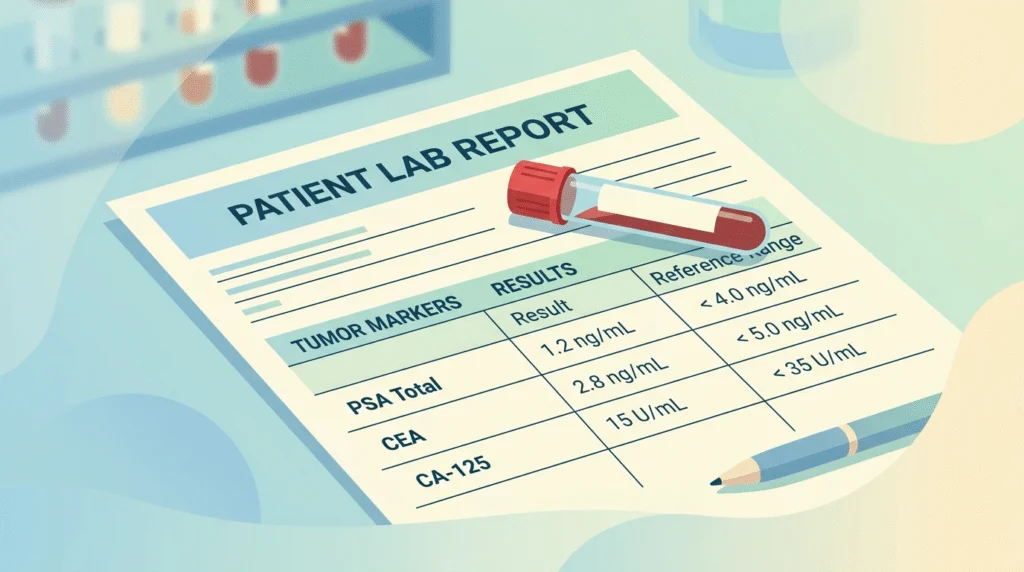
On your report, a tumor marker usually appears as a number with its unit and a reference range beside it. As with the rest of your results, that range is a guide rather than a hard line between healthy and unhealthy. This is exactly why a single value is read together with everything else your doctor knows about you, instead of on its own.
How doctors actually use tumor markers
Tumor markers are most valuable after a cancer diagnosis, not before one. No single result is read in isolation — doctors weigh a marker against your symptoms, examination, imaging, and other blood tests before drawing any conclusion. Within that bigger picture, markers are used in a few main ways.
Checking whether treatment is working
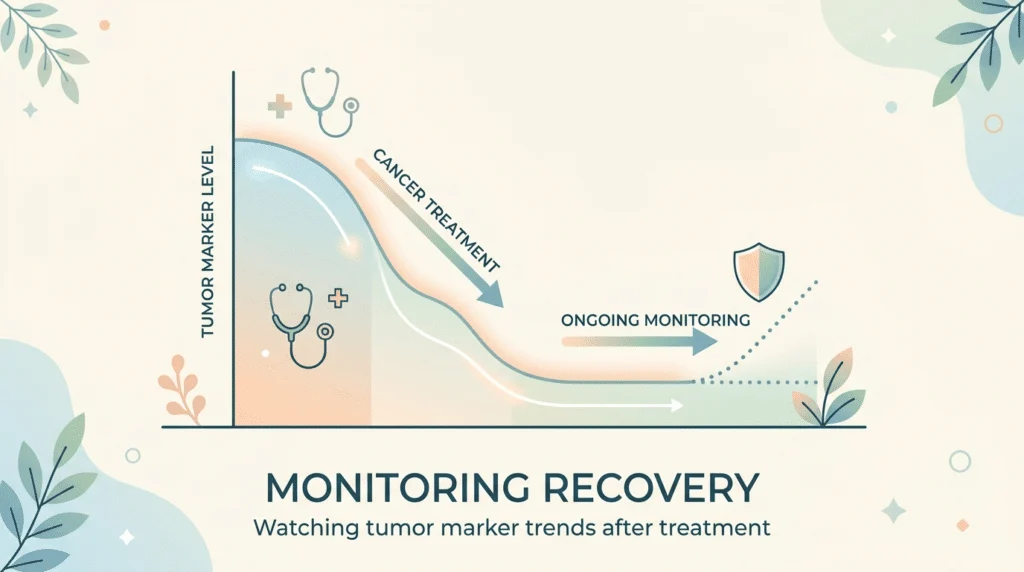
During treatment, the same marker is measured at intervals, an approach called serial testing. A falling level often suggests the cancer is responding. A level that stays the same or rises may signal that the treatment needs to change.
Watching for the cancer coming back
After treatment ends, periodic marker tests can act as an early warning. A rising level may prompt scans to check whether the cancer has returned, which doctors call a recurrence.
Supporting — not making — a diagnosis
A marker can add weight to a suspicion, but it never confirms cancer on its own. Doctors combine it with imaging and a biopsy before making a diagnosis. When a blood cancer such as myeloma is suspected, related tests like free light chains may be added.
Pointing toward the right treatment
Some markers, usually measured in tumor tissue, show whether a specific drug is likely to help. These are often called biomarkers for treatment. A well-known example is HER2 in certain breast cancers.
The thread running through all of these uses is the same: the trend over time usually matters more than any single number. A general marker such as lactate dehydrogenase (LDH) is most useful when followed across several tests rather than read once.
Why one number is not a diagnosis: the real limits
This is the part of the report that causes the most worry, so it is worth being clear. Tumor markers have two built-in weaknesses that every doctor keeps in mind.
They are not specific: levels can be high without cancer
Many markers are also made by healthy tissue or rise during harmless conditions. A high result often has an everyday explanation. For example:
- PSA can rise with an enlarged prostate (a common, non-cancerous change), a prostate infection, or even recent cycling.
- CA-125 can rise during menstruation, in pregnancy, or with endometriosis and ovarian cysts.
- CEA can be higher in people who smoke or who have inflammatory bowel disease.
Because of this lack of specificity, most men with a raised PSA do not turn out to have prostate cancer.
They are not sensitive: cancer can be present with normal levels
The reverse is also true. Some cancers make little or no marker, especially in the early stages. And not everyone with a given cancer has a raised level. A normal result is reassuring, but it does not rule cancer out by itself, particularly if you have symptoms.
Results vary from one lab to another
Each laboratory sets its own reference range and may use a slightly different method. A value that looks “high” against one lab’s range might read differently elsewhere. This is another reason doctors prefer to track your levels at the same lab over time.
Why tumor markers are usually not used to screen healthy people
It is reasonable to ask: if a blood test can spot a marker, why not use it to catch cancer early in everyone? Researchers have tried, and for most markers it does not work well.
The problem comes back to sensitivity and specificity. Used on people without symptoms, markers miss too many real cancers and flag too many people who are perfectly healthy. That can lead to needless anxiety, extra tests, and even harm from treating cancers that would never have caused trouble.
There are a few exceptions where screening can make sense. Calcitonin, for instance, can help screen members of families who carry a known inherited risk of medullary thyroid cancer.
A newer area is the multi-cancer detection (MCD) test, sometimes called a liquid biopsy. According to the U.S. National Cancer Institute, these tests look for tumor DNA and other markers in the blood of people without symptoms. Several are already on the market, but much remains to be learned about how best to use them and whether they truly reduce deaths. For now, they do not replace proven screening such as colonoscopy or mammograms.
What a high tumor marker result does — and does not — mean
If your result is above the reference range, here is a calmer way to think about it.
A single high value is a signal to look closer, not a diagnosis. On its own, it cannot tell you whether you have cancer, or what kind.
What your doctor may do next often includes:
- Repeat the test. One result can be affected by timing, infection, or lab variation. A second test, sometimes a few weeks later, shows whether the level is truly rising.
- Look at the trend. The direction across several tests is far more meaningful than one snapshot.
- Consider the context. Your symptoms, history, medicines, and other health conditions all matter.
- Order more tests if needed. Imaging, such as an ultrasound or scan, or a biopsy gives much more certain answers than a marker alone.
If your level is normal but you have worrying symptoms, do not let the number talk you out of seeing a doctor. A marker is only one piece of the picture.
When to talk to your doctor
A tumor marker result is always best understood with a professional who knows your history. Consider reaching out if:
- You have a result you do not understand, or one that is flagged as abnormal.
- You are being monitored after cancer treatment and notice a rising trend.
- You have ongoing symptoms — such as unexplained weight loss, persistent pain, unusual bleeding, or a new lump — whatever your marker shows.
- You feel anxious about a result and want it put in proper context.
Your doctor can explain what your specific numbers mean, decide whether to repeat or add tests, and reassure you when a high value turns out to have a harmless cause.
Key points to remember
If you take away only a few things from this guide, make them these:
- A tumor marker measures one substance in your blood, urine, or tissue — it does not scan your body for cancer.
- A high level does not confirm cancer, and a normal level does not fully rule it out.
- Many markers can rise for harmless reasons, from infection to pregnancy to inflammation.
- The trend across several tests, taken at the same lab, matters far more than a single number.
- Markers are most useful for monitoring a known cancer and watching for its return, and rarely for screening healthy people.
- Whatever your result, it is your doctor — not the number alone — who interprets what it means for you.
Glossary
- AFP (alpha-fetoprotein): A protein used as a marker for liver and germ cell (testicular) cancers, and also measured during pregnancy.
- Biomarker: Any measurable sign in the body that gives information about health or disease; in cancer, the term often refers to substances that guide treatment choices.
- Biopsy: A procedure that removes a small sample of tissue so it can be examined for cancer cells.
- CA-125 (cancer antigen 125): A protein mainly used to monitor ovarian cancer; it can also rise in several harmless conditions.
- CEA (carcinoembryonic antigen): A marker often used to follow colorectal and some other cancers.
- Circulating marker: A tumor marker found in body fluids such as blood or urine, rather than in tumor tissue.
- Liquid biopsy: A blood test that looks for tumor cells or tumor DNA shed into the bloodstream.
- PSA (prostate-specific antigen): A protein measured to help monitor, and sometimes screen for, prostate conditions including cancer.
- Recurrence: The return of a cancer after a period when it could not be detected.
- Sensitivity and specificity: Sensitivity is how well a test finds people who truly have a disease; specificity is how well it correctly clears people who do not.
Frequently asked questions
Should I be worried if my tumor marker level is slightly high?
A mildly raised marker is common and often has a harmless cause, such as a recent infection, inflammation, or normal lab variation. On its own, it is not a diagnosis of cancer. The usual next step is to repeat the test and look at whether the level is stable or rising over time, rather than reacting to a single number. Share the result with your doctor, who can weigh it against your symptoms and history and decide whether any further tests are needed. Try not to panic before that conversation.
How often are tumor markers measured during and after cancer treatment?
There is no single schedule, because it depends on the cancer type, the marker, and your treatment plan. During active treatment, a marker may be checked every few weeks or before each cycle to see how the cancer is responding. After treatment ends, tests are usually spaced further apart, for example every few months, and then less often over the years if levels stay stable. Your care team sets the timing that fits your situation and adjusts it as needed.
Do I need to fast or prepare before a tumor marker blood test?
For most tumor markers, no special preparation or fasting is required, and the test is a routine blood draw. Still, tell your doctor about any medicines, vitamins, or supplements you take, and mention recent procedures, as some can influence results. Timing can matter for certain markers — CA-125, for example, can be higher around menstruation. If any preparation is needed for your specific test, the lab or your doctor will let you know in advance.
Are tumor markers used to find out if a cancer has spread?
They can contribute to that picture, but they do not measure spread directly. In some cancers, a higher marker level tends to go along with a more advanced stage, so it adds one piece of information. However, doctors confirm whether a cancer has spread using imaging, such as scans, and sometimes a biopsy. A marker level alone cannot tell you where cancer is in the body or how far it has reached.
What is the difference between a tumor marker and a biomarker?
The terms overlap. “Biomarker” is a broad word for any measurable sign that gives information about health or disease. A tumor marker is a type of biomarker linked to cancer. In everyday cancer care, “biomarker” is often used specifically for features, frequently found in tumor tissue, that predict whether a particular treatment will work. A “tumor marker” more often refers to a substance measured in blood to help monitor a known cancer.
Can pregnancy or being a child affect tumor marker levels?
Yes. Some markers are naturally higher in certain life stages, which is why results are interpreted with that context in mind. Alpha-fetoprotein (AFP) and beta-hCG, for instance, normally rise in pregnancy and are even used in routine prenatal testing, so a high level is expected rather than alarming. Levels of some markers also differ in children. A doctor familiar with these patterns will know what is normal for your age and circumstances.
Sources
- National Cancer Institute — Tumor Markers
- Cleveland Clinic — Tumor Markers
- Mayo Clinic — Cancer blood tests: Lab tests used in cancer diagnosis
Further reading
- How to read your blood test results
- Prostate cancer: symptoms, diagnosis and treatment
- Colorectal cancer: causes, symptoms and treatments
- Breast cancer: understanding the disease and prevention
- Pancreatic cancer: diagnosis and treatment
Understand your lab results with AI DiagMe
Seeing a tumor marker like CEA, CA-125, or alpha-fetoprotein (AFP) on your report can be confusing, especially next to other tests such as your complete blood count or liver tests. AI DiagMe reads your lab results and explains, in plain language, what each value means and which ones are worth discussing with your doctor. It is built to help you understand your results, not to diagnose you or replace medical advice. Walk into your next appointment with clearer questions and more confidence.
➡️ Get your results interpreted in minutes