








































The blood test process can feel mysterious if you have never had blood drawn, or if you have only ever watched the needle go in and then waited days for a result to appear. This guide walks you through the full journey, from the moment you sit down in the chair to the point where your numbers show up in your patient portal. You will learn how to prepare, what the blood draw actually feels like, what happens to your sample once it leaves your arm, how long different tests take to come back, and which after-effects are normal versus worth a call to your doctor. Most blood tests are quick, low-risk, and far less dramatic than people imagine.
What is the blood test process, and why is it done?
A blood test is a routine procedure in which a small amount of your blood is collected and sent to a laboratory for analysis. The standard method is called venipuncture, which simply means taking blood from a vein, usually on the inside of your elbow. For some tests, a quick finger prick is enough, and for newborns a tiny heel prick is used instead.
Doctors order blood tests for several everyday reasons. The most common are checking your general health during a routine visit, looking for the cause of symptoms, screening for conditions before any symptoms appear, and monitoring a known condition or a treatment over time.
The blood test process is the same regardless of why it was ordered: the same draw, the same tubes, the same trip to the lab. What changes is which substances the laboratory measures in your sample.
From a single sample, a laboratory can count your blood cells, measure chemicals and minerals, check hormone and vitamin levels, and look for signs of infection or inflammation. That versatility is why one short draw can answer so many different questions about your health, and why your doctor may add tests to a sample you have already given rather than calling you back for another.
Common types of blood tests
Your doctor may request one panel or several at once. Some of the most frequently ordered include:
- A complete blood count (CBC), which counts your red cells, white cells, and platelets.
- A comprehensive metabolic panel, which checks kidney and liver function, blood sugar, and electrolytes.
- A lipid panel, which measures cholesterol and other fats linked to heart health.
- Targeted tests such as thyroid hormones, vitamin levels, or a diabetes blood test for blood sugar.
If you are unsure how a CBC differs from a metabolic panel, a short comparison of CBC versus CMP explains what each one looks at.
How to prepare for your blood test
For most blood tests, you do not need to do anything special. A few tests, though, have simple rules that help keep your results accurate.
Do you need to fast?
Fasting means not eating or drinking anything except water for a set period, usually 8 to 12 hours before the test. It matters for certain tests because food changes the levels being measured. Tests that often require fasting include a fasting blood sugar test, used in a diabetes blood test, and some lipid panels.
Plain water is almost always allowed and is even encouraged, since it keeps your veins easier to find. Do not stop any prescribed medicine to prepare for a test unless your doctor specifically tells you to.
Hydration and other practical tips
Drinking water in the hours before your appointment makes the draw smoother, because well-hydrated veins are fuller and easier to access. Keeping your arms warm helps too, so a long-sleeved layer is useful in a cold waiting room. If you have a history of feeling faint during blood draws, eat normally beforehand when fasting is not required.
What to bring and wear
Bring a photo ID and, if you take regular medicines or supplements, a short list of them. Wear a top with sleeves you can push up easily. If you have had trouble with blood draws before, tell the person taking your blood so they can take extra care.
What happens during the blood draw, step by step
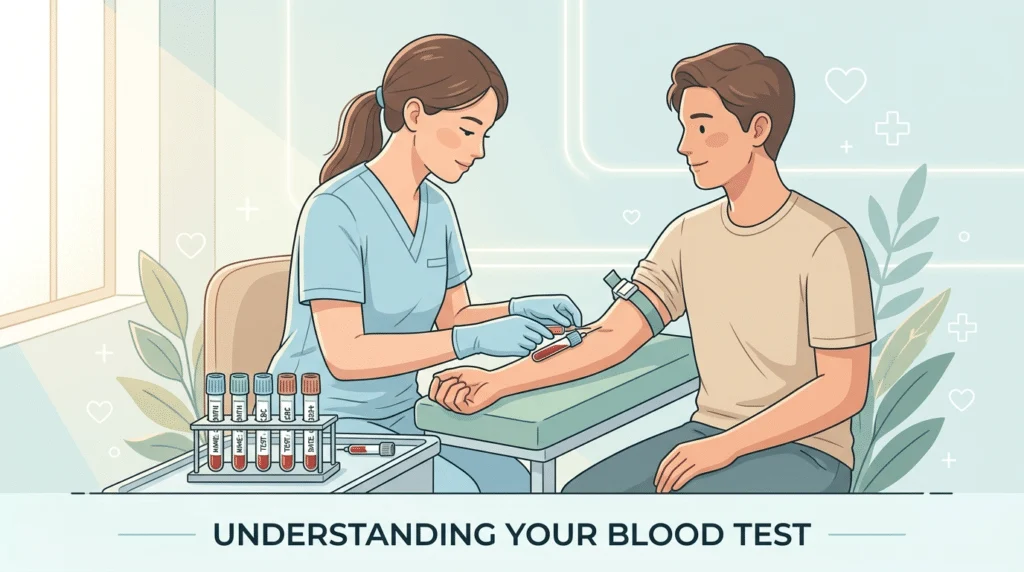
The draw itself is the part people worry about most, yet it is usually over in a couple of minutes. Here is what to expect, step by step:
- The phlebotomist confirms your identity, often asking your name and date of birth and checking them against the request.
- You sit in a chair with an armrest, or lie down if you prefer or have fainted before.
- A soft elastic band called a tourniquet is wrapped around your upper arm to make the veins stand out.
- The phlebotomist feels for a suitable vein, usually at the inner elbow, and cleans the skin with an antiseptic wipe.
- A thin needle is inserted. You feel a brief sharp scratch, not a deep pain.
- Blood flows into one or more collection tubes. Each tube has a different coloured top, because different tests need different additives.
- The tourniquet is loosened, the needle is removed, and you are asked to press a cotton pad on the spot.
- A small plaster or bandage goes over the site to stop any bleeding.
The whole visit usually takes about 10 to 15 minutes, even though the needle is only in your arm for a short part of that. If you feel dizzy at any point, say so straight away so the team can help you.

After the needle: what happens to your blood in the lab
This is the stage most guides skip, yet it explains why some results come back in hours and others take a week. Once your tubes are filled, they begin a short, carefully tracked journey.
Labeling and transport
Each tube is labeled with your details before it leaves the room, which is why your identity is checked so carefully. The samples are then sent to the laboratory, either by courier from a clinic or, in many hospitals, through a pneumatic tube system that whisks them across the building in minutes.
Spinning and separating
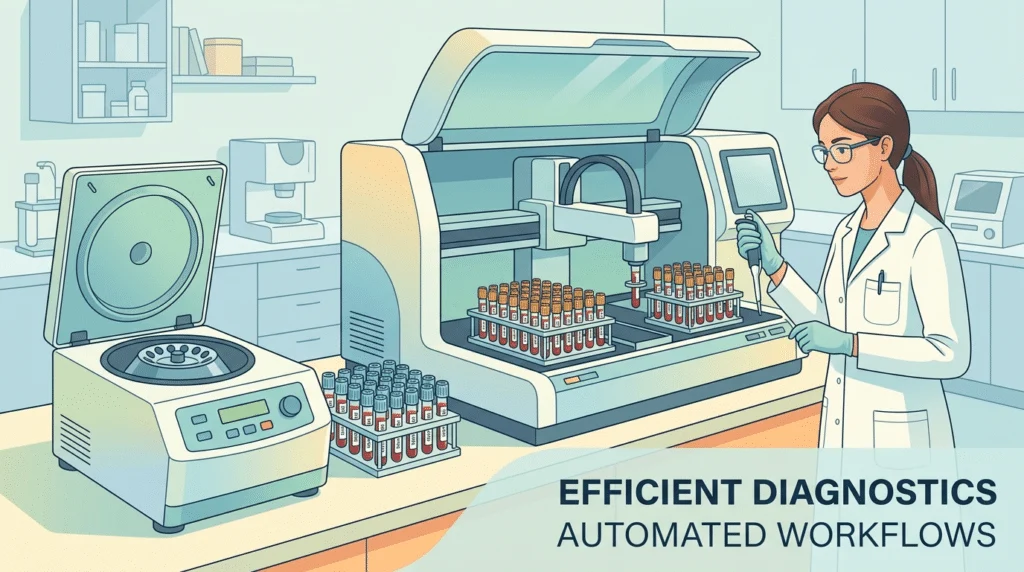
Many tubes are first placed in a centrifuge, a machine that spins them at high speed. Spinning separates the liquid part of your blood from the cells. The clear liquid above the cells is called plasma, or serum once clotting factors are removed, and it is what many chemistry tests actually measure.
Analysis on automated machines
Prepared samples move to automated analyzers that measure dozens of substances quickly and precisely. Routine tests such as a CBC or a metabolic panel are largely automated, which is why they are often ready the same day. More specialized tests may be run in batches or sent to a separate reference laboratory, and that extra handling is a common reason for a longer wait.
Checking and reporting results
When a result falls in the expected range, the laboratory system often validates it automatically. Results that are unusual or critical are reviewed by a trained laboratory scientist before they are released. The verified report is sent to the doctor who ordered the test, and you can usually view it through an online patient portal.
How long does the blood test process take?
Turnaround time covers everything after the draw: the lab processing plus the reporting. For most routine tests, results are ready within a few hours to a couple of days, while specialized tests can take a week or longer. For a deeper look, see our guide on how long blood test results take.
The table below shows typical ranges for common tests. These are general estimates only; your own laboratory, and how busy it is, can shift the timing in either direction.
| Test | Typical turnaround |
|---|---|
| Complete blood count (CBC) | Same day to 1–2 days |
| Metabolic panel (CMP) | Same day to 1–2 days |
| Lipid panel (cholesterol) | 1–2 days |
| HbA1c (average blood sugar) | 1–2 days |
| Thyroid tests (TSH, T4) | 1–3 days |
| Vitamin D (25-OH) | 2–7 days |
| Vitamin B12 and folate | 1–3 days |
| Pregnancy test (quantitative hCG) | Same day to 1–2 days |
| Tuberculosis blood test (IGRA) | 1–3 days |
| Mononucleosis (mono) test | Same day to 2 days |
| Antinuclear antibodies (ANA) | 3–7 days |
| HIV test (lab antigen/antibody) | Same day to 3 days |
| Hepatitis panel | 1–3 days |
| Celiac antibodies | 3–7 days |
| Blood culture (for infection) | 1–5 days |
| Genetic or specialized tests | 1–4+ weeks |
A few examples show why timing varies. Thyroid tests and a vitamin D test often run on dedicated machines or in batches, so they can take longer than a same-day CBC. Many blood tests during pregnancy are routine and come back quickly, while a blood culture must incubate for days before it is final.
Are blood tests processed on weekends?
It depends on where your blood goes. Hospital and emergency laboratories run 24 hours a day, every day, so urgent samples are processed at weekends. Routine samples taken at a GP surgery or an outpatient clinic may sit until the next working day, because courier pickups and routine batches often pause over the weekend. As a practical result, a non-urgent test drawn on a Friday afternoon may not be reported until early the following week.
What to expect after a blood test: aftercare and side effects
Most people feel completely normal after a blood test and carry on with their day. Minor, short-lived effects are common and not a cause for concern.
You may notice slight soreness, a small bruise, or a little lightheadedness. Keeping gentle pressure on the site and leaving the plaster on for about 20 to 30 minutes helps prevent bruising. It is sensible to avoid heavy lifting with that arm for a few hours, and to eat and drink something afterward, especially if you fasted. If you felt faint, sit until the feeling passes before you stand or drive.
When to call your doctor: signs to watch for
Serious problems after a blood draw are rare, but it helps to know the signs that deserve a phone call. Contact your doctor or clinic if you notice any of the following:
- Bleeding that does not stop after several minutes of firm, continuous pressure.
- A large or quickly spreading bruise, rather than a small one that fades over a few days.
- Severe or worsening pain in the arm, or numbness and tingling spreading into the hand, which can suggest nerve irritation.
- Signs of infection at the site, such as increasing redness, warmth, swelling, pus, or a fever in the days that follow.
- Fainting that does not quickly resolve once you sit or lie down.
These situations are uncommon, and the vast majority of people never need to make this call. Knowing the signs simply lets you act early in the rare case that something is not settling.
Making sense of your blood test results
When your report arrives, each result is shown next to a reference range, which is the span of values considered typical for that test. Values outside the range are often flagged with an “H” for high or an “L” for low. Reference ranges can differ slightly from one laboratory to another, and the abbreviations can be confusing, so our guide to reading blood test results and a list of common lab test abbreviations can help you find your footing.
One result outside the range is not a diagnosis. Many factors, including recent meals, exercise, medicines, hydration, and even the time of day, can nudge a value. Some tests, such as blood typing, describe a fixed characteristic rather than a problem to fix. Your doctor interprets your numbers together, alongside your history and symptoms, before deciding what, if anything, they mean for you.
Some clinics contact you only when a result needs action, so silence does not always mean everything is normal. If you have not heard back within the expected time for your test, or you simply want to understand a value, it is reasonable to ask for a copy of your report and a short explanation of what it shows.
Glossary
- Centrifuge: A laboratory machine that spins blood tubes at high speed to separate the liquid part from the blood cells.
- Fasting: Going without food and drink, except water, for a set time before certain tests so that recent meals do not affect the results.
- Hematoma: A collection of blood under the skin, seen as a bruise, that can form where the needle entered.
- Phlebotomist: A healthcare worker trained specifically to draw blood.
- Plasma: The clear, yellowish liquid part of blood that remains when the cells are separated out.
- Reference range: The span of values considered typical for a test, used as a comparison for your own result.
- Serum: The liquid part of blood after it has clotted and the clotting factors have been removed; used in many chemistry tests.
- Tourniquet: The elastic band placed around the upper arm to make veins easier to see and reach.
- Turnaround time: The time between your blood being drawn and your result being reported.
- Venipuncture: The medical term for taking a blood sample from a vein with a needle.
Frequently asked questions
Can I drink water before a fasting blood test?
In almost all cases, yes. Plain water is allowed and even encouraged before a fasting blood test, because it keeps you hydrated and makes your veins easier to find. Fasting refers to food and other drinks, such as juice, milk, coffee, and tea, which can change the levels of sugar, fats, and other substances being measured. Avoid those for the period your doctor specifies, usually 8 to 12 hours. If you are ever unsure whether water is allowed for a particular test, ask the clinic when you book. Sipping water beforehand can also reduce the chance of feeling lightheaded during the draw.
How much blood is taken during a blood test?
Less than most people expect. A typical draw fills one to a few small tubes, and each tube usually holds only a few milliliters, roughly a teaspoon or two each. Even when several tubes are collected for different panels, the total is a very small fraction of the blood in your body, which your system replaces quickly. The number of tubes depends only on how many tests your doctor ordered, not on how serious anything is. This is why a routine draw rarely causes more than brief tiredness, and why you can usually return to your normal activities the same day.
Why do some blood tests take longer to process than others?
Routine tests such as a complete blood count run on automated machines that produce results within hours. More specialized tests need extra steps: they may be processed in batches, require a culture that has to grow over several days, or be sent to a separate reference laboratory with the right equipment. Antibody tests, vitamin levels, and genetic tests often fall into this slower group. The reporting step matters too, since unusual or critical results are reviewed by a laboratory scientist before release. A result that is “late” is therefore often just a normal part of the turnaround time for that particular test.
Can different labs give different results for the same blood test?
Sometimes, slightly. Laboratories use different instruments and methods, so the exact number and the reference range can vary a little between them. This is one reason a result is always read against the range printed on that lab’s report, not a range from somewhere else. For ongoing monitoring, your doctor may prefer you use the same laboratory each time, so that changes over months reflect your body rather than a switch in method. Small differences between labs are usually not clinically important, but it is worth mentioning if you compare reports from two different places.
Can I lift weights or exercise after a blood test?
Light activity is generally fine, but it is sensible to avoid heavy lifting and intense exercise with the affected arm for a few hours. Strenuous use of the arm too soon can increase the chance of bruising or reopen the puncture site. Keep the plaster on for about half an hour, and if you feel at all lightheaded, wait until that passes before exercising. Most people are back to their usual routine, including the gym, by the next day. If your job or sport involves heavy upper-body effort, give the arm a short rest first and watch for any swelling.
Are at-home finger-prick tests as accurate as a lab blood draw?
At-home finger-prick kits can be convenient and are useful for some purposes, but they are not a full replacement for a laboratory blood draw ordered by your doctor. A standard venipuncture collects a larger, more stable sample and is analyzed on professional equipment, which suits the wide range of tests in a typical panel. Home tests vary in quality, so it helps to choose one your doctor or pharmacist recommends and to confirm important results with a clinic. Whatever method you use, discuss the results with a healthcare professional rather than acting on a single number alone.
Sources
- Blood tests — NHS
- What You Need to Know About Blood Testing — MedlinePlus (NIH)
- Blood Tests: Types, Results & How They Work — Cleveland Clinic
Further reading
- Read blood test results: a simple guide
- How long do blood test results take?
- CBC vs CMP: understanding the tests
- Blood tests during pregnancy: what’s checked
- Common medical lab test abbreviations
Understand your lab results with AI DiagMe
Once you know how the blood test process works, the next step is making sense of the numbers on your report. AI DiagMe helps you understand common results, such as a complete blood count, a metabolic panel, cholesterol (lipid panel), and thyroid tests, in clear, plain language. It is built to help you understand your results, not to diagnose you, and it never replaces your doctor’s judgment. If you are holding a report and want context before your next appointment, AI DiagMe can walk you through it.
➡️ Get your results interpreted in minutes