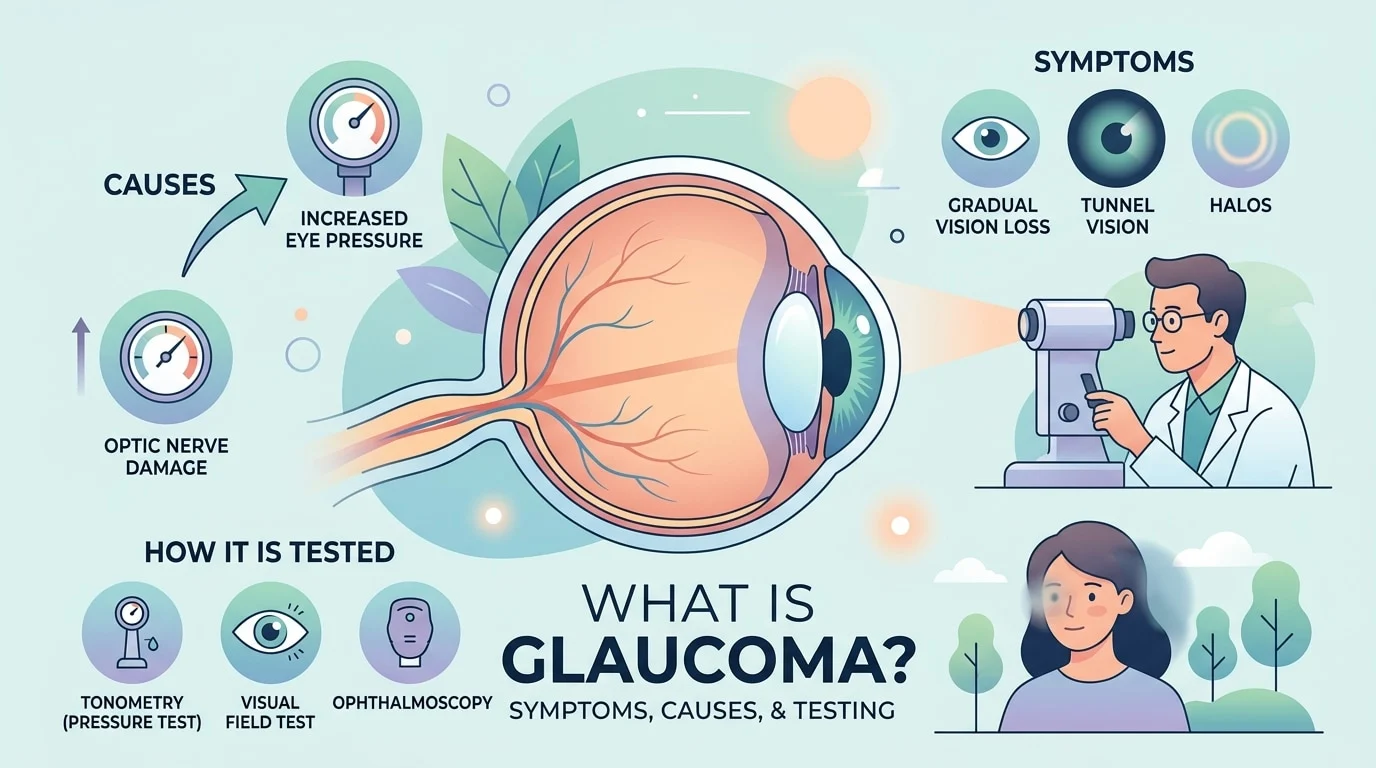
What is glaucoma? Glaucoma is a group of eye diseases that slowly damage the optic nerve, the cable that carries images from the eye to the brain. It is one of the leading causes of irreversible blindness, yet about half of the people who have it do not know, because the most common form steals sight so gradually that there are no early warning signs. This article explains what glaucoma is, the main types, the symptoms to watch for, who is most at risk, and the eye tests used to catch it. You will also find a tests table, a glossary, and answers to the questions people ask most.
Eye exam notes can look cryptic: see what PERRLA means on your record.
What is glaucoma, exactly?
Glaucoma develops when the optic nerve becomes damaged, often because pressure inside the eye is higher than the nerve can tolerate. A clear fluid called aqueous humor normally flows through the front of the eye and drains away. When that drainage system does not work well, fluid builds up and the internal pressure, known as intraocular pressure, rises. Over time this pressure injures the delicate nerve fibres, creating blind spots that usually start in the side vision.
Importantly, glaucoma can also occur when eye pressure sits in the normal range, so pressure is a major clue rather than the whole story. Because the damage cannot be reversed, the goal of care is to find the disease early and stop it from getting worse.
The main types of glaucoma
There are several forms, and they behave very differently.
- Open-angle glaucoma: by far the most common type. The drainage angle stays open but works poorly, so pressure climbs slowly and silently over years.
- Angle-closure glaucoma: the drainage angle becomes blocked, sometimes suddenly. An acute attack is a medical emergency.
- Normal-tension glaucoma: the optic nerve is damaged even though eye pressure measures normal. Reduced blood flow to the nerve may play a part, which is why it has been linked to conditions including migraine.
- Congenital glaucoma: a rare form present at or soon after birth, caused by a drainage problem in the developing eye.
Symptoms: the silent thief of sight
Open-angle glaucoma earns its nickname because, at first, it has no symptoms at all. Vision loss begins at the edges of your sight, closest to the nose, and progresses so slowly that the brain fills in the gaps. Many people do not notice until a significant amount of side vision is already gone.
Acute angle-closure glaucoma is the opposite: it can come on fast and severe. Warning signs of an attack include:
- Intense eye pain and a bad headache
- Nausea or vomiting
- Blurred vision and halos around lights
- A red eye
These symptoms need same-day care. If you suddenly notice black spots in vision along with eye pain, treat it as an emergency and go to an eye doctor or emergency room immediately.
What causes glaucoma and who is at risk
Scientists do not fully understand what triggers the most common forms, but raised eye pressure and reduced blood supply to the optic nerve are central. Several factors clearly raise the odds. According to the CDC, about 3 million Americans have glaucoma, and certain groups carry a much higher risk:
- Age: risk rises after 60, and earlier for some groups
- Race: Black Americans are 6 to 8 times more likely to develop glaucoma, and the risk climbs after age 40
- Family history: glaucoma runs in families
- Diabetes: people with the condition are about twice as likely to develop glaucoma
- Other factors: very high eye pressure, thin corneas, severe nearsightedness, eye injury and long-term steroid use
Because the disease and several of these risk factors are silent, regular eye exams are the only reliable way to find glaucoma early. The same healthy habits that protect your eyes also help you manage diabetes and keep high blood pressure under control.
How glaucoma is diagnosed
There is no single glaucoma test. Instead, an eye doctor combines several quick, painless checks during a comprehensive dilated eye exam. The table below shows what each one looks at.
| Eye test | What it checks | What to expect |
|---|---|---|
| Tonometry | Intraocular (eye) pressure | A quick puff of air or a gentle probe on the eye |
| Dilated eye exam (ophthalmoscopy) | The optic nerve at the back of the eye | Drops widen the pupil so the doctor can look inside |
| Visual field test (perimetry) | Side (peripheral) vision | You press a button when you see flashes of light |
| Optical coherence tomography (OCT) | Thickness of the optic nerve fibre layer | A painless scan that does not touch the eye |
| Gonioscopy | The eye’s drainage angle | A special contact lens checks whether the angle is open or closed |
| Pachymetry | Corneal thickness | A brief probe measures the front of the eye |
No single result confirms glaucoma; the doctor weighs them together and may repeat tests over time to look for change.
Can blood tests and systemic health play a role?
Glaucoma itself is diagnosed by an eye specialist, not by a blood draw. Even so, your general health matters, because the conditions that strain blood vessels also strain the optic nerve. Keeping blood sugar steady is one example: many adults at risk regularly review a diabetes blood test and track their blood glucose levels as part of protecting their eyes and the rest of the body.
Researchers are also exploring whether blood-based clues could one day flag glaucoma risk earlier, which we cover in the next section. For now, these markers support overall eye health rather than diagnose the disease.
Treatment options
Treatment cannot undo damage that has already happened, but it can stop or slow further loss. Eye doctors lower pressure using:
- Medicines, usually prescription eye drops, taken every day
- Laser treatment, a quick in-office procedure that helps fluid drain
- Surgery, when drops and laser are not enough, to create a new drainage route
Whatever the approach, glaucoma is a lifelong condition that needs regular monitoring. Taking drops exactly as prescribed and keeping every follow-up appointment are the most powerful ways to protect your remaining vision.
Latest advances in glaucoma detection
Research from the past three years is searching for ways to spot glaucoma sooner and predict who will get worse. These findings are encouraging but still being studied, so they add to, rather than replace, the standard eye exam.
- A study in Nature Medicine reported that a measure of energy production in blood immune cells was strongly linked to faster vision loss, pointing to a possible blood biomarker for progressing glaucoma. (Petriti and colleagues, 2024)
- A 2025 review described how artificial intelligence can read optic-nerve scans and retinal photographs to help detect glaucoma and forecast its progression. (Lan and colleagues, 2025)
- A 2026 multi-omics analysis linked certain blood and urine markers, including glucose, to glaucoma risk, supporting the search for systemic warning signs. (Sun and colleagues, 2026)
None of these approaches replaces a dilated eye exam today, and none should guide treatment without an eye specialist. They do, however, hint at earlier and more personalised screening to come.
Glossary of glaucoma terms
| Term | Definition |
|---|---|
| Aqueous humor | The clear fluid in the front of the eye whose flow and drainage affect eye pressure. |
| Intraocular pressure | The pressure inside the eye; raised levels are a key risk factor for glaucoma. |
| Optic nerve | The nerve that carries visual signals from the eye to the brain. |
| Open-angle glaucoma | The most common type, in which the drainage angle is open but works poorly. |
| Angle-closure glaucoma | A type in which the drainage angle is blocked; an acute attack is an emergency. |
| Peripheral vision | Side vision, usually the first to be affected by open-angle glaucoma. |
| Tonometry | The test that measures the pressure inside the eye. |
| Optical coherence tomography (OCT) | A painless scan that measures the optic nerve fibre layer. |
Frequently asked questions
What is usually the first sign of glaucoma?
For the most common open-angle type, there is often no noticeable first sign. Vision loss begins quietly at the edges of your sight and is easy to miss until it is advanced. That is exactly why routine eye exams matter, since they can catch damage before you would ever feel it.
Is glaucoma hereditary?
Family history is one of the strongest risk factors, and scientists have identified genes linked to higher eye pressure and optic nerve damage. If a close relative has glaucoma, tell your eye doctor and ask how often you should be screened.
Can glaucoma be cured?
There is no cure, and damage already done cannot be reversed. However, treatment that lowers eye pressure is very effective at stopping or slowing further loss, so most people who are diagnosed and treated early keep useful vision for life.
Does glaucoma cause blindness?
It can if left untreated, and glaucoma is a leading cause of irreversible blindness worldwide. With early detection and consistent treatment, the risk of going blind is greatly reduced.
How often should I have my eyes checked?
It depends on age and risk. As a general guide, adults aged 55 to 64 are advised to have an exam every one to three years, and those over 65 every one to two years, with more frequent checks for higher-risk groups. Your eye doctor can set the right schedule for you.
Can high blood pressure or diabetes affect glaucoma?
Both are linked to glaucoma risk and to eye health in general. People with diabetes are about twice as likely to develop glaucoma, so managing blood sugar and blood pressure supports your vision along with the rest of your body.
Sources
- National Eye Institute (NIH) — Glaucoma
- Centers for Disease Control and Prevention — About Glaucoma
- Mayo Clinic — Glaucoma: Symptoms and causes
Further reading
- HbA1c blood test: normal range and target levels
- Hypertension and headache: symptoms and causes
- Diabetic toenails: symptoms, causes and treatments
- Stroke (cerebrovascular accident): what to know
- Normal thyroid levels: understanding the ranges
Understand your lab results with AI DiagMe
Glaucoma is found and treated by an eye doctor, but the conditions that raise your risk — diabetes and high blood pressure among them — show up in everyday blood work. AI DiagMe helps you make sense of results such as blood sugar, HbA1c and cholesterol in clear language, so you can act on the numbers that protect your eyes and your overall health. It is built to help you understand your results and prepare for your appointments, not to diagnose disease or replace your doctor.
Get your results interpreted in minutes