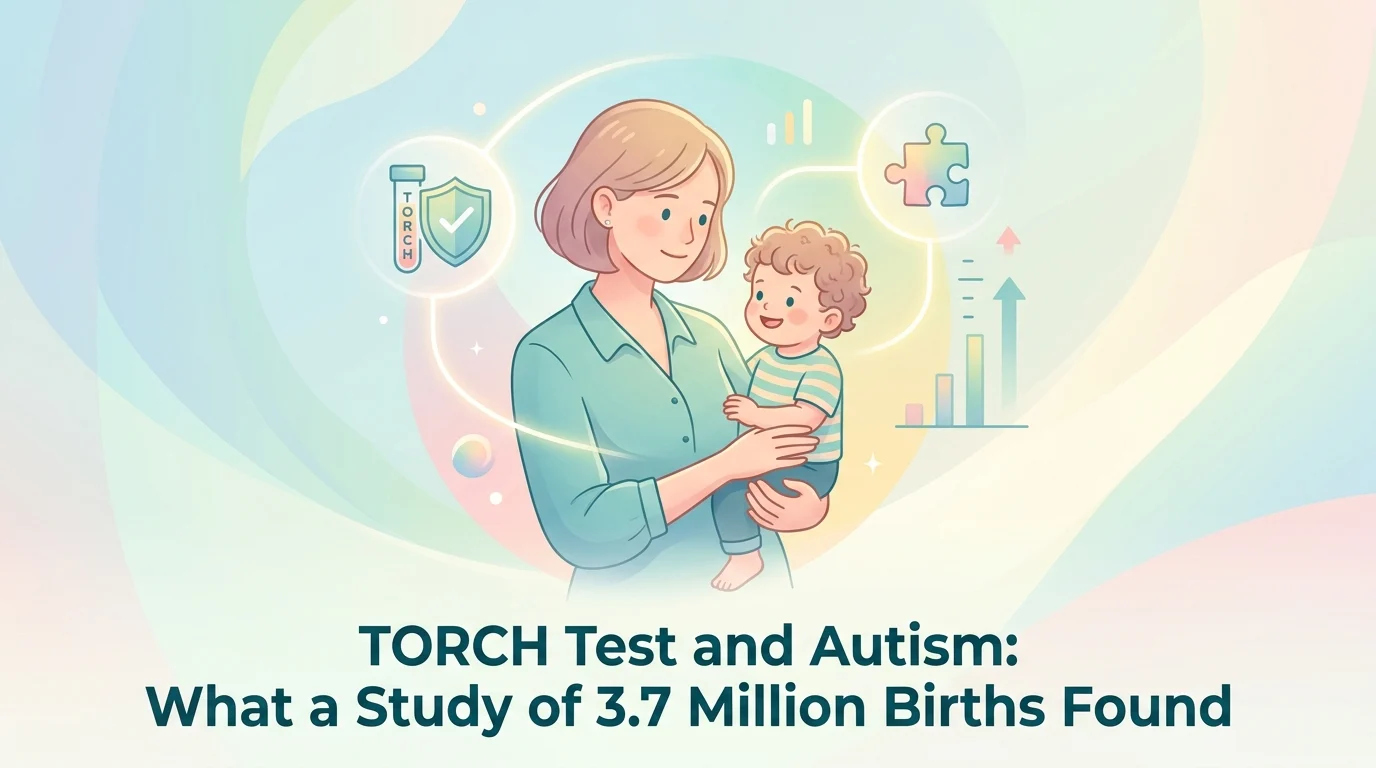
A TORCH test is a group of blood tests that looks for infections a pregnant woman can pass to her baby before birth, and a large Swedish study published on September 21, 2026 has put these infections back in the headlines. Researchers at Karolinska Institutet followed 3.7 million people from birth for up to three decades. They found that the rare babies born with a congenital TORCH infection were about three times more likely to be diagnosed with autism later in life, and more than seven times more likely to have an intellectual disability. The finding is striking, but it needs context: these infections are uncommon, and several of them can be prevented or treated. In this article you’ll learn what the study actually found, what it does and does not mean for a pregnancy, and which prenatal blood tests do the real protective work.
What the Swedish TORCH study found
The study, published in JAMA Pediatrics, used Swedish national registers that cover almost everyone born in the country between 1987 and 2021. Among roughly 3.7 million people, 975 had been diagnosed at birth with a congenital TORCH infection, meaning an infection acquired in the womb. The team then tracked later diagnoses, school grades and other neurodevelopmental conditions for up to 30 years.
- Autism was diagnosed about three times more often in children born with a TORCH infection.
- Intellectual disability was more than seven times more common, and its most severe forms were more than twenty times more common.
- The link with autism was strongest when an intellectual disability was also present, but it remained without one.
- Exposed children had slightly lower school grades at 16, even when they had no diagnosis at all.
- No consistent link appeared with obsessive-compulsive disorder, and the association with ADHD faded in the sibling analysis.
That sibling analysis is the most important part of the design. The researchers compared infected children with their own brothers and sisters who were not infected, which cancels out many things a family shares, such as genes, income and home environment. The results held, which suggests that the infections themselves, rather than family background, explain much of the extra risk.
A real risk, but a rare one
The relative risks are high, yet the absolute numbers are small. The authors estimate that congenital TORCH infections account for about 1.2% of cases of severe intellectual disability in Sweden, and for only around 0.034% of autism cases, roughly one case in 3,000. Put simply, almost all autism has nothing to do with these infections.
For the families concerned, however, the picture is different. The researchers estimate that about one in five children born with a TORCH infection may later be diagnosed with autism. They also stress that transmission from mother to fetus is unusual: most infections caught during pregnancy never cross the placenta, and even TORCH infections often do not.
What a TORCH test checks, infection by infection
TORCH is an acronym, not a single disease. Cleveland Clinic lists toxoplasmosis, other infections such as syphilis, HIV, parvovirus B19, chickenpox and Zika, rubella, cytomegalovirus (CMV) and herpes simplex virus. The blood tests that make up a TORCH test measure antibodies, the proteins your immune system makes against each germ. MedlinePlus describes the TORCH test, which it calls a TORCH screen, mainly as a newborn test and notes that a positive result always calls for confirmatory testing, along with testing of the mother.
| 感染症 | What the lab looks for | Usual place in US prenatal care | 主な予防法 |
|---|---|---|---|
| Toxoplasmosis | IgG and IgM antibodies to the Toxoplasma parasite | Tested when there is a specific reason rather than routinely | Well-cooked meat, washed produce, someone else cleaning the litter box |
| Syphilis (the “other” group) | A screening antibody test, then a confirmatory test | Recommended at the first prenatal visit, repeated later for some people | Testing and prompt antibiotic treatment of the mother and partners |
| Rubella | IgG antibodies that show immunity | Immunity commonly checked early in pregnancy | Vaccination before pregnancy |
| Cytomegalovirus (CMV) | IgG, IgM and sometimes IgG avidity | Not routine; ordered after an exposure, symptoms or ultrasound findings | Handwashing, avoiding contact with young children’s saliva and urine |
| Herpes simplex | Mostly a PCR swab of a sore; antibody tests have a limited role | Discussed based on history and symptoms | Identifying and treating infection; a cesarean birth is sometimes advised during an active outbreak |
A TORCH test result is read as a pattern, not as a single line. IgM antibodies tend to appear early in an infection, while IgG antibodies appear later and usually persist for life. A positive IgM on its own does not prove a recent infection, because it can linger for months or turn up as a false positive. Our library decodes the IgG, IgM and avidity patterns of a CMV blood test. A separate guide decodes トキソプラズマIgGおよびIgMの結果, and another page describes 免疫グロブリンG(IgG)血液検査. For the wider picture, our overview presents the serology test and its main panels.
What this changes for prenatal blood work
The study does not call for a new test, and it does not mean every pregnancy needs a full TORCH test. It strengthens the case for prevention tools that already exist, and most of them start with ordinary prenatal blood work. Our guide lists the standard blood tests during pregnancy.
- Know your rubella status before or early in pregnancy. The Swedish authors point out that rubella has nearly disappeared in Sweden since national vaccination, and vaccination before pregnancy remains the proven way to prevent congenital rubella.
- Do not skip syphilis screening. The CDC reports that congenital syphilis cases have more than tripled in recent years, with nearly 4,000 cases in 2024, the highest yearly number since 1994. The infection is curable when it is found and treated during pregnancy.
- Ask about CMV if you spend time with toddlers. There is no vaccine, but handwashing and avoiding young children’s saliva and urine lower the risk.
- Limit toxoplasmosis exposure through food safety and cat-litter precautions.
- Tell your clinician about any history of genital herpes, especially as your due date approaches.
Routine prenatal panels also screen for infections outside the TORCH acronym, such as hepatitis B. Another article explains hepatitis blood test results. If you are planning a pregnancy, a preconception visit is the easiest moment to review immunity and vaccinations, because the rubella vaccine is not given during pregnancy.
医療機関への相談のタイミング
- You develop fever, a rash, swollen glands or a flu-like illness in early pregnancy.
- You are not immune to rubella, or you do not know your status.
- A TORCH test or another antibody result shows a positive IgM or a pattern you do not understand.
- An ultrasound reports growth restriction or another finding your provider wants to investigate.
- Your newborn does not pass the hearing screen, or you have concerns about development later on.
When a baby is born with a congenital infection, pediatric teams usually plan closer follow-up of hearing, vision and development. That is where early support makes the biggest difference. For general guidance on any lab report, this page outlines a step-by-step method for reading blood test results.
最新の科学的進歩
According to research indexed in PubMed, several recent studies add useful context to the Swedish findings. Here is what they show, in plain terms.
Early screening can make congenital syphilis disappear
A Danish register study, meaning an analysis of national health records, covered nearly 900,000 births between 2010 and 2024. It found only five babies with congenital syphilis, and none after 2016, which the authors credit to first-trimester screening. What this means for you: the syphilis line on an early prenatal report is one of the most protective tests you will have.
US screening still has gaps
An analysis of insurance claims in the American Journal of Public Health found that syphilis screening happened in about three out of four Medicaid-insured pregnancies, compared with more than nine out of ten commercially insured ones, and far fewer people were screened in the first trimester. What this means for you: if you are unsure whether you were tested, ask. It is a simple blood draw.
Babies with silent CMV often do well early on
A small US study followed infants who had congenital CMV but no symptoms at birth. At 12 months, they performed like other babies on standard development tests. The result is early and follow-up continues. What this means for you: a CMV diagnosis at birth does not automatically predict developmental problems, which is why calm, structured follow-up is the usual approach.
Congenital toxoplasmosis needs long follow-up
A French cohort, a group of children followed over time, included 646 children treated for congenital toxoplasmosis. About three in ten developed at least one eye lesion over a median of 12 years, sometimes into adulthood, although severe damage was rare. What this means for you: when a congenital infection is diagnosed, regular eye and development checkups matter for years, not months.
用語集
| 用語 | 定義 |
|---|---|
| TORCH | An acronym for toxoplasmosis, other infections, rubella, cytomegalovirus and herpes simplex, germs that can pass from mother to fetus. |
| Congenital infection | An infection a baby acquires in the womb and already has at birth. |
| IgMとIgG | Two antibody types. IgM usually appears early in an infection; IgG appears later and often lasts for life. |
| IgG抗体親和性(アビディティ) | A lab measure of how tightly IgG binds a germ. Low avidity points to a recent infection, high avidity to an older one. |
| Sibling comparison | A study method that compares brothers and sisters to rule out factors a family shares, such as genes or environment. |
| Intellectual disability | Lasting limits in learning, reasoning and everyday skills that start during development, graded from mild to profound. |
よくある質問
What is a TORCH test?
A TORCH test is a group of blood tests that looks for antibodies against toxoplasmosis, other infections such as syphilis, rubella, cytomegalovirus and herpes simplex. MedlinePlus describes it mainly as a newborn screen used when a baby may have been infected before birth. In pregnancy, doctors more often order the individual tests that fit a situation rather than the whole group at once.
When is a TORCH test done in pregnancy?
There is no single date. Some components, such as syphilis screening and a rubella immunity check, are typically done at the first prenatal visit. Tests for CMV or toxoplasmosis are usually ordered after a known exposure, symptoms such as fever or swollen glands, or an ultrasound finding. A full TORCH screen is mostly used in newborns who show signs of infection.
Do TORCH infections cause autism?
The Swedish study found a clear link, and its sibling design makes family factors an unlikely explanation. Still, these infections are rare and explain only a tiny share of autism, about one case in 3,000 in Sweden. Most children with autism were never exposed to a TORCH infection, and most babies exposed to one infection in pregnancy are not infected themselves.
Does a positive TORCH test mean my baby is infected?
No. A positive IgM can be a false positive or linger for months after an old infection, so confirmatory tests and sometimes an IgG avidity test are needed. Even a confirmed infection in the mother does not always reach the fetus. When needed, specialists use tests such as PCR on amniotic fluid to answer that question directly.
Can TORCH infections be prevented?
Many can. Vaccination before pregnancy prevents congenital rubella, and syphilis can be cured when screening finds it early. Food safety and avoiding cat litter lower the risk of toxoplasmosis, while handwashing and not sharing utensils with toddlers reduce CMV exposure. Tell your clinician about any history of genital herpes so a plan can be made before delivery.
Should I ask for a full TORCH panel during pregnancy?
Usually a targeted approach works better than a full TORCH test. Each infection is read differently, and a broad panel can return confusing antibody results that lead to extra testing and worry. Ask your provider which tests match your history, your immunity and your exposures, and make sure the standard first-visit screening has been done.
参考文献
- MedlinePlus, US National Library of Medicine, National Institutes of Health — TORCH screen, 2024 — MedlinePlusのページを読む
- Centers for Disease Control and Prevention — About Congenital Syphilis, 2025 — read the CDC page
- Cleveland Clinic — TORCH Infections, 2026 — read the Cleveland Clinic page
- Karolinska Institutet — Rare pregnancy infections linked to autism, September 21, 2026 — read the press release
- Sjöqvist H., Dalman C., Mataix-Cols D., Gardner R. M., Karlsson H. — Congenital TORCH Infections and Neurodevelopmental Outcomes — JAMA Pediatrics, 2026 — 研究を読む
- Lausten-Thomsen U. et al. — Elimination of congenital syphilis: a nationwide register-based study, Denmark, 2010 to 2024 — Eurosurveillance, 2026 — 研究を読む
- Suarez E. A. et al. — Prenatal Care and Congenital Syphilis in the United States: Characterizing Screening and Treatment — American Journal of Public Health, 2026 — 研究を読む
- Stoyell S. M. et al. — Neurobehavioral outcomes of neonatal asymptomatic congenital cytomegalovirus infection at 12-months — Journal of Neurodevelopmental Disorders, 2024 — 研究を読む
- Journé A. et al. — Long-term Ocular Outcomes in Congenital Toxoplasmosis Treated Perinatally — Pediatrics, 2024 — 研究を読む
関連記事
- ガイドでは hCG levels week by week
- This article covers the fertility blood test panel
- ライブラリでは以下を詳しく説明しています 血球計算(全血球計算)
- This page describes abnormal blood test results and next steps
- Our reference chart summarizes 血液検査の基準値(正常範囲)
AI DiagMeで血液検査の結果をわかりやすく確認
Prenatal serologies rarely arrive alone. They sit on the same report as a blood count, a blood type, glucose and other results, and each antibody line only makes sense next to the others. AI DiagMe reads your blood, urine or stool report in plain language, so you arrive at your appointment knowing what was measured and which questions to ask. It helps you understand your results; it does not diagnose and does not replace your doctor or midwife.