

































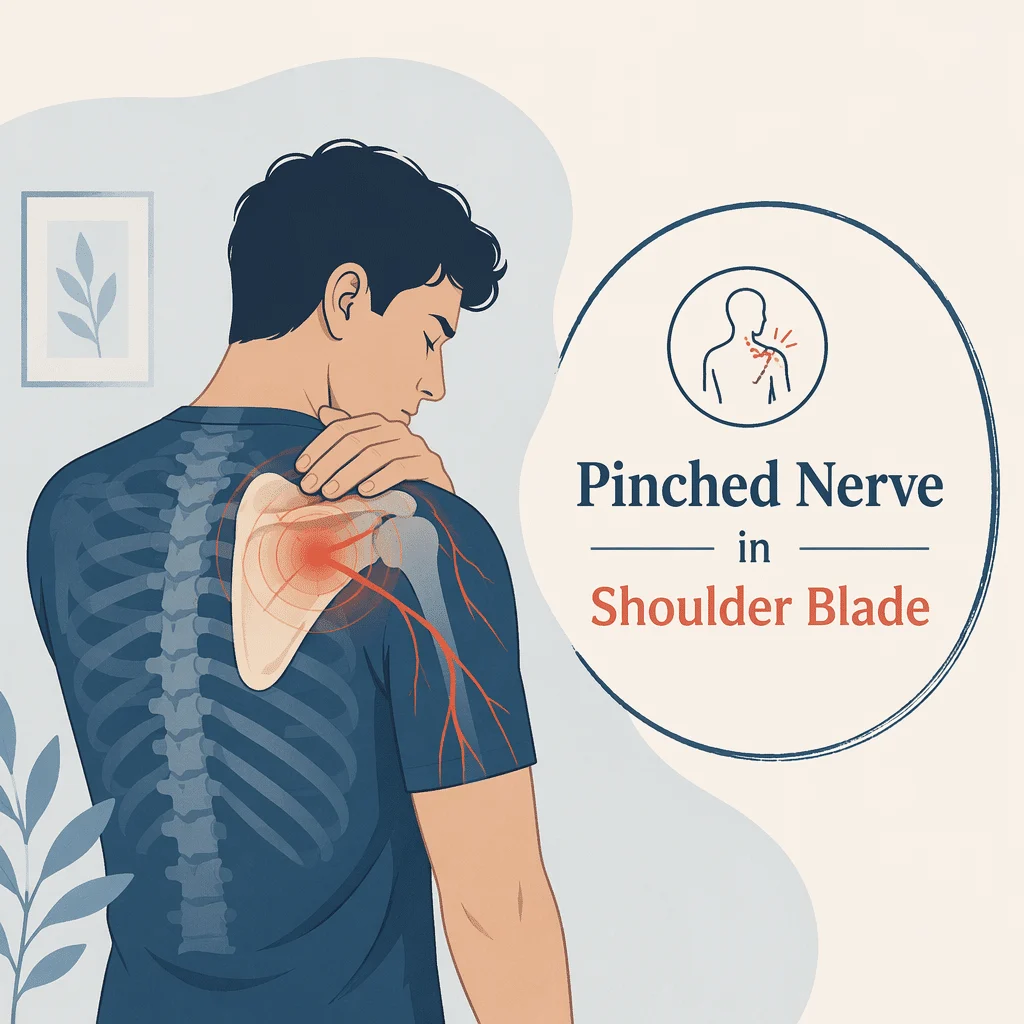
A pinched nerve in the shoulder blade is one of the most misleading pains in the body. You feel it deep under or beside the scapula, so that is where you press and rub. Yet in a large share of cases the nerve actually being squeezed sits several inches away, in the neck. That single fact changes how the problem is investigated, and it explains why months of treatment aimed at the shoulder blade so often achieve nothing.
In this article you’ll learn why neck nerve roots send pain to the shoulder blade, how to recognize that pattern, which other nerves around the scapula can be involved, and what assessment and treatment usually look like. Start with the emergency section immediately below: some pain felt at or between the shoulder blades comes from the heart, the aorta or the spinal cord, and those need a completely different response.
When shoulder blade pain is an emergency
The shoulder blade region is one of the places where the body files pain from organs that have nothing to do with muscles or nerves. Hence this section coming first.
Call 911 now if pain at, between or under the shoulder blades comes with any of the following:
- Chest pressure, tightness or squeezing, particularly with pain spreading to the jaw, neck or either arm
- Shortness of breath, sudden heavy sweating, nausea or light-headedness
- Sudden severe tearing or ripping pain between the shoulder blades, at full intensity from the first second
- Fainting, a racing or irregular heartbeat, or a sense that something is badly wrong
Do not drive yourself and do not wait to see whether it settles.
The cardiac pattern that gets dismissed
Pain between or under the shoulder blades, particularly on the left, or radiating to the jaw or an arm, can be a heart attack. The National Heart, Lung, and Blood Institute lists pain or discomfort in the back, shoulders, neck, jaw or arms among the recognized symptoms, alongside breathlessness, sweating, nausea and sudden dizziness.
The critical point is that the classic crushing central chest pain is not always there. Women, people with diabetes and older adults more often present without it, and some heart attacks produce almost no symptoms at all. That is exactly why interscapular pain gets written off as a muscle knot, and why the instruction here is call 911 rather than see your doctor. Blood tests such as troponin and BNP belong in an emergency department, not at home.
Aortic dissection, and other organs that refer upward
An aortic dissection is a tear in the wall of the body’s main artery. Its signature is sudden, severe, tearing or ripping pain between the shoulder blades, typically at maximum intensity immediately rather than building over minutes. This is a 911 call.
Other organs refer to the same territory. Gallbladder problems classically produce right upper abdominal pain travelling to the tip of the right shoulder blade after a fatty meal. A pulmonary embolism can cause upper back or shoulder pain with breathlessness or sharp pain on breathing in. Pancreatic inflammation refers straight through to the mid-back. And a Pancoast tumor at the apex of the lung can cause shoulder and scapular pain with arm symptoms and a drooping eyelid on the same side: persistent one-sided shoulder blade pain in a smoker or former smoker deserves a proper look at the lung.
Why the problem is usually in the neck
The muscles across your upper back are supplied by nerves that begin in the cervical spine, as is the skin over your shoulder, arm and hand. When one of those nerve roots is compressed where it exits the neck, the brain frequently reads the signal as coming from the shoulder blade.
This is not a fringe observation. The MedlinePlus entry on cervical spondylosis, the age-related wear that narrows those nerve exits, lists pain over the shoulder blade and on the inside of the shoulder blade among the common symptoms, spreading to the upper arm, forearm or fingers.
How C5, C6 and C7 send pain to the scapula
The roots most often involved are C5, C6 and C7. Between them they refer pain to the medial border of the shoulder blade and the interscapular region, the strip of muscle between the spine and the inner edge of the scapula. The same roots carry sensation to specific parts of the arm and hand, which is why a compressed root produces a deep, aching or burning pain around the shoulder blade plus numbness or tingling running down the arm into particular fingers.
Two things usually cause the compression. In younger adults it is more often a disc protrusion, where the soft centre of a cervical disc pushes out onto the exiting root. From middle age onward it is more often foraminal narrowing, where bone spurs and disc thinning shrink the bony tunnel the nerve passes through. The combined picture is cervical radiculopathy.
How cervical radiculopathy actually feels, and what sets it apart
Ordinary muscular shoulder blade pain is a diffuse ache you can cover with a whole hand and that shifts with posture. Cervical radiculopathy has a different signature, and three features are worth learning.
The first is what makes it worse. Symptoms often increase when you extend your neck, tip your head backward, or turn towards the painful side. Sneezing, coughing or laughing can send a jolt down the arm, and it is frequently worse at night.
The second is the shoulder abduction relief sign, which is genuinely distinctive. Many people with a compressed cervical root find their arm symptoms ease when they raise the affected arm and rest the hand on top of their head. It is a strong hint that the trouble is at the nerve root, because lifting the arm slackens tension on it. If you have caught yourself doing this, say so at your appointment.
The third is the shape of the arm symptoms. Nerve root pain follows a band or stripe down the arm rather than a vague region, and numbness sits in a defined patch of skin. Weakness, when it appears, is specific: difficulty lifting the arm out to the side, straightening the elbow, or gripping each point at a different root. General arm tiredness does not.
Matching what you feel to what it might mean
| What you notice | What it usually suggests | What to do |
|---|---|---|
| Deep ache at the inner edge of the shoulder blade with tingling running into the arm or specific fingers | A compressed nerve root in the neck, known as cervical radiculopathy | Book a medical assessment and describe the arm symptoms, not only the shoulder blade |
| Pain eases when you rest your hand on top of your head | The shoulder abduction relief sign, closely associated with cervical nerve root compression | Mention it specifically; it is a useful clue for the person examining you |
| Sudden tearing or ripping pain between the shoulder blades, at full intensity immediately | Possible aortic dissection | Call 911 |
| Interscapular pain with chest tightness, breathlessness, sweating or nausea | Possible heart attack, including in people with no classic chest pain | Call 911 |
| Clumsy hands, dropping things, trouble with buttons or handwriting, unsteady walking | Possible cervical myelopathy, meaning pressure on the spinal cord itself | Urgent medical assessment rather than starting physiotherapy |
| Deep aching along the inner scapular border with no arm symptoms, worse after long desk or driving sessions | A local nerve entrapment, muscular overload, or a rib or facet joint problem | Non-urgent medical review if it persists beyond a few weeks |
The other nerves that can be involved
Not every case comes from the neck. Three smaller nerves run through the shoulder blade region and can be irritated on their own, each a form of peripheral nerve compression with a recognizable pattern.
The dorsal scapular nerve
This nerve supplies the muscles that pull the shoulder blade toward the spine. Entrapped, usually where it passes through a neck muscle, it produces a deep, dull, persistent ache along the medial border of the scapula, often described as an ice pick behind the shoulder blade. Arm symptoms are typically absent or minor, which is one way it differs from a nerve root problem.
The long thoracic nerve and scapular winging
The long thoracic nerve supplies the serratus anterior, the muscle holding the shoulder blade flat against the rib cage. Its long, exposed course means it can be injured by a blow to the side of the chest, by carrying heavy loads on the shoulder, by repetitive overhead work, or after a viral illness.
When it stops working, the inner edge of the shoulder blade lifts away from the ribs. This is scapular winging, visible when someone pushes against a wall with straight arms: the blade sticks out like a small fin. People usually notice shoulder ache, difficulty raising the arm overhead and fatigue rather than the winging itself.
The suprascapular nerve
This nerve passes through a notch at the top edge of the shoulder blade and can be compressed there, sometimes by a cyst, causing a deep, poorly localized ache at the back and top of the shoulder, sometimes with weakness on rotating the arm outward.
Muscular, postural and joint causes
Muscle and joint problems remain the commonest explanation for pain that stays local to the shoulder blade with no arm involvement. Myofascial trigger points in the muscles between the spine and the scapula produce tender bands that refer pain a short distance, often to a spot people describe as under the shoulder blade. Postural overload does something similar: hours at a desk or behind a wheel hold the head slightly forward and the shoulder blades rounded, loading the muscles that anchor the scapula. The ache builds through the day and eases overnight.
The joints matter too. The small facet joints of the lower neck and upper back refer pain into the interscapular region in patterns overlapping almost exactly with the nerve root patterns. An irritated rib joint can produce a sharp, catching pain near the shoulder blade that worsens on a deep breath; our guide to rib cramps covers that. The shoulder itself also refers backward: rotator cuff disease, frozen shoulder and shoulder osteoarthritis can produce pain felt behind or below the scapula, with stiffness on moving the arm.
Cervical myelopathy: the warning signs that change everything
This is the one clinicians most fear missing. Cervical myelopathy means the spinal cord itself, rather than a single nerve root leaving it, is compressed inside the neck. It is usually degenerative and it is progressive, and damage that accumulates while it goes unrecognized does not reliably reverse.
The warning signs are quiet and easy to dismiss as ageing:
- Clumsy hands. Dropping cups, fumbling coins, struggling with buttons or a zipper
- Handwriting that has become messier over months
- Unsteady walking, a wider stance, or a sense of needing to watch your feet
- Symptoms in both arms rather than one
- Numbness, weakness or stiffness spreading into the legs
- New problems with bladder control, which is a late and urgent feature
Any of these alongside neck or shoulder blade pain warrants prompt medical assessment rather than a course of physiotherapy or manual treatment. If you have also noticed a change in sensation across your back or numbness in your feet, flag that combination.
What assessment and treatment usually involve
Most people with cervical radiculopathy improve over weeks to months without an operation. That is the background for everything else.
Assessment starts with the story and a physical examination. A clinician tests strength in specific muscle groups, checks reflexes, maps altered sensation, and uses positional tests that load or unload the nerve root. That examination tells them which root is involved and whether the spinal cord is affected.
Imaging is not needed immediately in the absence of red flags. When symptoms persist, worsen, or come with weakness or myelopathic signs, MRI is the usual next step. Nerve conduction studies and electromyography can help confirm which nerve is affected.
Conservative care is the mainstay: activity modification, workstation and driving-position review, and supervised physiotherapy. Prescribers use a range of medication options for nerve pain, chosen for the individual; this article does not guide that choice. If pain remains limiting, image-guided steroid injections are one option. Surgery to decompress the nerve is considered for progressive weakness, for symptoms that fail to settle, and more urgently for myelopathy.
Why exercises should come from a clinician who has examined your neck
You will find a great many shoulder blade stretching routines online, and this article deliberately does not add another. The right movement depends entirely on the diagnosis: loading that helps a postural ache can aggravate an inflamed nerve root, and any movement programme is inappropriate until myelopathy has been ruled out. Self-manipulating or cracking your own neck is a separate problem, because it can worsen an undiagnosed condition and because neck manipulation carries a small but real risk of vertebral artery injury. A clinician who has examined your neck can tell you what is safe. A video cannot.
When to see a doctor
Arrange an emergency response for anything in the box above. Otherwise, book an appointment if any of the following apply.
- Shoulder blade pain with pain, numbness or tingling travelling into the arm or hand
- Weakness in a specific movement, such as lifting the arm, straightening the elbow or gripping
- Any of the myelopathy signs listed above, which warrant an urgent appointment
- Pain that has not improved after a few weeks, or that is steadily worsening
- Night pain that wakes you regularly, unexplained weight loss, fever, or a history of cancer
- Symptoms that began after a fall, a car accident or a direct blow
Come prepared. Note where the pain starts and travels, which neck positions change it, whether resting your hand on your head helps, and whether anything has changed in your hands or walking.
Latest scientific advances in diagnosing shoulder blade nerve pain
Research indexed in PubMed over the past three years has sharpened two things: how long spinal cord compression in the neck goes unrecognized, and how modest the evidence for conservative treatment is.
A systematic review and meta-analysis in Brain and Spine in 2025 pooled 78 studies from 18 countries on degenerative cervical myelopathy. What was found: most people had symptoms for well over a year before diagnosis, and the delay was longest between first seeing a clinician and being diagnosed, not between symptom onset and seeking help. What this means for you: the bottleneck is recognition. If clumsiness or balance changes accompany your neck or shoulder blade pain, name them out loud at your appointment.
A prospective study in Scientific Reports in 2025 compared people with degenerative cervical myelopathy against age-matched healthy volunteers. What was found: the symptoms that best separated the groups were neck pain, arm or hand numbness, hand clumsiness, walking imbalance and arm weakness, while detailed sensory testing and grip measurement performed poorly. What this means for you: the diagnostic value sits in the history and in simple tests of reflexes, strength and walking, so describe daily-life changes rather than pain alone.
Two treatment reviews land in the same place. A systematic review in The Clinical Journal of Pain in 2023 assessed 59 randomized trials of conservative treatment for cervical radiculopathy and found certainty of evidence low to very low across every intervention, none clearly superior. A 2024 systematic review in the Journal of Evaluation in Clinical Practice compared personalized physiotherapy with surgery and found arm pain and disability broadly similar, while surgery did better on neck pain, sensory loss and perceived recovery, again on low-certainty evidence. What this means for you: nobody has a proven universal recipe, surgery is not automatically better for arm pain, and the choice is a conversation rather than a protocol.
Finally, a 2024 systematic review and meta-analysis in the Indian Heart Journal examined sex differences in acute coronary syndrome. What was found: women more often presented with the non-ST-elevation form of heart attack, the type least likely to look dramatic on an initial tracing, were less likely to receive angiography or a stent, and had worse survival. What this means for you: if you are a woman with upper back or interscapular pain alongside chest, breathing, sweating or nausea symptoms, treat it as cardiac until a professional says otherwise.
Frequently asked questions
How do I know if it’s my heart or a pinched nerve?
Honestly, you cannot reliably tell, and neither can a clinician without tests. Nerve pain more often changes with neck position and comes with arm tingling in a stripe, while cardiac pain more often comes with chest pressure, breathlessness, sweating or nausea and does not change when you move. But those patterns overlap, and heart attacks in women, people with diabetes and older adults frequently arrive without classic chest pain. The practical rule is simple: if there is any chest, breathing, sweating or fainting component, call 911 and let an emergency team rule it out.
How long does a pinched nerve in the shoulder blade take to heal?
Most cervical radiculopathy settles over weeks to a few months without surgery, and improvement is usually gradual rather than sudden. Arm pain tends to ease before numbness does, and numbness can linger after the pain has gone. Recovery is slower when the nerve has been compressed for a long time, and slower again if there is significant weakness. Pain that is still unchanged after several weeks, or that is worsening, is a reason to go back rather than a reason to wait longer.
Should I stretch it?
Not on the strength of a video or an article, including this one. The right movement depends on which structure is irritated, and a stretch that helps a postural muscular ache can inflame a compressed nerve root. Movement programmes are also inappropriate until spinal cord compression has been ruled out. Ask a clinician who has actually examined your neck for a programme built around your findings. Self-manipulating or cracking your own neck should be avoided outright, both because it can worsen an undiagnosed problem and because neck manipulation carries a small but real vertebral artery risk.
Why does it hurt more at night?
Several reasons stack up. Lying down removes the distraction of the day, so the signal becomes more noticeable. Sleeping positions can hold the neck in extension or rotation for hours, which is exactly the position that narrows the space a nerve root travels through. Inflammatory nerve pain also tends to have a nocturnal rhythm regardless of position. Night pain alone is common and not alarming, but night pain that consistently wakes you, especially with weight loss, fever or a history of cancer, should be reported promptly.
Is pain in the left shoulder blade more worrying than the right?
Slightly, but only because of what else lives on that side. Left-sided interscapular pain overlaps with the referral territory of the heart, so any accompanying chest, breathing or sweating symptoms should be treated as cardiac until proven otherwise. Right-sided shoulder blade tip pain has its own flag, since gallbladder problems refer there, especially after fatty meals and with right upper abdominal pain. For nerve causes, side makes no difference at all: a compressed C6 root behaves the same whichever side it is on.
Do I need an MRI for shoulder blade nerve pain?
Usually not straight away. In the absence of red flags, imaging early on rarely changes what happens next, and cervical scans in adults commonly show wear that has nothing to do with the current symptoms. MRI becomes genuinely useful when symptoms persist despite conservative care, when there is weakness, when the picture suggests spinal cord involvement, or when surgery is being considered. Your clinician’s examination, not the scan, is what determines whether and when imaging is warranted.
Glossary
| Term | Definition |
|---|---|
| Scapula | The anatomical name for the shoulder blade, the flat triangular bone on the back of the rib cage. |
| Nerve root | The first segment of a nerve as it leaves the spinal cord and exits through a bony opening in the spine. |
| Cervical radiculopathy | Irritation or compression of a nerve root in the neck, causing pain, numbness, tingling or weakness along that nerve’s territory. |
| Cervical myelopathy | Compression of the spinal cord itself within the neck. It is progressive and causes clumsiness, balance problems and symptoms in more than one limb. |
| Referred pain | Pain felt in one place while the actual source is somewhere else, because both share nerve pathways. |
| Foraminal narrowing | Reduction in the size of the bony tunnel a nerve root passes through, usually from age-related wear, bone spurs or disc thinning. |
| Interscapular region | The area of the upper back between the two shoulder blades, on either side of the spine. |
| Dorsal scapular nerve | A small nerve supplying muscles that draw the shoulder blade toward the spine. Entrapment causes a deep ache along the inner scapular border. |
| Long thoracic nerve | The nerve to the serratus anterior muscle, which holds the shoulder blade flat against the rib cage. |
| Scapular winging | Visible lifting of the inner edge of the shoulder blade away from the rib cage, most obvious when pushing against a wall. |
| Shoulder abduction relief sign | Easing of arm symptoms when the hand is rested on top of the head, a clue that a cervical nerve root is compressed. |
Sources
- MedlinePlus, U.S. National Library of Medicine. Cervical spondylosis. https://medlineplus.gov/ency/article/000436.htm
- National Heart, Lung, and Blood Institute. Heart Attack Symptoms. https://www.nhlbi.nih.gov/health/heart-attack/symptoms
- National Heart, Lung, and Blood Institute. Aortic Aneurysm. https://www.nhlbi.nih.gov/health/aortic-aneurysm
- National Institute of Neurological Disorders and Stroke. Peripheral Neuropathy. https://www.ninds.nih.gov/health-information/disorders/peripheral-neuropathy
- Malone A, Sofiany M, Dawood G, et al. Duration of symptoms before diagnosis in degenerative cervical myelopathy: A systematic review and meta-analysis. Brain and Spine, 2025. Indexed in PubMed. https://doi.org/10.1016/j.bas.2025.104252
- Soufi K, Ortuno O, Castillo JA, et al. Assessing the diagnostic accuracy of symptoms and signs of degenerative cervical myelopathy: A prospective study. Scientific Reports, 2025. Indexed in PubMed. https://doi.org/10.1038/s41598-025-20928-4
- Plener J, Csiernik B, To D, et al. Conservative Management of Cervical Radiculopathy: A Systematic Review. The Clinical Journal of Pain, 2023. Indexed in PubMed. https://doi.org/10.1097/AJP.0000000000001092
- Klein Heerenbrink S, Coenen P, Coppieters MW, et al. Cost-effectiveness of personalised multimodal physiotherapy compared to surgery in patients with cervical radiculopathy: A systematic review. Journal of Evaluation in Clinical Practice, 2024. Indexed in PubMed. https://doi.org/10.1111/jep.14036
- Dutta D, Mahajan K, Verma L, Gupta G, Sharma M. Gender differences in the management and outcomes of acute coronary syndrome in Indians: A systematic review and meta-analysis. Indian Heart Journal, 2024. Indexed in PubMed. https://doi.org/10.1016/j.ihj.2024.10.002
Further reading
- Nerve compression syndrome: symptoms and treatments
- Tingling in the back: symptoms and causes
- Rib cramps: causes, symptoms and treatments
- Pain under the left breast: causes, symptoms and treatments
- Neuralgia: causes, symptoms, diagnosis and treatments
Understand your lab results with AI DiagMe
Nerve compression is diagnosed by clinical examination and, when needed, imaging. No blood test can confirm or exclude a pinched nerve, and AI DiagMe does not diagnose one.
What blood work does do is help a doctor exclude other explanations. Depending on the picture, that might include troponin for a cardiac cause, CRP for inflammation, CPK for muscle involvement, glucose for diabetes, or vitamin B12 where nerve symptoms are widespread. AI DiagMe helps you understand results like these in plain language before your next appointment.
It is not for emergencies. If your symptoms match the emergency box above, call 911.
Get your results interpreted in minutes