





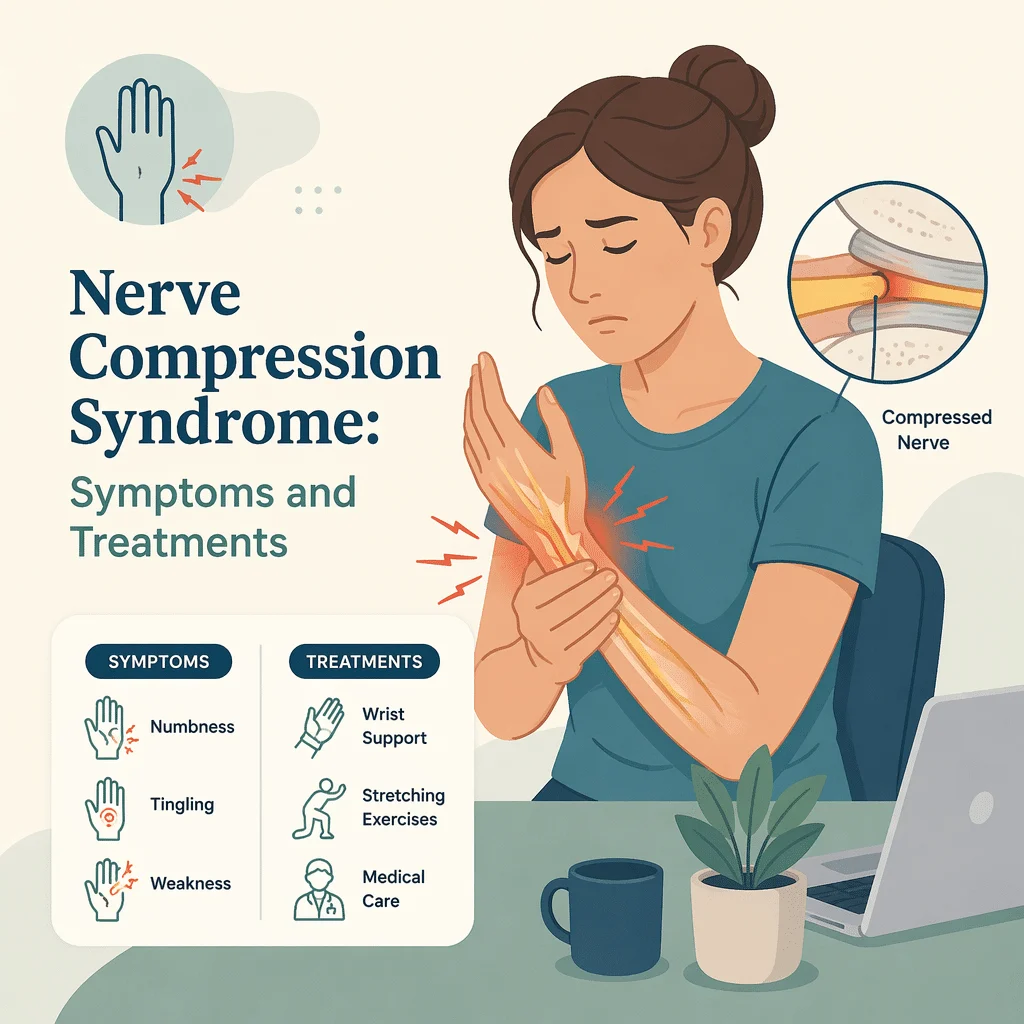
Nerve compression syndrome develops when surrounding tissue presses on a nerve and disturbs the signals it carries, producing numbness, tingling, burning pain or weakness in the area that nerve serves. The pressure can come from a swollen tendon sheath, a bulging disc, scar tissue, fluid retention, or a passage that is simply tighter than average. Most cases settle with unhurried, non-surgical care, and knowing which type you have changes what to do next. In this article you will learn how the problem begins, where it appears and what each site feels like, which tests confirm it, which blood tests find a treatable cause, and which treatments the evidence supports.
What nerve compression syndrome is
A peripheral nerve works like a bundle of insulated wires. The fibres carry sensation towards the brain and instructions out to the muscles, and a fatty sheath called myelin keeps each signal fast and clean. Nerve compression syndrome is what happens when something squeezes that bundle: the sheath deforms, the signal slows at that point, and the brain receives a garbled version of what the nerve reported.
Why pressure produces such odd sensations
Sensory fibres are thinner and more fragile than motor fibres, so they complain first. That explains the sequence most people describe: pins and needles, then patchy numbness, then a burning ache, and only later a loss of strength. Sustained pressure also throttles the tiny vessels feeding the nerve, which is why symptoms flare at night. Early changes are reversible; after months the fibres degenerate and recovery slows, the strongest argument for getting nerve compression syndrome assessed early rather than waiting it out.
How common these syndromes are
Compressed nerves are among the most frequent reasons people consult for numbness. A 2024 meta-analysis pooling more than five million people found carpal tunnel syndrome strikingly common, though figures varied enormously depending on whether the diagnosis rested on symptoms or formal testing. The honest summary: it affects a meaningful slice of adults, women far more often than men, and the true number depends on where you draw the diagnostic line.
Where nerves get trapped and what each site feels like
Nerves are vulnerable wherever they pass through a tight tunnel of bone, ligament or muscle, or sit close to the surface with little padding. Because each nerve supplies a defined territory of skin and set of muscles, your symptom pattern usually reveals the site long before any test does.
| Compression site | Nerve involved | Signature symptoms | Common triggers |
|---|---|---|---|
| Wrist (carpal tunnel) | Median nerve | Numbness in the thumb, index and middle fingers, worse at night; weak pinch grip | Repetitive gripping, vibrating tools, pregnancy, thyroid or blood sugar disorders |
| Inner elbow (cubital tunnel) | Ulnar nerve | Tingling in the ring and little fingers, inner elbow ache, clumsy grip | Leaning on the elbow, long periods with it bent, sleeping arm folded |
| Neck (cervical radiculopathy) | Cervical nerve root | Shooting pain from the neck into the shoulder and arm, patchy numbness, weakness | Disc herniation, osteoarthritic bone spurs, neck injury |
| Lower back (lumbar radiculopathy, sciatica) | Lumbar or sacral nerve root | Pain from the buttock down the back of the leg, numbness in the calf or foot | Disc herniation, spinal canal narrowing, heavy lifting |
| Outer hip and thigh | Lateral femoral cutaneous nerve | Burning and numbness across the outer thigh, no weakness | Tight belts and waistbands, weight gain, pregnancy, tool belts |
| Inner ankle (tarsal tunnel) | Tibial nerve | Burning in the sole, numbness in the heel and arch, worse after standing | Flat feet, ankle swelling, old sprain, fluid retention |
| Outer knee | Common peroneal nerve | Foot drop, numbness over the top of the foot and outer shin | Habitual leg crossing, prolonged squatting, tight casts, rapid weight loss |
Arm and hand
The wrist and inner elbow account for most upper limb cases. A useful self-check is which fingers are affected: the thumb side points to the median nerve at the wrist, the little finger side to the ulnar nerve at the elbow. Pain around the shoulder blade can come from an irritated nerve root in the neck rather than the joint itself, and we cover pinched nerve in shoulder blade causes and treatments.
Spine, hip and leg
In the lower body, compression most often begins at the spine. When a lumbar nerve root is pinched, pain travels down the leg in a narrow band, and we explain sciatica symptoms, causes and red flags. Further down, a nerve can be trapped at the knee or the ankle, and we describe pinched nerve in knee symptoms, causes and treatments.
Numbness in a single toe usually reflects a small terminal branch rather than a spinal problem, and we review numb big toe causes, symptoms and treatments. Tingling that spreads across the back rather than following one band is a different situation, and we map tingling in the back causes, patterns and red flags.
What causes nerve compression syndrome and who is at risk
It is rarely one thing. Most people with nerve compression syndrome have a mechanical trigger acting on a background that already made the nerve less resilient. Separating the two matters: the mechanical part responds to splints and technique changes, the background to treating the condition behind it.
Mechanical and anatomical causes
- Repetitive forceful gripping or pinching, especially with vibration from power tools
- Sustained awkward postures, such as hours with the elbow bent or the wrist bent back
- Direct pressure from a hard edge, crossing the legs, or a tight cast or waistband
- A herniated disc or bone spurs narrowing the space where a nerve root exits
- Swelling after a fracture, sprain or surgery, and the scar tissue that follows
- A tunnel narrow by birth, which is why some families see several affected members
Health conditions that leave nerves vulnerable
Several conditions add fluid to a tight space or make nerve fibres less tolerant of pressure. Diabetes is the clearest example: raised blood sugar damages small nerves and their blood supply, so a squeeze a healthy nerve would shrug off becomes symptomatic. If you track your numbers, we explain the A1C conversion chart that turns your A1C into average glucose, and we explain fasting blood glucose levels and what they mean.
An underactive thyroid causes swelling that narrows tunnels such as the carpal tunnel, and we cover hypothyroidism symptoms, causes and treatment. Inflammatory joint disease thickens the tissue lining tendons, and we detail rheumatoid arthritis symptoms, diagnosis and treatment. Pregnancy adds fluid retention and usually resolves after delivery. A vitamin B12 deficiency compresses nothing, but damages nerves independently and can mimic or worsen a genuine entrapment.
Work, weight and everyday habits
A 2024 systematic review of spinal nerve compression identified a consistent set of contributing factors: the middle decades of adult life, smoking, extra body weight, cardiovascular risk factors, and work involving repeated forward bending or manual handling. Several are modifiable, the encouraging part. At the wrist, duration matters more than intensity: two hours of continuous gripping is harder on a nerve than the same total spread across a day.
How doctors diagnose nerve compression syndrome
Diagnosis is built in layers. The history tells the clinician which nerve is involved, the examination tests that hypothesis, and only then do electrical or imaging tests confirm severity. Federal health agencies maintain a plain-language carpal tunnel syndrome overview.
The examination and provocative tests
Your clinician will map where sensation is reduced, test specific small muscles, and check reflexes. They then use provocative manoeuvres, which load the suspect nerve to see whether symptoms reappear. Tapping over the nerve is the Tinel sign; holding the wrists flexed is the Phalen test. A 2023 meta-analysis of thirty-one studies found neither reliable alone: a positive result is informative, a negative one misses many genuine cases. No single bedside test should reassure you if symptoms persist.
Nerve conduction studies, EMG and ultrasound
A nerve conduction study passes a small electrical pulse along the nerve and measures how fast and how strongly it arrives; a local slowdown pinpoints the compression and grades its severity. Electromyography, usually done at the same visit, samples muscle activity with a fine needle and shows whether the muscles have begun to suffer. Ultrasound is the newer alternative: painless, quick, and able to show the nerve swollen just before the squeeze, plus structural causes such as a cyst.
Blood tests that look for a treatable cause
Blood work does not diagnose a trapped nerve, but often explains why it gave way. When symptoms affect both sides, are severe for the strain involved, or improve slowly, clinicians check thyroid function, blood sugar, vitamin B12 and inflammatory markers. We explain the TSH blood test and how to read your thyroid results, we explain the vitamin B12 blood test and how to read your results, and we explain the CRP blood test and how to read your inflammation results. Correcting one of these will not release the compression, but it removes a headwind that blunts every other treatment.
Treatments for nerve compression syndrome
Treatment escalates in steps, and most people never reach the top of the ladder. The decision points are how long symptoms have lasted, whether strength or muscle bulk is being lost, and how much sleep and work suffer.
Conservative care comes first
Rest from the aggravating activity, a splint holding the joint in neutral overnight, and a change to how you work at a desk or bench form the backbone of first-line care. Nerve gliding exercises, which coax the nerve to slide freely inside its sheath, are low risk. A 2025 network meta-analysis of forty-nine trials ranked hands-on manual therapy highest for pain relief. Anti-inflammatory tablets help the ache but not the pressure.
Corticosteroid and other injections
A steroid injection near the tunnel reduces swelling and can buy months of relief, valuable when the cause is temporary, as in pregnancy. It is also diagnostically useful: a good response supports the diagnosis. Relief often fades, and repeated injections are avoided because they weaken nearby tissue.
When surgery makes sense
Surgery releases the structure doing the squeezing, most commonly by dividing the ligament that forms the roof of the carpal tunnel. It is reserved for symptoms persisting despite months of conservative care, or for anyone showing muscle wasting or constant numbness, where waiting risks permanent loss. Recovery takes weeks for light activity and months for heavy grip work. Night-time numbness often improves within days; fingertip feeling takes longer.
When to see a doctor about nerve compression syndrome
Most compressed nerves are an inconvenience rather than an emergency, but a few should not be managed at home.
Seek same-day or emergency care if you have:
- New weakness that stops you lifting your foot, gripping or holding objects
- Numbness around the groin, buttocks or inner thighs, or new loss of bladder or bowel control, alongside back pain
- Symptoms appearing suddenly after a fall, road accident or direct blow
- Rapidly spreading numbness on both sides of the body
- Fever, unexplained weight loss or night pain alongside back and leg symptoms
Book a routine appointment if you have:
- Tingling or numbness waking you most nights for more than two or three weeks
- Symptoms in both hands or both feet, which raises the chance of a medical cause
- Visible thinning of the muscle at the base of the thumb
- Numbness that has become constant rather than intermittent
- No improvement after a month of splinting and activity changes
Preventing nerve compression syndrome from returning
Once irritated, a nerve stays sensitive for a long time, so prevention is about removing sustained load. Keep joints near neutral: a wrist neither bent forward nor backward, an elbow not folded past a right angle for hours. Break up long stretches of the same movement, and check what your body rests on, since armrests, desk edges and leg crossing are frequent culprits.
Keeping the underlying medical picture in good order matters just as much. Stable blood sugar, a treated thyroid, controlled inflammation and adequate vitamin B12 give a nerve more margin before pressure becomes symptomatic. Smoking is worth singling out: it appears repeatedly as a risk factor for spinal nerve compression and narrows the vessels supplying nerves. Gradual weight loss lowers spinal loading and tissue swelling.
Latest scientific advances
Research from the past three years has shifted several practical points about testing and treating a compressed nerve. Here is what the newest evidence says.
Ultrasound has caught up with electrical testing, and a normal test proves little
A 2025 systematic review compared ultrasound scanning with nerve conduction studies across eighteen earlier studies and found no meaningful difference in how well each identified carpal tunnel syndrome. A 2023 review of provocative manoeuvres pointed the same way: the Tinel sign misses roughly half of true cases. What this means for you: an ultrasound scan first is a defensible modern choice, not a shortcut, and if a clinician taps your wrist, gets no response and sends you away while symptoms keep waking you, it is reasonable to ask for further assessment.
A splint first does not close the door on surgery, and injection remains unsettled
A 2024 Cochrane review, the type that pools every trial on a question and grades how trustworthy the answer is, found surgery produced a clear overall improvement more often than non-surgical care, but the gap in everyday symptoms and hand function was small enough that many would not notice it. Nearly half of those who began with a splint chose surgery later, while almost nobody operated on needed a second operation.
A separate 2024 Cochrane review compared steroid injection with surgery and found the evidence too uncertain to declare a winner. What this means for you: a splint first wastes nothing, and an injection offered before an operation reflects genuine uncertainty rather than reluctance to refer you.
Hands-on therapy performed better than expected, and hydrodissection is one to watch
A 2025 network meta-analysis, a method that ranks treatments against each other even when they were never tested head to head, pooled forty-nine trials and put manual therapy from a trained therapist top for pain relief, ahead of laser and shockwave devices; follow-up was short, so how long the benefit lasts is unknown. A 2025 review of nine small studies examined hydrodissection, injecting a little fluid alongside the nerve under ultrasound guidance to free it from the tissue pressing on it, and found simple dextrose solution best for early relief. What this means for you: skilled hands-on treatment deserves a place in the conversation, and hydrodissection is worth asking about.
For sciatica, surgery buys speed rather than a better endpoint
A 2023 analysis in a major medical journal pooled twenty-four trials on sciatica caused by a slipped disc. Surgery relieved leg pain noticeably faster in the first weeks and months, but by twelve months the difference between operated and non-operated groups had largely gone, and the authors rated their certainty as low. What this means for you: if the pain is bearable and you have no weakness, waiting is a genuine option.
Glossary
| Term | Definition |
|---|---|
| Carpal tunnel | A narrow passage on the palm side of the wrist, bounded by wrist bones and a thick ligament. The median nerve and nine tendons share the space, so any swelling raises pressure quickly. |
| Median nerve | The nerve that supplies feeling to the thumb, index and middle fingers and powers the muscles at the base of the thumb. It is the nerve trapped in carpal tunnel syndrome. |
| Ulnar nerve | The nerve running behind the inner elbow, in the groove people call the funny bone. It serves the ring and little fingers and most of the small muscles that fine-tune grip. |
| Radiculopathy | Compression or irritation of a nerve root where it leaves the spine. Symptoms follow the strip of skin that root supplies, which is why the pain travels down an arm or leg. |
| Entrapment neuropathy | The medical name for a nerve squeezed at a specific anatomical choke point. Nerve compression syndrome is the everyday term for the same thing. |
| Nerve conduction study | A test that sends a small electrical pulse along a nerve and measures how fast and how strongly the signal arrives. Slowing at one spot points to compression there. |
| Electromyography | Often shortened to EMG, this test records the electrical activity of muscle using a fine needle. It shows whether a compressed nerve has begun to affect the muscles it supplies. |
| Provocative test | A quick manoeuvre performed in the consulting room that deliberately loads a nerve to see whether it reproduces your symptoms. The Phalen test and the Tinel sign are the best known. |
| Hydrodissection | An ultrasound-guided injection of fluid alongside a nerve, intended to separate it from the tissue pressing on it. It is a newer option still under study. |
| Foot drop | Weakness of the muscles that lift the front of the foot, so the toes catch on the ground when walking. It is a warning sign of significant nerve compression. |
Frequently asked questions
Is nerve compression dangerous?
In most cases, no. A nerve that is intermittently squeezed causes unpleasant symptoms but no lasting harm, and the great majority of people recover with conservative care. The risk lies in ignoring it for a long time. Prolonged pressure damages the nerve fibres themselves, and once muscle has thinned or numbness has become constant, recovery is slower and may be incomplete even after successful surgery. There is also a small group of urgent presentations, particularly loss of bladder or bowel control with back pain, or sudden weakness after an injury, which need same-day assessment.
What does a nerve conduction test diagnose?
It measures how quickly and how strongly an electrical signal travels along a nerve, which tells the clinician three things: whether a nerve is genuinely being compressed, exactly where along its course the problem sits, and how severe the damage is. It also helps distinguish a single trapped nerve from a generalised nerve disorder affecting many nerves at once, such as the neuropathy that can accompany diabetes or a vitamin B12 deficiency. That distinction matters because the treatments are completely different.
How accurate are nerve conduction tests?
They are good but not perfect. Recent comparative research puts their sensitivity in the same range as ultrasound scanning, meaning both miss a proportion of real cases. Accuracy also varies with age: the test performs differently in younger and much older patients, partly because normal reference values shift over a lifetime. Clinicians therefore treat the result as one piece of evidence rather than a verdict, and weigh it against your symptoms and examination findings.
Does a nerve conduction test have side effects?
Serious side effects are very rare. The nerve conduction part feels like a series of brief static shocks, uncomfortable but not painful for most people, and leaves nothing behind. If electromyography is done as well, a fine needle is inserted into a few muscles, which can leave mild soreness or a small bruise for a day or two. Tell the person doing the test if you take blood thinners or have a pacemaker or other implanted device, as they will adapt the technique.
Can a nerve conduction test be done on the legs and feet?
Yes. The technique is identical to the version used on the arms, with electrodes placed along the sciatic, tibial or peroneal nerve pathways. Leg testing is commonly requested when there is foot drop, numbness in the sole or heel, or leg pain that could come either from a compressed spinal nerve root or from a nerve trapped lower down at the knee or ankle. Testing both legs helps separate a single trapped nerve from a widespread neuropathy.
How long does a compressed nerve take to recover?
It depends on how long it was compressed and how much damage occurred. Symptoms present for a few weeks often settle within a month or two once the pressure is removed. When compression has lasted many months, the insulating sheath has to rebuild, and improvement typically unfolds over three to six months. If the nerve fibres themselves were damaged, regrowth happens slowly, on the order of a millimetre a day, so feeling in the fingertips or toes may take a year or more to return, and some loss can be permanent.
Sources
- National Institute of Arthritis and Musculoskeletal and Skin Diseases — Carpal Tunnel Syndrome: Symptoms and Causes — NIAMS, National Institutes of Health. niams.nih.gov
- MedlinePlus Medical Encyclopedia — Carpal tunnel syndrome — U.S. National Library of Medicine. medlineplus.gov
- Mayo Clinic — Pinched nerve: symptoms and causes — Mayo Foundation for Medical Education and Research. mayoclinic.org
- Lusa V, Karjalainen TV, Paakkonen M, et al. — Surgical versus non-surgical treatment for carpal tunnel syndrome — Cochrane Database of Systematic Reviews, 2024. PubMed and DOI
- Ashworth NL, Bland JD, Chapman KM, et al. — Local corticosteroid injection versus surgery for carpal tunnel syndrome — Cochrane Database of Systematic Reviews, 2024. PubMed and DOI
- Chen Y, Han B, Zhang X, et al. — Conservative treatments of carpal tunnel syndrome: a systematic review and network meta-analysis — Archives of Physical Medicine and Rehabilitation, 2025. PubMed and DOI
- Dabbagh A, MacDermid JC, Yong J, et al. — Diagnostic test accuracy of provocative maneuvers for the diagnosis of carpal tunnel syndrome: a systematic review and meta-analysis — Physical Therapy, 2023. PubMed and DOI
- Gay ME, Lima JG, Vieites V, et al. — Comparison of diagnostic modalities for carpal tunnel syndrome: a systematic review — Cureus, 2025. PubMed and DOI
- Lee K, Park JM, Yoon SY, et al. — Ultrasound-guided nerve hydrodissection for the management of carpal tunnel syndrome: a systematic review and network meta-analysis — Yonsei Medical Journal, 2025. PubMed and DOI
- Gebrye T, Jeans E, Yeowell G, et al. — Global and regional prevalence of carpal tunnel syndrome: a meta-analysis based on a systematic review — Musculoskeletal Care, 2024. PubMed and DOI
- Liu C, Ferreira GE, Abdel Shaheed C, et al. — Surgical versus non-surgical treatment for sciatica: systematic review and meta-analysis of randomised controlled trials — BMJ, 2023. PubMed and DOI
- Hincapie CA, Kroismayr D, Hofstetter L, et al. — Incidence of and risk factors for lumbar disc herniation with radiculopathy in adults: a systematic review — European Spine Journal, 2024. PubMed and DOI
Further reading
- Low vitamin B12: symptoms, causes, treatments
- Numbness in heel: nerve causes, warning signs, tests
- Diabetes: symptoms, causes, diagnosis and treatment
- ESR blood test: what your sed rate results mean
- High TSH symptoms: what they mean and what to check next
Understand your lab results with AI DiagMe
Nerve compression syndrome is often the visible tip of a wider picture: raised blood sugar, an underactive thyroid, a vitamin B12 shortfall or ongoing inflammation all leave nerves more fragile and slower to heal. Blood tests such as HbA1c and fasting glucose, TSH, vitamin B12 and inflammatory markers like CRP put numbers on that background. AI DiagMe reads those numbers back to you in plain language, so you arrive at your appointment knowing what to ask. It helps you understand your results; it does not diagnose you and it does not replace your doctor.
Get your results interpreted in minutes