Rib cramps are sudden, gripping spasms in the muscles between the ribs, and in most cases they come from a strain rather than a disease. But rib pain and chest pain overlap, and that overlap is why this page starts with a warning rather than reassurance. In this article you will learn what an intercostal muscle spasm is, which everyday habits set one off, how costochondritis and Tietze syndrome differ from a plain strain, why shingles and rib stress fractures get missed, and which patterns mean you should stop reading and get emergency help. It is written for adults with new or recurring rib cage pain. Read the red box below first.
Call 911 or your local emergency number now, and do not drive yourself, if rib or chest pain comes with any of the following:
- pressure, tightness, squeezing or heaviness in the chest
- pain spreading to an arm, shoulder, jaw, neck, back or upper stomach
- shortness of breath, at rest or on light effort
- cold sweating for no clear reason
- nausea, vomiting, light-headedness or fainting
- unusual, unexplained exhaustion, especially in women
- coughing up blood
- sudden sharp pain on one side with breathlessness, which can signal a blood clot in the lung
- any rib pain after a fall, a crash or a significant blow to the chest
This page is health information, not a triage tool. It cannot assess you, and must never be used to talk yourself out of calling for help.
What rib cramps and intercostal muscle spasms actually are
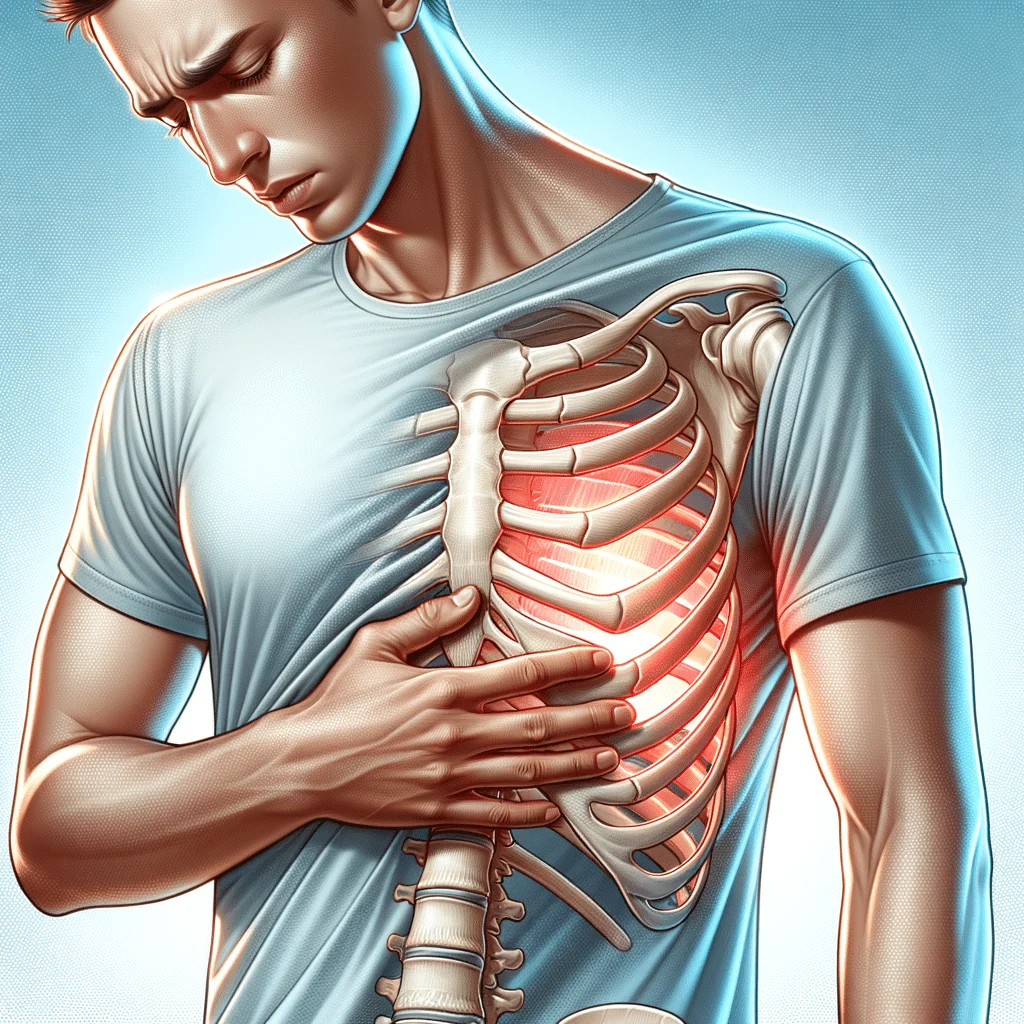
Between each pair of ribs sit thin sheets of muscle called the intercostal muscles. They lift and lower the rib cage every time you breathe, and they brace the trunk when you twist, lift or cough. Because they never really stop working, they are easy to overload and slow to rest.
A cramp, or spasm, is an involuntary contraction the muscle will not release on command. Around the ribs it feels sharp and gripping, usually on one side, and eases within seconds to a few minutes. What lingers afterwards is a duller, bruised soreness that flares with a deep breath or a stretch overhead.
A strain is different: fibers are overstretched or torn, so the soreness is constant and takes days to weeks to settle. One thing matters more than the label. A muscular explanation is a conclusion a doctor reaches after ruling other things out, never one you reach at home.
Everyday causes of rib cramps
Coughing fits, unaccustomed exercise and sudden twisting
A hard cough is one of the most demanding things you can ask an intercostal muscle to do, and several days of it will leave the rib cage genuinely sore. The same goes for a first week back at the gym, a house move, or any sudden twist that catches the trunk unprepared. Pain that starts a day after unfamiliar effort is the classic pattern.
Posture, long hours seated and stress-related bracing
Sitting slumped for hours shortens the muscles at the front of the chest and leaves those between the shoulder blades working overtime. Anxiety adds a second layer, because many people under pressure breathe shallowly and hold the rib cage half-braced all day without noticing. Both produce nagging, position-dependent discomfort.
Dehydration, electrolytes and pregnancy
Cramping is more likely when fluid and mineral balance is disturbed by heat, heavy sweating, vomiting or certain medicines. When cramps are widespread and recurrent, doctors sometimes check magnesium blood levels or potassium test results. Be careful with this idea, because an abnormal mineral level rarely explains pain confined to one spot on one side. Pregnancy is a separate and common cause, since the growing uterus pushes the lower ribs outward and stretches the muscles between them.
The side stitch during exercise
Runners and swimmers know the sharp, cramping pain under the ribs that arrives mid-effort and vanishes minutes after stopping. Sports medicine calls it exercise-related transient abdominal pain. It is harmless, it is linked to eating or drinking large volumes shortly before exercise, and it fades as fitness improves. A stitch that behaves unlike your usual one, or that does not settle with rest, deserves a professional opinion.
Costochondritis and Tietze syndrome: when the rib joints are inflamed
Ribs do not attach directly to the breastbone. They connect through costal cartilage, and those junctions can become inflamed. Costochondritis is that inflammation: aching or sharp pain at the front of the chest, typically over the fourth to sixth rib joints, worse on deep breathing or coughing. Tietze syndrome is the less common cousin, adding visible swelling at a single joint, usually in younger adults.
Here is the genuinely useful part. If pressing firmly on one spot of the chest wall reproduces the exact pain you came in with, a musculoskeletal cause becomes considerably more likely, and clinicians treat reproducible tenderness as a real diagnostic signal.
What it does not do is exclude anything. A heart attack and a tender rib joint can occupy the same chest on the same afternoon, and pressing on your own ribs is not a test. Inflamed rib cartilage occasionally has a rheumatic or infectious cause, another reason a persistent case belongs in a consulting room.
When it is a rib stress fracture or a slipping rib
Bone stress injuries in athletes
Ribs can crack from repetition alone, without any single impact. Rowers, pitchers, swimmers, golfers and weightlifters are all affected. Pain builds over weeks, sharpens on the movement that caused it, and bites when you sneeze or roll over in bed. Because it starts as a vague rib or shoulder ache, it is frequently misread as a soft-tissue strain and diagnosed late.
Slipping rib syndrome
The lower ribs join each other by cartilage rather than the breastbone. If that connection loosens, a rib tip can slide over its neighbour and irritate the nerve underneath. People describe a click or pop, then a stabbing pain in the lower rib or upper abdomen that certain positions reproduce. It is under-recognized, often mistaken for a digestive problem, and can persist for years before anyone names it.
Shingles and referred pain: two mimics worth knowing
Shingles before the rash appears
Shingles is a reactivation of the chickenpox virus in a single nerve, and the rib cage is one of its favorite territories. The catch is timing. The US Centers for Disease Control and Prevention notes that pain, itching or tingling can begin several days before any rash appears, so the earliest phase looks like a muscle or nerve problem.
The clue is the pattern: burning, electric or band-like pain wrapping around one side of the chest, never crossing the midline, often with skin so sensitive that clothing hurts. If a blistering stripe then appears along that band, contact a doctor promptly rather than waiting, because antiviral treatment works best when it starts early. Our guide covers shingles symptoms and testing.
Organs that send pain to the ribs
Pain felt at the ribs does not always start there. Gallbladder problems classically refer pain to the right lower ribs and right shoulder blade, sometimes hours after a fatty meal, and our article explains gallbladder emergencies and their warning signs. The spleen can produce left-sided rib pain. The kidneys refer pain to the flank and lower ribs, a pattern anyone will recognize who has read about kidney stones and their symptoms. The pleura, the lining around the lungs, stabs with each breath in, as described in our piece on pneumonia and back pain.
Why you cannot tell muscle pain from heart or lung pain yourself
This is the section that matters most. Readers of a page about rib cramps are, understandably, looking for permission to relax. That permission cannot honestly be given.
Muscular chest wall pain, cardiac pain and pain from a clot in the lung share too many features to be separated by feel. Heart attacks do not always announce themselves with crushing central pain. The US National Heart, Lung, and Blood Institute lists symptoms that can start slowly, stay mild, come and go over hours, or occur with no chest pain at all. Pain in the shoulder, back, arm or upper stomach is on that list, and so is unexplained tiredness lasting days.
Women are affected by this more than men. The same institute states that women are more likely to have shoulder, back or arm pain, breathlessness, unusual weakness, an upset stomach or anxiety, with or without chest pain, and that many women do not recognize these as cardiac symptoms and delay going to hospital. Women are also more likely to have heart attacks not caused by narrowed coronary arteries, which makes them harder to detect on first-line testing. If you are a woman weighing up whether rib pain is “just muscular”, that should push you toward getting checked, not away from it.
| Situation | What the pain is like | What goes with it | What to do |
|---|---|---|---|
| More likely musculoskeletal | Sharp or aching in one small spot, changes with posture, movement or a deep breath, and pressing on the spot reproduces it | A recent cough, unfamiliar exercise, a twist or long desk hours, and you feel well | Avoid what triggers it and book a routine appointment if it is not improving within two weeks |
| Needs same-day medical review | Persistent, worsening, waking you at night, or a one-sided burning band that clothing aggravates | Fever, a new rash, weight loss, a lump over a rib, known cancer, osteoporosis, or past blood clots | Contact your doctor or an urgent care service today, not next week |
| Call 911 immediately | Pressure, tightness or heaviness in the chest, or sudden severe one-sided pain, even if it feels muscular | Breathlessness, sweating, nausea, spread to arm or jaw, faintness, coughing blood, or recent trauma | Call emergency services now and do not drive yourself to hospital |
How a doctor sorts out rib pain
An assessment starts with the story: what you were doing when it began, what makes it better or worse, how it has changed, and your risk factors. The examination follows, and it is more informative than people expect. A clinician presses along each rib and cartilage joint, watches you breathe and twist, and checks the skin for shingles.
Testing is guided by risk, not curiosity. Where a cardiac cause is possible an electrocardiogram comes first, often with a troponin blood test, the marker that rises when heart muscle is damaged. Where a clot in the lung is a concern, a D-dimer test may form part of a structured pathway, and our overview of pulmonary embolism explains why that pathway is so cautious. Inflammation may prompt a C-reactive protein measurement, and muscle damage a creatine phosphokinase blood test.
No single blood test rules a heart attack in or out alone, which is why clinicians repeat tests and combine them with the electrocardiogram and your story. Imaging is used selectively too: a chest X-ray misses many rib stress fractures, so sports physicians often go to CT or MRI when the history points that way.
If everything points to the chest wall, clinicians commonly suggest relative rest from the aggravating movement, gentle breathing and stretching once the acute phase settles, and heat or ice according to what the person finds helpful. Those measures are for a musculoskeletal cause a professional has confirmed. They are not a substitute for that confirmation, and no article can supply it. Our guides describe the same logic applied to hamstring cramps and their triggers and to knee muscle spasms.
Latest scientific advances in understanding rib pain
Research since 2023 has moved in one consistent direction: musculoskeletal chest pain is common, but the label is applied too quickly and too often.
A 2025 review in Paediatric and Neonatal Pain examined how chest pain in children is assessed. Although the cause is non-cardiac in the overwhelming majority of cases, the authors found the traditional musculoskeletal labels, including costochondritis and Tietze syndrome, have been applied far more broadly than the evidence supports. They argued the diagnosis should require reproducible tenderness or a plausible mechanical history. What this means for you: the tender-to-press sign is real and clinicians use it, but it is a supporting clue used by someone who has considered everything else, not a self-test.
A 2025 cohort study in Primary Health Care Research and Development, the TRACE study, reviewed more than 1,800 people who contacted an out-of-hours primary care service in the Netherlands about chest pain. Musculoskeletal causes were the single most common explanation in both sexes. Even so, roughly one in twenty women and one in twelve men turned out to have acute coronary syndrome, a group of conditions that includes heart attack. Reported symptoms were broadly similar between the sexes, so the description alone did not separate them. What this means for you: in exactly the population that assumes rib pain is muscular, a meaningful minority were wrong.
A 2024 cohort study in the journal Diagnosis followed troponin testing across an Amsterdam primary care network covering more than 3,000 tested patients. Musculoskeletal symptoms were again the most frequent final diagnosis, and doctors commonly ordered C-reactive protein and D-dimer alongside the troponin. Crucially, troponin testing in this setting identified about 78 of every 100 people who went on to have a heart attack or die within a month. What this means for you: a normal result is reassuring but not absolute, it is read alongside your symptoms and electrocardiogram, and that is a reliability limit rather than a flaw.
A 2025 narrative review in Current Sports Medicine Reports focused on rib bone stress injuries in athletes. It described how repetitive upper-body loading in rowing, throwing, swimming, golf and weightlifting can crack a rib without any impact, and how the resulting vague rib or shoulder pain leads to misdiagnosis and delayed management. Recovery was linked not only to rest but to training load, technique and bone health. What this means for you: if you train hard and the pain built up over weeks rather than appearing suddenly, say so explicitly, because it changes what your clinician looks for.
Finally, a 2023 study in Frontiers in Oncology traced the diagnostic journey of 300 people with multiple myeloma, a cancer of bone marrow cells. Roughly half had received a different diagnosis first, and musculoskeletal conditions including costochondritis and muscle strains accounted for the largest share. Chest or shoulder pain was among the earliest symptoms in about one in five, and having it was associated with a lower chance of a correct diagnosis within twelve weeks. What this means for you: this is not a reason to fear cancer over a sore rib, which remains uncommon. It is a reason to go back if the pain does not follow the expected course, because a musculoskeletal label given once is not permanent.
These studies point the same way. Chest wall pain is usually what it appears to be, examination genuinely helps, and the errors that cause harm come from stopping the thinking too early.
Glossary of key terms
| Term | Definition |
|---|---|
| Intercostal muscles | The layered sheets of muscle between adjacent ribs that move the chest during breathing and stabilize the trunk |
| Muscle spasm | An involuntary contraction that a muscle will not release on command, felt as a sudden gripping pain |
| Costal cartilage | The firm, flexible tissue that connects the ribs to the breastbone and to one another |
| Costochondritis | Inflammation of the joints where ribs meet the breastbone, causing pain that is tender to press |
| Tietze syndrome | A less common condition similar to costochondritis but with visible swelling at a single rib joint |
| Slipping rib syndrome | A condition in which a loose lower rib slides over its neighbour and irritates the nerve beneath it |
| Bone stress injury | Damage to bone caused by repeated loading over time rather than by a single impact |
| Referred pain | Pain felt in one part of the body that originates in an organ or structure somewhere else |
| Pleura | The thin lining around the lungs and inside the chest wall, which causes stabbing pain when inflamed |
| Postherpetic neuralgia | Long-lasting nerve pain that can persist in the area where a shingles rash has healed |
Frequently asked questions
Is my rib pain a heart attack?
Nobody can answer that from a description, and this page will not try. Cardiac pain can be mild, can come and go, can sit in the shoulder or jaw instead of the chest, and can appear without chest pain at all. If you have pressure or tightness in the chest, spreading pain, breathlessness, sweating, nausea, faintness or unexplained exhaustion, call 911 now. If none of those apply but the pain is new, persistent or frightening you, contact a doctor today for an assessment. Doing nothing because a website described muscle cramps is the outcome to avoid.
Why do my ribs cramp when I cough?
Coughing is a violent, repeated contraction of the intercostal muscles and the diaphragm. After a few days of a chest infection those muscles are fatigued and inflamed, so each new cough lands on tissue that is already sore. That is the most common reason rib pain follows a cold or a flu. It should ease as the cough settles. Rib pain that appears with fever, colored phlegm, breathlessness or coughing up blood is a different situation and needs same-day medical attention rather than patience.
How long do rib cramps last?
The spasm itself usually passes within seconds to a few minutes. The soreness left behind commonly lasts a few days, and a genuine muscle strain around the ribs can take two to six weeks because the muscles are used with every breath and cannot be immobilized. Costochondritis often runs longer, sometimes several weeks to months, with flares. Pain that is still worsening after two weeks, or that has changed character, should be reassessed rather than waited out.
Can dehydration or low electrolytes cause rib cramps?
Disturbed fluid and mineral balance makes cramping more likely across the whole body, and heat, heavy sweating, vomiting, diarrhea or certain medicines can all contribute. It is a weaker explanation than most people assume for pain fixed in one spot on one side, which points more towards a local muscle, joint or nerve problem. A clinician who suspects a mineral cause will usually test rather than guess, and will look for a reason behind any abnormal result.
Are rib cramps normal in pregnancy?
Rib discomfort is very common in later pregnancy, because the uterus pushes the lower ribs outward and stretches the muscles between them while hormonal changes loosen the joints. It typically eases after delivery. Pregnancy also raises the risk of blood clots and of certain heart problems, and pregnancy-related conditions such as preeclampsia can cause pain under the right ribs. Any rib or chest pain in pregnancy with breathlessness, severe headache, visual changes, swelling or nausea should be discussed urgently with your maternity team.
What is the difference between costochondritis and a rib fracture?
Costochondritis is inflammation of cartilage and produces tenderness spread across one or more rib joints near the breastbone, usually without any injury. A fracture, whether from impact or from repetitive loading in sport, tends to produce pain concentrated on one precise point of bone, sharp with coughing, sneezing or rolling over in bed. Only imaging can separate them reliably, and stress fractures in particular are often invisible on a standard chest X-ray, so a normal X-ray does not settle the question.
Sources
- MedlinePlus, US National Library of Medicine: Chest Pain
- National Heart, Lung, and Blood Institute: Heart Attack Symptoms
- National Heart, Lung, and Blood Institute: Heart Attacks in Women
- Centers for Disease Control and Prevention: Shingles Symptoms and Complications
- Kassab M, Katyal A, Franciosi S, Sanatani S. Chest Pain in Children: Is It Another “Growing Pain”? Paediatric and Neonatal Pain, 2025
- Manten A, Hummel B, Bolijn R, et al. Sex differences in chest pain presentation, triage assessment, and outcomes in urgent primary care: findings from the TRACE cohort study. Primary Health Care Research and Development, 2025
- Harskamp RE, Melessen IM, Manten A, et al. Troponin testing in routine primary care: observations from a dynamic cohort study in the Amsterdam metropolitan area. Diagnosis, 2024
- Schwanz KL, Karnovsky SC, Malafronte J, et al. Rib Bone Stress Injuries: A Narrative Review with Protocol for Rehabilitation and Prevention. Current Sports Medicine Reports, 2025
- Vijjhalwar R, Song K, Shrestha R, et al. Patient-reported symptoms and diagnostic journey in Multiple Myeloma. Frontiers in Oncology, 2023
Further reading
- Tingling in the chest: causes and risks
- The cardiac markers panel
- How to read an electrolyte panel
- Dehydration and blood pressure
- Pulmonary embolism: symptoms and diagnosis
Understand your lab results with AI DiagMe
If a doctor investigates rib or chest pain, they may order tests such as troponin, D-dimer, C-reactive protein or muscle enzymes, and the results often arrive before anyone has time to explain them. AI DiagMe helps you understand those numbers in plain language after your appointment, so you can ask better questions at the follow-up. It does not diagnose, it does not triage symptoms, and it is not for emergencies. If you have chest pain with any of the warning signs on this page, call 911 instead of opening a website.
Get your results interpreted in minutes