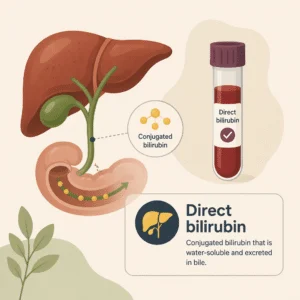

































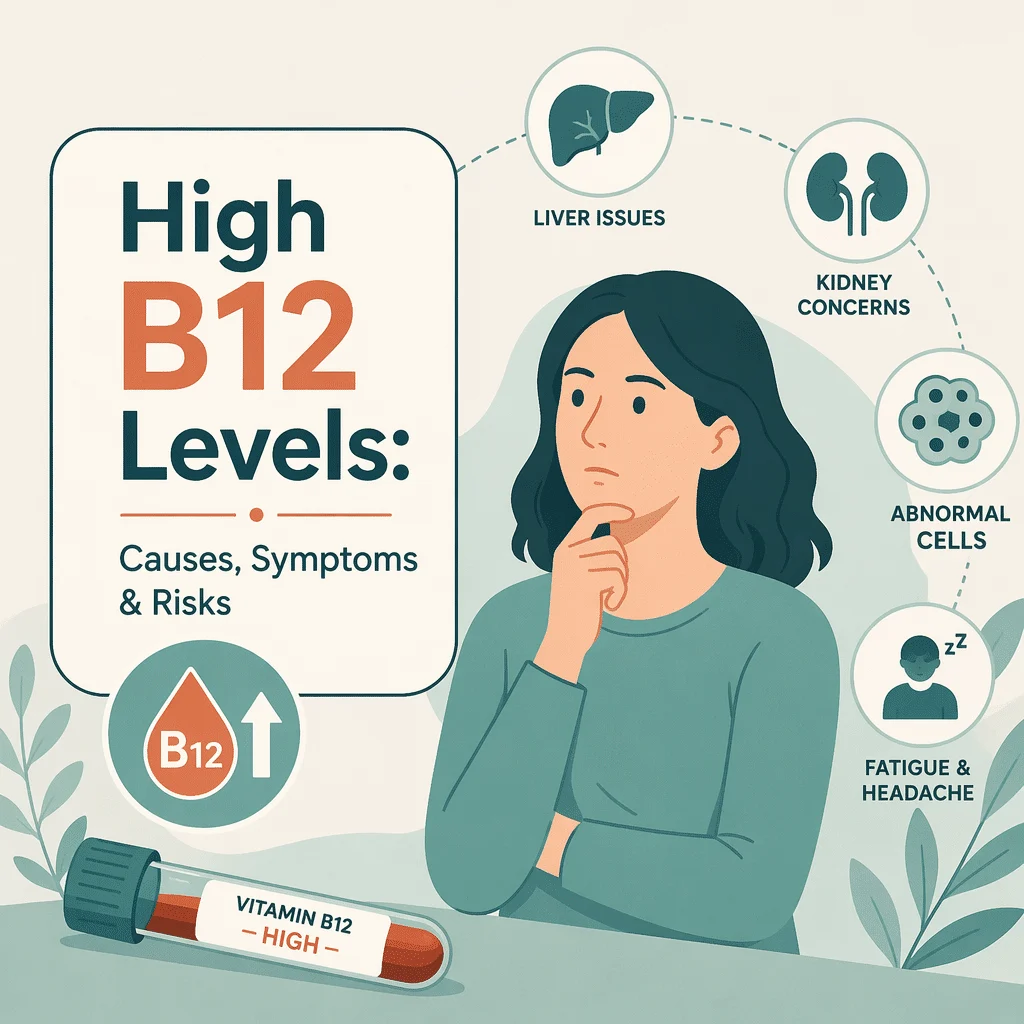
If a lab report shows high B12 levels, the most likely explanation is also the most reassuring one: vitamin B12 is going into your body from outside. Oral supplements, B-complex tablets, multivitamins, fortified cereals and plant milks, energy drinks and, above all, B12 injections all push the number up. That is exactly what they are designed to do.
Excess vitamin B12 from supplements is not considered toxic. The body excretes what it cannot use, which is why no upper intake limit has ever been set for it.
A second scenario deserves calm attention: a raised B12 in someone taking nothing at all. That is not a diagnosis, but it is worth a conversation with a doctor.
In this article you’ll learn why supplements and injections raise B12 and why that is harmless, how B12 travels in the blood and why a total number can mislead, what an unexplained elevation can point to, what functional deficiency means despite a high result, what a doctor does next, and when to seek advice.
What a high B12 means on a lab report
Vitamin B12, also called cobalamin, is measured in serum, the liquid part of blood left after clotting. Most United States laboratories report a reference range of roughly 160 to 950 pg/mL, though exact figures differ between labs, so a result should be read against the range printed on your own vitamin B12 blood test report.
A value above that range is called hypercobalaminemia. It describes a number, not a disease, and unlike a high potassium or calcium it does not itself damage tissue.
People often search for the symptoms of high B12 levels. The honest answer is that a raised B12 on its own usually causes none: any symptoms you do have are far more likely to belong to whatever caused the elevation than to the vitamin.
Why supplements and injections raise B12, and why that is not harmful
By a wide margin, the commonest reason for high B12 levels is supplementation. That is not a side effect or a mistake, but the expected result of taking the vitamin.
Tablets, B-complex products and fortified foods
Adults need about 2.4 micrograms of vitamin B12 a day, according to the National Institutes of Health Office of Dietary Supplements. Over-the-counter tablets frequently contain hundreds or thousands of times that amount. Only a small share of a large oral dose is absorbed by the body’s usual receptor-based route, but the surplus crossing the gut wall by simple diffusion is still enough to lift a serum reading well above the reference range.
Fortified breakfast cereals, nutritional yeast, plant-based milks, protein powders and energy drinks contribute quietly. Many people certain they take no supplements are in fact getting a substantial daily dose from a fortified product they think of as ordinary food, as our guide to vitamin B12 sources sets out.
B12 injections
Intramuscular B12 bypasses the digestive system entirely. A single injection can send a serum level into the thousands and keep it elevated for weeks or months. If you have had an injection in the past year, an elevated result is expected and needs no further explanation.
This matters practically. Injections are usually prescribed for a diagnosed deficiency, sometimes for life, as in pernicious anemia or after stomach surgery. Stopping them because a follow-up test looks too high would be a mistake, and untreated vitamin B12 deficiency can cause lasting nerve damage. Only the prescriber can make that decision.
Is there an upper limit for B12?
Vitamin B12 has no Tolerable Upper Intake Level. The Office of Dietary Supplements states that none has been established because B12 is regarded as safe even at high doses, with the kidneys clearing the surplus into the urine. A high number driven by intake is therefore a bookkeeping observation, not a health problem.
How B12 travels in your blood, and why a total B12 can mislead
Vitamin B12 does not float freely in plasma. It rides on two carrier proteins, and the distinction between them explains most of the confusion around this test.
Haptocorrin, also known as transcobalamin I, carries the large majority of circulating B12, typically around three-quarters of it. That fraction is a parked reservoir your cells cannot take up.
Transcobalamin carries the smaller remaining share, and that is the fraction cells can absorb and use. Laboratories occasionally report it separately as active B12 or holotranscobalamin.
A standard serum B12 test measures both fractions together, so a total result mostly reflects how much haptocorrin is circulating, and haptocorrin is made by white blood cells. Anything that increases white cell production, or releases haptocorrin-bound B12 from a damaged organ, lifts the total without saying anything about whether your tissues have enough usable vitamin.
What an unexplained high B12 can point to
If you take no supplements, have had no injections, eat no heavily fortified products and your B12 is repeatedly high, the pattern is worth investigating. It is a recognized and under-appreciated laboratory signal. Three organ systems come up most often.
The liver
The liver is the body’s main B12 store. When liver cells are damaged by alcohol, viral hepatitis, fatty liver disease or cirrhosis, stored B12 leaks into the bloodstream and the liver clears haptocorrin less efficiently. MedlinePlus lists liver disease, including cirrhosis and hepatitis, among the recognized causes of an increased B12 level. In one Spanish hospital series of adults with a very high B12 and no supplementation, structural liver disease was present in roughly a quarter. This is why liver function tests are usually ordered alongside a repeat B12.
The bone marrow
Because haptocorrin is made by white blood cells, conditions in which the marrow overproduces those cells raise the total B12. MedlinePlus specifically names myeloproliferative disorders, including polycythemia vera and chronic myelogenous leukemia.
In these conditions the high B12 almost never appears alone. The full blood count is usually abnormal too, with a raised white cell count, platelet count or hematocrit. A high B12 with an entirely normal blood count is far less concerning than one sitting next to abnormal counts.
The kidneys
The kidneys are the main route by which surplus B12 leaves the body. When kidney function declines, clearance slows and the level drifts upwards. This is usually a modest rise in someone already known to have chronic kidney disease, showing up alongside other changes on a kidney function panel.
High B12 and cancer: what the research honestly shows
Several observational studies have found that among people with an unexplained high B12, meaning elevated with no supplement or injection to account for it, a cancer is subsequently diagnosed more often than in people with a normal B12. The association is real and has been reproduced often enough that internists have written about it for years.
Now the proportion, because three things are true at once. First, the association comes from groups of patients, largely hospital populations already unwell enough to have blood taken. It is not a screening test, it has never been validated as one, and no guideline recommends measuring B12 to look for cancer.
Second, most people with a raised B12 do not have cancer and will not develop it. In the cohorts studied, the large majority of raised results were explained by supplementation, by liver disease, or by nothing identifiable at all.
Third, where a malignancy is found it is most often a liver cancer or a blood cancer, the two categories that also explain the biology: one involves the organ storing B12, the other the cells making its carrier protein.
The translation is straightforward. An unexplained high B12 is a reason to mention the result to your doctor and have a basic set of checks done. It is not a reason to assume the worst, and it is not a cancer test.
Functional B12 deficiency despite a high level
Serum B12 is a poor marker of whether your tissues have enough usable vitamin. Because most of what the test measures is inert haptocorrin-bound B12, it is entirely possible to have a normal or even high total B12 while your cells are functionally short. Nerve symptoms in someone whose B12 looks normal are the classic example.
Two other blood tests answer the question the B12 level cannot. Methylmalonic acid, usually shortened to MMA, and homocysteine are substances the body clears using B12-dependent enzymes. If usable B12 is inadequate, both accumulate. A raised MMA in particular is the standard way to confirm that a deficiency is real at cell level.
Folate matters here too, since homocysteine also rises when folate is low, which is why a folate blood test is often run alongside. Because both vitamins affect red cell size, a raised MCV can also be a clue when the B12 looks comfortable.
So if you have symptoms that fit B12 deficiency and a high serum B12, the two facts are not contradictory. A doctor may reasonably check MMA and homocysteine rather than dismissing the possibility on the strength of the total.
What to do about a high B12
Reading your own situation at a glance
The table below covers the four situations that account for almost every high B12 result.
| Your situation | What it usually means | What to do |
|---|---|---|
| You take a B12 or B-complex supplement, a multivitamin, or fortified foods and drinks | An expected result. Supplemental B12 raises the serum level by design and the surplus is passed in the urine. | Nothing urgent. Tell your doctor exactly what you take so the result can be read correctly. Do not change a prescribed dose on your own. |
| You have had B12 injections in the past year | Expected, often for months after the last dose, because injections bypass the gut and can push levels very high. | Continue as prescribed. Only the prescriber should change or stop an injection given for a diagnosed deficiency. |
| You take no B12 in any form and the level is high | An unexplained elevation. Usually still benign, but it is a recognized signal that deserves a look. | Book a routine appointment. Expect a repeat B12, a full blood count and liver function tests. |
| High B12 alongside an abnormal blood count or abnormal liver tests | The combination is far more informative than the B12 alone and points towards the liver or the bone marrow. | See your doctor promptly rather than waiting. A referral to a hematologist or a liver specialist may follow. |
What a doctor usually does next
The first step is almost never another blood test. It is a conversation.
Your doctor will ask what you take: prescription vitamins, over-the-counter tablets, multivitamins, injections at any point in the past year, protein shakes, fortified cereals, energy drinks. That question resolves most cases on the spot, and no further work-up is needed.
If nothing explains it, a sensible next round usually includes a repeat B12 to confirm the finding is not a one-off, a full blood count, and liver enzymes such as ALT and AST. Kidney function is often checked at the same time.
Depending on what those show, a doctor may add abdominal imaging or refer to a hematologist or liver specialist. If your symptoms suggest deficiency despite the high number, MMA and homocysteine may be added.
What a doctor will not usually do is treat the B12 number itself. There is nothing to lower and no medication for it: the work is directed at the explanation, not the value.
When to see a doctor
Signs that warrant a doctor’s review
- Unexplained weight loss
- Night sweats
- Unusual bruising or bleeding
- Persistent fatigue together with an abnormal full blood count
- Yellowing of the skin or eyes, or swelling of the abdomen
- A high B12 in someone taking no supplements, no injections and no fortified products
Outside these situations, a high B12 in someone who takes a supplement is not an emergency. Mention it at your next routine visit so it can be interpreted in context.
Latest scientific advances in understanding high B12
Research published since 2023 points in two directions at once: reassurance about supplements, and a clearer sense of when an elevation deserves attention. According to PubMed:
A systematic review of elevated B12, cancer and mortality (2024)
What was found: a team at Pontificia Universidad Javeriana in Bogota pooled thirteen studies of adults with abnormally high B12. Across those examining cancer, an elevated B12 was consistently associated with a higher chance of a cancer being present or later diagnosed. The link with overall death rates was much less consistent.
What this means for you: the association keeps appearing across independent studies, which is why doctors take an unexplained elevation seriously. But an association seen in groups of patients is a long way from a prediction about any one person, and the authors note that the causes of a high B12 are multiple and its consequences not clearly established.
An incidental-finding cohort from a Spanish university hospital (2023)
What was found: among 4,800 people who had a B12 measured, about 7 in 100 had a level above 1000 pg/mL. After excluding those taking B12 and those already known to have cancer, 250 patients were followed for roughly two years. Structural liver disease was found in about a quarter. A solid-organ cancer was diagnosed in around one in five and a blood cancer in about one in fourteen, most often within the first year.
What this means for you: this was a hospital population, so the percentages are far higher than in a well person having a routine check. The useful lesson is about timing. If an unexplained elevation is going to matter, it tends to declare itself within about a year, which is why a doctor may simply arrange follow-up rather than an immediate hunt.
Functional cobalamin deficiency in the general United States population (2024)
What was found: researchers analyzing more than 22,000 adults from the National Health and Nutrition Examination Survey defined functional cobalamin deficiency as a raised methylmalonic acid despite a serum B12 above 400 pg/mL. Around 4.5 in 100 adults fitted that pattern, roughly twice as many as had classic low-B12 deficiency, and it was linked to higher long-term mortality while classic deficiency was not, once other factors were accounted for.
What this means for you: a comfortable-looking B12 does not guarantee your cells are getting what they need. If you have symptoms that fit deficiency, asking your doctor about methylmalonic acid is reasonable even when the B12 looks fine.
Elevated cobalamin in childhood (2025)
What was found: a retrospective review of 388 children with a very high B12 at a large hospital in Ankara. Supplementation explained close to half the cases and more than 8 in 10 children had no symptoms at all. Five children with neither supplementation nor a known chronic illness were later diagnosed with a malignancy, including chronic myeloid leukemia.
What this means for you: the same two-part message applies to children. Most high results are explained by treatment and are harmless, but a persistently high level with no explanation should be followed rather than filed away.
Glossary of key terms
| Term | Definition |
|---|---|
| Cobalamin | The chemical name for vitamin B12. |
| Hypercobalaminemia | The medical term for a vitamin B12 level above the laboratory reference range. |
| Haptocorrin | A carrier protein made by white blood cells that transports most of the B12 in blood in a form cells cannot use. |
| Transcobalamin | The carrier protein that delivers the smaller, usable fraction of B12 to cells; sometimes reported as active B12. |
| Methylmalonic acid (MMA) | A substance that builds up when cells lack usable B12, used to confirm a true deficiency. |
| Homocysteine | An amino acid that rises when B12 or folate is insufficient at cell level. |
| Myeloproliferative disorder | A group of bone marrow conditions in which too many blood cells are produced. |
| Serum | The liquid part of blood remaining after it has clotted, and the fraction B12 is measured in. |
| Reference range | The span of values a laboratory considers typical for its own test and population. |
| Pernicious anemia | An autoimmune condition that blocks B12 absorption and is usually treated with lifelong injections. |
Frequently asked questions
Can you have too much B12?
Not in the way people usually fear. Vitamin B12 is water-soluble, and the kidneys pass the surplus into the urine rather than storing it. The National Institutes of Health Office of Dietary Supplements has not set a Tolerable Upper Intake Level for B12 precisely because no reliable evidence of harm from high intakes has been established in healthy people. So a high number caused by tablets, fortified foods or injections is not itself a toxicity problem. What matters is whether something other than intake is behind the result.
Does high B12 mean cancer?
No. Most people with a high B12 do not have cancer. Studies in hospital patients have found that an unexplained elevation, with no supplement or injection to account for it, is associated with a higher chance of a cancer being diagnosed, most often a liver or blood cancer. That association is a reason to mention the result to your doctor and have a repeat test, a full blood count and liver tests. It is not a cancer test, it has never been validated as one, and it says nothing definite about any individual.
Should I stop my B12 supplement because my level is high?
Talk to your doctor first, and do not stop an injection prescribed for a diagnosed deficiency. B12 injections are often given for conditions such as pernicious anemia or after stomach surgery, where stopping can allow nerve damage to develop. For an over-the-counter tablet you are taking without a medical reason, your doctor may suggest pausing it and repeating the test later so the result can be interpreted cleanly. That decision belongs with the person who knows your history.
Can high B12 levels cause symptoms?
Very rarely on their own. A raised serum B12 does not damage tissue and is not associated with a recognizable set of symptoms. If you feel unwell alongside a high result, the symptoms are much more likely to come from whatever caused the elevation, such as liver disease or a blood disorder, than from the vitamin. Some people report acne or a flushing sensation after high-dose injections, but that relates to the injection rather than the blood level.
How long do high B12 levels take to come down?
It depends on the source. After stopping oral tablets, levels usually fall over several weeks to a few months. After injections the decline is slower, and a level can stay above the reference range for six months or more after the last dose. This is why doctors often wait and repeat the test rather than acting on a single reading. If the level stays high with no B12 going in, that persistence is the finding worth investigating.
Can a high B12 result be a laboratory error?
It can happen. Assay interference, sample handling and taking a supplement shortly before the blood draw can all distort a reading, and different laboratories use different methods and reference ranges. A single unexpected result is rarely acted on alone. Confirming with a repeat sample, ideally at the same laboratory, is a standard and sensible first step before anyone starts looking for an underlying cause.
Sources
- National Institutes of Health, Office of Dietary Supplements. Vitamin B12: Fact Sheet for Health Professionals
- MedlinePlus, National Library of Medicine. Vitamin B12 level
- National Institute of Diabetes and Digestive and Kidney Diseases. Cirrhosis
- Amado-Garzon SB, Molina-Pimienta L, Vejarano-Pombo A, Velez-Bonilla M, Moreno-Chaparro J, Buitrago-Lopez A. Elevated Vitamin B12, Risk of Cancer, and Mortality: A Systematic Review. Cancer Investigation, 2024. https://doi.org/10.1080/07357907.2024.2366907
- Pardo Lledias J, Martin Millan M, Mazariegos Cano JA, Aimar Marco C, Arias Martinez N, San Pedro Careaga B, Urizar Ursua E, Insua Garcia MC, Lavin Gomez BA, Hernandez Hernandez JL. Incidental detection of raised serum levels of vitamin B12 and its association with neoplasms. Revista Clinica Espanola, 2023. https://doi.org/10.1016/j.rceng.2023.12.002
- Liu Y, Gao Y, Liu Y, Zhang Y, Wang S, Yu B. Prevalence of Functional Cobalamin Deficiency and Relevant Mortality Risk in the General Population: An Unheeded Phenotype Distinct from Cobalamin Deficiency. Journal of the American Nutrition Association, 2024. https://doi.org/10.1080/27697061.2024.2412594
- Kalayci F, Yigit M, Kalyoncu Arican GM, Gokdol MY, Tekin MY, Kalayci OK, Celebier K, Kacar D, Yarali N. Elevated serum cobalamin levels in childhood: a retrospective analysis. BMC Pediatrics, 2025. https://doi.org/10.1186/s12887-025-06304-1
Further reading
- Vitamin B12 blood test: understanding your results
- Folic acid blood test
- High MCV levels: causes and symptoms
- Liver function tests
- Complete blood count
Understand your lab results with AI DiagMe
A high B12 rarely makes sense on its own. It reads very differently next to a full blood count, liver function tests and a folate result, and next to the list of supplements you actually take. AI DiagMe puts your vitamin B12 value back into that context in plain language, so you can see which questions are worth raising. It helps you understand your results, it does not diagnose, and it does not replace your doctor.
Get your results interpreted in minutes