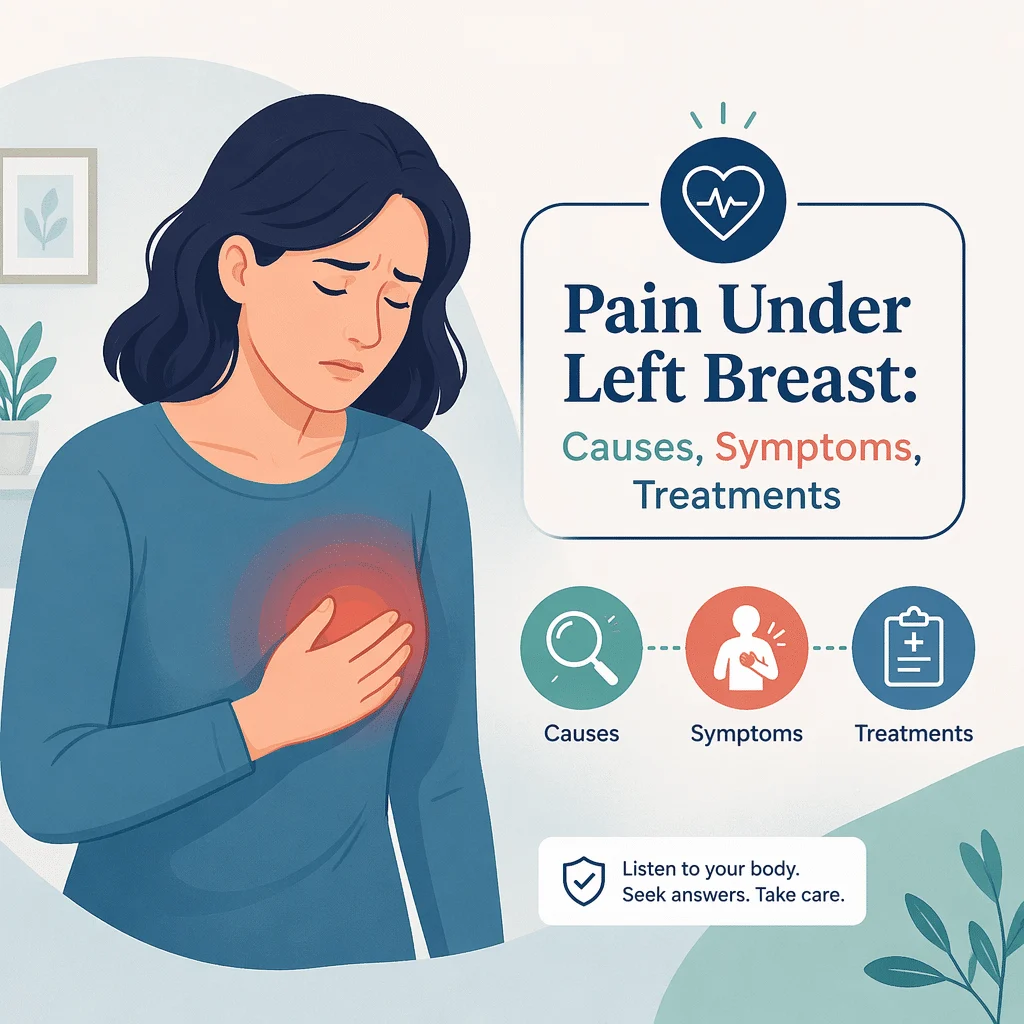
Pain under left breast is one of the most searched symptoms online, and one of the hardest to interpret. That small patch of chest sits above the stomach, beside the spleen, under the lower left lung, over the lower ribs and their cartilage — and directly in front of the heart. A dozen problems produce discomfort in the same place, and several feel remarkably similar.
In this article you’ll learn what lies under the left breast, what each group of causes feels like, why “it feels muscular” is never a safe conclusion to reach alone, and how clinicians work this out. It is written for adults with new, changing or persistent left lower chest pain. Check the red-flag box immediately below before reading on.
Call 911 now if any of these apply
Do not drive yourself and do not wait to see whether it passes. Call 911, or your local emergency number, if pain under your left breast comes with any of these:
- Chest pressure, tightness, squeezing or heaviness
- Pain spreading to arm, jaw, neck, shoulder or back
- Shortness of breath at rest or on light effort
- Cold sweating or clamminess
- Nausea or vomiting alongside the pain
- Light-headedness or fainting
- A strong feeling that something is badly wrong, a sense of doom
- Sudden sharp pain with breathlessness or a racing heart, which can mean a pulmonary embolism (a clot in the lung) or a collapsed lung
- Coughing up blood
- Pain after a fall, a blow to the chest or a crash
Also call 911 if the pain is severe, unlike anything before, or lasts more than a few minutes. Ambulance crews can record an ECG and start treatment on the way, and people arriving by ambulance often get faster care.
What sits under the left breast, and why the area hurts
The left lower chest is crowded. It holds the lower part of the heart and the sac around it, the lower lobe of the left lung and its lining, the top of the stomach, the splenic flexure — the sharp bend where the colon turns downward under the left ribs — and the spleen. Around all of that sit the ribs, the cartilage joining them to the breastbone, and the intercostal muscles between them.
These structures share nerve pathways. Signals from the chest wall, heart, diaphragm and upper gut reach the brain by overlapping routes, which is why a stomach problem can feel like heart pain and a heart problem can feel like indigestion. That overlap is normal anatomy, and it is the main reason self-diagnosis here fails so often.
Chest wall causes: ribs, cartilage and muscle
The chest wall is a frequent explanation for pain under the left breast, but usually only once a clinician has ruled out serious causes.
Costochondritis and Tietze syndrome
Costochondritis is inflammation where rib cartilage meets the breastbone. It causes sharp or aching pain over one spot, often worse on deep breaths, coughing, twisting or pressing. Tietze syndrome is a less common relative in which one costal joint is visibly swollen as well as tender. Both can last weeks and flare with activity.
Muscle strain, rib injury and nerve pain
The intercostal muscles between the ribs can be strained by heavy lifting, unfamiliar exercise, a long coughing illness or an awkward night’s sleep. Bruised or fractured ribs give sharp, localized pain that worsens with each breath. Spasm of these muscles gives a related pattern, described in our guide to rib cramps. Shingles can cause burning, band-like pain along one rib space for days before any rash appears, as explained in our article on shingles symptoms and testing.
Reproducible tenderness — pain that appears reliably when you press the same spot — makes a chest wall cause more likely. It excludes nothing. People having a heart attack can have a tender chest wall, and a rib strain can sit alongside a heart problem in the same person. Treat this clue as information for your clinician, not a verdict.
Digestive causes, including trapped gas at the splenic flexure
Trapped gas and splenic flexure syndrome
The splenic flexure is the sharp left-sided bend in the colon, tucked high under the ribs. Gas can collect there and stretch the bowel wall, producing cramping, fullness or a surprisingly sharp pain under the left breast — a pattern sometimes called splenic flexure syndrome. It often shifts position, eases after burping or opening the bowels, and comes and goes over hours. It is common and rarely explained well, but it is a conclusion reached after serious causes are considered, not a first assumption.
Reflux, gastritis, ulcers and the pancreas
Gastroesophageal reflux disease (GERD) pushes stomach acid into the esophagus and burns upward toward the throat, worse after large meals, bending forward or lying down. Gastritis and peptic ulcers cause gnawing upper abdominal pain felt under the left ribs. Pancreatitis causes steady, severe upper abdominal pain that bores through to the back, usually with vomiting.
Reflux is the cause most often identified when chest pain turns out not to be cardiac — which is exactly why assuming it is risky. Related reading: acid reflux and cough, chest pain after drinking soda, and pancreatitis.
The spleen
The spleen lies just under the left ribs, behind the stomach. When it enlarges — from infections such as glandular fever, from some blood disorders or from liver disease — it can cause a dull ache or fullness, sometimes with early satiety, meaning you feel full after very little food. A splenic infarct, where part of the spleen loses its blood supply, causes sharper, more persistent pain. An enlarged spleen can also bleed dangerously after modest trauma, one more reason left-sided pain after any impact needs urgent assessment rather than rest and ice.
Heart-related causes of pain under the left breast
Angina and heart attack
The heart lies behind the breastbone and extends leftward. Angina is chest discomfort caused by reduced blood flow to the heart muscle. It classically feels like pressure, tightness, squeezing or heaviness rather than a pinpoint stab, may spread to the arm, jaw, neck, shoulder or back, and stable angina appears on exertion and settles within minutes of rest. A heart attack does not settle with rest, and often comes with sweating, nausea, breathlessness or light-headedness. The NHLBI notes that heart attacks do not always begin with sudden crushing pain: symptoms can start slowly, stay mild, or come and go over hours.
Pericarditis and myocarditis
Pericarditis is inflammation of the sac around the heart, and it gives one of the few genuinely useful positional clues in chest pain: sharp pain that is worse lying flat and better sitting up and leaning forward, often worse on a deep breath. Myocarditis, inflammation of the heart muscle, can cause chest pain with breathlessness, palpitations or unusual fatigue, often after a viral illness. Both need assessment; neither is managed at home.
Women and people with diabetes are more often missed
This matters especially on a page about pain “under the left breast”, a phrase searched far more often by women. Women having a heart attack are more likely than men to have shoulder, back or arm pain, breathlessness, prolonged tiredness, an upset stomach or anxiety — with chest pain or without it. The NHLBI states that women may downplay these symptoms and delay going to hospital, and that initial hospital screening may not detect an early or atypical heart attack, leaving women at higher risk afterwards.
People with diabetes are also more likely to have blunted or absent chest pain, because nerve damage from long-standing high blood sugar dulls the warning signal. The NHLBI describes these as silent heart attacks, more common in older adults and people with high blood sugar or diabetes. If you are a woman, or you have diabetes, the absence of classic crushing chest pain is not reassurance.
Lung causes
Pleurisy, inflammation of the lining of the lung, causes sharp pain that worsens on breathing in, coughing or sneezing and eases when you hold your breath. Pneumonia adds fever, cough and breathlessness, and can refer pain into the back — see our article on pneumonia and back pain. A pneumothorax, or collapsed lung, causes sudden sharp one-sided pain with breathlessness, sometimes in tall, slim young people. A pulmonary embolism, a clot in the lung circulation, causes sudden pain, breathlessness and a fast heartbeat, occasionally with coughing up blood. The last two are emergencies, and risk rises after long immobility, recent surgery, pregnancy, cancer or a previous clot.
Anxiety and panic: real, but never a self-diagnosis
Panic attacks genuinely cause chest pain, a pounding heart, breathlessness, tingling and a sense of impending disaster, and they are a common reason for emergency visits. The pain is real, not imagined. But anxiety here is a diagnosis of exclusion, and exclusion is medical work: it needs an examination, and usually an ECG and blood tests. Plenty of people have both an anxiety disorder and a heart condition. If you notice a recurring pattern, our guide to anxiety can help you describe it — after a clinician has assessed the episode, not instead.
Why you cannot reliably tell these apart yourself
This is the most important section of this article. No combination of sensations reliably separates cardiac from non-cardiac chest pain from the outside. Clinicians use risk scores, an ECG and blood tests precisely because the story alone is not accurate enough, and even those have real limits.
Three beliefs cause the most harm. “It must be muscular because I can press on it.” “I’m too young for a heart problem.” “It comes and goes, so it can’t be serious.” None hold up. Tender chest walls occur in people having heart attacks, heart attacks happen in people’s thirties, and cardiac pain can wax and wane over hours. Symptoms such as tingling in the chest or shortness of breath after eating arise from harmless and dangerous causes alike.
The table below is a guide to what to do next, not a diagnostic tool. No row rules anything out.
| What the pain is like | What it may point to | What to do |
|---|---|---|
| Sharp, pinpoint, reproduced when you press the same spot | Chest wall: costochondritis, Tietze syndrome, muscle strain, rib injury | More likely a chest wall cause, but rules nothing out. Get a medical review; call 911 if any red flag appears |
| Worse lying flat, better sitting up and leaning forward | Pericarditis (inflamed sac around the heart) | Same-day medical assessment, not self-care |
| Pressure or squeezing spreading to arm, jaw, neck, shoulder or back, with sweating, nausea or breathlessness | Possible heart attack or angina | Call 911 now. Do not drive yourself |
| Sudden sharp pain with breathlessness or coughing blood | Possible pulmonary embolism or collapsed lung | Call 911 now |
| Burning rising toward the throat, worse after meals or lying down | Reflux, gastritis or an ulcer | Reflux and cardiac pain overlap. Get it assessed rather than assumed |
| Cramping fullness relieved by burping, wind or opening the bowels | Trapped gas at the splenic flexure of the colon | Usually benign, but only after serious causes are considered |
| Pain after a fall, a blow to the chest or a crash | Rib fracture, bruised lung or splenic injury | Urgent assessment; call 911 for severe pain, breathlessness or faintness |
What a clinician actually does
Assessment starts with your story: what the pain feels like, where it travels, what brings it on and relieves it, and your risk factors. The clinician listens to your heart and lungs, presses on your chest and upper abdomen, checks blood pressure, pulse and oxygen level, and looks at your legs for signs of a clot.
An electrocardiogram (ECG), a quick tracing of the heart’s electrical activity, is usually done early because it is fast and can change everything. Blood tests follow: troponin, a protein released when heart muscle is injured, often repeated hours later; D-dimer when a clot is being considered; inflammatory markers such as CRP; and sometimes creatine phosphokinase (CPK) as a muscle marker. A chest X-ray, an ultrasound, or a CT scan may follow, and where doubt remains coronary CT angiography shows the coronary arteries directly.
Once a benign cause is confirmed, clinicians may suggest measures matched to that diagnosis — gentle stretching and local heat for a confirmed chest wall strain, or dietary and posture changes for confirmed reflux. Those suggestions belong after a diagnosis, not before one, and should come from the clinician who examined you.
Latest scientific advances in evaluating chest pain
Research from 2023 to 2025 shows how seriously chest pain should be taken and where current tools fall short. All studies below are indexed in PubMed.
Risk scores are not safe enough to rule out a heart attack
A 2025 study in Open Heart applied the preHEAR and preHEART risk scores — checklists built from history, ECG, age, risk factors and a troponin level — to two European emergency primary care cohorts. Neither ruled out a heart attack safely enough to be used alone, and every heart attack missed in the low-risk group was in a woman.
What this means for you: even a clinician using a validated checklist cannot always exclude a heart attack without further testing. A reader working from an article cannot.
Women with acute coronary syndrome are treated less and fare worse
A 2024 systematic review and meta-analysis in the Indian Heart Journal pooled studies of acute coronary syndrome — heart attacks and unstable angina — and found women were less likely to receive diagnostic angiography, artery-opening procedures and standard medicines, and had worse outcomes than men.
What this means for you: under-treatment of women is measurable, not theoretical. Say plainly that you are worried about your heart, and ask what has been done to exclude a cardiac cause.
Chest wall pain involves more than the rib joints
A 2025 review in Clinical Anatomy examined the myofascial continuum — the connected sheets of fascia linking neck, chest and upper limbs — and argued it is an under-recognized source of non-cardiac chest pain alongside Tietze syndrome, costochondritis and slipping rib.
What this means for you: chest wall pain can be more diffuse than one tender joint, so a shifting ache does not make it less likely — and still does not exclude a cardiac cause.
Reflux and heart disease overlap
A 2023 narrative review in the Journal of Clinical Medicine described gastroesophageal reflux disease as both the most common imitator of cardiac chest pain and a condition that frequently coexists with cardiovascular disease.
What this means for you: reflux does not protect you from a heart problem. “It’s just my reflux” is among the least safe conclusions to draw here.
Emergency departments lean on imaging to avoid misdiagnosis
A 2024 review in the International Journal of Cardiovascular Imaging set out how acute chest pain is evaluated in emergency departments, noting that missed diagnoses cost lives, and describing the growing role of coronary CT angiography for ambiguous cases.
What this means for you: separating serious from harmless chest pain is hard enough that hospitals invest in better imaging — a measure of the difficulty, and a reason not to attempt the same judgment at home.
Glossary of key terms
| Term | Definition |
|---|---|
| Angina | Chest discomfort caused by reduced blood flow to the heart muscle, often triggered by exertion. |
| Acute coronary syndrome | Umbrella term covering heart attacks and unstable angina, where blood flow to the heart is suddenly reduced. |
| Costochondritis | Inflammation of the cartilage that joins the ribs to the breastbone, causing tender, localized chest pain. |
| Tietze syndrome | A less common relative of costochondritis in which one costal joint is visibly swollen as well as tender. |
| Intercostal muscles | The muscles running between the ribs that move the chest wall during breathing. |
| Splenic flexure | The sharp bend where the colon turns downward high under the left ribs, a common place for gas to become trapped. |
| Pericarditis | Inflammation of the sac around the heart; pain typically worsens lying flat and eases sitting forward. |
| Pleurisy | Inflammation of the lining of the lung, causing sharp pain that worsens on breathing in. |
| Pulmonary embolism | A blood clot lodged in the lung circulation, causing sudden chest pain and breathlessness. A medical emergency. |
| Troponin | A protein released into the blood when heart muscle is injured, measured to help detect a heart attack. |
Frequently asked questions
Can trapped gas really cause pain under my left breast?
Yes. Gas collecting at the splenic flexure, the high left bend of the colon, can stretch the bowel wall and produce cramping or even sharp pain in exactly that spot. It typically moves around, eases after burping, passing wind or opening the bowels, and changes with meals. However, gas is a comfortable explanation, and comfortable explanations are the ones that get people into trouble with left-sided chest pain. If the pain is new, severe, or comes with any of the red flags listed near the top of this article, treat it as an emergency first and consider gas afterwards.
Why do I get sharp pain under my left breast when I breathe?
Pain that is clearly worse on breathing in points toward the chest wall or the lining of the lung. Costochondritis, an intercostal strain, a rib injury and pleurisy all behave this way, and so does pericarditis. But breathlessness alongside that sharp pain changes the picture completely: a pulmonary embolism or a collapsed lung both present as sudden one-sided pain with difficulty breathing. If you are short of breath, your heart is racing, or you feel faint, call 911 rather than waiting to see how it develops.
Why does the pain come and go?
Intermittent pain feels reassuring, and it should not. Chest wall pain flares with movement and settles with rest. Gas pain waxes and wanes over hours. Reflux comes and goes with meals and posture. But cardiac pain also comes and goes: the NHLBI notes that heart attack symptoms may start slowly and may come and go over several hours. A stop-start pattern therefore tells you very little on its own, and it is not a reason to delay assessment.
How do I know if it is my heart?
You cannot know on your own, and that is the honest answer. Pressure or squeezing that spreads to the arm, jaw, neck, shoulder or back, arriving with sweating, nausea or breathlessness, is the classic warning pattern and needs a 911 call. But heart attacks also present as fatigue, an upset stomach or breathlessness with little or no chest pain, particularly in women and people with diabetes. Only an examination, an electrocardiogram and blood tests such as troponin can separate cardiac from non-cardiac pain reliably.
I am young, female and otherwise healthy. Do I still need to worry?
Being young and healthy lowers your risk. It does not make a cardiac cause impossible, and it should not change what you do when red flags appear. Research on risk scoring in emergency primary care found that the heart attacks missed in low-risk patients were all in women. Conditions such as spontaneous coronary artery dissection, myocarditis and pulmonary embolism also affect younger people, including during and after pregnancy. Take the symptoms seriously, describe them plainly, and ask what has been done to exclude a cardiac cause.
What does pain under the left breast when lying down mean?
Two common patterns worsen when you lie flat. Reflux does, because acid moves back up the esophagus more easily, and it usually burns upward and follows meals. Pericarditis also does, and characteristically improves when you sit up and lean forward, which is one of the more useful clues in chest pain. A third possibility is simply pressure on a tender chest wall. Because pericarditis needs same-day assessment, positional chest pain is a reason to be seen rather than to change pillows.
Sources
- Heart Attack Symptoms — National Heart, Lung, and Blood Institute (NHLBI), NIH.
- Heart Attacks in Women — National Heart, Lung, and Blood Institute (NHLBI), NIH.
- Chest Pain — MedlinePlus, U.S. National Library of Medicine.
- About Heart Attack Symptoms, Risk, and Recovery — Centers for Disease Control and Prevention (CDC).
- Johannessen TR, Melessen IMB, Vallersnes OM, Manten A, Halvorsen S, Atar D, Harskamp RE. Adequately identifying low-risk chest pain in emergency primary care: evaluating the performance of preHEAR(T) based on two European cohorts. Open Heart. 2025. Retrieved from PubMed. DOI: 10.1136/openhrt-2025-003362
- Dutta D, Mahajan K, Verma L, Gupta G, Sharma M. Gender differences in the management and outcomes of acute coronary syndrome in Indians: A systematic review and meta-analysis. Indian Heart Journal. 2024. Retrieved from PubMed. DOI: 10.1016/j.ihj.2024.10.002
- Raja G P, Punja R, Cruz AM, Prabhu A. The Myofascial Continuum: Anatomical Insights Into Noncardiac Chest Pain. Clinical Anatomy. 2025. Retrieved from PubMed. DOI: 10.1002/ca.70004
- Gries JJ, Chen B, Virani SS, Virk HUH, Jneid H, Krittanawong C. Heartburn’s Hidden Impact: A Narrative Review Exploring Gastroesophageal Reflux Disease (GERD) as a Cardiovascular Disease Risk Factor. Journal of Clinical Medicine. 2023. Retrieved from PubMed. DOI: 10.3390/jcm12237400
- Sarto G, Simeone B, Spadafora L, Bernardi M, Rocco E, Pelle G, et al. Management of acute chest pain in the Emergency Department: benefits of coronary computed tomography angiography. The International Journal of Cardiovascular Imaging. 2024. Retrieved from PubMed. DOI: 10.1007/s10554-024-03274-w
Further reading
- Rib cramps: causes, warning signs and what to do
- BNP: the cardiac blood marker explained
- Creatine kinase-MB (CK-MB): a cardiac marker
- Nighttime nausea: causes, symptoms and treatments
- Shortness of breath after eating: causes and treatments
Understand your lab results with AI DiagMe
If a doctor investigates pain under your left breast, they may order an electrocardiogram and blood tests such as troponin, D-dimer or inflammatory markers. Those results often arrive as numbers with little explanation. AI DiagMe helps you understand what a completed blood report means in plain language, so you can have a better conversation at your follow-up.
To be explicit: AI DiagMe does not diagnose, does not triage symptoms, and cannot tell you whether your chest pain is cardiac. It is not for emergencies. If you have chest pain with any red flag described above, call 911 instead.
Get your results interpreted in minutes