





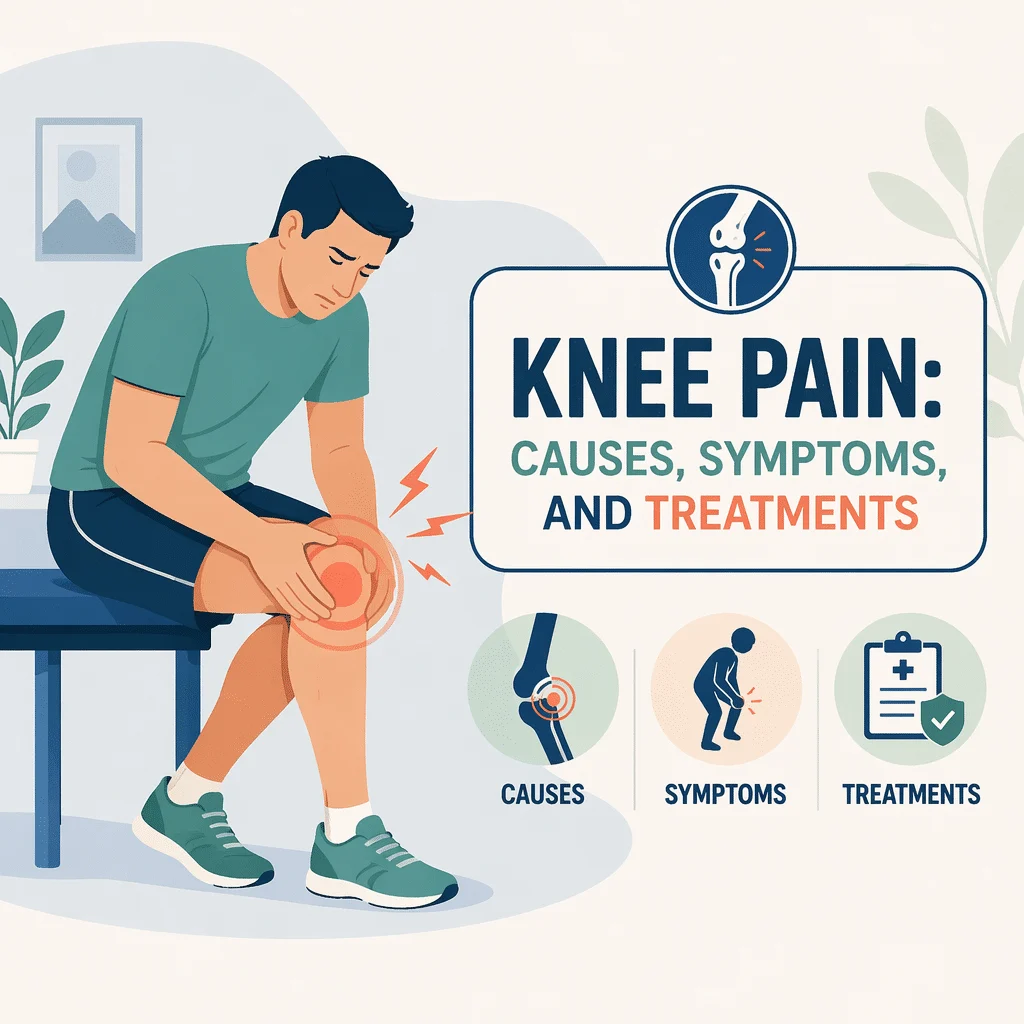
Knee pain is one of the most common reasons adults book an appointment: it accounts for roughly one in twenty adult primary care visits. Yet the phrase covers dozens of different problems, from a kneecap that tracks badly in a 25-year-old runner to worn cartilage in a 70-year-old gardener. Three things narrow the list quickly: where the pain sits, what triggers it, and how it behaves across the day. In this article you’ll learn how to read your own symptoms by location and by pattern, which causes are most likely at your age, which warning signs need same-day care, what blood tests can and cannot show, and which treatments have real evidence behind them.
Where your knee pain sits tells you a lot
The knee is a hinge held together by ligaments, cushioned by two C-shaped cartilage pads called menisci, and covered at the front by the kneecap. Each structure sits in a different place, so the spot that hurts is genuinely informative. Point to the sorest area with one finger first: precise pain behaves differently from a deep ache.
| Where it hurts | What it usually suggests | What tends to help first | When to get it looked at |
|---|---|---|---|
| Front, around or under the kneecap | Patellofemoral pain in active younger people, kneecap tendon overload, or kneecap-compartment wear after 50. Worse on stairs, after long sitting, and squatting. | Fewer deep bends and stairs for a few weeks, hip and thigh strengthening, then gradual reloading. | Pain still there after six weeks of self-care, or a knee that gives way. |
| Inside of the knee (medial) | The most common location. Medial osteoarthritis after 45, inner meniscus irritation, or the tendons attaching just below the joint line. | Managing load rather than resting completely, thigh strengthening, weight management. | A firm block to straightening, true locking, or swelling that returns whenever you walk. |
| Outside of the knee (lateral) | Iliotibial band irritation in runners and cyclists, lateral meniscus problems, or outer-compartment wear. | Reducing mileage rather than stopping, hip strengthening, and checking footwear or bike setup. | Pain that starts at the same distance every session and has not shifted in a month. |
| Behind the knee (posterior) | Most often fullness from joint fluid pushed backward by a problem inside the joint. Less commonly a calf muscle or vein. | Treating whatever inside the joint produces the fluid, not the bulge itself. | A swollen, warm or tender calf needs same-day assessment. Any firm, fixed lump should be examined. |
| Deep, diffuse, hard to point to | Inflammatory arthritis, joint infection, or pain referred from the hip or lower back. | Clinical assessment rather than self-care: the answer is rarely mechanical. | Fever, pain that wakes you at night, or a hot and visibly swollen knee: urgently. |
A soft, fluid-filled swelling behind the knee is a different problem from a firm lump that does not change with activity, and our library examines a lump or swelling behind the knee. Pain that travels down the leg from the lower back is a third pattern, and our team describes the symptoms and red flags of sciatica.
Mechanical or inflammatory: a simple reading grid
After location, ask whether the knee is behaving mechanically or inflammatorily. Mechanical problems are about load: something is worn, torn, or overworked, and using it hurts. Inflammatory problems come from the immune system or an infection: the joint lining is angry, so rest stiffens it and movement loosens it. The distinction decides whether blood tests are worth doing at all.
| Clue | Points toward a mechanical problem | Points toward an inflammatory problem |
|---|---|---|
| Morning stiffness | Brief, under 30 minutes, gone after a few steps | Prolonged, 30 to 60 minutes or more, returning after sitting |
| What makes it worse | Activity, stairs, kneeling, long walks | Rest and inactivity; the joint loosens once you move |
| Night pain | Mainly after a heavy day or lying awkwardly | Can wake you in the second half of the night |
| Other joints | Usually one knee, sometimes both if both are worn | Often several joints, symmetrical, sometimes hands and feet |
| Swelling | Comes and goes with activity | More persistent, often with warmth over the joint |
| Whole-body signs | None | Fatigue, low-grade fever, rash, unintended weight loss |
Real knees do not always sort neatly into one column: an osteoarthritic joint can flare for a week, and an inflammatory joint can also be mechanically worn. Treat the grid as a way to frame the conversation with your doctor, not as a verdict. If your answers cluster in the right-hand column, our health library explains the different forms of arthritis, and our team covers the diagnosis and treatment of rheumatoid arthritis.
The most likely causes of knee pain, by age
Age is not destiny, but it shifts the odds enough to be worth using. A review of knee pain published in JAMA in 2023 set out how sharply the probable diagnosis changes across the decades.
Under 40: kneecap pain and sports injuries
The leading cause here is patellofemoral pain, a catch-all term for pain arising where the kneecap glides on the thigh bone. It has a lifetime prevalence of around one in four, and pain at the front of the knee while squatting is one of its most reliable signs. It does not mean the cartilage is crumbling. The other big category is acute injury: a twist with the foot planted can tear a meniscus or a cruciate ligament, usually with an immediate pop, rapid swelling, and a knee that feels unreliable afterward.
40 to 60: degenerative tears and early wear
This is the age where meniscal tears stop being injuries and start being wear. They affect roughly one adult in eight, and past 40 many appear without any dramatic incident, sometimes found on a scan ordered for something else. Early osteoarthritis often overlaps. Muscle problems around the joint also become more common, and our library explains knee muscle spasms and their triggers.
Over 60: osteoarthritis and its look-alikes
Osteoarthritis is the most likely explanation for activity-related knee pain after 45, particularly when morning stiffness lasts under half an hour. It also gets blamed for everything, which is the trap. Crystal arthritis can settle in a knee rather than a toe, and we describe the treatments that relieve gout pain. Autoimmune disease can start late, and our library covers the joint symptoms of lupus. Nerve compression can produce knee pain that never quite matches the joint, and another guide covers a pinched nerve in the knee.
Red flags: knee pain that needs urgent attention
Most knee pain can wait for a routine appointment. Four situations cannot. Mayo Clinic publishes a list of knee symptoms that warrant a same-day call.
- A hot, visibly swollen, very painful knee with fever or feeling unwell. This can be septic arthritis, an infection inside the joint, and it is an emergency: an infected joint can be damaged within days and needs the fluid drawn off and tested urgently.
- Inability to put weight on the leg after a fall, twist or direct blow, or an obviously deformed knee. Go to urgent care or an emergency department the same day.
- A knee that suddenly locks and cannot be fully straightened after a twisting injury. A displaced fragment of meniscus can physically block the joint and needs prompt orthopedic assessment. Long-standing catching in an older, worn knee is far less urgent.
- Calf swelling, warmth, or tenderness alongside the knee pain, especially after surgery, a long flight, or a period of immobility. This raises the question of a deep vein blood clot and needs same-day assessment.
Outside those four, a knee sore for more than six weeks despite sensible self-care, or one that keeps giving way, still deserves an appointment. Pain in several joints at once, with fatigue or fever, also belongs in front of a clinician.
How doctors work out the cause of knee pain
The story and the examination do most of the work
The great majority of knee diagnoses are made before any test. Your clinician wants to know when the pain started, whether there was a specific incident, what makes it better and worse, whether the joint swells or locks, and how long the morning stiffness lasts. Then they examine it: feeling along the joint line, checking how far it bends and straightens, testing the ligaments, and watching you walk and squat. Tenderness along the joint line is one of the more dependable findings.
When imaging helps, and when it does not
Scans are less necessary than most people expect. The 2023 JAMA review states plainly that X-raying every patient with suspected knee osteoarthritis is not recommended: the diagnosis can be made clinically, and the picture often does not match the pain. Plenty of people have impressive wear on film and no symptoms. Imaging earns its place when the answer would change what happens next: after significant trauma, when surgery is on the table, or when something in the story does not fit.
What blood tests can and cannot show
This is the part patients most often get wrong, so it is worth being blunt: no blood test diagnoses a mechanical knee problem. There is no marker for a torn meniscus, a strained ligament, or a kneecap that tracks badly. Those are found by examination and, when needed, by imaging. Blood work answers a different question: whether something systemic is driving the joint.
When the picture leans inflammatory, a few tests are commonly ordered. Inflammatory markers such as C-reactive protein and the sedimentation rate show whether inflammation is present anywhere in the body, without saying where; our guide explains high CRP levels and what raises them, and we also cover the erythrocyte sedimentation rate. Our team covers what a uric acid blood test shows, and it supports a gout diagnosis, though the level can be normal during an attack and raised in people who never get one. Rheumatoid factor and anti-CCP antibodies help when several joints are involved. Lyme serology has a place after a tick bite in an endemic area, and our library describes the stages of Lyme disease.
One test outranks all of these when a joint is hot and swollen: drawing a sample of joint fluid with a needle. It distinguishes infection from crystals from inflammation in a way no blood test can.
What actually helps knee pain
Exercise is the treatment with the strongest evidence
Every major guideline puts exercise first, ahead of medication and well ahead of surgery, for osteoarthritic and patellofemoral pain alike. The counterintuitive part is that loading a sore knee sensibly makes it better rather than worse: strong thigh and hip muscles change how force passes through the joint, and conditioned tissue tolerates more. The National Institute of Arthritis and Musculoskeletal and Skin Diseases makes the same point: movement lowers joint pain and stiffness and improves flexibility.
What matters most is consistency rather than the perfect program. Expect a few weeks before anything shifts, accept mild soreness that settles within a day, and progress in small increments.
Weight, load, and everyday habits
Each step sends several times body weight through the knee, so even modest weight loss changes the daily load for people carrying extra. Beyond weight, the everyday details add up: swapping deep squatting for a kneeling pad, splitting a long walk into two shorter ones, replacing worn shoes, and using a stick on the opposite side during a flare. None is dramatic alone. Together they often decide whether a knee settles.
Medicines, injections, and surgery
Pain relief has a supporting role, and the right choice depends on your other conditions and medicines: a conversation for your doctor or pharmacist rather than an article. Topical anti-inflammatories are often tried first for a joint as superficial as the knee. Steroid injections can settle a badly inflamed joint for weeks to months and are best seen as a window in which to rebuild strength, not a repair. Joint replacement is reserved for end-stage disease once conservative options have genuinely been used.
Where the evidence is weaker than the marketing
Two honest caveats. First, no supplement has been shown to regrow or repair cartilage in humans, whatever the packaging implies; some people report symptom relief, but that is a different claim from structural repair. Second, arthroscopic surgery for a degenerative meniscal tear is not recommended, even when the knee catches, because trials have repeatedly found it no better than a good exercise program. And prolonged rest weakens the muscles that protect the joint, which is why modern advice is relative rest rather than immobility.
Latest scientific advances
Knee pain research has been active over the last three years, and most of it has reinforced rather than overturned the basics. Here is what changed.
Aerobic exercise came out on top in the largest comparison yet
A 2025 network meta-analysis in the BMJ pooled 217 randomized trials covering more than 15,000 people with knee osteoarthritis and compared exercise types head to head. A network meta-analysis ranks treatments even when they were never tested directly against each other. Aerobic exercise, meaning walking, cycling or swimming, probably gave the largest pain improvements over three months, while strengthening and mixed programs did most for function. What this means for you: the walking or cycling you might actually keep up is a legitimate first-line treatment. The authors rated their confidence as moderate, so the ranking could shift.
A big Cochrane review is honest about how large the benefit is
The Cochrane review of land-based exercise for knee osteoarthritis was updated in 2024 with 139 trials and around 12,500 participants. Exercise probably improves pain, function and quality of life in the short term. The authors then checked those improvements against the smallest change a patient would notice, and found the benefit sat close to that threshold rather than comfortably above it. What this means for you: exercise works and remains the first thing to try, but expect a meaningful improvement rather than a transformation.
European guidelines put self-management at the core
EULAR, the European rheumatology society, updated its recommendations for managing hip and knee osteoarthritis without drugs in 2023. The eight recommendations start with an individualized plan built on education and self-management, then cover exercise dosage and progression, healthy weight, footwear and walking aids, and work advice. Agreement among the 25 experts was near-unanimous. What this means for you: understanding your own knee and having a plan you can run yourself is not the soft option before the real treatment. It is part of it.
Yoga held its own against a strengthening program
A randomized trial in JAMA Network Open in 2025 assigned 117 adults aged 40 and over with painful knee osteoarthritis to yoga or a conventional strengthening program for 12 weeks. Yoga did not beat strengthening on the main pain measure, but it did as well, and edged ahead on some secondary measures over 24 weeks. Side effects were mild in both groups. What this means for you: this is a single trial rather than settled evidence, but the best exercise for a sore knee is largely the one you will still be doing in six months.
Glossary of key terms
| Term | What it means |
|---|---|
| Patellofemoral pain | Pain arising where the kneecap glides over the thigh bone. Typically felt at the front of the knee on stairs, when squatting, or after long sitting. |
| Meniscus | One of two C-shaped cartilage pads that sit between the thigh bone and shin bone and spread load across the joint. The plural is menisci. |
| Osteoarthritis | Gradual wear of joint cartilage and the bone underneath it, producing activity-related pain and brief morning stiffness. It is not simply aging, and it is not inevitable. |
| Effusion | An excess of fluid inside the joint, which is what people mean by water on the knee. It signals irritation inside the joint rather than a diagnosis in itself. |
| Septic arthritis | Infection inside a joint. It produces a hot, swollen, very painful joint, often with fever, and is a medical emergency. |
| C-reactive protein (CRP) | A blood protein that rises when inflammation is present anywhere in the body. It confirms that inflammation exists but does not say where or why. |
| Erythrocyte sedimentation rate (ESR) | A blood test measuring how fast red blood cells settle in a tube. Like CRP it is a general marker of inflammation, and it moves more slowly. |
| Anti-CCP antibodies | Antibodies against cyclic citrullinated peptides, used alongside rheumatoid factor when several joints are involved. They are fairly specific to rheumatoid arthritis. |
| Joint aspiration | Drawing fluid from a joint with a needle, then analyzing it. It is the only reliable way to separate infection, crystals, and inflammation quickly. |
Frequently asked questions
Why does my knee hurt when I bend and straighten it?
Pain through the arc of movement usually means something is being compressed or caught as the joint travels. If it is at the front and worse going down stairs or standing up from a low chair, the kneecap joint is the usual explanation. If it is along the inside or outside joint line and comes with a click or a catch, a meniscus is more likely. If the knee cannot be fully straightened at all, that is a different and more urgent situation. Pain that stays within a mild range and settles quickly afterward is generally safe to work with; pain that builds over the day and leaves the knee swollen the next morning means the load is too high for now.
What can cause knee pain with no injury at all?
Most knee pain arrives without a memorable incident. Osteoarthritis develops over years. Degenerative meniscal tears after 40 often appear with no trauma. Patellofemoral pain typically follows a change in training volume, footwear or job rather than a single event. Inflammatory arthritis, gout and joint infection have nothing to do with mechanics. Pain can also be referred to the knee from the hip or the lower back, which is why a knee that hurts but examines completely normally prompts a look elsewhere. The absence of an injury is not reassuring or worrying in itself; the pattern of the pain matters far more.
Why is knee pain more common in women?
Knee osteoarthritis and patellofemoral pain are both more frequent in women, and the reasons are partly anatomical and partly hormonal. A wider pelvis changes the angle at which the thigh muscles pull on the kneecap, which loads the kneecap joint differently. Ligament laxity varies across the menstrual cycle. Osteoarthritis rates rise noticeably after menopause. None of this makes knee pain inevitable, and none of it changes the treatment: strengthening, load management and weight management work the same way regardless of sex.
Why does my knee hurt more at night?
Two different explanations, and telling them apart is useful. Mechanical knees often ache in the evening after a demanding day, or when you lie on the sore side, and they settle once you find a comfortable position, sometimes with a pillow between the knees. Inflammatory joints behave differently: they can wake you in the second half of the night and are stiff for a long spell in the morning. Night pain that wakes you regularly, especially with fever, unexplained weight loss or pain in several joints, should be reported to a doctor rather than managed at home.
How long should I wait before getting knee pain checked?
Same day if you cannot bear weight after an injury, if the knee is hot and swollen with fever, if it has locked and will not straighten, or if the calf is swollen and warm. Within a week or two if the knee keeps giving way, if it swells every time you use it, or if several joints hurt together with fatigue. Otherwise, six weeks of sensible self-care is a reasonable trial: relative rest rather than immobility, load management, and daily strengthening. If nothing has shifted in that time, book the appointment rather than repeating the same six weeks.
Can I keep exercising with knee pain?
In most cases yes, and stopping altogether tends to make things worse by weakening the muscles that protect the joint. The workable rule is that mild discomfort during activity is acceptable if it settles within about 24 hours and does not leave the knee more swollen. If it does, the load was too high, so reduce the volume rather than abandoning the activity. Swapping the type of loading often solves it: cycling and swimming let you keep training while the knee tolerates less impact. If you are recovering from a specific injury or surgery, follow the plan you were given instead.
Sources
- Mayo Clinic — Knee pain: symptoms and causes, 2025 — mayoclinic.org
- National Institute of Arthritis and Musculoskeletal and Skin Diseases (NIAMS), National Institutes of Health — Osteoarthritis: causes, symptoms and treatment — niams.nih.gov
- MedlinePlus, National Library of Medicine — Knee injuries and disorders — medlineplus.gov
- Duong V, Oo WM, Ding C, Culvenor AG, Hunter DJ — Evaluation and Treatment of Knee Pain: A Review — JAMA, 2023 — doi.org/10.1001/jama.2023.19675
- Yan L, Li D, Xing D, et al. — Comparative efficacy and safety of exercise modalities in knee osteoarthritis: systematic review and network meta-analysis — BMJ, 2025 — doi.org/10.1136/bmj-2025-085242
- Lawford BJ, Hall M, Hinman RS, et al. — Exercise for osteoarthritis of the knee — Cochrane Database of Systematic Reviews, 2024 — doi.org/10.1002/14651858.CD004376.pub4
- Moseng T, Vliet Vlieland TPM, Battista S, et al. — EULAR recommendations for the non-pharmacological core management of hip and knee osteoarthritis: 2023 update — Annals of the Rheumatic Diseases, 2024 — doi.org/10.1136/ard-2023-225041
- Abafita BJ, Singh A, Aitken D, et al. — Yoga or Strengthening Exercise for Knee Osteoarthritis: A Randomized Clinical Trial — JAMA Network Open, 2025 — doi.org/10.1001/jamanetworkopen.2025.3698
Further reading
- Knee muscle spasm: causes, symptoms and treatments
- Hamstring cramps: causes, symptoms and treatments
- High CRP levels: causes, symptoms and treatments
- The vitamin D blood test and how to read your results
- The calcium blood test and the bone and mineral panel
Understand your lab results with AI DiagMe
No blood test can diagnose a worn meniscus or a kneecap that tracks badly, but when knee pain comes with fever, several sore joints, or morning stiffness that drags on, the lab report becomes part of the answer. Inflammatory markers such as CRP and the sedimentation rate, uric acid, and antibody tests for rheumatoid arthritis are the numbers most often ordered, and they are easy to misread on your own. AI DiagMe explains what your results mean in plain language, with an interpretation reviewed by a committee of doctors. It helps you understand your report and prepare better questions; it does not diagnose, and it does not replace your doctor.
Get your results interpreted in minutes