

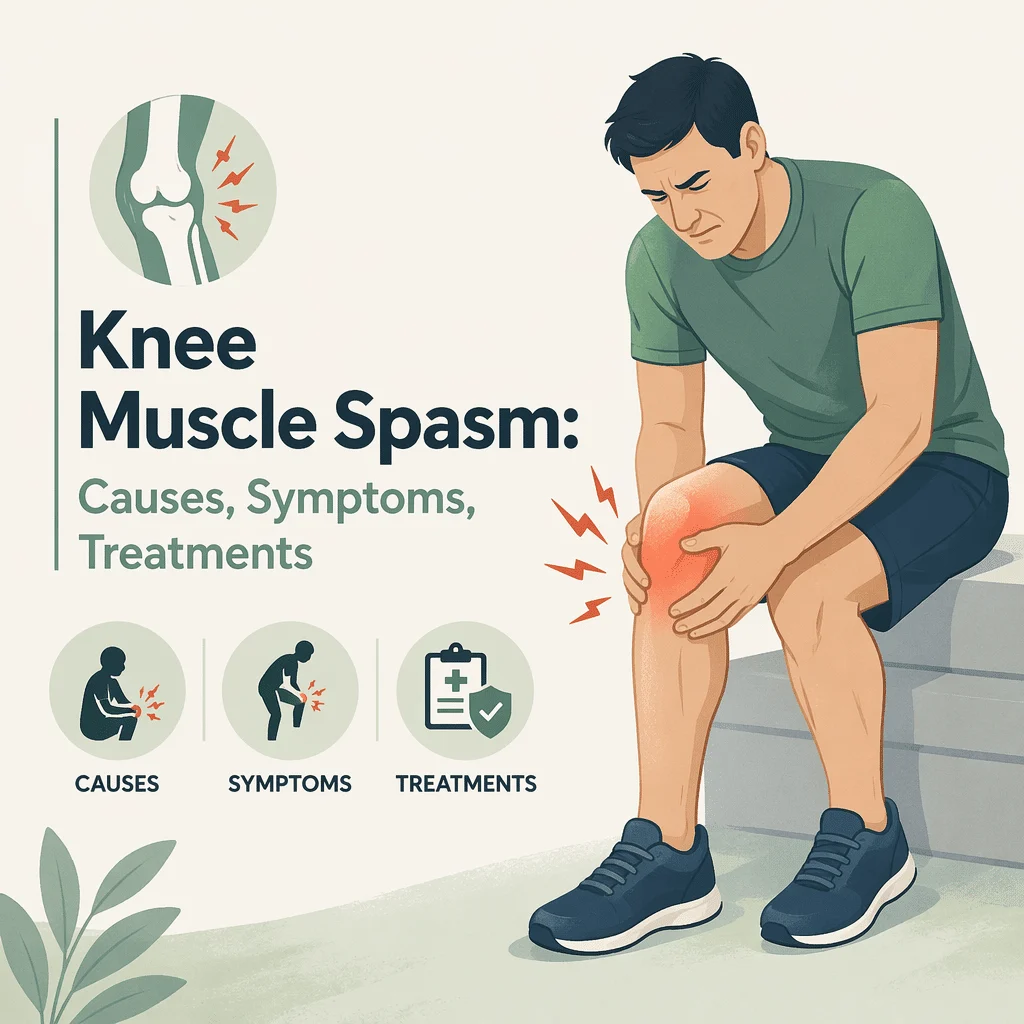
A knee muscle spasm is a sudden, involuntary tightening of one of the muscles that move or steady the knee — usually the quadriceps at the front of the thigh, the hamstrings at the back, or the calf just below the joint. Some episodes last a few seconds and feel like a flutter under the kneecap. Others lock the leg for minutes and are painful enough to stop you mid-stride. The large majority are harmless and settle on their own. A smaller number point to fluid loss, a mineral imbalance, a medication side effect, or a knee injury that deserves a closer look. In this article you’ll learn what sets these spasms off, how to release one quickly, which clues separate an ordinary cramp from a warning sign, and which lab tests doctors commonly order when the spasms keep coming back.
What a knee muscle spasm actually is
Muscle fibers contract when a nerve tells them to. A spasm happens when that signal fires without any decision on your part, and the muscle stays contracted instead of letting go. You may see the muscle bulge or ripple under the skin, and the area often stays tender for a day or two afterward, much the way it feels after an unusually hard workout.
Three muscle groups are usually involved around the knee. The quadriceps runs down the front of the thigh and straightens the joint. The hamstrings run down the back and bend it. The calf muscles cross behind the knee and pull on it whenever the foot points. Because all of them attach near the joint, a spasm in any one of them is felt as a knee problem even when the joint itself is perfectly healthy. Our team also explains the main causes of knee pain.
Spasm, cramp, twitch, or contracture
These four words describe different events, and telling them apart changes what you should do next. A spasm is any involuntary contraction. A cramp is a spasm that hurts and visibly hardens the muscle. A twitch, also called a fasciculation, is a small flicker of a few fibers under the skin — visible, usually painless, and common in people who are tired, stressed, or heavily caffeinated. A contracture is a shortening that will not release with stretching and belongs to a different family of causes. A 2023 review in Practical Neurology stresses that ordinary cramps are, most of the time, part of normal physiology, and that only a minority reflect an underlying nerve or systemic disease.
What causes a knee muscle spasm
Overuse, fatigue, and muscle damage
Straining or overusing a muscle is the most common trigger listed by MedlinePlus. A long run, a new squat routine, a day of gardening on your knees, or simply holding one position for hours can leave the quadriceps or hamstrings firing erratically. Fatigue changes the way the sensors inside the muscle report tension to the spinal cord, and the muscle becomes easier to lock up. This is why cramps in endurance sport typically appear late in an event rather than at the start.
Fluid loss, heat, and minerals
Cleveland Clinic lists exercising in extreme heat, dehydration, too little stretching, and imbalances in potassium, magnesium, and calcium among the usual contributors. Sweating heavily without replacing fluid reduces blood volume and shifts the balance of salts around the muscle fibers. Long-term diuretic use, repeated vomiting or diarrhea, and very restrictive diets can do the same thing more slowly. We also examine the effects of dehydration on blood pressure, which often show up in the same episodes.
Signals coming from the knee joint itself
After a knee injury, the joint can send a stream of abnormal signals that partly switches the quadriceps off. Clinicians call this arthrogenic muscle inhibition, and it produces the opposite of what most people expect: instead of a hard cramp, the thigh muscle fails to fire properly, the knee will not fully straighten, and the leg feels as though it might give way. A 2024 study in the American Journal of Sports Medicine found this pattern in more than half of a large series of recent anterior cruciate ligament injuries. Knee osteoarthritis can produce a similar guarding reflex, with the muscles around a painful joint holding themselves tight.
Medications and medical conditions
Several medicines are recognized triggers, and MedlinePlus names them alongside dialysis and pregnancy. Diuretics change potassium and magnesium levels. Statins cause muscle symptoms in a minority of users: a 2023 review in Endocrine Practice notes that unexplained cramps, together with a previously raised creatine kinase level, are among the markers that should prompt a conversation about statin tolerance rather than a silent stop. Thyroid disorders, diabetes, nerve disorders, and liver disease all appear on the Mayo Clinic list of conditions that raise the risk. Cramps are especially frequent in advanced liver disease — a 2023 review in JAMA reports that roughly two out of three people living with cirrhosis experience them, and that they can be treated.
Twitches elsewhere raise the same question: see what causes a twitching nose and when it matters.
Possible causes, symptom clues, and the tests often ordered
The table below is a reading grid, not a diagnosis. It shows how clinicians typically move from a pattern of symptoms to a short list of tests. Your own history, your medication list, and a physical examination always come first.
| Possible cause | Clues in your symptoms | Tests doctors often order |
|---|---|---|
| Overuse or an unusually hard workout | Spasm during or hours after unfamiliar effort; the thigh or calf stays sore and tender | Often none; creatine kinase if the pain is severe or the urine turns dark |
| Fluid loss and heat | Cramps after prolonged sweating, thirst, dark urine, lightheadedness on standing | Electrolyte panel (sodium, potassium, chloride, bicarbonate), creatinine |
| Low minerals | Cramps in several muscle groups, tingling, eyelid twitching, restrictive diet or long-term diuretics | Magnesium, potassium, calcium, sometimes vitamin D |
| Thyroid disorder | Cramps with fatigue, cold intolerance, weight change, dry skin | TSH first, then free T4 if TSH is abnormal |
| Kidney disease or dialysis | Cramps in the evening or during a dialysis session, swelling, reduced urine output | Creatinine and eGFR, electrolyte panel |
| Medication side effect | Cramps that began weeks after starting a statin, a diuretic, or an asthma inhaler | Creatine kinase, potassium, magnesium, plus a medication review |
| Knee injury or osteoarthritis | Thigh muscle that will not fully straighten the knee, a sense of giving way, swelling after a twist | Clinical knee examination and imaging rather than blood tests |
| Nerve compression in the lower back | Spasm with shooting pain, numbness, or tingling running down the leg | Clinical examination; imaging if warning signs are present |
| Liver disease | Frequent night cramps, fatigue, easy bruising, abdominal swelling | Liver enzymes, albumin, platelet count |
How to stop a knee muscle spasm
In the moment
- Stretch the muscle that is cramping. For the quadriceps, stand up, bend the knee, and pull the heel gently toward the buttock. For the hamstrings, straighten the leg and lean forward from the hips.
- Massage the tight area with firm, steady pressure while you hold the stretch.
- Put weight on the leg if you can. Walking a few steps often breaks the cycle faster than lying still.
- Apply warmth to a muscle that feels tight and cold to a muscle that feels sore and inflamed after the spasm has passed.
- Drink fluid if you have been sweating, and keep drinking over the next few hours rather than all at once.
Over the next few days
Expect residual tenderness. Keep moving with easy, pain-free range of motion instead of resting completely, and reintroduce load gradually. If a single episode was violent, or if the muscle stays swollen and painful for more than 48 hours, that is worth a call to your doctor rather than another workout.
Which lab tests help when knee spasms keep coming back
A one-off cramp after a hot run rarely needs a blood draw. Recurrent spasms — several a week, or spasms with other symptoms — are a different situation, and a small set of routine tests explains a large share of them.
- An electrolyte panel checks sodium, potassium, chloride, and bicarbonate, the salts that govern how easily a muscle fiber fires. Our guide explains what an electrolyte panel measures.
- Magnesium and calcium are measured separately from the standard panel in many labs. This article details the symptoms of magnesium deficiency, and our guide covers the calcium blood test and the bone panel.
- Creatinine and eGFR show how well the kidneys are clearing waste and holding fluid balance. Our team describes the markers in a kidney function panel.
- TSH screens the thyroid, since both an underactive and an overactive gland can produce cramps and muscle weakness. This resource lists the normal thyroid hormone ranges.
- Creatine kinase, often shortened to CK or CPK, rises when muscle fibers are damaged. It is the test that separates ordinary post-exercise soreness from significant muscle breakdown. This guide explains the CPK blood test and what it measures.
Cramps rarely stay confined to one muscle group, so the same workup applies whichever leg muscle is affected. Our team also covers cramps in the hamstring muscles.
When to see a doctor
Mayo Clinic, MedlinePlus, and Cleveland Clinic converge on a short list of situations that justify medical advice rather than self-care.
- The spasms are severe, or they keep coming back several times a week.
- They do not improve with stretching, gentle movement, and fluids.
- The leg is swollen, red, warm, or the skin has changed appearance.
- You notice muscle weakness, numbness, or loss of coordination between episodes.
- The cramps appear all over the body rather than in one area.
- They started after a new medication, or alongside a known kidney, liver, or thyroid condition.
Seek urgent care if severe muscle pain and cramping follow an extreme effort and your urine turns brown or cola-colored. A 2023 systematic review in the Clinical Journal of Sport Medicine identifies exactly that combination — heavy exertion, muscle soreness or cramps, and dark urine — as the pattern that should trigger testing for exertional rhabdomyolysis, a condition in which damaged muscle releases its contents into the blood and can strain the kidneys.
How to prevent knee muscle spasms
Prevention works best when it targets the mechanism rather than a single mineral.
- Build the workload gradually. Sudden jumps in distance, weight, or heat exposure account for most avoidable episodes.
- Strengthen the muscles around the knee. Regular resistance work for the quadriceps and hamstrings improves how well a muscle tolerates fatigue.
- Stretch after activity rather than only before, and hold each position long enough to feel the muscle release.
- Replace fluid and salt during long or hot sessions, without overshooting on plain water alone.
- Review your medication list with your doctor if the spasms began within a few weeks of a new prescription.
- Get up and move if your work keeps you seated for hours, which Cleveland Clinic links to nighttime leg cramps.
Latest scientific advances
Research published over the last three years has shifted how specialists think about cramps around the knee and lower limb. Here is what it says, in plain language.
Electrolytes explain less than we assumed
Two recent studies in endurance athletes tested the classic idea that cramps come from losing salts in sweat. A 2026 analysis of nearly 50,000 Ironman-distance triathletes over three decades found that blood sodium and potassium levels were no different between athletes who cramped and athletes who did not; dehydration and sheer exhaustion were the factors that stood out. A 2026 ultra-trail study reached the same conclusion and added a new one: the runners who cramped showed higher levels of creatine kinase and LDH — two markers that rise when muscle fibers are damaged — in the 24 to 48 hours afterward. What this means for you: if you cramp during long efforts, topping up on salt tablets is unlikely to be the whole answer. Muscle fatigue and muscle damage matter at least as much, which is why pacing and conditioning tend to help more than supplements.
Strength training may be the most useful preventive measure
In that same ultra-trail study, regular lower-limb strength training was far less common among the runners who cramped than among those who did not. The finding is observational — it shows an association, not proof of cause — but it lines up with what is known about fatigue resistance. On the joint side, a 2024 network meta-analysis in PLoS One pooled trials of resistance training in knee osteoarthritis and found that all three formats studied improved pain and knee function more than conventional physiotherapy alone. What this means for you: strengthening the thigh muscles is one of the few measures supported for both the spasm and the underlying knee problem.
Supplements: one disappointment, one early signal
Magnesium is the supplement most often suggested for cramps, and the evidence does not support it for the common nighttime variety. A 2023 evidence summary in American Family Physician concluded that magnesium supplementation does not reduce idiopathic nocturnal leg cramps in adults — meaning cramps with no identified underlying cause. That does not apply to people with a genuinely low magnesium level, who do need correction. Meanwhile, a 2024 randomized trial published in JAMA Internal Medicine tested vitamin K2 in nearly 200 adults aged 65 and over with frequent night cramps and found fewer cramps per week compared with a dummy capsule, with no related side effects. What this means for you: this is one well-conducted trial in older adults from a single country. It is an encouraging early result, not yet a recommendation, and it is a conversation to have with your doctor rather than a reason to start supplementing.
After a knee injury, the problem may be too little muscle activity
The 2024 American Journal of Sports Medicine study of recent anterior cruciate ligament injuries found arthrogenic muscle inhibition — the reflex shutdown of the quadriceps described earlier — in a majority of cases, and reported that most of those cases resolved with a simple, targeted exercise program. What this means for you: if your knee feels tight, unstable, or unable to straighten after an injury, the answer is usually structured rehabilitation rather than rest. A 2023 review in Practical Neurology makes the complementary point for cramps in general: a careful history and examination identify the cause in most people, and extensive testing is reserved for those with warning signs.
Glossary
| Term | Definition |
|---|---|
| Arthrogenic muscle inhibition | A reflex in which an injured or painful joint partly switches off the muscles around it, so the quadriceps cannot contract fully even though it is undamaged. |
| Contracture | A lasting shortening of a muscle or the tissue around it that does not release with stretching, unlike a cramp. |
| Creatine kinase (CK or CPK) | An enzyme stored inside muscle cells. Blood levels rise when muscle fibers are damaged, so it helps gauge how much strain a muscle has taken. |
| eGFR | Estimated glomerular filtration rate, a calculated figure that summarizes how efficiently the kidneys filter the blood. |
| Electrolyte | A mineral that carries an electrical charge in body fluids, such as sodium, potassium, calcium, or magnesium. Electrolytes control how nerves and muscles fire. |
| Fasciculation | A small, visible flicker of a few muscle fibers under the skin, commonly called a twitch. It is usually painless. |
| Hamstrings | The group of muscles running down the back of the thigh that bend the knee and extend the hip. |
| Quadriceps | The four-part muscle group at the front of the thigh that straightens the knee and absorbs shock when you land. |
| Rhabdomyolysis | A condition in which damaged muscle releases its contents into the bloodstream, sometimes turning the urine dark and putting the kidneys under strain. |
| TSH | Thyroid-stimulating hormone, the pituitary signal that tells the thyroid how much hormone to make. It is the usual first-line thyroid blood test. |
Frequently asked questions
What causes painful knee spasms?
Most painful spasms around the knee come from muscle overuse and fatigue, from fluid loss during heat or heavy exercise, or from holding one position for a long time. Low potassium, calcium, or magnesium can contribute, as can certain medications, kidney or thyroid disease, and nerve compression in the lower back. When a spasm follows a knee injury, the joint itself may be driving an abnormal muscle reflex. A single painful episode after unusual effort is usually nothing more than that. Repeated painful spasms deserve a medical review, because the cause is often identifiable and treatable.
How do I stop knee muscle twitching?
Twitching that you can see but barely feel is generally benign and linked to fatigue, stress, caffeine, or dehydration. Reducing caffeine, sleeping enough, drinking regularly through the day, and gently stretching the thigh usually settle it within a few days. If the twitching persists for weeks, spreads to other areas, or comes with genuine muscle weakness or wasting, arrange a medical assessment rather than waiting it out.
Can you have a muscle spasm in the knee with no pain?
Yes. A painless spasm feels like a tightening, a pulling, or a fluttering sensation without the sharp grip of a cramp. It often reflects a fatigued muscle or a low-grade twitch of a few fibers. Painless spasms are common and rarely serious. What matters is whether anything else accompanies them: swelling, weakness, numbness, an inability to fully straighten the knee, or a sense that the leg gives way. Those additional signs, not the pain itself, are what prompt investigation.
What does a knee spasm feel like?
Most people describe a sudden hardening of the thigh or calf, a visible bulge or ripple under the skin, and an inability to move the joint normally until it releases. It typically lasts from a few seconds to a couple of minutes. Afterward the muscle often stays tender to the touch for a day or two. Because the muscles that cross the knee attach close to the joint, the sensation is frequently felt inside the knee even when the joint is entirely normal.
Why do I get muscle spasms after a knee replacement?
Spasms are common in the weeks after knee surgery. The muscles around the joint have been through swelling, altered movement patterns, and a period of reduced use, and they respond by tightening. The joint also sends abnormal signals during healing that disturb how the quadriceps fires. Guided rehabilitation, gradual loading, and consistent range-of-motion work usually resolve it. Tell your surgical team if spasms are intense, worsening, or paired with fever, marked swelling, or increasing redness.
Why does my knee twitch when I am lying down?
Muscles are at their most relaxed when you lie down, so small contractions that pass unnoticed during the day become obvious. The end of a physically demanding day, low fluid intake, caffeine, and certain medications all make it more likely. Cleveland Clinic also links prolonged sitting and poor positioning to nighttime leg cramps. If the sensation is an urge to move the legs that eases only when you move them, discuss restless legs syndrome with your doctor, because that is a different condition with its own management.
Sources
- Mayo Clinic — Muscle cramp: symptoms and causes, 2025 — mayoclinic.org
- MedlinePlus, National Library of Medicine — Muscle cramps, 2024 — medlineplus.gov
- Cleveland Clinic — Muscle spasms (muscle cramps): causes, treatment and prevention, 2023 — my.clevelandclinic.org
- Dijkstra JN, Boon E, Kruijt N, et al. — Muscle cramps and contractures: causes and treatment — Practical Neurology, 2023 — doi.org/10.1136/pn-2022-003574
- Sonnery-Cottet B, Hopper GP, Gousopoulos L, et al. — Incidence of and risk factors for arthrogenic muscle inhibition in acute anterior cruciate ligament injuries — American Journal of Sports Medicine, 2024 — doi.org/10.1177/03635465231209987
- Nilssen PK, Hew-Butler T, Rosemann T, et al. — Exercise-associated muscle cramps in Ironman-distance triathletes over three decades — Clinical Journal of Sport Medicine, 2026 — doi.org/10.1097/JSM.0000000000001276
- Martinez-Navarro I, Montoya-Vieco A, Hernando B, et al. — Muscle cramping in ultra-trail: dehydration and electrolyte depletion versus muscle damage — Journal of Strength and Conditioning Research, 2026 — doi.org/10.1519/JSC.0000000000005440
- Jiang Y, Zhang J, Wang X, et al. — Effects of three types of resistance training on knee osteoarthritis: a systematic review and network meta-analysis — PLoS One, 2024 — doi.org/10.1371/journal.pone.0309950
- Tan J, Zhu Y, Li Y, et al. — Vitamin K2 in managing nocturnal leg cramps: a randomized clinical trial — JAMA Internal Medicine, 2024 — doi.org/10.1001/jamainternmed.2024.5726
- Kaufman N, Nguyen T, Bolduc L — Does magnesium supplementation treat nocturnal leg cramps? — American Family Physician, 2023 — pubmed.ncbi.nlm.nih.gov/38215424
- Tsushima Y, Hatipoglu B — Statin intolerance: a review and update — Endocrine Practice, 2023 — doi.org/10.1016/j.eprac.2023.03.004
- Bäcker HC, Richards JT, Kienzle A, et al. — Exertional rhabdomyolysis in athletes: a systematic review — Clinical Journal of Sport Medicine, 2023 — doi.org/10.1097/JSM.0000000000001082
- Tapper EB, Parikh ND — Diagnosis and management of cirrhosis and its complications: a review — JAMA, 2023 — doi.org/10.1001/jama.2023.5997
Further reading
- How to read your blood test results
- The comprehensive metabolic panel explained
- Sciatica symptoms, relief, and red flags
- Rib cramps, their causes, and their warning signs
- The vitamin D blood test and how to read it
Understand your lab results with AI DiagMe
When knee spasms keep returning, the explanation is often visible in a few routine blood values rather than in the knee itself. AI DiagMe reads your lab report and explains, in plain language, what your sodium, potassium, magnesium, and calcium levels mean, alongside kidney markers such as creatinine, thyroid screening with TSH, and creatine kinase when muscle strain is a question. The goal is to help you understand what your results say and to arrive at your appointment with clear questions. It does not make a diagnosis and does not replace your doctor.
Get your results interpreted in minutes