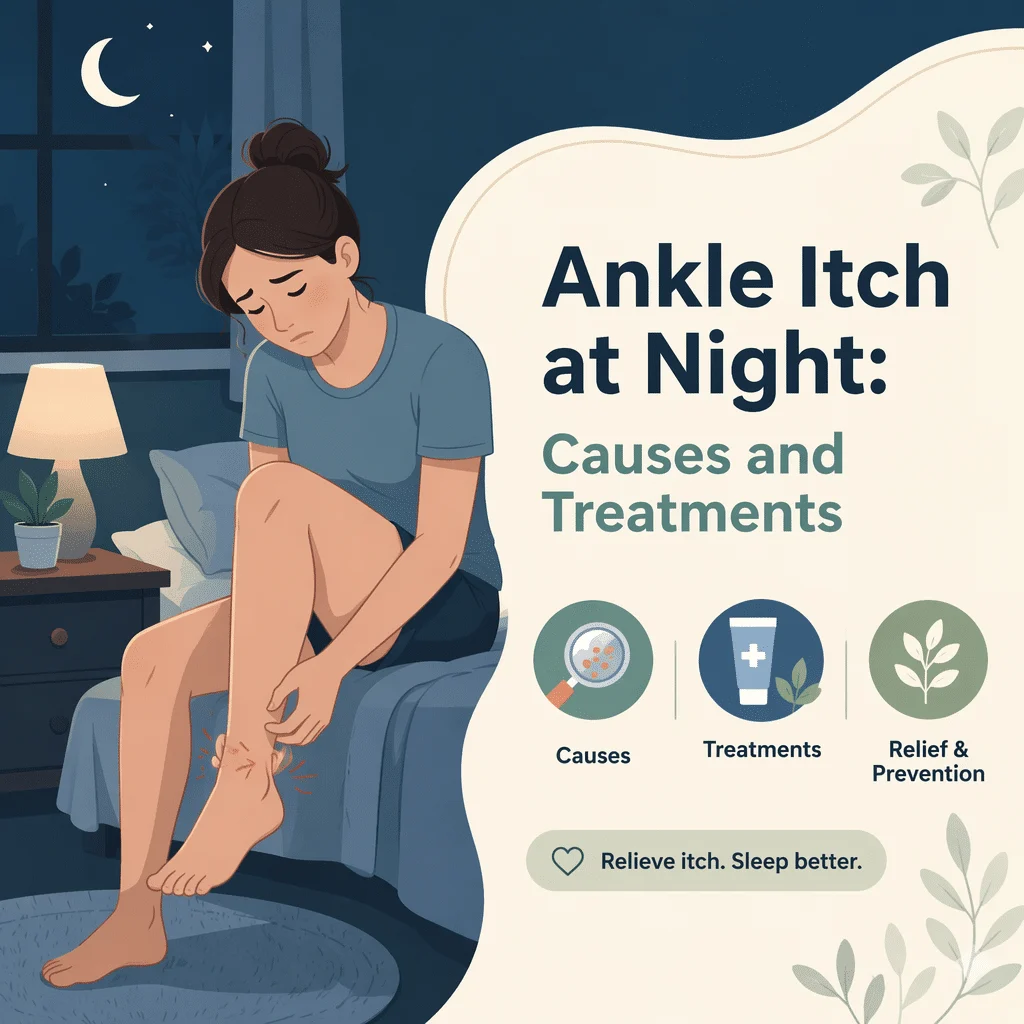
An ankle itch at night that pulls you out of sleep is one of the most common and most frustrating skin complaints. The reassuring part is that the pattern itself carries information. Itch really does intensify after dark, for measurable reasons, and the ankle sits at the crossroads of several very different problems: dry skin and eczema, sock elastic and nickel buckles, mites, sluggish leg circulation, irritated nerves, and, when there is no rash at all, occasionally an internal issue that shows up on a blood test. In this article you’ll learn why nighttime itching worsens, how to read your own pattern, which lab tests clinicians consider, the warning signs that deserve prompt care, and the measures that reduce nighttime scratching.
Why an ankle itch at night gets worse after dark
Why does skin that felt fine at 3 p.m. become unbearable at 11 p.m.? Several normal overnight changes stack up, and they explain why relief measures aimed at the night work best.
Your skin gets warmer and loses more water overnight
Core body temperature falls in the evening, partly by sending blood to the skin of the hands, feet and lower legs. That makes the skin warmer, and warm skin is itchier skin: heat lowers the threshold at which itch nerve fibers start firing. The skin also loses water through its surface faster at night. Bedding, thick socks and a heated bedroom amplify both effects, which is why the itch often starts within minutes of getting under the covers.
Cortisol dips while itch signals keep running
Cortisol, the body’s own anti-inflammatory hormone, follows a daily rhythm: highest in the morning, lowest around midnight. Skin inflammation is therefore least suppressed in the small hours, and several itch-related immune messengers peak overnight too. This is ordinary physiology, and it is why nocturnal itch is a recognized clinical pattern.
Nothing else is competing for your attention
Itch is a perception, and perception is competitive. During the day, movement, conversation and screens crowd it out; a dark, quiet bedroom offers nothing to crowd it out with. Scratching then delivers a few seconds of relief followed by more inflammation and more itch, the itch-scratch cycle. Repeated over weeks, it thickens the skin into a patch that itches because it has been scratched so often.
Skin conditions behind an itchy ankle at night
Dry skin, or xerosis
Dry skin is the single most common reason ankles itch, especially in older adults, in winter, and in anyone who takes long hot showers. The skin over the ankle bone is thin, has few oil glands, and is rubbed by socks and shoes all day. It looks dull or finely flaky and responds well to plain emollient.
Eczema and contact dermatitis
Atopic dermatitis produces pink, scaly, intensely itchy patches, often in people with a family history of asthma or hay fever. Contact dermatitis is instead a reaction to something touching the skin, and around the ankle the culprits are predictable: sock elastic, rubber or dye in the fabric, nickel in an anklet or shoe buckle, bandage adhesive, or a product applied to the area. Redness tracing the exact outline of a sock cuff or a buckle is a reaction to that object, not a coincidence. Our team also explains the signs of spongiotic dermatitis, the microscopic pattern behind many eczema-type rashes, and our library describes the main types of skin rash.
A less obvious variant is a reaction to household insect debris. We detail carpet beetle dermatitis, which produces itchy bumps where skin meets bedding or carpet. Psoriasis can affect the lower leg too, though it looks silvery and well defined rather than weepy; our team reviews the triggers of psoriasis.
Scabies, the classic nighttime itch
Nocturnal itch is the signature of scabies. A mite burrows into the top layer of skin, and the itch comes from an allergic reaction to the mite and its waste. The Centers for Disease Control and Prevention describes intense itching, especially at night, as one of its most common symptoms. Two features point strongly toward it: the itch wakes you repeatedly, and other people in the household are itching too. Typical sites include the finger webs, wrists, waistline, armpits and ankles. It is treatable, but it needs a diagnosis and household contacts treated too.
Thickened skin from scratching
Lichen simplex chronicus is what happens when a spot has been scratched for months: the skin turns leathery, its lines exaggerated, often darker than the skin around it. The outer ankle is a favorite location because it is easy to reach. It will not settle until the scratching stops, which means treating whatever started it.
Circulation: the ankle-specific cause people miss
Stasis dermatitis is a common cause of ankle itching in adults over about 50, and it is regularly mistaken for dry skin or infection. It develops when leg vein valves no longer close properly, so blood pools in the lower leg. Pressure builds in the small vessels, fluid and blood cells leak into the tissue, and the skin becomes inflamed.
The pattern is recognizable. Both ankles are usually involved, rarely equally. Swelling is worse by evening and better after a night lying flat. The skin above the inner ankle takes on a brown or rust-colored stain from iron left behind by leaked red blood cells; it may feel tight, look shiny and itch persistently. Because the skin barrier is already compromised, people with stasis dermatitis often develop an added allergic reaction to the creams applied there. Left unmanaged for years, the process can progress to a slow-healing ulcer. Leg elevation and clinician-guided compression are the mainstays of care, and this is a cause worth naming to a doctor.
When ankle itch at night comes with no rash
This is the situation that most deserves attention. If your skin looks normal apart from scratch marks, the itch is not starting at the skin surface, and a systemic cause becomes worth considering, especially if the itch is not confined to the ankles. Published clinical guidance separates itch localized to one area, which more often points to a nerve problem, from generalized itch, which raises the possibility of an internal cause: disorders of iron metabolism, chronic kidney disease, liver disease with obstructed bile flow, thyroid conditions, blood disorders, and, uncommonly, a cancer such as lymphoma.
None of that means an itchy ankle signals serious disease; in the large majority of cases it is dry skin. But itch without a rash is a recognized reason to look at routine blood tests. The table below maps what you can observe onto what clinicians typically consider.
| What you notice | What it often points to | What a clinician may consider |
|---|---|---|
| Dry, finely flaky skin on both ankles, worse in winter | Xerosis, or simple dry skin | Usually no testing; diagnosed by looking |
| Redness tracing the sock cuff, a buckle or a bandage edge | Contact dermatitis, irritant or allergic | Patch testing if it recurs |
| Severe itch after midnight, others in the home itching too | Scabies | Skin scraping or dermoscopy |
| Both ankles swollen by evening, brown staining, prominent veins | Stasis dermatitis from venous insufficiency | Venous ultrasound; sometimes kidney, liver and heart markers |
| No rash beyond scratch marks, and itch is not only on the ankles | Possible systemic cause | Complete blood count, ferritin and iron studies, TSH, creatinine and eGFR, liver enzymes and bilirubin, glucose and HbA1c |
| Burning or crawling in one small patch, skin looks normal, cold helps | Neuropathic itch from an irritated nerve | Nerve or lower-spine assessment; glucose and HbA1c |
| A thick, leathery patch exactly where you scratch most | Lichen simplex chronicus | Clinical diagnosis; the trigger is looked for |
Nerve-related causes of a persistently itchy ankle
Neuropathic itch starts in the nervous system rather than the skin, and it feels different. It arises on normal-looking skin, is often described as burning, crawling or tingling rather than as a straightforward itch, may come with patches of numbness, and is eased by cold rather than by scratching. Around the ankle, the usual sources are a compressed nerve, an old scar or burn, healed shingles, or small-fiber nerve damage from long-standing high blood sugar. Because the skin looks fine, this cause is often missed for months.
Which lab tests are typically considered
When itch has no rash, is generalized, or has not responded to sensible skin care, a short panel of common blood tests covers most internal causes worth ruling out. This is what your clinician is likely reasoning about, and knowing it makes the conversation easier.
- A complete blood count looks at red cells, white cells and platelets, and can reveal anemia or a blood disorder that causes itch. This guide covers the complete blood count in detail.
- Ferritin and iron studies assess iron stores. Low iron causes itch even before anemia develops. Our team explains the causes of low ferritin, and we break down the iron studies panel.
- TSH screens thyroid function. An underactive or overactive thyroid can leave the skin dry and itchy. Our guide explains normal thyroid levels.
- Creatinine and estimated glomerular filtration rate assess the kidneys. Itch is a well-known symptom of advanced kidney disease. We also cover the kidney function panel.
- Liver enzymes, alkaline phosphatase and bilirubin look for cholestasis, a slowing of bile flow that causes intense itch, typically worse at night and on the palms and soles. Our team explains liver function tests.
- Fasting glucose and HbA1c assess blood sugar, relevant to nerve-related itch and to the dry skin that accompanies poorly controlled diabetes. We explain diabetes blood tests.
The same reasoning applies when the soles itch; our team also explains the causes of itchy feet at night.
Red flags: when to see a doctor promptly
Most nighttime ankle itch is a nuisance, not a warning. A few situations justify a same-week appointment or, in the first case, urgent care.
- A rash spreading quickly, with fever, or with skin that is hot, tender and increasingly painful, which can indicate infection.
- A break in the skin near the ankle that has not healed in a few weeks, particularly on a swollen or brown-stained leg.
- Itch all over the body with unexplained weight loss, drenching night sweats, or swollen glands.
- Yellowing of the eyes or skin, dark urine, or pale stools alongside the itch.
- Sudden, severe, generalized itch during pregnancy, especially on the palms and soles, which needs assessment without delay.
- Itch that repeatedly wakes you and has not improved after two to three weeks of consistent moisturizing.
Practical relief for nighttime itching
These measures are non-prescription, low-risk and aimed at the overnight mechanisms described above. They will not fix scabies or venous disease, but they reduce the nightly misery in almost every cause.
- Apply a fragrance-free emollient to the whole lower leg within minutes of the shower, while the skin is still damp, and again at bedtime. Fragrance and botanical extracts are common triggers of allergic reactions on already-irritated skin.
- Keep showers short and warm rather than hot. Hot water strips skin lipids and reliably worsens itch for the following hour.
- Cool the bedroom and use lighter bedding. Since warm skin is itchier skin, this single change often does more than any cream.
- Choose loose cotton socks over tight synthetic ones, wash them in a fragrance-free detergent with no added softener, and skip socks in bed if you can. If the rash follows the sock cuff exactly, change the socks before anything else.
- Keep fingernails short and filed smooth, and consider thin cotton gloves at night if you scratch in your sleep. Limiting the damage breaks the cycle.
- A cool damp cloth or a cool pack over clothing interrupts the itch signal, and is especially effective for nerve-related itch.
- If your legs swell during the day, raise them above hip level in the evening and discuss compression with your doctor before buying anything.
Talk to a pharmacist or clinician before starting any medicated cream or oral antihistamine, particularly if you are older, pregnant or taking other medicines. Treatment depends entirely on the cause, and a product that helps eczema can worsen a fungal infection or mask scabies.
Latest scientific advances
Research on itch has moved quickly in the last three years. According to PubMed, here is what recent work adds.
Nighttime itch is now formally recognized in clinical guidance
A European expert guideline on chronic pruritus, published in 2025, sets out a stepwise approach to itch lasting more than six weeks: identify the cause first, then treat in stages. What this means for you is that persistent itch should be explained, not simply suppressed.
Where the itch is located helps narrow the cause
A 2024 practical guide for itch with no visible rash separates itch confined to one area, which more often reflects an irritated nerve, from itch spread over the body, which more often reflects an internal cause such as low iron, kidney or liver disease, or a thyroid disorder. What this means for you: whether the itch stays on your ankles or turns up elsewhere is one of the most useful things to tell a clinician.
Unexplained itch is common, and honest about its limits
A 2026 systematic review, a study that pools and grades all the available evidence, examined chronic itch with no identifiable cause. Mechanisms remain only partly understood, and the evidence behind most treatments is still weak. What this means for you is that normal test results are a recognized situation with a name, not a dead end and not something you imagined, though treatment is often a matter of trial and adjustment.
Stasis dermatitis is frequently misdiagnosed
Two 2023 reviews of stasis dermatitis, the ankle rash caused by pooling blood in leg veins, make the same point: it mimics other conditions, it is poorly recognized, and misdiagnosis leads to unnecessary treatment. People with it also commonly react to the very creams applied to treat it. What this means for you: if you have swollen ankles with brown-stained, itchy skin and creams keep making things worse, a second look at the diagnosis is reasonable.
Scratching at night measurably fragments sleep
A 2023 study used wrist sensors and overnight sleep monitoring in children with eczema and found that scratching episodes frequently pushed them into lighter sleep or woke them. A 2025 pooled analysis covering tens of thousands of people with eczema found that a little over four in ten reported sleep problems. What this means for you is that the exhaustion is a real consequence of the itch, so treating the itch treats the tiredness. A 2025 study following scabies patients through treatment found that nighttime itch and sleep disturbance both improved substantially once treatment began.
Nerve-driven itch is treated differently
A 2024 review of nerve-related itch confirms the practical signs: it begins on normal-looking skin, is often mixed with burning or other odd sensations, and is relieved by cold. What this means for you: if moisturizers do nothing and cold does everything, say so, because it changes what your clinician looks for.
Glossary
| Term | Definition |
|---|---|
| Pruritus | The medical word for itching. Chronic pruritus means itch that has lasted more than six weeks. |
| Xerosis | Abnormally dry skin. It is the most frequent reason skin itches, particularly in older adults and in cold weather. |
| Atopic dermatitis | The medical name for eczema, a long-term inflammatory skin condition causing dry, itchy, scaly patches. |
| Contact dermatitis | A rash caused by something touching the skin, either through direct irritation or through an allergic reaction. |
| Stasis dermatitis | Inflammation of the lower leg skin caused by blood pooling in the leg veins. It usually brings swelling and brown skin staining. |
| Lichen simplex chronicus | A thickened, leathery patch of skin produced by months of repeated scratching or rubbing. |
| Ferritin | A blood protein that reflects how much iron the body has in storage. A low value indicates depleted iron stores. |
| eGFR | Estimated glomerular filtration rate, a calculated figure that indicates how well the kidneys are filtering blood. |
| Cholestasis | A slowdown or blockage of bile flow from the liver. It can cause an intense itch that is often worse at night. |
| Neuropathic itch | Itch that originates in a damaged or irritated nerve rather than in the skin itself, typically on normal-looking skin. |
Frequently asked questions
Why do my ankles itch at night but feel fine during the day?
Three normal overnight changes overlap. Your skin surface warms up as your body redirects blood to the limbs to lower core temperature, and warm skin is more itch-sensitive. Water loss through the skin surface increases at night, so the skin is also drier. Cortisol, your natural anti-inflammatory hormone, reaches its lowest point around midnight, leaving skin inflammation less suppressed. Add the absence of daytime distraction, and the same underlying problem becomes far more noticeable. This is why cooling the bedroom and moisturizing at bedtime often help more than any daytime measure.
What does it mean if my ankles itch but there is no rash?
Usually it means dry skin that has not yet produced a visible change, and moisturizing consistently for two or three weeks resolves most cases. If the itch persists, is not limited to the ankles, or wakes you regularly, clinicians consider an internal cause: low iron stores, thyroid disease, reduced kidney function, a liver problem affecting bile flow, or high blood sugar. That is generally assessed with a short set of routine blood tests. Itch confined to one small patch of normal-looking skin more often suggests an irritated nerve than an internal condition.
Why does my ankle itch all the time, not just at night?
Round-the-clock itching in one spot points away from a simple dry-skin explanation. The two most likely patterns are a patch that has been scratched so long that it has thickened and now itches on its own, and a nerve-related itch, which typically feels like burning or crawling, sits on skin that looks normal, and calms down with something cold rather than with cream. Persistent itch in one place that has lasted more than six weeks is worth having examined rather than continuing to treat blindly.
Can socks cause an itchy ankle at night?
Yes, and it is one of the more common explanations. The elastic band at the top of a sock contains rubber accelerators, and sock fabric may contain dyes and finishing chemicals, all of which are recognized contact allergens. Tight elastic also traps heat and moisture, which alone can provoke itching. The telltale sign is a band of irritation that matches the position of the sock cuff. Switching to loose, undyed cotton socks and a fragrance-free detergent for a few weeks is a reasonable first test.
Why does the inside of my ankle itch more than the rest?
The skin over the inner ankle is where the pressure from leg vein problems is highest, so it is the first place stasis dermatitis appears, often with brown staining and evening swelling. It is also thin, poorly supplied with oil glands and constantly rubbed by footwear, which makes it prone to dryness. Persistent itching on the inner ankle in an adult over 50, especially with any swelling, deserves a look from a doctor rather than a moisturizer alone.
Does a healing sprain or fracture make the ankle itch?
Itching during recovery from an ankle injury is common and usually harmless. Skin under a cast or brace gets warm, sweaty and unable to shed dead cells normally, and healing tissue and regrowing small nerve fibers can generate itch-like sensations. Never push objects down a cast to scratch, as this breaks the skin and invites infection. Persistent itching with redness, increasing pain, warmth or discharge is not part of normal healing and should be checked.
Sources
- MedlinePlus, National Library of Medicine — Itching (pruritus): causes and when to seek care — https://medlineplus.gov/itching.html
- Centers for Disease Control and Prevention — About Scabies — https://www.cdc.gov/scabies/about/index.html
- Mayo Clinic — Itchy skin (pruritus): symptoms and causes — https://www.mayoclinic.org/diseases-conditions/itchy-skin/symptoms-causes/syc-20355006
- MedlinePlus Medical Encyclopedia, National Library of Medicine — Stasis dermatitis and ulcers — https://medlineplus.gov/ency/article/000834.htm
- Weisshaar E, Müller S, Szepietowski JC, et al. — European S2k Guideline on Chronic Pruritus — Acta Dermato-Venereologica, 2025 — https://doi.org/10.2340/actadv.v105.44220
- Hashimoto T, Okuno S — Practical guide for the diagnosis and treatment of localized and generalized cutaneous pruritus (chronic itch with no underlying pruritic dermatosis) — The Journal of Dermatology, 2024 — https://doi.org/10.1111/1346-8138.17565
- Akiska YM, Gandhi I, Adler R, et al. — Pathogenesis and Therapeutics for Chronic Pruritus of Unknown Origin: A Systematic Review — International Journal of Dermatology, 2026 — https://doi.org/10.1111/ijd.70259
- Yosipovitch G, Nedorost ST, Silverberg JI, et al. — Stasis Dermatitis: An Overview of Its Clinical Presentation, Pathogenesis, and Management — American Journal of Clinical Dermatology, 2023 — https://doi.org/10.1007/s40257-022-00753-5
- Yosipovitch G, Jackson JM, Nedorost ST, et al. — Stasis Dermatitis: The Burden of Disease, Diagnosis, and Treatment — Dermatitis, 2023 — https://doi.org/10.1089/derm.2022.0076
- Sugiyama A, Murakami Y, Okamoto K, et al. — Nocturnal Scratching and Quality of Sleep in Children with Atopic Dermatitis — Acta Dermato-Venereologica, 2023 — https://doi.org/10.2340/actadv.v103.12345
- Zhang N, Chi H, Jin Q, et al. — Prevalence of sleep disorders in atopic dermatitis: a systematic review and meta-analysis — Archives of Dermatological Research, 2025 — https://doi.org/10.1007/s00403-025-04176-0
- Güven M, Parlakdağ Kılcıoğlu A — Clinical Features and Quality of Life in Patients with Scabies — Türkiye Parazitoloji Dergisi, 2025 — https://doi.org/10.4274/tpd.galenos.2025.70894
- Pereira MP, Metz M — Neuropathy in pruritus medicine: recommended diagnostics and therapy — Dermatologie, 2024 — https://doi.org/10.1007/s00105-024-05374-z
Further reading
- Anemia: symptoms, causes, types and how it is diagnosed
- Hypothyroidism: symptoms, diagnosis and treatments
- Allergy blood testing: IgE and allergy panels explained
- Diabetes: causes, symptoms and treatments
- Lymphoma: symptoms, causes and treatments
Understand your lab results with AI DiagMe
When an ankle itch at night comes without a rash, the answer often sits in a handful of ordinary blood tests rather than in a cream. AI DiagMe turns those results into plain language, so you can see what a low ferritin, a borderline TSH, a raised creatinine or an elevated liver enzyme actually means before your next appointment. It is built to help you understand your own numbers and prepare better questions. It does not diagnose you, and it does not replace your doctor.
Get your results interpreted in minutes