



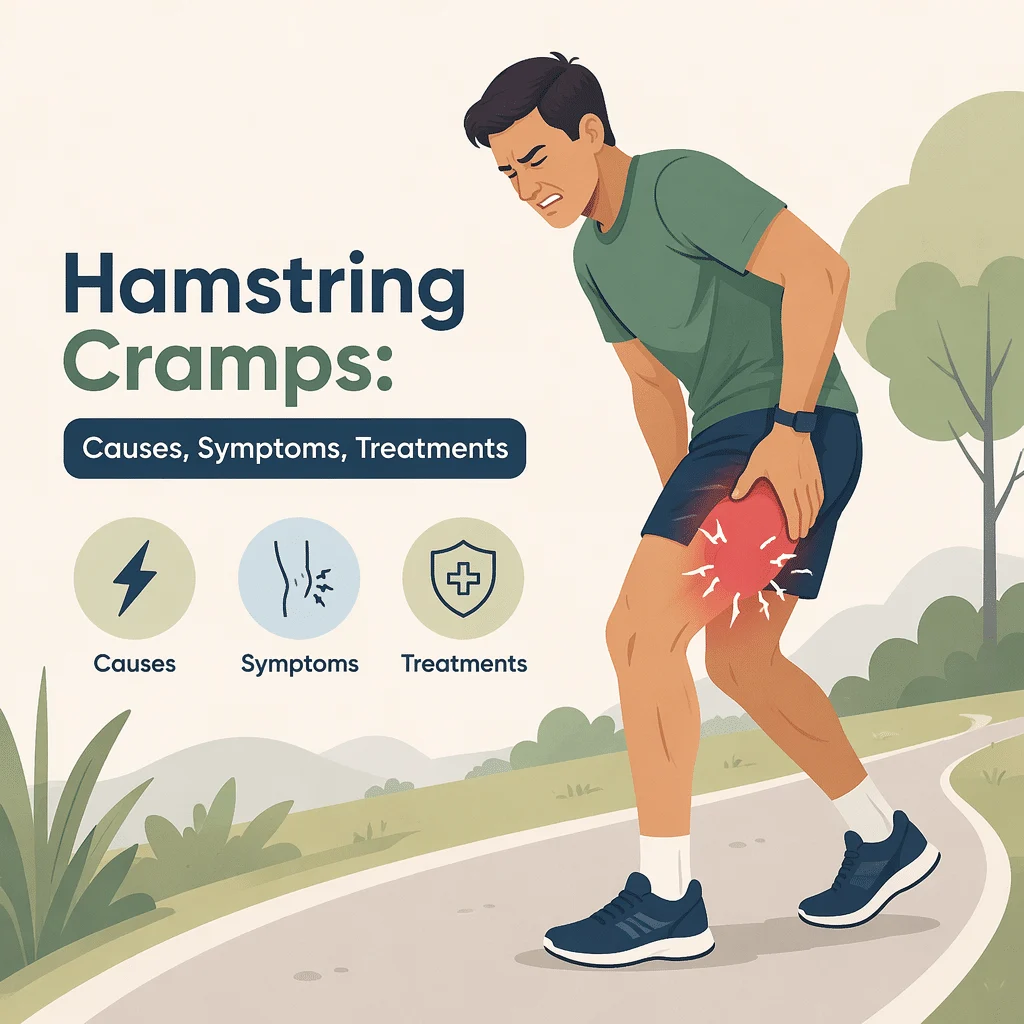
Hamstring cramps are sudden, involuntary contractions of the three muscles at the back of the thigh, and they can be sharp enough to stop a run mid-stride or wake you at three in the morning. This article separates two situations that are far too often lumped together: cramping that strikes during or right after exercise, and cramping that arrives at night or at rest. In the sections below you will learn what the evidence actually supports about why these episodes happen, which relief technique has the strongest backing, how to tell a harmless cramp from a muscle tear, a blood clot or a trapped nerve, and which laboratory tests are worth discussing with your doctor.
What hamstring cramps are and why this muscle group is vulnerable
The hamstrings are three muscles that run down the back of the thigh: the biceps femoris, the semitendinosus and the semimembranosus. They cross two joints at once, bending the knee and extending the hip. That dual job makes them powerful, and it also makes them awkward to control at the extremes of their range.
A cramp is a sustained contraction that you did not ask for and cannot immediately switch off. The muscle visibly knots under the skin, the pain is intense, and most episodes last from a few seconds to a couple of minutes. Tenderness and a bruised feeling can linger for a day or two afterward, which is normal and not a sign of damage on its own.
Why two-joint muscles cramp so easily
When a muscle contracts while it is already in a shortened position, the reflexes that normally limit contraction work less well. Bending the knee while the hip is extended puts the hamstrings in exactly that position. This is why so many people report hamstring cramps during leg curls, glute bridges, or when they stretch their toes downward in bed. The same mechanical logic explains cramping in other muscle groups, and our team also explains the causes of knee muscle spasm.
Exercise cramps and night cramps are not the same problem
Treating all cramps as one condition is the single biggest reason people end up with advice that does not work for them. The two main patterns have different triggers, different risk profiles and different sensible responses.
Cramping during or right after effort
Exercise-associated cramping typically appears late in a hard or unusually long session, often in the muscles doing the most repetitive work. Runners, cyclists, triathletes and weekend athletes returning after a break are the classic groups. The cramp usually follows fatigue rather than preceding it, and it frequently strikes at a moment when the muscle is contracting in a shortened position, such as the final drive of a pedal stroke or the push-off phase of a sprint.
Cramping at night or at rest
Night cramps behave differently. They tend to strike a muscle that is doing nothing at all, they become more common with age, and they are also more frequent during pregnancy. Several widely used medications are associated with them, including some diuretics, statins and certain drugs prescribed for blood pressure or mood. Prolonged sitting with the knees bent, which compresses the back of the thigh, can also set them off during the day.
What causes hamstring cramps: two competing explanations
Here is where honest reporting matters. Search the internet and you will be told confidently that hamstring cramps are caused by dehydration and lost minerals. The research is considerably less settled than that.
The dehydration and electrolyte theory
This is the familiar story: heavy sweating drains water and salts, the muscle becomes irritable, and it cramps. It has been repeated for decades and underpins an entire product category. It is also only partly supported. Several studies comparing athletes who cramp with athletes who do not have failed to find the expected differences in hydration or blood mineral levels.
Altered neuromuscular control
The leading competing explanation shifts attention from body fluids to the nervous system: muscle fatigue disturbs the reflex loop that normally tells a muscle when to stop contracting. Sensors in the tendon that would ordinarily switch off an excessive contraction become less effective, while the signals driving contraction stay on, leaving the muscle stuck in the on position. This view fits a striking everyday observation: stretching the cramping muscle usually stops the cramp within seconds, which is hard to explain if the problem were a whole-body shortage of fluid or salt.
What this disagreement means for you
You do not have to pick a side, and the evidence does not currently allow anyone to pick one for you. Both mechanisms probably contribute, and their relative weight likely differs between a dehydrated ultramarathon runner and a healthy seventy-year-old cramping in bed. The practical consequence is that you should be skeptical of any single-cause explanation, and equally skeptical of any product promising to eliminate cramps by fixing that one cause. A separate guide explains the effects of dehydration on blood pressure.
How to stop a hamstring cramp
One intervention has consistent support during an episode: passive stretching of the muscle that is cramping. It is simple, it costs nothing and it usually works within seconds to a minute.
- Straighten the leg at the knee. This is the movement that lengthens the hamstrings.
- With the leg straight, gently bring your toes toward your shin and, if you can, raise the whole leg toward you. Sitting on the floor with the leg extended in front of you works well.
- Hold a steady, moderate stretch. Do not bounce and do not force it into sharp pain. Sustained gentle tension is what settles the contraction.
- Hold the position until the muscle releases, then ease off slowly rather than dropping the leg.
Massage of the cramping muscle, walking around, and applying warmth afterward are commonly used and low risk, though the evidence behind them is weaker than for stretching. There is no medication that safely and reliably aborts an ordinary cramp in the moment.
After the cramp passes
Expect the muscle to feel tender. Keep moving gently, avoid a hard session on that leg for a day or two, and pay attention to whether pain persists beyond what a cramp should leave behind. That last point is the crucial one, and it leads directly to the next section.
Is it really a cramp? Five conditions that get confused
A genuine cramp releases and resolves. Pain that outlives the episode, or a leg that changes in appearance, is telling you something else is happening. The table below compares hamstring cramps with four conditions that are regularly mistaken for them.
| Condition | How it starts | How long it lasts | What relieves it | Swelling or skin change | Urgency |
|---|---|---|---|---|---|
| Hamstring cramp | Sudden knotting, at night or late in effort | Seconds to a few minutes | Gently stretching the muscle | None; mild tenderness for a day | Routine; see a doctor if frequent |
| Hamstring strain or tear | Sudden during a sprint or stretch, sometimes with a pop | Days to weeks | Rest; pain remains when the muscle is relaxed | Bruising may appear over hours to days | Prompt assessment, especially with weakness |
| Deep vein thrombosis | Gradual, constant ache in the calf or thigh | Constant; it does not release | Nothing reliably relieves it | Swelling, warmth, redness, one leg larger | Urgent; seek same-day medical care |
| Sciatica | Pain travels from the lower back down the back of the leg | Ongoing; worse in certain positions | Changing position, not stretching the muscle | None; numbness or tingling is common | Non-urgent unless weakness or bladder changes |
| Peripheral artery disease | Brought on by walking a predictable distance | Until you stop walking | Resting for a few minutes | Cool or pale skin, reduced hair growth | Not an emergency, but needs vascular review |
Red flags that need urgent attention
Seek same-day medical care if leg pain comes with swelling of one leg, warmth, redness or skin discoloration. That combination can indicate a deep vein thrombosis, a clot in a deep leg vein, which can travel to the lungs and become life-threatening. Do not stretch or massage a leg you suspect of harboring a clot, and do not wait to see whether it settles overnight.
Also seek prompt assessment for a sudden pop followed by pain that persists once the muscle relaxes, visible bruising down the back of the thigh, difficulty bearing weight, new numbness or weakness in the leg, or cramps that wake you repeatedly night after night. This guide describes the warning signs of sciatica.
Medical causes worth a lab check
Most hamstring cramps are not caused by disease. But when they become frequent, severe, or new for you, a handful of treatable conditions are worth ruling out with your doctor. A large study of more than twenty thousand cycling race entrants found that a history of chronic disease and regular use of chronic medication were each linked to exercise-associated cramping, which supports looking at the whole medical picture rather than the muscle alone.
- Low magnesium, potassium, calcium or sodium, which can follow illness, diuretic use or persistent vomiting and diarrhea.
- Dehydration significant enough to disturb blood chemistry.
- Reduced kidney function, which alters the balance of minerals the body can maintain.
- An underactive thyroid, which commonly causes muscle aching and stiffness alongside fatigue.
- Poorly controlled diabetes with nerve damage, which changes how muscles are signaled.
- Statin-associated muscle symptoms, where cramping, aching or weakness follows a cholesterol-lowering medication.
The tests your doctor may consider
None of these are cramp tests, and none should be self-ordered as a substitute for a consultation. They are the panels a clinician typically reaches for when cramps look like a symptom rather than an isolated event. Our team explains the electrolyte panel, which reports sodium, potassium, chloride and bicarbonate.
- A basic or comprehensive metabolic panel, covering minerals, blood sugar and kidney markers in one draw. This article explains how to read a comprehensive metabolic panel.
- Magnesium, which is not included in a standard panel and must be requested separately. Our team details the symptoms of magnesium deficiency.
- Kidney markers such as creatinine and estimated filtration rate. We also cover the kidney function panel.
- Thyroid-stimulating hormone, the first-line thyroid screen. This guide reviews normal thyroid levels and a companion piece explains the symptoms of a high TSH.
- HbA1c, which reflects average blood sugar over two to three months. A separate article covers the main diabetes blood tests.
- Creatine kinase, an enzyme released when muscle fibers are damaged, particularly relevant if you take a statin. Our team explains the creatine phosphokinase blood test.
- Vitamin D, often measured alongside calcium when muscle symptoms are being investigated.
Preventing hamstring cramps without overpromising
Conditioning and load management
The most consistent theme across studies of athletes is that cramping tracks with fatigue and with training that outpaces preparation. Building volume gradually, respecting recovery days, and including regular lower-limb strength work are the measures most plausibly linked to fewer episodes. In one study of ultra-trail runners, those who cramped were noticeably less likely to do regular lower-limb strength training than those who did not.
Fluids and sodium
Adequate hydration remains sensible, and during prolonged exercise with heavy sweating, replacing sodium as well as water is reasonable. What the evidence does not support is that topping up minerals prevents cramps in people who are neither exercising at length nor losing large volumes of sweat. Drinking large amounts of plain water during endurance events carries its own risk of diluting blood sodium, so more is not automatically better.
Supplements: what the evidence supports
Magnesium is the supplement most often recommended for cramps, and the evidence is genuinely mixed rather than uniformly positive. A pooled analysis of randomized trials found a benefit during pregnancy but no significant effect for nocturnal or persistent leg cramps in adults generally, and calcium and potassium lacked supporting evidence. Correcting a deficiency you do not have is unlikely to help, and high-dose mineral supplements are not risk-free, particularly with reduced kidney function.
Stretching before exercise
Stretching stops a cramp in progress. Whether it prevents future cramps is a separate question, and the answer is far less flattering. When researchers compared athletes who cramp with those who do not, the amount of pre-event stretching did not predict who would cramp. In one of the studies reviewed, the athletes who cramped had actually stretched considerably more than those who did not. Stretch for mobility and comfort by all means, but do not rely on it as cramp insurance.
Latest scientific advances
Research over the past three years has shifted the conversation away from the sports-drink explanation and toward the nervous system. Here is what has emerged, in plain language.
Cramps may be a failure to stop, not a failure to start
A 2026 review proposed reframing cramps as a problem of ending a contraction rather than triggering one. The muscle is not simply switched on too hard; the mechanisms that should switch it off, including the spinal circuits that inhibit contraction and the energy-dependent process that lets fibers relax, fall short. What this means for you: it explains why lengthening the muscle by stretching works so quickly, and why an episode can persist even after you stop moving. This is a conceptual framework rather than a proven treatment target, so no new therapy follows from it yet.
Runners who cramped were not the most dehydrated
In a 2026 study of finishers in an ultra-trail race, those who developed cramps did not show greater dehydration or lower blood sodium than those who did not. What did differ was muscle damage: markers of muscle breakdown in the two days after the race were substantially higher in the runners who had cramped. What this means for you: muscle overload appears to matter more than fluid loss, which points toward training preparation rather than another electrolyte tablet. This was a small study of fifty-eight runners, so it narrows the picture rather than closing the case.
Three decades of triathlon medical records point the same way
An analysis published in 2024 reviewed thousands of medical records collected at a world championship triathlon over thirty years. Athletes treated for cramps did not differ in blood sodium or potassium from those who were not, though they had lost more body weight during the race. What this means for you: blood mineral levels alone are unlikely to explain a cramp during sport.
Mineral supplements help some groups and not others
A 2026 systematic review pooled thirteen randomized trials of mineral supplementation for cramps and muscle pain. Magnesium reduced cramp frequency in pregnancy across four trials, but across four trials in adults with night or persistent leg cramps it made no meaningful difference. Sodium-based solutions helped in specific contexts such as prolonged exercise. What this means for you: a supplement that genuinely helps one group can do nothing for another, and pregnancy-related cramps should not be used to justify magnesium for a healthy adult with night cramps. Discuss supplementation with your doctor, particularly if your kidney function is reduced.
Glossary
| Term | Definition |
|---|---|
| Hamstrings | The group of three muscles at the back of the thigh that bend the knee and extend the hip. |
| Charley horse | Everyday name for a sudden, painful muscle cramp, most often in the leg. |
| Exercise-associated muscle cramps | Cramps that occur during or shortly after physical effort, often abbreviated EAMC in research papers. |
| Electrolytes | Minerals such as sodium, potassium, calcium and magnesium that carry an electrical charge and allow nerves and muscles to work. |
| Golgi tendon organ | A sensor in the tendon that reports how hard a muscle is pulling and helps switch off an excessive contraction. |
| Creatine kinase | An enzyme that leaks into the blood when muscle fibers are damaged, sometimes measured as CPK. |
| Deep vein thrombosis | A blood clot in a deep vein, usually in the leg, abbreviated DVT. It requires urgent medical care. |
| Claudication | Muscle pain brought on by walking a set distance and relieved by rest, caused by reduced blood flow. |
| Hypothyroidism | An underactive thyroid gland, which can cause muscle aching, stiffness and fatigue. |
| Hyponatremia | A blood sodium level that is too low, which can follow drinking large volumes of plain water during endurance events. |
Frequently asked questions
Why do my hamstrings cramp when I bend my knee?
Bending the knee shortens the hamstrings, and a muscle contracting from an already shortened position is more likely to cramp. The reflexes that limit contraction are least effective at that end of the range. This is why the cramp often arrives as you draw your heel toward your buttock rather than when the leg is straight, and why straightening the knee is the movement that releases it.
Why do my hamstrings cramp during leg curls or glute bridges?
Both exercises ask the hamstrings to contract hard in a shortened position, and both are commonly performed at the end of a session when the muscle is already fatigued. If it happens repeatedly, it is usually a signal about load and sequencing rather than about your diet. Reducing the range slightly, moving the exercise earlier in the session, or lowering the weight while you build capacity often resolves it.
How long does it take to recover from a hamstring cramp?
The cramp itself typically resolves within seconds to a few minutes once you stretch the muscle. Residual soreness is common and usually fades within one to two days. If pain is still limiting you after several days, or if it hurt to walk immediately afterward, the episode may have involved a strain rather than a simple cramp and is worth having assessed.
Can hamstring cramps happen while sitting?
Yes. Long periods seated with the knees bent hold the hamstrings in a shortened position and reduce circulation through the back of the thigh, which is a common trigger. Standing and walking for a few minutes each hour, and straightening the legs periodically, usually helps. If sitting cramps come with swelling in one leg, that is a different situation and needs same-day medical attention.
What deficiency causes leg cramps at night?
No single deficiency has been shown to cause most night cramps. Low magnesium, potassium, calcium or sodium can all contribute when they are genuinely low, which is why blood tests are useful when cramps are frequent. In the majority of otherwise healthy adults with night cramps, however, no deficiency is found, and supplementing without a confirmed shortfall has not been shown to help.
Can a hamstring cramp turn into a hamstring injury?
A cramp is not itself a tear, but cramping is a signal of fatigue, and fatigued muscles are more injury-prone. Continuing at full intensity through repeated cramping is a reasonable thing to avoid. The clearest distinction is what happens afterward: a cramp releases and leaves mild soreness, whereas a strain leaves pain that persists while the muscle is relaxed, often with bruising or weakness.
Sources
- MedlinePlus, National Library of Medicine — Muscle Cramps — https://medlineplus.gov/musclecramps.html
- Mayo Clinic — Muscle cramp: symptoms and causes — https://www.mayoclinic.org/diseases-conditions/muscle-cramp/symptoms-causes/syc-20350820
- Cleveland Clinic — Leg cramps at night: causes, pain relief and prevention — https://my.clevelandclinic.org/health/diseases/14170-leg-cramps
- National Heart, Lung, and Blood Institute — Deep vein thrombosis — https://www.nhlbi.nih.gov/health/deep-vein-thrombosis
- Takahashi A — Muscle cramps as disorders of impaired termination of contraction: an integrated neurophysiological framework — Physiological Reports, 2026 — https://pubmed.ncbi.nlm.nih.gov/42400240/
- Martinez-Navarro I, Vicente-Mampel J, Lopez-Grueso R, et al. — Muscle cramping in ultra-trail: dehydration and electrolyte depletion versus muscle damage — Journal of Strength and Conditioning Research, 2026 — https://pubmed.ncbi.nlm.nih.gov/42172290/
- Nilssen PK, Johnson KB, et al. — Exercise-associated muscle cramps in Ironman-distance triathletes over 3 decades — Clinical Journal of Sport Medicine, 2024 — https://pubmed.ncbi.nlm.nih.gov/39405382/
- Evers-Smith JW, et al. — Does prophylactic stretching reduce the occurrence of exercise-associated muscle cramping? A critically appraised topic — Journal of Sport Rehabilitation, 2023 — https://pubmed.ncbi.nlm.nih.gov/37758261/
- Patil S, et al. — The role of electrolytes in muscle pain syndromes: a systematic review and meta-analysis — International Dental Journal, 2026 — https://pubmed.ncbi.nlm.nih.gov/41812583/
- Pohl C, et al. — Independent risk factors associated with a history of exercise-associated muscle cramps among 21,460 cycling race entrants (SAFER XXXVI) — Brazilian Journal of Physical Therapy, 2025 — https://pubmed.ncbi.nlm.nih.gov/41418715/
Further reading
- Rib cramps: causes, warning signs and what to do
- Calcium blood test and the bone and mineral panel
- Vitamin D blood test: how to read your results
- A1C conversion chart: turn your A1C into average glucose
- Diabetes: causes, symptoms and treatments
Understand your lab results with AI DiagMe
When hamstring cramps become frequent rather than occasional, the answer often sits in a handful of ordinary blood results your doctor may already have ordered. Minerals such as magnesium and potassium, kidney and blood sugar markers, a thyroid check and muscle enzymes each tell part of the story, and they are far more informative read together than one line at a time. AI DiagMe helps you understand what those numbers mean in plain language so you can have a better conversation at your next appointment. It does not diagnose, and it does not replace your doctor.
Get your results interpreted in minutes