
































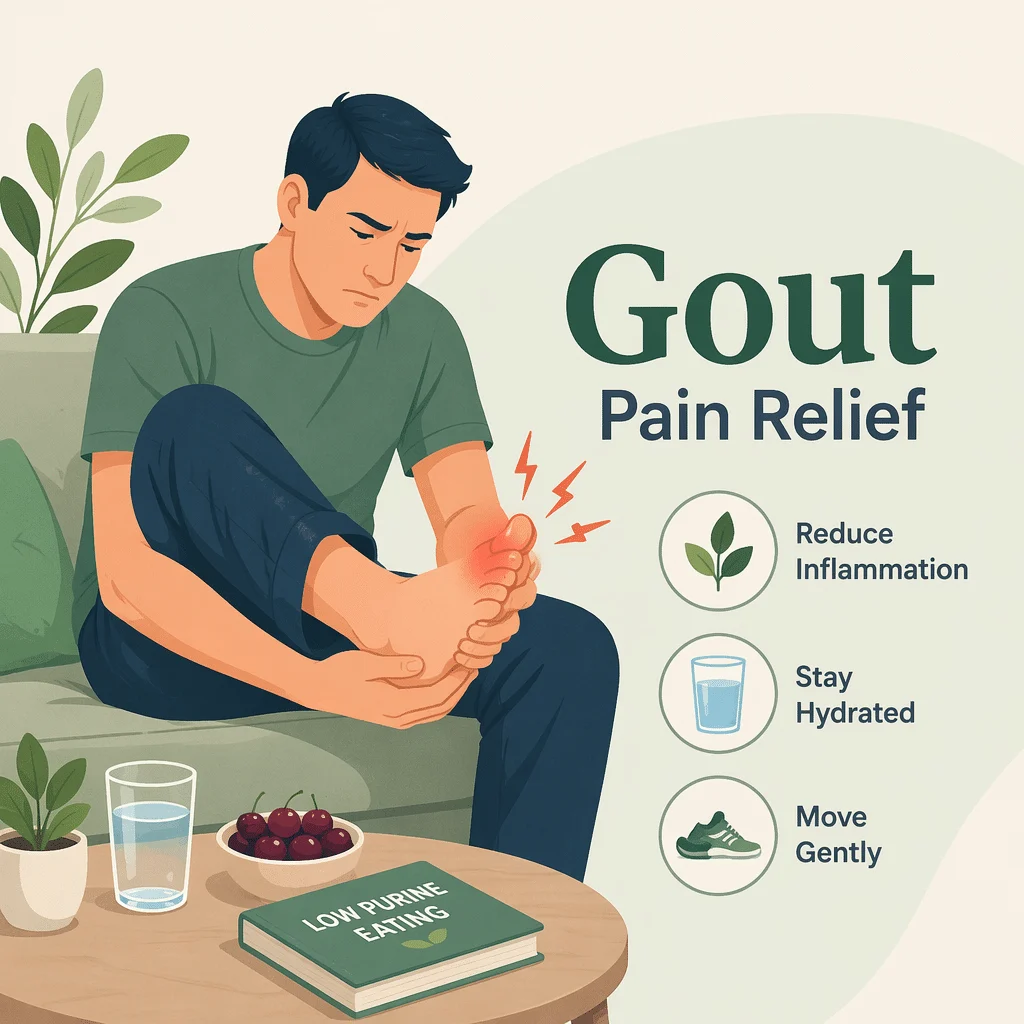
Gout pain relief is what almost everyone searches for at three in the morning, when one joint has become so tender that the weight of a bedsheet is unbearable. That pain is real and it deserves a real answer. It is also only half the answer: the flare in front of you needs settling, and the reason it happened needs treating. Those are two different jobs.
In this article you’ll learn what a gout flare actually is, which non-drug measures are safe to start straight away, how clinicians choose between the three groups of anti-inflammatory medicine, why a normal uric acid result does not rule gout out, and why lowering urate to a target is what reliably stops flares coming back.
Before anything else, read the emergency box below. A hot, swollen joint together with fever or feeling generally unwell needs same-day assessment, because a joint infection can look exactly like gout.
What a gout flare is, and why it hurts so much
Gout is caused by monosodium urate crystals. When blood urate stays high for long enough, urate comes out of solution and forms microscopic needle-shaped crystals in and around joints, where they can sit quietly for years. A flare happens when the immune system suddenly reacts to them, fast and out of all proportion to the size of the joint.
The classic site is the joint at the base of the big toe, the first metatarsophalangeal joint. Gout there has its own name, podagra. But flares also strike the midfoot, ankle, knee, wrist and fingers, and a first attack outside the toe is often not recognized as gout.
The timing is characteristic. Most flares begin overnight, build rapidly, and peak within roughly twelve to twenty-four hours. The joint becomes exquisitely tender rather than simply sore: people describe being unable to tolerate a sock or the bedclothes touching the skin.
Left alone, many flares settle over one to two weeks. That creates a trap: the pain going away does not mean the crystals have gone. They are still there, and so is what made them.
Septic arthritis: the mimic you cannot ignore
A joint infection, septic arthritis, produces a hot, red, swollen, agonizing joint. So does gout, and you cannot tell them apart by looking. Inflammation markers such as C-reactive protein, the erythrocyte sedimentation rate and the white cell count on a complete blood count rise in both, so they do not settle it either.
The difference matters enormously. Untreated septic arthritis can destroy a joint within days and can be fatal. It is diagnosed by drawing fluid out of the joint and culturing it, and that needs to happen quickly.
Get same-day emergency assessment if you have:
- A hot, swollen, very painful joint together with fever, chills, sweats or feeling unwell in yourself.
- Redness spreading outward from the joint across the skin.
- A first-ever attack of this kind, an artificial joint, or a weakened immune system.
- Chest pain, breathlessness, an irregular heartbeat or one-sided weakness while taking a urate-lowering medicine.
- A rash, mouth ulcers or fever in the first weeks after starting allopurinol. This can be a rare but serious hypersensitivity reaction: stop the medicine and seek urgent care.
A joint infection cannot be told apart from a gout flare by appearance. If there is any doubt, it has to be excluded first.
Getting through a flare
What you can safely do yourself
None of these will end a flare alone, but all are safe and all help.
- Rest the joint, stop weight-bearing, and elevate the limb.
- Apply something cold, wrapped in a cloth rather than on bare skin, for short periods.
- Keep bedding off the joint. A pillow either side, or a box holding the covers up, makes the night bearable.
- Wear the loosest footwear you own, or none, and keep drinking fluids unless told otherwise.
Contact your clinician early rather than waiting to see whether it settles. Treatment works better started sooner, and an early call also settles the infection question.
The medicines a clinician may use
Three groups of anti-inflammatory medicine are used for gout flares: non-steroidal anti-inflammatory drugs, colchicine, and corticosteroids given by mouth, by injection into a muscle, or injected directly into the affected joint. A 2025 review of acute gout care by Abhishek and Cipolletta in Clinical Medicine (DOI) notes they have broadly similar effectiveness, differing mainly in side effects. What differs is who can safely take them.
That is why the choice belongs to a prescriber rather than to a pharmacy shelf. Non-steroidal anti-inflammatory drugs are the clearest example: they are hazardous or outright contraindicated in chronic kidney disease, which is common in gout, and in heart failure, in anyone on an anticoagulant, and in people with a history of stomach ulcers or bleeding. Recommending them generically to someone with gout is not safe. If you have ever been told your kidney blood tests were abnormal, this applies to you.
Corticosteroids raise blood glucose, which matters if you have diabetes. Colchicine has to be adjusted, or avoided, in kidney and liver impairment and alongside several common drugs. The right choice and the right dose depend on your kidney function, heart history, stomach history and full medication list. That is a conversation, not a guess.
Colchicine deserves a warning of its own
Colchicine is effective, and it is also one of the more dangerous medicines in ordinary outpatient use. The gap between a therapeutic amount and a toxic amount is narrow, overdose is frequently fatal, and there is no antidote. It also interacts seriously with several widely prescribed medicines, including the antibiotic clarithromycin, certain statins and ciclosporin, all of which can raise colchicine levels in the body.
The rules are simple and there are no exceptions. Take colchicine exactly as prescribed to you. Never take extra because the pain has not gone yet, never top up, never use a pack left over from a previous flare without asking, and never take medicine prescribed to somebody else.
Why a normal uric acid result does not rule out gout
Urate levels often fall during an acute flare. A blood sample taken while the joint is at its worst can come back squarely in the normal range in someone who genuinely has gout. People are told, on the strength of that single result, that they cannot have gout, and then go years without the treatment that would have stopped it.
The reverse error is just as common: plenty of people have a high urate level and never develop gout. The number is one piece of the picture, not the verdict. The definitive test is finding urate crystals in fluid drawn from the joint and examined under a polarized-light microscope. Where that is not possible, ultrasound and dual-energy CT are increasingly used, because both show urate deposits directly.
A urate measurement is still valuable, but its job is different: it is most informative once the flare has settled, and afterwards to check treatment is working. Our guide to the uric acid blood test covers what it measures and how it is read.
The thing that actually works: lowering urate to a target
Here is the hopeful part, and the most important passage on this page. Gout is one of very few forms of arthritis that can be brought to a complete standstill. Crystals are not permanent: lower blood urate below the level at which urate stays dissolved, keep it there long enough, and the deposits gradually dissolve away. The US National Institute of Arthritis and Musculoskeletal and Skin Diseases describes gout as one of the most controllable forms of arthritis, and notes many people can become gout free.
That is what urate-lowering therapy does. Allopurinol and febuxostat reduce how much urate the body makes; other agents help the kidneys clear more of it. This is not pain relief: it removes the cause.
Most people with gout are undertreated: given something for the flare and nothing for the cause, started on a low dose never increased, or they stop. Two traps explain most of the stopping. The first is that starting a urate-lowering drug can itself provoke flares in the first months, as old crystal deposits shift. This is expected, and it is why a preventive anti-inflammatory is usually co-prescribed for a period at the start. It is not the drug failing, and not a reason to abandon it.
The second is stopping urate-lowering treatment during a flare. Do not do this. Stopping makes urate rebound and tends to prolong things, and starting or stopping these medicines mid-flare is a decision for the prescriber, not for the patient at 3am. The US Food and Drug Administration makes the same point in its safety communication on febuxostat: do not stop without speaking to your health care professional, because doing so can worsen your gout.
Treat-to-target in practice means a urate goal agreed with your clinician, repeat blood tests, and the dose stepped up until the goal is reached, then held there for years, with kidney function monitored alongside. If you have been on the same dose for years and still flare, the level has probably never been checked against a target.
| Your situation | What it usually means | What to do |
|---|---|---|
| First-ever hot, painful joint | It could be gout, but it could equally be infection, a different crystal, or injury. Nothing has been confirmed yet | Same-day medical assessment. A first episode should be diagnosed, not self-treated |
| Known gout, familiar joint, typical flare, no fever | Most likely a gout flare following its usual pattern | Contact your clinician promptly and follow the flare plan you have agreed. Rest, elevate, cool the joint, keep bedding off it |
| Hot swollen joint with fever, chills or feeling unwell | Cannot be told apart from gout by appearance. A joint infection has to be excluded | Emergency same-day assessment. Do not wait to see whether it settles overnight |
| A flare soon after starting allopurinol or febuxostat | An expected early effect as urate falls and old crystals shift. It is not proof the drug has failed | Keep taking the urate-lowering medicine and tell your prescriber. Never stop it on your own |
| Flares still happening after months or years of treatment | Urate is probably not at target, or the dose has never been increased to reach it | Ask for a urate level and a written target. Undertreatment is the usual explanation, not bad luck |
| Rash, mouth ulcers or fever in the first weeks of allopurinol | Possible hypersensitivity reaction. Rare, but potentially serious | Stop the medicine and seek urgent medical care the same day |
Diet, genetics and the blame attached to gout
Gout has been called the rich man’s disease for three hundred years. The framing is inaccurate, unkind, and it stops people asking for help.
Gout is substantially genetic. Most of your urate level is set by how efficiently your kidneys and gut handle urate, and that is inherited. The strongest genetic signals found in large population studies sit in genes encoding urate transporters, the proteins deciding how much urate you keep. Two people can eat identically and only one will develop gout.
Diet does matter, modestly, and far less than urate-lowering therapy. The evidence supports reducing beer and spirits, sugar-sweetened drinks and high-fructose corn syrup, and very high purine loads such as organ meats and some shellfish. Several long-standing villains have been acquitted: purine-rich vegetables are not the problem they were once thought to be, and low-fat dairy appears if anything mildly protective.
And the part that usually goes unsaid: diet alone rarely controls established gout. If you have already cut the beer and the soda and you are still flaring, that is not a failure of willpower and it is not your fault. It is the point at which urate-lowering treatment is needed.
Gout travels with high blood pressure, insulin resistance and abnormal blood fats, so it is worth having blood glucose and triglycerides checked too.
Cherry juice, apple cider vinegar and celery seed: what the evidence shows
Tart cherry has the most respectable evidence of the three, which is not saying much. Some small studies and observational data suggest fewer flares among people who eat cherries, but the trials are small, short and inconsistently designed, and no major guideline recommends cherry as a treatment. It is a reasonable food, not a substitute for treatment.
Apple cider vinegar has no credible evidence behind it for gout, and acidic drinks taken regularly erode tooth enamel and irritate the stomach, a poor combination with anti-inflammatory medicines. Celery seed extract has essentially no reliable human trial evidence in gout, and vitamin C, though mildly urate-lowering in general populations, has not produced useful reductions in people who already have gout. Supplements are not standardized and some interact with prescribed medicines, so tell your clinician whatever you take.
What untreated gout does over the long run
Repeated flares are not the worst of it. Over years, untreated deposits build into tophi: firm chalky lumps under the skin around joints, fingers, elbows and ears. They start painless and end up damaging bone and soft tissue and deforming joints for good.
Uric acid kidney stones also form more readily when urine stays persistently acidic, which is why urine pH is sometimes measured in people who make stones repeatedly.
Gout also keeps company with chronic kidney disease, high blood pressure and cardiovascular disease. Association is not cause, and much of the overlap reflects shared risk factors, but it is a good reason to treat gout as a whole-body signal and to watch markers such as LDL cholesterol and kidney markers in urine.
Latest scientific advances in gout treatment
Research over the past three years has shifted the emphasis from flare firefighting toward getting urate down and keeping it down. Five recent publications, retrieved from PubMed, show where the field stands.
Reaching the urate target is linked to better heart outcomes
What was found: in a very large primary-care cohort newly started on urate-lowering treatment, those who reached the urate target within the first year had fewer major cardiovascular events over five years, and fewer flares, than those who did not. Cipolletta and colleagues, JAMA Internal Medicine, 2026 (DOI).
What this means for you: the target is not an abstract laboratory goal. Ask what yours is and whether you have reached it.
Normal urate during a flare does not exclude gout
What was found: a review of what its authors call normal serum uric acid gout confirmed that urate can sit inside the normal range during a flare, that diagnosis based on that single result is unreliable, and that imaging such as ultrasound or dual-source CT is needed to detect crystal deposits. Yang and colleagues, Frontiers in Endocrinology, 2026 (DOI).
What this means for you: if you were told you could not have gout because your uric acid was normal during an attack, that reasoning does not hold.
The genetics of gout sit in the urate transporters
What was found: a synthesis of genetic, epigenomic and transcriptomic research reported that the strongest genetic signals for serum urate map mainly to genes encoding urate transporters in the kidney and gut, with further signals in the pathways regulating inflammation. Leask and colleagues, Nature Reviews Rheumatology, 2024 (DOI).
What this means for you: your urate level is largely set by inherited machinery. Gout is not a verdict on your character.
Early flares are part of starting treatment, not a sign of the wrong drug
What was found: a post-hoc analysis of a randomized multicenter trial compared flare risk while allopurinol and febuxostat were started and titrated treat-to-target with anti-inflammatory prophylaxis. Flare risk during that phase was similar for both. Barry and colleagues, Arthritis & Rheumatology, 2024 (DOI).
What this means for you: flares in the first months of urate-lowering treatment are a feature of the process, not evidence your medicine is wrong.
Undertreatment, not treatment failure, is the usual problem
What was found: a review of current gout therapy reported that only a minority to around half of patients receive definitive treatment, and fewer than half remain adherent. The authors recommend treat-to-target with several months of flare prophylaxis at the start, and survey newer agents in development. McCarty, Gaffo and Diaz-Torne, Therapeutic Advances in Musculoskeletal Disease, 2025 (DOI).
What this means for you: if your gout is not controlled, the likeliest reason is that treatment was never pushed to target, or was stopped.
Frequently asked questions
How do I stop gout pain fast?
Honestly: faster than doing nothing, but not instantly, and nobody should promise you otherwise. The fastest safe route is to contact a clinician the same day, because flare treatment works better the earlier it is started and because the infection question needs answering. While you wait, rest and elevate the joint, apply something cold wrapped in a cloth, keep bedding and footwear off it, and keep drinking fluids unless you have been told to restrict them. Do not raid the medicine cabinet. Anti-inflammatory medicines are unsafe for a large proportion of people with gout, and self-dosing is where the real harm happens.
Should I stop my allopurinol during a flare?
No. Stopping urate-lowering treatment in the middle of a flare makes things worse, not better. Urate rebounds, crystals keep shifting, and the flare tends to last longer. If you are already established on allopurinol or febuxostat, keep taking it and tell your prescriber that you are flaring. Starting or stopping urate-lowering therapy mid-flare is a decision for the person who prescribed it. The one exception is a rash, fever or mouth ulcers in the early weeks of allopurinol, which needs urgent same-day medical attention.
Is gout my fault?
No. Gout is substantially inherited. The main determinant of your urate level is how your kidneys and gut handle urate, and that is written into your genes, not into your food diary. Diet has a real but modest effect, well behind urate-lowering medication. Plenty of people who eat carefully still get gout, and plenty of people who eat badly never do. The centuries-old picture of gout as a self-inflicted disease of overindulgence is wrong, and it has done real damage by making people ashamed of a treatable condition.
How long does a gout flare usually last?
Most flares build over the first day, plateau, and then fade over roughly one to two weeks without treatment. Appropriate treatment started early generally shortens that considerably. What the timeline does not tell you is anything about the underlying disease. The pain resolving simply means the immune reaction has burned itself out; the crystal deposits that triggered it are still in the joint, waiting. Flares that come more often, last longer, or involve more joints over time usually indicate that urate has never been brought down to target.
Can I use medicine left over from my last flare?
No, and this matters more with gout than with most conditions. Leftover packs are often incomplete, out of date, or prescribed when your kidney function, heart condition or other medicines were different from today. Colchicine in particular has a narrow margin between a helpful and a toxic amount, and taking extra or repeating an old course without advice can be fatal. Never take a friend’s or a relative’s gout medicine either, however similar their symptoms sound. Ask your clinician or pharmacist first, every time.
Can I drink alcohol at all if I have gout?
It is not all-or-nothing. Beer and spirits have the clearest link with flares, beer particularly, partly because of its purine content and partly through alcohol’s effect on urate excretion. Wine appears less strongly associated, though heavy intake of anything is unhelpful. Binge drinking is a classic flare trigger. Cutting back genuinely helps, but it will not on its own control established gout, and it should not be offered to you as an alternative to urate-lowering treatment.
Glossary of key terms
| Term | Definition |
|---|---|
| Urate (uric acid) | A normal waste product formed when the body breaks down purines. It is carried in the blood and mostly removed by the kidneys. |
| Monosodium urate crystals | Needle-shaped crystals that form when urate comes out of solution and settle in and around joints. They are what the immune system reacts to during a flare. |
| Flare | A sudden episode of intense joint inflammation triggered by urate crystals, typically starting overnight and peaking within a day. |
| Podagra | Gout affecting the joint at the base of the big toe, the first metatarsophalangeal joint. The classic and commonest site. |
| Tophus (plural tophi) | A firm lump of accumulated urate crystals under the skin, seen in long-standing untreated gout. Can damage bone and joints. |
| Hyperuricemia | A urate level in the blood above the normal range. Common, and by itself not the same thing as having gout. |
| Urate-lowering therapy | Long-term medication, such as allopurinol or febuxostat, that reduces the amount of urate in the blood so existing crystals dissolve. |
| Treat-to-target | A strategy in which the dose of urate-lowering therapy is increased and monitored until an agreed urate level is reached and maintained. |
| Joint aspiration | Drawing fluid out of a joint with a needle so it can be examined for crystals and cultured for infection. The definitive test. |
| Septic arthritis | Infection inside a joint. It looks like gout, needs emergency treatment, and can destroy a joint within days. |
Sources
- National Institute of Arthritis and Musculoskeletal and Skin Diseases (NIAMS). Gout. niams.nih.gov
- Centers for Disease Control and Prevention (CDC). Gout. cdc.gov
- MedlinePlus, US National Library of Medicine. Gout. medlineplus.gov
- US Food and Drug Administration. FDA adds Boxed Warning for increased risk of death with gout medicine Uloric (febuxostat), 2019. fda.gov
- Cipolletta E, Zverkova Sandstrom T, Rozza D, et al. Treat-to-Target Urate-Lowering Treatment and Cardiovascular Outcomes in Patients With Gout. JAMA Intern Med. 2026;186(3):332-342. https://doi.org/10.1001/jamainternmed.2025.7453
- Yang XH, Zhan XL, Xuan QX, Jin HM, Ye ZB. Normal serum uric acid gout: a neglected and challenging condition. Front Endocrinol (Lausanne). 2026;17:1873856. https://doi.org/10.3389/fendo.2026.1873856
- Leask MP, Crisan TO, Ji A, Matsuo H, Kottgen A, Merriman TR. The pathogenesis of gout: molecular insights from genetic, epigenomic and transcriptomic studies. Nat Rev Rheumatol. 2024;20(8):510-523. https://doi.org/10.1038/s41584-024-01137-1
- Barry A, Helget LN, Androsenko M, et al. Comparison of Gout Flares With the Initiation of Treat-to-Target Allopurinol and Febuxostat: A Post-Hoc Analysis of a Randomized Multicenter Trial. Arthritis Rheumatol. 2024;76(10):1552-1559. https://doi.org/10.1002/art.42927
- McCarty KL, Gaffo AL, Diaz-Torne C. Gout therapy updated. Ther Adv Musculoskelet Dis. 2025;17:1759720X251384584. https://doi.org/10.1177/1759720X251384584
- Abhishek A, Cipolletta E. Gout on the acute medical take. Clin Med (Lond). 2025;25(4):100331. https://doi.org/10.1016/j.clinme.2025.100331
Further reading
- Uric acid blood test: interpretation
- Kidney stones: causes, symptoms and treatments
- High BUN and creatinine levels explained
- High CRP levels: causes, symptoms, treatments
- Normal urine pH levels: causes and meaning
If you have gout, you will end up holding a lot of numbers: uric acid, kidney function, inflammatory markers such as CRP, and the metabolic results that often travel alongside. AI DiagMe turns those reports into plain language so you can see what changed and what to ask about. One caveat worth stating clearly: a uric acid result on its own can neither confirm nor exclude gout, and no tool can make that diagnosis for you. AI DiagMe helps you understand your results; it does not diagnose, it does not replace your doctor, and it is not for emergencies.
Understand your lab results with AI DiagMe
Get your results interpreted in minutes