



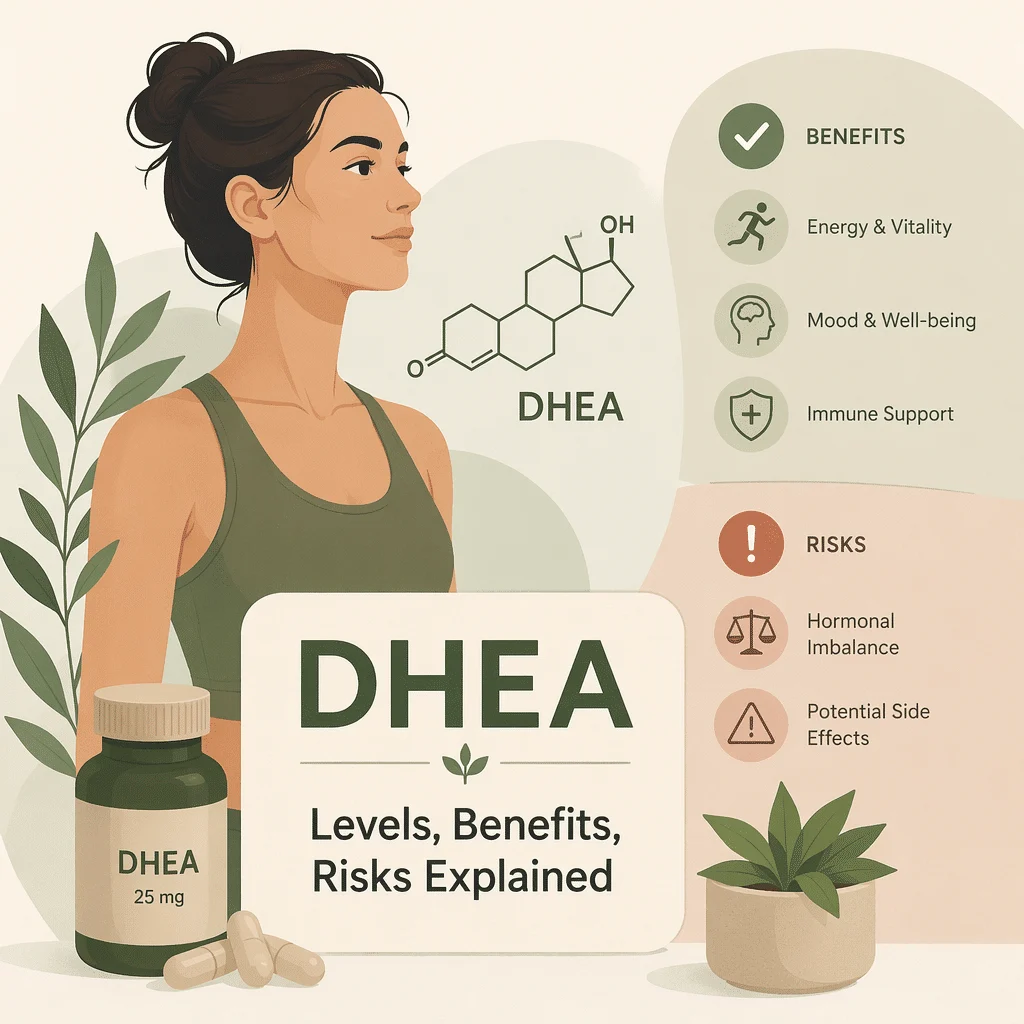
DHEA levels are measured to see how the adrenal glands are working, not to score your energy or your age. DHEA (dehydroepiandrosterone) is a steroid hormone produced mainly by the outer layer of the adrenal glands, and laboratories almost always measure its longer-lasting form, DHEA-S. In this article you will learn where these hormones come from, why DHEA-S is the version drawn in a blood test, how results shift across a lifetime, and what a high or a low result can point toward. You will also find a measured look at over-the-counter DHEA supplements and a clear guide to when a result deserves a medical appointment. The goal is context rather than self-diagnosis, because a single hormone value rarely means much on its own.
What DHEA and DHEA-S actually are
DHEA is one of the most abundant steroid hormones in the human body. It is best described as a precursor: a raw material the body converts into other hormones, rather than a hormone with one dedicated job of its own. MedlinePlus notes that DHEA-S plays an important role in making the male sex hormone testosterone and the female sex hormone estrogen, which is why it sits near the start of a production chain rather than at the end of it.
That precursor status explains how clinicians read it. A DHEA-S result is rarely informative by itself. It becomes useful when it is placed next to other hormones, next to the person’s age and sex, and next to what they are actually experiencing.
Where these hormones are made
Most DHEA comes from the adrenal cortex, the outer layer of the two small adrenal glands that sit on top of the kidneys. Smaller amounts come from the ovaries and the testicles. Because the adrenal contribution dominates so heavily, DHEA-S behaves in practice as an adrenal marker: it reflects adrenal androgen output much more than it reflects what the ovaries or testicles are doing. That is its main value in a workup, and it is why it usually appears as part of a wider panel. Our team also explains what an adrenal panel measures.
Why laboratories measure DHEA-S rather than DHEA
DHEA itself is awkward to measure. Its concentration rises and falls through the day in step with the adrenal rhythm, so a single sample would largely capture the hour it happened to be drawn. DHEA-S is the sulfated form of the same molecule, with a sulfate group attached. That version circulates in far larger amounts, stays in the blood much longer, and does not swing from hour to hour. One DHEA-S sample therefore gives a stable picture of adrenal androgen production, which is exactly what a clinician needs. Cortisol is the opposite case, where the timing of the draw changes everything; our library covers the basics of a cortisol blood test.
How DHEA levels change across a lifetime
The age pattern is the most consistent feature of this marker, and it is the reason no single universal number exists. Levels are very low in childhood, climb sharply as the adrenal glands mature, reach their highest point in youth, then decline steadily for the rest of life. MedlinePlus places the peak around puberty. Mayo Clinic describes natural DHEA levels as peaking in early adulthood and then slowly falling with age. Either way, the direction of travel after young adulthood is downward, and that decline is a normal feature of aging rather than a disorder to be corrected.
Two practical consequences follow. First, a result that would be unremarkable at twenty-five may be flagged at sixty-five, and the reverse is equally true. Second, laboratories report DHEA-S against intervals specific to age and sex, and those intervals also differ between laboratories because different assays are used. A number copied from one lab report cannot be judged against another lab’s chart, and it cannot be judged against a figure found online. MedlinePlus is explicit that a provider interprets the result by weighing your symptoms, age, sex, medical history and other blood tests together.
What a high DHEA-S result can point toward
A raised DHEA-S signals that the adrenal glands are producing more androgen than expected for that age and sex. It is the beginning of a search, not a conclusion. MedlinePlus lists congenital adrenal hyperplasia, adrenal tumors that may be benign or cancerous, polycystic ovary syndrome and, rarely, ovarian tumors among the possible explanations.
Androgen excess and PCOS
In women, a raised DHEA-S is often found during an assessment for signs of androgen excess: irregular or absent periods, acne that persists past adolescence, hair thinning at the crown, or unwanted hair growth on the face and body. MedlinePlus also lists a deepening voice and a markedly muscular build among the features that prompt testing. Polycystic ovary syndrome is the most common condition behind this picture, although the hormone most closely associated with it is testosterone rather than DHEA-S. A DHEA-S that is raised while ovarian markers look ordinary suggests the adrenal glands, rather than the ovaries, are the main source. Our team details the diagnosis of polycystic ovary syndrome, and a companion guide explains the causes of high testosterone in women.
Adrenal tumors and congenital adrenal hyperplasia
A markedly raised DHEA-S, particularly when symptoms have appeared over months rather than years, prompts a direct look at the adrenal glands. Imaging and further hormone testing are used to check for a tumor. This is an uncommon finding, and the ordinary explanations are far more likely, but it is the reason a strikingly high result is taken seriously rather than watched.
Congenital adrenal hyperplasia is a different mechanism altogether. It is an inherited enzyme difference that pushes adrenal production toward androgens. Because the enzyme block sits at a specific step, it is investigated with a targeted precursor hormone measurement alongside DHEA-S, not with DHEA-S alone. In infants it can present with ambiguous genitalia, which is why MedlinePlus notes that baby girls may need this testing.
What a low DHEA-S result can point toward
A low DHEA-S suggests either that the adrenal glands are producing less than expected, or that the signal instructing them to produce has weakened. MedlinePlus points to Addison disease, a form of primary adrenal insufficiency, and to hypopituitarism, in which the pituitary gland fails to send an adequate signal.
Adrenal insufficiency and the pituitary
The adrenal glands do not act alone. The pituitary gland releases ACTH, which instructs the adrenal cortex to produce cortisol and adrenal androgens. When the adrenal glands themselves are damaged, ACTH rises while cortisol and DHEA-S fall. When the pituitary is the problem, ACTH is low or inappropriately normal, and adrenal output falls with it. The pattern across the three measurements, not any one of them, is what separates the two. This is why DHEA-S is seldom ordered in isolation. Our library describes the role of ACTH in adrenal control, and another guide covers the causes of low morning cortisol.
Long-term corticosteroid treatment
Taking glucocorticoid medication over a long period, whether for asthma, an inflammatory disease or after a transplant, suppresses the pituitary signal, and adrenal output falls with it. This route to adrenal insufficiency is far more common than the rare autoimmune and inherited forms. A low DHEA-S in someone on long-term steroids is often explained by the treatment itself rather than by a separate disease. Never stop or adjust a steroid dose on your own: stopping abruptly can be dangerous, and any change belongs to the prescriber.
How the DHEA-S test is ordered and read
DHEA-S is measured on an ordinary blood sample taken from a vein in the arm. Because the sulfated form is stable through the day, most laboratories do not require a particular time or fasting, though you should follow whatever instructions your own laboratory provides.
What matters far more than the figure in isolation is the company it keeps. The table below shows how clinicians frame a DHEA-S result within a wider pattern. It deliberately contains no numbers, because meaningful thresholds depend on the laboratory, the assay, your age and your sex.
| Pattern seen | Usually read alongside | What the combination may suggest |
|---|---|---|
| DHEA-S raised, testosterone ordinary | Total and free testosterone, SHBG | An adrenal rather than ovarian source of androgen |
| DHEA-S raised, testosterone also raised | Testosterone, LH, FSH, ultrasound findings | Androgen excess assessed as a whole, such as PCOS |
| DHEA-S markedly raised, symptoms appearing quickly | Imaging, cortisol, precursor hormones | Prompts a direct assessment of the adrenal glands |
| DHEA-S low, morning cortisol low, ACTH high | Early-morning cortisol, ACTH | Points toward primary adrenal insufficiency |
| DHEA-S low, morning cortisol low, ACTH low or normal | Early-morning cortisol, ACTH, pituitary review | Points toward a pituitary cause |
| DHEA-S low, long-term steroid treatment | Medication history, early-morning cortisol | Often explained by the treatment itself |
What can shift a result
Several ordinary things move a DHEA-S value, which is another reason a lone figure is a weak basis for worry:
- DHEA taken as a supplement in the days or weeks before the draw
- Glucocorticoid medication, which lowers adrenal output
- Other hormone treatments, including hormonal contraception
- Pregnancy and the postpartum period
- Serious acute illness
- The assay the laboratory uses, which is why two labs can report the same sample differently
Tell whoever orders the test about every medication and supplement you take, including anything bought without a prescription. Because DHEA-S is usually one line on a larger request, it also helps to understand the neighboring markers. Our library covers the meaning of sex hormone-binding globulin results, we describe the hormones included in a female hormone panel, and we also explain the basics of testosterone as a blood marker.
DHEA supplements: an evidence-based reality check
DHEA is sold over the counter in the United States and marketed heavily. The single most important thing to understand is that it is a hormone, not a vitamin. Swallowing it adds to the same androgen pathway the body already regulates, and the body does not distinguish between a hormone from a capsule and a hormone from the adrenal cortex.
Mayo Clinic reviews the evidence condition by condition and reaches an unfavorable overall verdict. On antiaging claims specifically, it states that research has not proved them to be true. It warns that DHEA might raise the risk of hormone-sensitive cancers such as prostate and breast cancer, and lists oily skin, acne and unwanted male-pattern hair growth in women among the side effects. It also flags interactions: taken with estrogen it may cause symptoms of excess estrogen, and taken with testosterone it may drive the development of typically male characteristics in women.
The National Institutes of Health Office of Dietary Supplements reaches a similar conclusion on athletic claims, reporting no evidence of increases in strength, aerobic capacity, lean body mass or testosterone levels in men, and noting that the safety of DHEA has not been well studied. Over several months it does raise testosterone in women, with acne and facial hair growth as the visible consequence. Mayo Clinic further notes that the National Collegiate Athletic Association bans DHEA use among athletes, so a supplement taken casually can end a competitive season.
There is one more consequence that matters directly here: taking DHEA before a blood test corrupts the very result you are trying to understand. A supplement-driven DHEA-S value tells the clinician about the capsule, not about the adrenal glands, and can send a workup down the wrong path. If you take DHEA and a hormone test has been requested, say so before the sample is drawn.
When to see a doctor
A DHEA-S result outside the reported interval is a reason for a conversation, not for alarm. Some situations deserve prompt medical attention rather than watchful waiting:
- Signs of androgen excess that are new and progressing quickly, such as rapid unwanted hair growth, a deepening voice or hair loss at the crown
- Periods that have become irregular or have stopped without an obvious explanation
- Persistent unexplained fatigue with nausea, poor appetite, unintentional weight loss or dizziness on standing
- A markedly abnormal result of any kind, particularly one that is far outside the reported interval
- Signs of early or unusual puberty in a child, or ambiguous genitalia in a newborn
- Any symptoms while taking, tapering or having recently stopped long-term steroid medication
Seek urgent care for severe weakness with vomiting, abdominal pain, confusion or collapse in someone known to have adrenal insufficiency or on long-term steroids. This combination can indicate an adrenal crisis, which is a medical emergency.
Latest scientific advances
Research over the past three years has sharpened how DHEA-S is used as a diagnostic marker, and has also tempered expectations about DHEA as a treatment.
A 2025 review in JAMA set out how adrenal insufficiency is diagnosed in adults and placed DHEA-S alongside early-morning cortisol and ACTH as one of the three routine measurements. What this means for you: if a clinician orders DHEA-S together with a morning cortisol, that is the standard approach rather than an unusual one. The same review emphasizes that adrenal insufficiency caused by long-term glucocorticoid medication is common, while the inherited and autoimmune forms are rare.
A 2025 study from Mayo Clinic examined more than a thousand adults who had undergone a stimulation test, a procedure in which a synthetic signal hormone is injected and cortisol is measured before and afterward. DHEA-S measured on its own separated people with adrenal insufficiency from those without about as well as a baseline morning cortisol did. More usefully, when morning cortisol fell in the ambiguous middle zone, a DHEA-S that was not low made adrenal insufficiency very unlikely. What this means for you: pairing these two blood tests may spare some people the longer stimulation procedure. This is one large single-center study rather than a guideline change, so it is a promising direction still to be confirmed. The same work found that recent glucocorticoid medication blunted how well DHEA-S performed, which is one more reason to declare every medication.
A 2025 practical guide to adrenocortical carcinoma, a rare cancer of the adrenal cortex, was published in The Lancet Diabetes and Endocrinology by specialist teams in Germany and Italy. It underlines how uncommon the tumor is and how completely its assessment depends on a full hormone workup combined with imaging rather than on any single blood value. What this means for you: a raised DHEA-S is not evidence of an adrenal tumor. The ordinary explanations are vastly more common, and the wider workup exists precisely to tell them apart.
On the supplement side, a 2023 systematic review gathered the trials of DHEA used as a treatment in rheumatic diseases. Across twenty-one studies the clearest signal was in systemic lupus erythematosus, where DHEA showed a mild to moderate effect on disease activity along with a positive effect on bone density. In Sjogren’s syndrome, rheumatoid arthritis and fibromyalgia the results were unconvincing. What this means for you: even where DHEA has been studied most seriously, it is a prescribed treatment for a specific diagnosis under specialist supervision, not a general-purpose supplement. The reviewers recorded mild androgenic effects, such as acne and unwanted hair growth, as the most common complaint.
A 2023 systematic review looked at DHEA given to women with a reduced ovarian reserve before in vitro fertilization, covering seven studies and just over four hundred women. The only randomized controlled trial among them, the most reliable design because participants are assigned to treatment or comparison by chance, found no difference between the treated and untreated groups, while the weaker study designs reported benefits. Pregnancy outcomes did not differ. What this means for you: this is a specialist fertility question settled with a fertility team, and the evidence is not strong enough to justify taking DHEA on your own initiative.
Glossary
| Term | Definition |
|---|---|
| DHEA (dehydroepiandrosterone) | A steroid hormone made mainly by the adrenal glands. The body converts it into other sex hormones. |
| DHEA-S (dehydroepiandrosterone sulfate) | The sulfated, longer-lasting form of DHEA. This is the version measured in a blood test because it stays stable through the day. |
| Adrenal cortex | The outer layer of each adrenal gland. It produces cortisol, aldosterone and adrenal androgens including DHEA. |
| Androgen | A family of hormones, including testosterone and DHEA, that drive typically male physical characteristics. Everyone produces them in differing amounts. |
| Precursor | A substance the body converts into something else. DHEA is a precursor because it is raw material for other hormones. |
| ACTH (adrenocorticotropic hormone) | A hormone released by the pituitary gland that instructs the adrenal cortex to produce cortisol and adrenal androgens. |
| Adrenal insufficiency | A condition in which the adrenal glands do not produce enough cortisol. It may stem from the glands themselves, from the pituitary gland or from long-term steroid treatment. |
| Congenital adrenal hyperplasia | An inherited difference in an adrenal enzyme that shifts hormone production toward androgens. It is present from birth. |
| Assay | The specific laboratory method used to measure a substance. Different assays give slightly different figures for the same sample. |
| Reference interval | The span of results seen in a comparison population, printed next to your value. For DHEA-S it depends on age, sex and the laboratory. |
Frequently asked questions
What causes high DHEA levels in women?
A raised DHEA-S in a woman most often turns up during an assessment of androgen excess, where polycystic ovary syndrome is the commonest explanation. MedlinePlus also lists congenital adrenal hyperplasia, adrenal tumors that may be benign or cancerous, and rarely ovarian tumors. Because DHEA-S comes overwhelmingly from the adrenal glands, a raised value combined with ordinary ovarian markers points toward an adrenal source. The result never stands alone: a clinician reads it with testosterone, the menstrual history, the pace at which symptoms appeared and, when needed, imaging. Mildly raised values are common and frequently turn out to have an unremarkable explanation.
Is there a normal DHEA level by age?
There is no single normal figure that applies to everyone. DHEA-S is very low in childhood, peaks in youth and then declines steadily through adult life, so laboratories report it against intervals built for a specific age band and sex. Those intervals also differ from laboratory to laboratory because different assays are used. This is why comparing your value to a chart found online is unreliable, and why we do not publish one here. Read your result against the interval printed on your own report, and let the clinician who ordered it interpret the rest.
What does a low DHEA-S result mean?
On its own, not a great deal, since levels fall naturally with age. In a clinical context it can point toward reduced adrenal output. MedlinePlus names Addison disease and hypopituitarism as possibilities, and long-term glucocorticoid medication is a common cause of a low value. Distinguishing between these depends on the pattern across early-morning cortisol, ACTH and DHEA-S together, not on DHEA-S alone. A low result alongside persistent fatigue, nausea, appetite loss or dizziness on standing warrants a medical appointment rather than a supplement.
Do I need to fast before a DHEA-S test?
Usually not. Because the sulfated form stays stable through the day, most laboratories do not require fasting or a specific appointment time, which is one of the practical advantages of measuring DHEA-S rather than DHEA. That said, instructions vary between laboratories, and DHEA-S is often drawn alongside other hormones such as early-morning cortisol that do carry timing requirements. Follow the instructions attached to your own request form, and ask the laboratory directly if anything is unclear.
Can DHEA supplements change my test results?
Yes, and substantially. DHEA is a hormone rather than a vitamin, so taking it adds directly to what the test measures. A DHEA-S value in someone taking supplements reflects the capsule as much as the adrenal glands, which can make the result impossible to interpret and can send a workup in the wrong direction. Declare any DHEA product before your sample is taken, and never start or stop a supplement in order to influence a test result. Your clinician will advise on what to do.
Are DHEA levels different in men and women?
Yes. Men generally show higher DHEA-S values than women, which is why laboratories publish separate intervals for each sex as well as for each age band. The consequences of an abnormal result also differ: in women a raised value is often investigated because of visible signs of androgen excess, whereas in men those signs are absent and the result is more often examined as part of a broader adrenal or pituitary assessment. In both cases the value is interpreted within the pattern of the whole panel.
Sources
- MedlinePlus, National Library of Medicine — DHEA Sulfate Test — https://medlineplus.gov/lab-tests/dhea-sulfate-test/
- Mayo Clinic — DHEA — https://www.mayoclinic.org/drugs-supplements-dhea/art-20364199
- National Institutes of Health, Office of Dietary Supplements — Dietary Supplements for Exercise and Athletic Performance: Health Professional Fact Sheet — https://ods.od.nih.gov/factsheets/ExerciseAndAthleticPerformance-HealthProfessional/
- Vaidya A, Findling J, Bancos I — Adrenal Insufficiency in Adults: A Review — JAMA, 2025 — https://doi.org/10.1001/jama.2025.5485
- Han AJ, Suresh M, Gruber LM, et al. — Performance of Dehydroepiandrosterone Sulfate and Baseline Cortisol in Assessing Adrenal Insufficiency — The Journal of Clinical Endocrinology and Metabolism, 2025 — https://doi.org/10.1210/clinem/dgae855
- Fassnacht M, Puglisi S, Kimpel O, Terzolo M — Adrenocortical carcinoma: a practical guide for clinicians — The Lancet Diabetes and Endocrinology, 2025 — https://doi.org/10.1016/S2213-8587(24)00378-4
- Skare TL, Hauz E, de Carvalho JF — Dehydroepiandrosterone (DHEA) Supplementation in Rheumatic Diseases: A Systematic Review — Mediterranean Journal of Rheumatology, 2023 — https://doi.org/10.31138/mjr.20230825.dd
- Yuan WS, Abu MA, Ahmad MF, Elias MH, Abdul Karim AK — Effects of Dehydroepiandrosterone (DHEA) Supplementation on Ovarian Cumulus Cells following IVF/ICSI Treatment: A Systematic Review — Life (Basel), 2023 — https://doi.org/10.3390/life13061237
Further reading
- High cortisol levels: symptoms and causes
- Urine cortisol: understanding test results
- Male hormone panel: what it measures
- Low testosterone in women: causes, symptoms and treatments
- Estradiol: decoding this hormonal marker
Understand your lab results with AI DiagMe
A DHEA-S value only becomes meaningful next to the results around it, and most people receive a report without the context needed to read that pattern. AI DiagMe turns a lab report into plain language, explaining what markers such as DHEA-S, morning cortisol, ACTH and testosterone reflect and why they are grouped together. It helps you arrive at your appointment understanding your own results and knowing which questions to ask. It does not diagnose, and it does not replace your doctor.
Get your results interpreted in minutes